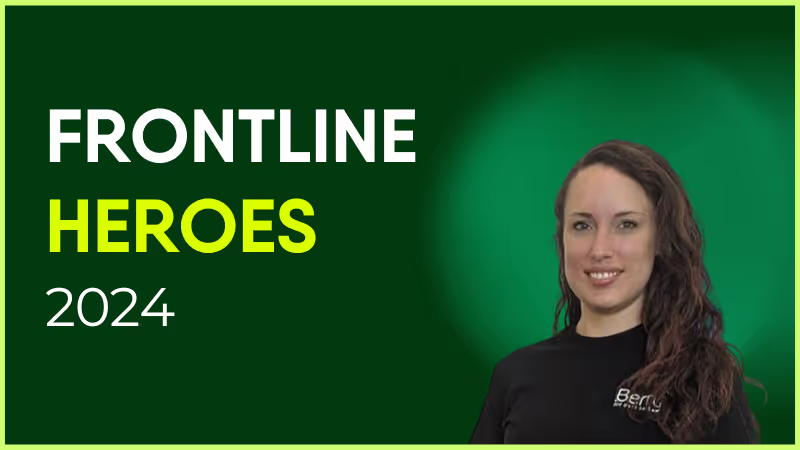
Hannah’s hard work and dedication to quality don’t go unnoticed, and she is a key contributor to making the department successful. She is an amazing self-starter, reliable, and always team-oriented.
In her role, she is responsible for everything relating to customer quality response at the facility, which helps us increase customer satisfaction and efficiency and adhere to regulations that are critical to the manufacturing process. Her role includes but is not limited to: Customer complaint investigations (TICS), Return Material Authorizations (RMAs), NCMR generation and completion via software (C-Pro), participation in CAPA processes for addressing internal and external requests, supplier (SCARS), supervising returned material, tracking, inventory adjustments and corrections, analysis, and reporting.
She also supervises the calibration of laboratory equipment and weigh scales, and conducts preventive maintenance of testing instruments, important for preventing defects and maintaining consistency.
Throughout all of this, she manages to deliver clear, concise communication across all levels of the organization.
What does she want to do next?
She’ll be supported to do whatever she wants to do!
Nominated by: Darrius Walker, QA Manager
What we'll cover
Start your free trial today
See how Blink helps frontline teams stay connected, informed, and engaged.
FirstUp has helped many organizations modernize internal communications. But for teams seeking more flexibility, frontline access, or a better employee experience, it may not be the perfect fit. Whether you're frustrated by limited integrations, a lack of mobile-first functionality, or underwhelming adoption, you're not alone in searching for smarter alternatives.
In this guide, we’ve rounded up the top 12 alternatives to FirstUp in 2025 — starting with Blink. These tools offer innovative ways to connect your workforce, enhance engagement, and streamline operations. From robust employee apps to modern intranets, you’ll find the right solution for your team’s size, industry, and needs.
What to look for in a Firstup alternative
Not all internal communications platforms are created equal — and the right fit depends on your workforce, goals, and challenges. If you’re considering a switch from FirstUp, here are the key features and capabilities to prioritize:
#1. Mobile-first design
Your platform should meet employees where they are — especially if they’re on the frontline or rarely at a desk. A true mobile-first experience ensures every worker can engage with critical updates, resources, and conversations in real time.
{{mobile-main="/image"}}
#2. Targeted, personalized comms
Look for tools that go beyond blast messages. You’ll want to deliver relevant content to the right people at the right time — whether by role, location, or shift — to drive real engagement and cut through the noise.
#3. All-in-one functionality
Switching between apps for chat, tasks, surveys, and documents leads to confusion and lower adoption. Platforms that unify communication, content, and workflows in one place help your employees stay connected and productive.
#4. High adoption rates
It’s not just about features — it’s about usage. Look for vendors that prove high adoption and engagement across all employee types, including those without email addresses or corporate devices.
#5. Easy integration
Your internal comms platform should play nicely with the tools you already use — from HRIS systems to scheduling platforms, document storage, and SSO providers.
{{mobile-hub="/image"}}
#6. Analytics & feedback
You can’t improve what you don’t measure. The best alternatives to Firstup offer real-time analytics, sentiment insights, and feedback loops to help you understand what’s working — and what’s not.
Best for: Mid to large enterprises looking for real adoption.
Blink simplifies internal communication by turning fragmented tools into one seamless platform. With integrated chat, company news, surveys, and more, Blink boosts engagement and ensures every employee stays connected — without the complexity. It is designed to adapt to a wide range of industries and team structures.
Why teams switch to Blink:
No email needed for access — ideal for any employee
Combines communication, engagement, and workflows in one app
Rapid implementation and proven high adoption
Integrated analytics, automation, and feedback loops
Used by McDonald’s, Domino’s, JD Sports, Shake Shack, Stagecoach, and more.
Gartner Rating: 4.8 out of 5
{{watch-video="/callouts"}}
#2. Workvivo – Best for culture-first comms
Workvivo brings a social networking layer to internal communication, helping employees engage with each other and company updates. Its features include live feeds, recognition posts, and integration with enterprise tools. It suits organizations looking to make culture a visible part of daily work.
Gartner Rating: 4.7 out of 5 (55 reviews)
Pricing available upon request
#3. Staffbase – Best for enterprise comms complexity
Popular for its intranet and mobile app, Staffbase helps companies streamline internal communication and align employees with company news and leadership updates. It is designed to adapt to a wide range of industries and team structures. Compared to FirstUp, it provides strong targeting and content management but may require heavier admin involvement and longer setup times.
Gartner Rating: 4.6 out of 5
Pricing available upon request
#4. Haiilo – Best for content planning & publishing
Haiilo (formerly COYO) offers an impressive suite of tools for comms professionals who prioritize content workflows and analytics. It’s a solid option for campaign planning, though its user experience may feel more CMS-like than employee-first.
Gartner Rating: 4.1 out of 5
Pricing available upon request
#5. Simpplr – Best for intranet-focused organizations
Simpplr brings a modern take to the traditional intranet. Compared to FirstUp’s campaign-centric model, Simpplr provides cleaner navigation, better search, and tailored experiences for desk-based teams — but lacks some engagement features.
Gartner Rating: 4.6 out of 5
Pricing available upon request
#6. Beekeeper – Best for operational messaging
Beekeeper is designed for frontline teams and focuses on messaging, shifts, and operations. While it’s mobile-friendly like FirstUp, it leans more toward productivity tools than holistic engagement or content delivery.
Gartner Rating: 4.6 out of 5
Pricing available upon request
#7. Unily – Best for full-scale intranet deployments
Unily is an enterprise-grade digital workplace solution with deep customization and strong knowledge management features. While powerful, it may be more complex than necessary for companies focused solely on internal communications.
Gartner Rating: 4.3 out of 5 (10 reviews)
Pricing available upon request
#8. Nudge – Best for microlearning & task nudges
Nudge isn’t a direct FirstUp replacement but offers a focused solution for frontline enablement. It’s built for delivering bite-sized training, checklists, and nudges — not full-scale comms or engagement strategies.
Gartner Rating: 4.5 out of 5
Pricing available upon request
#9. Jostle – Best for small teams getting started
Jostle is a straightforward internal comms platform with a clean interface and ease of use. It’s suitable for smaller companies but lacks the targeting, integrations, and scalability of more enterprise-ready platforms like FirstUp.
Gartner Rating: 4.5 out of 5
Pricing available upon request
#10. Zoho Connect – Best for Zoho-centric teams
Part of the Zoho suite, Zoho Connect works well for companies already using Zoho tools. However, it lacks the strategic targeting and campaign flexibility of Firstup, making it better suited for basic collaboration.
Gartner Rating: 4.2 out of 5
Pricing available upon request
#11. MangoApps – Best for flexibility & custom use cases
MangoApps blends messaging, documents, and intranet tools into a unified experience. It offers flexibility, but may require more effort to configure effectively compared to FirstUp’s out-of-the-box campaigns.
Gartner Rating: 4.4 out of 5
Pricing available upon request
#12. Axero – Best for knowledge management
Axero is built around content discovery, document libraries, and compliance. While it offers solid internal search and knowledge sharing, it’s less dynamic than Firstup for ongoing employee engagement or communications.
Gartner Rating: 4.3 out of 5
Pricing available upon request
Final thoughts: Choose what’s best for your workforce
Choosing an internal communications tool isn’t just about features — it’s about fit. FirstUp may work for some, but if you're looking for faster implementation, deeper engagement, or better mobile access, one of these 12 platforms might be a better match. Blink leads the way for companies who need one powerful platform to connect everyone — from the boardroom to the break room.
Why teams choose Blink over Firstup
Firstup is built for large, primarily desk-based enterprises coordinating comms across many internal systems, but that complexity often leaves frontline and deskless workers as an afterthought. Blink flips that: it's mobile-first from day one, with no corporate email required, and used daily by teams at McDonald's, Domino's, and Chick-fil-A. If your workforce is mostly on the floor, not behind a desk, see how Blink compares.
At Blink, our mission is to connect and empower workforces worldwide, and a crucial part of that mission is ensuring that our platform is accessible to everyone.
We’re excited to announce that Blink is now WCAG 2.2 level AA compliant, marking a significant milestone in our commitment to accessibility.
Why accessibility matters
Roughly 15% of the global population — around 1 in 6 people — lives with some form of disability. Given these numbers, there’s a high likelihood that many Blink users depend on our app to be accessible.
Many countries require digital products to meet accessibility standards, so we take these obligations seriously. However, our commitment to accessibility goes beyond compliance. It’s about making sure that our platform meets the needs of all users, removing barriers and creating a truly inclusive environment.
Understanding WCAG standards
The Web Content Accessibility Guidelines (WCAG) are a set of internationally recognized standards for digital accessibility. Developed by the World Wide Web Consortium (W3C), these guidelines ensure that content is accessible to people with disabilities, including those who rely on assistive technologies like screen readers or alternative input devices.
WCAG standards are organized into three levels of compliance: A, AA, and AAA. Level A does not achieve accessibility in many situations, yet AAA is not recommended by the W3C because it is not possible to satisfy all Level AAA Success Criteria for some content. Therefore we comply with AA, whilst striving to meet as many AAA criteria as possible. The latest version of the standards, WCAG 2.2, includes updated requirements that address new aspects of accessibility, such as improved keyboard navigation, visible focus indicators, and content predictability.
How we’ve updated the Blink experience
Here are some of the key accessibility enhancements we’ve introduced as part of our efforts to be WCAG 2.2 AA compliant:
#1. Media accessibility
Blink now supports features that make media content more inclusive. For example, we’ve added the ability to set alternative text for image-only context, allowing user-generated content to be accessible to a broader audience.
#2. Improved visual and text contrast
To enhance readability, we’ve adjusted contrast levels to ensure that users can easily distinguish text from background colors across all devices — an essential feature for individuals with visual impairments.
#3. Flexible orientation and resize options
Blink’s content and interface elements can now be resized up to 200% without losing clarity, and the platform supports both landscape and portrait orientations. These improvements make it easier for users to read and navigate on any device, regardless of their visual needs.
#4. Keyboard navigation and focus visibility
Keyboard focus is now visible and consistent across all interactive elements, enhancing accessibility for users relying on keyboard navigation. Additionally, we’ve ensured that elements won’t change unexpectedly when they receive focus, which prevents accidental interactions and supports smooth navigation.
#5. Consistent navigation and error prevention
We’ve made navigation more predictable and consistent across the app. Users will now receive helpful error messages and suggestions to prevent data entry mistakes, making Blink more user-friendly and inclusive.
Blink’s commitment to accessibility
We’re dedicated to empowering diverse workforces and ensuring that our technology is accessible and inclusive. Here’s how we’re continuing to prioritize accessibility:
Adhering to standards: We maintain strict alignment with the WCAG 2.2 level AA, ensuring that Blink meets industry-recognized accessibility standards.
Inclusive development: Accessibility is at our engineering core. From screen reader compatibility to clear navigation, we build with accessibility in mind at every stage.
Transparent accessibility: We provide an up-to-date, transparent accessibility statement, outlining our efforts and providing information to our users.
Accessibility isn’t just about checking the box — it’s about empowering individuals and creating an environment where everyone has an equal opportunity to thrive.
Internal communications is the practice of keeping all employees, at every level of an organization, connected and in the loop. The primary goal of an internal communications strategy is to ensure that all members of an organization are well-informed and able to collaborate effectively.
Clear and streamlined communications are an essential factor in the success of any company, whether it has ten employees or one thousand. Over 40% of workers say that their trust in their leadership and team has been compromised due to poor communication.
From frontline workers to admins behind a desk, when each individual has a clear understanding of business goals, values, and guidelines, it makes for a much more connected workflow.
Read on to understand everything you need to know about internal communications, the types of internal communication, and the benefits that come from implementing a solid internal communications strategy.
Understanding internal communications
Internal communications can take a variety of forms – email, intranet, chat apps, newsletters, in-person meetings, bulletin boards, or an app specifically designed to streamline internal communications.
An effective internal communications strategy helps every employee feel connected to the larger company vision, and therefore aware of how their individual roles contribute to the overall success of the organization. A JobsinME poll found that a massive 85% of workers feel more connected to their jobs when there is effective communication in the workplace.
A solid internal communications strategy goes a long way in fostering that engagement – employees feel involved in the company mission and understand the role they play.
Regular communication also helps build trust between employees and leadership, strengthening that sense of belonging. Plus, those open channels of communication allow employees to share their ideas, concerns, and feedback, making them feel valued and empowered.
In frontline organizations, an effective internal communications strategy is even more critical. Deskless employees can be harder to reach through email or memos, as they’re not constantly checking email or messages (or may not even have access to these tools). But these frontline workers are even more in need of clear communications, to mitigate misunderstandings, enhance safety and compliance, and share urgent updates.
An internal communications app, like Blink, is ideal for organizations with frontline workers, connecting everybody and placing everything they need in one place.
This type of internal communication flows from higher levels of management to lower levels. It starts with the C-suite, who makes all the calls, then disseminates their instructions, policies, and decisions to the organization’s employees through managers and leaders.
Within an internal communications strategy, top-down communications are a structured approach that ensures important directives and guidelines are communicated uniformly. Top-down comms not only maintain consistency but also help in disseminating organizational objectives effectively throughout the workforce.
Formal top-down employee communication methods include company-wide emails, official announcements, regular town hall meetings, or memos from upper management.
For example, in a hospital's internal communications strategy, this could look like an all-staff email sharing new patient care protocols. In a manufacturing plant, a bulletin board could display dates for upcoming safety training sessions. Or in retail, a company-wide text message can share information about a new product that management wants workers to upsell.
Pros
It is an efficient way to communicate broad messages.
Messages are controlled and aligned with organizational goals, reducing misunderstandings.
Conveys a sense of professionalism in conveying critical information.
Cons
It doesn’t consider how employees can share feedback.
The passive reception of information may lead to disengagement.
Information flow can be slow, causing delays in decision-making and implementation.
It’s impersonalized, which can give employees a sense of being undervalued.
2. Formal bottom-up communication
This is the process where employees at lower levels of the hierarchy communicate their feedback, suggestions, concerns, and ideas to higher levels of management or leadership.
This type of communication involves conveying information from the "bottom" of the organizational structure upward, allowing employees to have a voice, contribute their insights, and influence decision-making processes.
Three-quarters of employees are more engaged and feel more effective when they feel their voice is heard, Workforce Institute found.
When included as a part of an internal communications strategy, formal bottom-up employee communication not only empowers workers but also fosters a culture of inclusion and innovation within an organization. It's a valuable channel for capturing on-the-ground insights, which can often be missed by higher management. Less than half of employees feel as though they have an easy way to share feedback on key communications; a solid bottom-up communication strategy is one way to mitigate this.
In a frontline organization, there are many ways to implement formal bottom-up communications. Employee surveys are a popular way to gather feedback from an entire team at once, and Blink’s in-app survey tool allows HR teams to get real-time data straight from the mouths of employees.
For example, in a healthcare setting, nurses and medical staff might use formal bottom-up communication to suggest improvements in patient care protocols or to report safety concerns.
Other formats for bottom-up communications include anonymous feedback forms and regular one-on-one meetings between employees and their managers.
By actively encouraging and acting upon this type of feedback, organizations can harness the collective intelligence of their workforce and adapt to the evolving needs of the industry.
Pros
Employees feel heard and valued, leading to higher employee engagement.
A range of diverse perspectives can be gathered, leading to more well-rounded and innovative solutions.
Frontline employees can identify challenges that might not be apparent to higher-level management.
When employees are involved in change processes, they are more likely to support and adapt to new initiatives.
Cons
Gathering, reviewing, and responding to a large volume of employee feedback can be time-consuming.
It can be resource-intensive, requiring specific software.
Not all employee suggestions may align with organizational goals or be feasible to implement.
Formal bottom-up communication may result in inconsistent messaging across teams.
3. Formal horizontal communication
This is the sharing of communications between individuals or departments at the same hierarchical level within the organization, for example, cross-functional meetings or interdepartmental emails.
Unlike the vertical communication we discussed above, which involves information flowing up or down within an organization, formal horizontal communication is between colleagues who hold similar positions within the organization.
Leadership consultancy Fierce, Inc. found that 86% of employees feel that a lack of proper collaboration and miscommunication between teams lead to workplace failures.
Formal horizontal communication helps facilitate the smooth functioning of departments, coordination, collaboration, and information sharing. For instance, in a retail setting, it's crucial for the sales team to communicate effectively with inventory management to ensure products are stocked efficiently.
In frontline organizations, formal horizontal employee communication connects the various cogs that make up the company and keeps it functioning. Within the structured internal communications strategy, it can take many forms, including project reports, regular email updates between departments, and the establishment of specific cross-functional teams.
When done right, formal horizontal communication enables seamless collaboration and makes the company culture one of teamwork and shared goals
The key here is constant communication. Using an internal app with a chat function - whether it’s private messaging or a group chat - will promote regular collaboration. Blink’s chat feature enables seamless conversation, to encourage employees to work together and share ideas.
Pros
Promotes knowledge sharing between peers with different expertise.
Allows teams to align their efforts and activities with each other, avoiding overlap or conflict.
Improves communication within the organization, leading to better company culture.
Allows colleagues to provide feedback on each other's work, which they’re often more receptive to than feedback from above.
Cons
A reliance on formal channels may discourage spontaneous creative interactions between colleagues.
Communication may become siloed within specific departments.
Can sometimes be time-consuming, especially when multiple people need to be involved.
May not adapt well to rapidly changing circumstances or unexpected needs.
4. Informal communication
Unlike other aspects of an organization’s internal communications strategy, informal communication isn’t facilitated or regulated by the organization’s internal communication channels. It happens spontaneously between colleagues – water cooler chat, if you will.
This style of communication often occurs in casual settings or through personal relationships and can take place at various levels of the organization, including between employees and managers, and even across different departments.
Informal comms include face-to-face conversations, social media interactions, instant messaging, and phone calls. It serves as a complement to formal communication channels and plays a significant role in building relationships and shaping the company culture.
We can look at Bank of America as a case study. Breaks for customer service employees used to be staggered so as not to have a shortage of staff fielding customer complaints. However, an internal audit found that productivity increased when workers took breaks together and socialized over lunch.
Oftentimes, frontline employees are working in silos and isolated from their coworkers. In frontline organizations, informal communications go beyond just sharing practical insights, it also gives these frontline workers a sense of camaraderie and belonging. In high-stress environments like hospitals or retail, where teams need to work seamlessly to serve customers and patients, these informal connections are invaluable.
Furthermore, workers can share valuable information that they learn on the job, which might not necessarily warrant discussion in formal channels. For example, tips for handling certain customers, which patient rooms have better heating, or even finding help to cover a shift.
The informal nature of these interactions fosters a culture of approachability, ultimately contributing to a more resilient and united frontline workforce.
The main Feed in Blink is designed specifically to foster this informal communication that keeps an organization running. It brings the whole company together in one place, without the formality of a memo or email chain. The Feed looks and feels like the social media apps we’re already accustomed to, making it easy for everyone to use.
Pros
Quick and easy, especially in fast-paced environments.
Helps to build personal relationships and a sense of camaraderie among employees.
Allows frontline workers a way to connect and engage with their coworkers, especially those who don’t have these opportunities come naturally.
Practical knowledge, tips, and best practices are shared more easily through informal conversations.
Cons
Frontline workers are limited in their opportunities for spontaneous chat, requiring the need for a centralized informal communications platform.
It can lead to the spread of inaccurate information or rumors if not properly managed.
Individuals who are not part of specific conversations or social circles may be inadvertently excluded.
Important issues might not receive the attention they deserve when discussed informally.
Why is internal communications important for your business?
For a truly effective internal communications strategy, a workforce should be three things: connected, engaged, and aligned.
A connected workforce
The right internal communications strategy bridges the gap between remote, frontline, and office employees. Without a wide-reaching net, internal communications can become stilted or even ineffective.
Frontline employees are consistently at a disadvantage due to the fact they most times do not have a company email or a desktop, like the organization’s office workers.
More than 80% of the global workforce is deskless. Whether your company is in healthcare, manufacturing, or transportation, these frontline workers need to feel just as involved and valued as the ones behind a desk.
For these organizations, effective internal communications reduce turnover, increase profits, enhance employee experience, and boost productivity. Read more about deskless worker team communication here.
An engaged workforce
Transparent communication empowers employees and boosts morale.
When employees are informed about the company's vision and the reasons behind certain actions, they feel a sense of ownership and inclusion. Transparency fosters trust, as employees perceive that their contributions and concerns are valued, leading to increased engagement and overall satisfaction.
Two-way internal communication is essential for employee engagement – as we covered above, top-down communication can lead to passive reception of information, which is a killer for engagement.
An effective internal communications strategy gives employees the ability to voice concerns and provide feedback or suggestions to management. This gives them a direct hand in decision-making, directly increasing their engagement with their work.
An aligned workforce
Aligning teams and goals across the entire organization, from the CEO to frontline workers, is crucial for success.
This involves ensuring everyone is across the broad business goals and objectives and understands how their individual work is crucial for reaching these goals. A study conducted by IBM found that 72% of employees don’t understand their organization’s core strategy, due to poor communication.
Don’t let that 72% be your employees. An aligned workforce ensures that the messages being communicated resonate with everyone, and are understood in the intended manner.
Effective internal communications leads to better collaboration, within teams and across departments.
Strategies to implement successful internal communications
Only 7% of workers agree that internal communication within their workplace is accurate, timely, and open.
Building a cohesive internal communications strategy is the key to uniting and motivating your workforce. We’ll touch on some strategies to help you create a successful internal communication plan, or you can read our in-depth step-by-step guide to writing an internal communications strategy.
Utilize technology for internal communication
These days, there are endless tools and software available to help organizations stay on top of internal communications. We’re no longer in the age where we have to rely on printed memos and morning meetings.
Blink, and other digital communication tools which promote collaboration and information sharing, can totally revolutionize an organization. They provide efficient, real-time means to disseminate information, engage employees, and foster collaboration.
Not only can these platforms allow employees to ask questions, provide feedback, and participate in discussions, but they also act as a centralized place for policies, procedures, and guides that employees can access.
A recent Emergence study found that more than half of deskless workers are dissatisfied with the software solutions provided by employers.
Particularly for decentralized teams and organizations with frontline workers, technology-driven internal communication plays a pivotal role in keeping employees informed, connected, and aligned with organizational goals.
Understand how to best reach your employees
Obviously, organizations are made up of different types of employees, and traditional top-down internal communication strategies generally don’t take this into account. In order to make sure your message is relevant to your audience, you need to tailor your message based on who you are communicating with.
For example, a message intended for frontline staff may focus on practical details and how it impacts their daily tasks, while a message for senior management might emphasize strategic implications and long-term business goals.
Consider the different workers that need to be reached with your internal communications strategy, and segment your audiences based on:
Job role
Seniority level
Communication needs
Whether they are desk-based or frontline workers
Then, you can analyze previous engagement data to see what type or format of content works best for each audience – eg. Email, live chat, video, etc., and the best times to communicate for the most engagement.
Utilizing technology can be very helpful here. Blink offers real-time powerful analytics to help you understand what content performs best, when, and with whom.
By customizing the messaging approach, and using data to optimize what the content is and when you are sending it, internal communication becomes more effective, increasing employee engagement and alignment with goals.
Establish regular feedback
Without regular feedback, internal communications are simply one-sided, which does nothing for employee engagement and satisfaction.
Every successful internal communications strategy should have built-in practices to regularly collect feedback from employees at every level of the organization. This can be done through surveys, suggestion boxes, town halls, anonymous feedback, or weekly leadership check-ins.
Employee feedback allows an internal communications strategy to be actually shaped by the people it’ll affect, not just the high-up decision-makers behind desks. Highlighting areas where improvement is needed – before it escalates into a problem – is crucial, not just for the employee experience but also for the success of the business as a whole.
Case study: Our collaboration with Salutem
During the COVID pandemic, the health industry faced endless challenges. Employees and organizations were dramatically affected by high levels of stress, low staff morale, and a huge hit to communications.
Salutem, a healthcare company that provides services such as care homes and healthcare staffing, needed a solution to overcome the challenges presented by the pandemic. To do so, Salutem used Blink to revamp their internal communications strategy.
With Blink’s easy-to-use super-app, Salutem was able to launch monthly surveys, collect feedback and plan face-to-face group meetings to encourage two-way conversations between managers and staff.
Salutem launched S.E.L.F (Salutem Employee Listening Forum) initiatives to connect staff and promote a culture of free communication within the organization. Each division had a rep – nominated by managers through the Blink Feed – who were responsible for moderating Blink Channels and following up with their respective teams.
Colleagues were encouraged to share thoughts and open up conversations around concerns or opportunities for growth, which started conversations and reconnected employees across all teams.
The improvements that came from the new internal communications strategy were nearly immediate. The organization saw a:
300% increase in survey responses
92% adoption rate of Blink
Tenfold increase in staff who were easy to communicate with
The integral role of internal comms in organizational success
There aren’t many constants in this world, particularly in the ever-changing landscape of a frontline organization. But one does remain: the vital role of an internal communications strategy. From formal top-down messages that steer the company's vision to informal water cooler chats that breed friendships, effective internal communication is crucial for the success of any organization.
By implementing a solid internal communications strategy, organizations can create a workplace where ideas flow freely, where feedback is valued, and where employees are informed, engaged, and motivated. It's a workplace where everyone, from frontline staff to top executives, feels heard, appreciated, and connected.
Internal communications shouldn’t just be a strategy, however. It needs to be a core tenet of your organization’s culture. Introducing an effective tool – like Blink – to encourage effective internal communication is key. By fostering open dialogue, valuing feedback, and leveraging technology, organizations can create an environment where everyone feels heard, informed, and engaged.
It's not about reinventing the wheel, but about adopting effective internal communications strategies that keep your workforce connected and motivated.
Inbox zero has always been the dream. But maybe it’s time to dream bigger.
It once defined workplace comms. But today, email is slow, unengaging, and clunky — as anyone lost in a “reply all” chain will tell you. It’s fallen so far out of favor that, for an increasing number of employees, an inbox isn’t even part of the job anymore.
A new generation of employee experience platforms is rewriting internal communication rules. They’re making inbox zero the default — not because people are managing email better, but because they don’t need email at all.
These platforms are introducing faster, more interactive, and more human channels of communication. And they’re transforming how organizations reach their people. Here’s why email can’t carry your internal comms strategy anymore — and the benefits of building a workplace that thrives without an inbox.
The pitfalls of email for internal communication
So why has email fallen behind the times? Because email communication comes with some serious drawbacks.
It’s overwhelming
The reason people dream of inbox zero? Because their email account is overflowing with messages. Employees receive hundreds of emails every day.
What’s more, there’s no clear message hierarchy. Meeting invites, newsletters, urgent safety updates. They all compete for space in the same inbox. It’s hard for employees to see what’s most important at a glance, so critical messages get lost in the noise.
It’s unengaging
Scroll through a social media feed and you’ll see videos, polls, and interactive content designed to grab and hold your attention. Now think about the last email you read. Did it land with the same impact? Probably not.
In a world of TikTok, WhatsApp, and Instagram, static text feels flat. Emails are competing with these highly visual, highly engaging formats — and they just can’t keep up with audience expectations.
It’s hard to measure
Unless you send all emails via an email platform, it’s impossible to know if employees are actually opening, reading, and acting upon your updates. Are employees skimming? Ignoring? Misunderstanding?
Without robust analytics, it’s impossible to know. It’s then hard to make meaningful improvements to the internal comms experience.
It excludes the frontline
83% of frontline employees don’t have a company email address. Even if they do, logging into a shared portal in the break room is hardly practical.
Email isn’t an effective way to reach frontline teams. So you end up excluding an important segment of your audience — and have to resort to inefficient and unreliable methods of communication, like paper notices and manager phone calls.
{{mobile-main="/image"}}]
The rise of alternative employee communication channels
Email communication has its limits and alternative internal communication tools are on the rise. These platforms are built to make comms faster, more engaging, and more accessible. And some companies are now ditching email entirely, shifting all workplace communication over to these modern tools.
Today, 70% of comms professionals say they use chat tools and 73% say they use an employee app to communicate as an organization. Here’s what employees at those organizations are experiencing:
A mobile-first platform
The best mobile-first communication and intranet platforms provide the same seamless user experience across all devices, including small smartphone screens. Employees can access updates, resources, and workplace tools wherever they are, without needing a corporate email address.
Notifications + social feed
Instead of digging through their inbox, employees get instant notifications when a critical message lands. They can then head to the platform dashboard to view mandatory reads — or scroll the dynamic social feed, where news is organized and personalized by role, team, or tenure.
Channels for every type of communication
Modern platforms give structure to internal communications. Teams, communities, leadership updates, and company resources all have their own clearly defined channels. So employees know exactly where to go for official memos, knowledge sharing, and details of the latest team social.
Two-way communication
Employees have lots of ways to interact with internal content on a modern comms platform. They can comment on a news feed post, respond to a poll or survey, react with emojis. They can even — depending on the permissions you set — create their own community-building content for your internal channels.
Engaging communications
The best employee intranets borrow from the apps your workers already love. Photos, videos, reels, memes, and visually-rich content make updates short, memorable, and enjoyable to consume. Your messages land — and stick — without adding to inbox overload.
{{mobile-stories="/image"}}
The productivity + engagement upside of a zero-email comms approach
With modern internal communications software, it’s possible to adopt a zero-email strategy. And the benefits go far beyond clearing inboxes. Here’s what this approach can do for your organization:
Faster information flow. No more waiting for employees to log into a shared workstation to view the latest company email. Critical updates reach everyone through push notifications, ensuring your messages are seen and read quickly.
Clear messaging. The comms experience is personalized to each employee. So people only see what matters to their role, team, or location. This reduces unnecessary noise and helps your messages cut through more effectively.
A stronger sense of belonging. Email wasn’t built for culture-building. But internal communications platforms create shared spaces, where employees can celebrate wins, recognize peers, and feel part of the bigger picture. The result is greater engagement and loyalty across your workforce.
Comms people actually want to read. When comms are visual, bite-sized, and interactive, employees are more likely to read them. They engage with your content and return regularly to your comms platform, so it’s easier to land messages.
Self-service and streamlined workflows. The best internal comms platforms integrate with the other workplace software you already use. Employees can action a message in clicks because all tools and resources are linked.
Equal access across the workforce. Historically, there’s been a divide between frontline and desk-based employees. With a zero-email approach, you bring everyone together. You welcome frontline employees into company culture, strengthening engagement and retention as a result.
{{mobile-live-stream-poll="/image"}}
So what does the future of internal communications look like?
In a not-too-distant future, we predict that “inbox zero” will no longer be the dream of employees tackling a never-ending influx of emails. Instead, it will be an organizational norm. And moving beyond email to modern communication platforms will open up a new realm of possibilities for workplace connection.
Comms rethink their playbook
With improved internal communication tools on the table, the comms team can quit their reliance on email. They can meet employees where they are — on their smartphones, scrolling through engaging multi-media content — to create communications that work for every employee.
And, with new communication channels at their disposal, they’ll get creative. Employee-generated content, short-form video, and highly visual posts will become the standard. Comms teams will create Insta-worthy internal comms and find new ways to land messages.
HR and IT invest in an integrated solution
Employee experience isn’t just HR’s job — it’s everyone’s. And, because a single, integrated platform can solve for HR, IT, and comms, this is a setup that more organizations will embrace.
Thanks to deep integrations and single sign-on technology, employees can access everything they need from a single, user-friendly dashboard. Checking up on company news? Requesting a shift swap? Completing the next module of their current training course? It’s all right there, at their fingertips — without juggling multiple tabs and logins.
For IT, that means less firefighting and better ROI from existing tools. For HR, it means higher employee engagement and retention. And for comms, it means a direct line to every member of staff — hard-to-reach frontline workers included.
Teams use platform analytics to take comms even further
The future of comms is data-driven. Teams won’t just hit send and hope for the best. They’ll use platform analytics to see what’s working, what’s not, and where to improve.
That means sharper targeting, smarter campaigns, and data-driven comms strategies that reach the right employees at the right time. Teams can also measure how comms impact big business outcomes, like employee engagement, retention, and customer satisfaction.
Ultimately, analytics give comms a seat at the table. Teams move from being messengers to strategic partners, involved from the start in shaping initiatives and able to demonstrate solid comms ROI.
Stop dreaming of inbox zero. Go beyond email in 2026.
Our vision for the future of internal communications may feel a long way from the comms reality you’re living today. But the truth is, many organizations are already a ways down this path.
They’ve recognized that email is a drain on productivity and engagement. And they’re moving beyond it. No more inbox battles. No more missed messages. Instead, they’re embracing modern, mobile-first internal comms that reach every employee, wherever they are.
They’re making use of multi-media content, notifications, and analytics to ensure all employees get the information and connection they need to succeed in the workplace.
By ‘encourage’, we don’t mean ‘tolerate’. We mean: do you actively encourage it? Do you run regular feedback initiatives and act on them? Do you train managers to ask for, accept and pass on feedback?
A major survey we conducted recently suggests that ‘not being listened to’ is employees’ number one gripe with management – and one that has a significant impact on talent retention. In other words, there could be a huge amount of untapped innovation going to waste, right under your nose.
With over a fifth (22%) of those who raise issues at work feeling that they receive no advice or support, there’s definitely more organizations could be doing. Here’s how an employee voice strategy could help.
Voice of the employee – what is it?
Whenever we’re grappling with important workplace concepts, we can always rely on the CIPD for a useful, easily digestible summary. They define employee voice as:
“The means by which people communicate their views to their employer and influence matters that affect them at work”
If we were to distill this a little more, our answer to “what is employee voice?” would be
“your employees’ involvement in decision making processes and how you encourage it”.
What is an employee voice strategy?
An employee voice strategy is how you encourage your workforce to have their say.
It’s worth distinguishing between ‘action’ and ‘strategy’ here. Running employee surveys as and when might be a useful action to take, but doesn’t constitute a strategy in itself. An employee voice strategy is a planned and sustained program of activities that encourage your employees to make their voices heard.
Check out the employee voice examples below for specific strategy building blocks, but make sure everything you create is built on these two key principles:
Commitment to a ‘speak up’ culture: if employees consider the risks of speaking up (whether delivering a positive input or a criticism) then they simply won’t bother. Make it rewarding to contribute (even if the feedback is negative) and more employees will do so.
Commitment to employee-centered leadership: senior management must take the lead in listening to employees and acting on feedback. High-visibility commitment to this at senior levels will increase the success of your employee voice strategy.
What are the benefits of employee voice?
Employee voice is good for your workforce. Colleagues feel you take their input seriously, and feel happier and safer in their roles as a result.
Secondly, it’s great for your business! In a nutshell, a great employee voice strategy encourages innovation, boosts performance and rubs off on that all important bottom line.
Employee voice and workplace engagement
Employees like to be involved in the decisions that affect them. CIPD data suggests that employees’ satisfaction with involvement in decision-making is significantly and positively related to their overall job satisfaction.
But employee voice doesn’t just affect how happy employees are at work. It also affects how invested they are in your organization and its long-term success.
Being able to participate in decision-making automatically draws your employees into the mission of your business. Rather than being there to follow orders, they become stakeholders that actively contribute to key business achievements.
This sense of ownership is called employee engagement, and it contributes significantly to long-term business success.
A pre-COVID Gallup poll found that companies with high employee engagement achieved:
10% higher customer ratings
17% higher productivity
20% higher sales
21% higher profitability
Importantly, as the Great Resignation continues to cause staffing issues for many businesses, employee engagement also breeds employee retention, making it that bit easier to hold onto your top performers in a tough market. Regularly surveying your employees to keep your finger on the pulse, and actually actioning the results is a simple employee engagement best practice to follow and help your team invested.
Employee voice and organizational performance
Why ignore your single biggest pool of ideas for improving your organization’s performance?
The link between employee voice and organisational performance is hard to ignore. Your employees know the ins and outs of your organization better than anyone. They can tell you better than anyone about which processes work, which don’t, where major silos exist and where slowdowns occur.
Yet all too often, segments of the workforce – frontline employees in particular – feel as if their input won’t be taken seriously. If you allow this type of sentiment to grow, employees won’t share valuable insights further up the chain.
You might not find any million dollar ideas here (but hey, don’t rule it out), but you can expect a million smaller bits of feedback that could help your business run that bit more effectively. The sum of all these parts: cost savings for you, increased satisfaction for your employees. Everyone’s a winner.
Employee voice and compliance
In a recent online poll, a stunning 93% of respondents thought that becoming a whistleblower would negatively impact their career. There are still huge barriers to overcome for employees who witness wrongdoing or poor practice and want to report it.
Encouraging a genuinely open culture via employee voice initiatives makes it so much more likely that your employees will speak up if they see something wrong. In some cases, this opportunity to fix issues internally can save a huge amount of financial and reputational damage.
The importance of employee voice and communication
We recently conducted a case study of frontline healthcare workers in the UK. When asked about the one thing they would say to senior management anonymously, their answers were pretty telling:
“Please answer my emails and questions. I am trying to do my best at work and would appreciate feeling listened to.”
“Communication please!”
“Listen to us! We have been here long enough to know what works.”
Creating an employee voice strategy formalizes two-way communication so that it’s not left to individuals to follow up. An organizational commitment to communication ensures that people feel heard on a personal level, whilst providing senior decision-makers with the tools to keep the conversation going.
Employee voice examples
Employee voice can be direct or indirect, formal or informal.
Direct employee voice involves speaking directly to senior management, line managers and other decision makers with feedback and suggestions. Indirect employee voice does this through an intermediary, such as an employee committee, representative, or union rep.
Formal employee voice is expressed through official, codified channels, such as employee surveys. Informal employee voice can be expressed wherever and whenever – a quick email to a line manager or dropping in for a conversation during a senior exec’s office hours are both good examples.
As you build your employee voice strategy, you’ll likely use a combination of all of these to make sure your workforce truly feels heard. Here are a few examples of employee voice initiatives that you could start in your business.
Regular ‘pulse’ surveys with a process for gathering and acting on feedback
Training on workplace practices and how to flag up when they aren’t being followed
Regular one-to-ones with line managers for two-way feedback and suggestions
Open office hours for senior managers and key decision makers
Open forums or meetings for discussing new initiatives and proposals
Transparent communication about company news and developments
You can extend the scope of your employee voice strategy using the right software tools. Arguably this is hugely beneficial for all businesses now, and for remote, hybrid and mobile teams this is essential.
An employee app with an instantly updated newsfeed, two-way content creation and the ability to support employee-generated content is a must-have, as is employee survey software,
Final thoughts on employee voice
Your employees are brimming with great ideas! Why lock that away?
It’s on you, as a workplace, to actively encourage employees to share these ideas. Don’t sit back and hope people come to you – shout about how receptive you are (and mean it) and how much you value ideas and contributions from across the business.
You’ll need:
The drive to create a culture where everyone feels able to speak up
A commitment at senior leadership level to open communication and two-way dialogue
The willingness to take the negative feedback along with the positive
Use the ideas above to get started. Focus on meaningful sustainable change and commit for the long term and you’ll get results.
Blink’s newsfeed, social sharing and two-way publishing features help you encourage employee voice. Book a free demo to find out how.
Out of all the terms we’ve added to our lexicon over the course of 2020, ‘frontline workers’ is our favorite.
At Blink, we build software that improves the experience of thousands of frontline workers all over the world. We know how hard they work. The hours they put in. The pride they take in keeping their communities healthy, fed and well looked-after.
There’s a lot about this year we’d all like to move on from. The word 'unprecedented' being one of them. But there’s one thing that we need to take forward, and that's our appreciation of brave frontline teams.
We're forever indebted to you. Thank you for looking after us during the most unprecedented (sorry) of times.
We can’t possibly mention you all, and we’re sorry. But we hope you know how much we appreciate everything you do for us.
Long live society’s newfound appreciation; long may it continue!
The frontline workers we need to thank
NHS medical teams
This Christmas, many will be raising glasses to the medical staff who threw themselves behind global efforts to contain the pandemic and minimize its impact.
We’ll certainly be joining them.
So, here’s to the doctors, nurses, paramedics, healthcare assistants, physios, occupational therapists and pharmacists.
Whether directly or indirectly involved in treating Coronavirus patients, the world owes you one.
While we extend our gratitude to healthcare workers globally, we can’t help but be extremely grateful for our native NHS. Providing stellar, free-at-the-point-of-access care during a global pandemic isn’t easy - but somehow you’ve managed, and managed spectacularly.
It’s stories like that of Dr Sarbjit Clare, Sandwell and West Birmingham Hospital NHS Trust's deputy medical director, that demonstrate what a gargantuan effort healthcare workers put in.
Central to operational and clinical decision-making surrounding COVID-19 treatment, Dr Clare cared for over 700 patients. Oh, and she single-handedly kept her department open when all her colleagues were sick or self-isolating.
If treating and caring for patients wasn’t enough, some healthcare workers took on even more responsibility in their spare time. Ashleigh Linsdell founded and coordinated a national effort to make scrubs during the UK shortage.
Alison Williams raised funds for COVID-19 patient essentials, including iPads to help them contact their families during isolation.
NHS support teams
We need to thank the often-overlooked support teams that keep wheels turning behind the scenes.
Without them, it would be practically impossible for healthcare workers to do what they do. They’re the backbone keeping the NHS - and healthcare organisations the world over - together and functional.
Caterers for keeping staff and patients fed.
Laundry and housekeeping staff for keeping hospitals clean, whilst navigating intense and often-changing safety regulations.
Hospital porters, for providing an ever friendly, welcoming service. Veteran porter Terry Allen worked tirelessly for patients, transferring them between departments, facilitating their treatment and helping them feel comfortable.
The NHS’s medical teams provide first-class care, but they couldn’t do it without Terry and thousands of others like him.
Care home workers
Residential care home staff - working with elderly people or those with disabilities - look after those most vulnerable to COVID-19.
It’s a tough, underappreciated (and often underpaid) job. So, it's all the more remarkable that care workers have gone above and beyond for their patients and their families.
Care staff have made it an absolute priority to keep their residents safe. Sometimes, they have done so at great personal sacrifice to them and their own families.
Countless others moved away temporarily, when the support of loved ones has never been more important.
We haven’t even mentioned all the work they put in keeping spirits up amongst those who couldn’t go outside.
From fiddling about with FaceTime to organizing activities, care home residents would have struggled without them.
Supermarket workers
A huge shoutout to supermarket and food supply chain workers for putting food on our tables.
Whether you’ve been working on the supermarket floor or manning the warehouse, we wouldn't have survived the pandemic without you. We mean that literally –– access to food is generally important for long-term survival, after all.
Here are a few of the ways food supermarket and food supply chain workers made a difference:
Eased shortages by introducing limits on certain items (toilet roll, anyone?) and enforcing them effectively at checkouts
Remapped warehouses and supermarkets and implemented queueing systems so they could operate with social distancing
Kept up with frequently changing regulations with regard to masks and PPE
Stepped up to a massive increase in demand for online orders/home delivery
Julie Cook, who works at Asda in Aberdare, South Wales, spent her time off shopping for care homes to ensure they received key supplies.
It’s thanks to supermarket workers like Julie that we’ve all been able to eat and shop safely this year. So, wherever you shop, make sure to thank their in-store team for their efforts when you pop in next.
Teachers
As schools shut and lessons launched online, anyone with a child found themselves more appreciative of how hard teachers work.
If you thought homeschooling your school-aged child was hard, imagine trying to teach a class of 30. Then imagine trying to teach a class of 30 online, with the myriad distractions and potential for disruption that offers.
Teachers have kept classrooms open for children of key workers. Dealt with whole year groups being sent home for isolation. And increased their risk of exposure to the virus to minimise disruption to education.
Headteacher Jane Davenport and the staff at Reynalds Cross School kept classrooms open for children of key workers. They also made sure the school’s most vulnerable children - with complex educational, healthcare and behavioural needs - could attend classes safely. Jane put so much work that she was recognised with an OBE for services to young people with special educational needs and disabilities.
They’ve certainly earned those Christmas chocolate boxes, bottles of wine and ‘best teacher ever’ mugs. If you can’t offer these, a nice note thanking them will be equally as treasured!
Logistics personnel
In a pandemic, it’s vital to keep key supply lines open. That’s exactly what lorry drivers do, alongside the logistics teams that support them.
The logistics sector made sure food, essential medicines, PPE and medical equipment were delivered to organizations in need, whilst working under significant pressure and increased demand.
To all the frontline workers across the logistics and supply chain sector, whether working for an in-house operation or a third-party logistics specialist –– thank you.
You can’t eat food that doesn’t arrive on supermarket shelves before expiring. Pharmacists can’t fill prescriptions if they don’t have the right medication on hand. Doctors and nurses can’t protect themselves with PPE if it doesn’t arrive on time.
Logistics teams make this all happen.
Public transport workers
Car ownership is by no means a given amongst many groups of frontline workers. Without the efforts of public transport personnel worldwide, lots of urgently-needed staff would have been stranded.
Drivers, ticket sellers, platform guards and many others in every transport system across the globe need to be thanked here.
We were in awe of how professionally our own transit clients’ workforces carried out their duties under lockdown regulations.
Drivers from Go Ahead, Metroline and Stagecoach provide essential services whilst operating in uncertain and unfamiliar circumstances. Not to mention dealing with significantly reduced capacity to ensure social distancing. Kudos to you.
Police, fire and social workers
While it’s great we recognize the contribution ambulance drivers and paramedics made, it’s easy to forget other essential services.
For police and fire crews, this involved keeping essential services running, whilst adding new responsibilities to their workloads.
For example, UK police have been tasked with enforcing both national and local lockdown laws. These have often changed quickly, and guidance for policing them has been somewhat vague at times.
Enforcing them whilst strengthening links to local communities has been a difficult, often thankless task. We’d like to thank them for their part in containing the spread of the virus.
Meanwhile social services workers have continued to do an emotionally demanding job in extremely difficult conditions.
The Queen’s Birthday Honours List reflected this, with both senior and on-the-ground practitioners recognised for the work they do.
Social workers Manvir Hothi (Hammersmith and Fulham), Danny Levine (North Yorkshire) and Louise Peart (Vale of Glamorgan) were all recognised for supporting service users throughout the pandemic - but that’s only the tip of the iceberg.
Thousands more helped vulnerable people and families navigate a particularly confusing time, provided community-based support and eased the loneliness of those self-isolating.
Postal workers and parcel couriers
There’s a lot to be said for delivering ‘everyday’ post as well.
Ask yourself: how much more difficult would those initial stages of lockdown have been without that new hobby you took up?
How much more lonely would elderly relatives or those living alone have felt without cards, letters and gifts delivered?
Postal workers kept it together in tough working conditions. In doing so, they kept countless others together by keeping them connected and keeping them occupied.
Lockdown would have been a lonelier, more boring place without them.
Honorable mentions
Containing and treating the Coronavirus pandemic has required a Herculean effort from so many key workers across different industries.
Not everyone involved in the COVID effort needed to work directly on the frontline. So much organization has gone on behind the scenes, from so many people – many of whom weren't involved as professionals.
We’d like to give an honourable mention to the groups below for stepping up!
Operations who repurposed their facilities
The most impressive thing about society’s collective response to the Coronavirus was how everyone came together.
Companies repurposing their manufacturing operations to provide essential items and supplies was just one example of this phenomenon.
It takes entrepreneurship, ingenuity and a lot of hard work to turn around a new, unfamiliar product at short notice. We think it’s important to recognise just how much effort this took, for both strategic decision-makers and on-the-ground workforces.
There are countless examples across the globe here. Close to home, we saw international craft beer brewery BrewDog produce batches of hand sanitizer to help meet skyrocketing demand.
Luxury fashion brand Barbour’s manufacturing workforce turn their sewing machines away from wax jackets to making seriously high-quality medical gowns.
Further north, design teachers from James Calvert Spence College and Duchess’s Community High School in Northumberland teamed up to make PPE.
James Calvert Spence science teacher Dan Davison, who previously worked in an NHS lab, helped develop a test protocol whilst still teaching online classes. Miss Scrimgeour, Mr Donnison and Ms Whitelock from the two schools’ DT departments laser cut visors for use across local hospitals and care homes.
This ‘all hands on deck’ attitude helped significantly in easing shortages - particularly at a local level.
Last but not least... let's hear it for the volunteers
Alongside frontline workers and key workers paid to do their jobs, an army of volunteers rose to the challenge.
They transformed old bedsheets into useful medical scrubs, started essential goods collections for struggling families, dedicated their time to befriending isolated people over the phone and so much more.
We can’t list everyone who helped out, so to finish off, we’ll share Cambridgeshire resident Geoff Norris’ story.
Already a frontline worker, Geoff worried elderly and vulnerable residents would struggle to get their groceries amidst food shortages. Noticing that all the delivery slots were booked up too, he set up a weekly food delivery service.
On the days he wasn’t working at Asda in Wisbech, he picked up orders, put them through the tills and delivered them at his expense, using his own vehicle. Soon, he had recruited colleagues to help, and was taking orders via phone and email.
We all know a Geoff - or several - who has selflessly given up their time to help others during the pandemic. In our eyes, they’re just as much key workers as anyone else.
So we’ll end by saying “thank you, volunteers, for donating time when you didn’t have to, and making a real difference to so many.”
Your contribution has been absolutely unprecedented (oh no!), and we appreciate it.
While 2020 was a rotten year for many, many reasons, the sense of togetherness fostered is inspiring and moving.