
Cleaner/Shunter Supervisor – Coalville for Arriva Buses
Jess DeVore
Published:
November 25, 2024
Last updated:
December 14, 2024
What we'll cover
What makes her awesome?
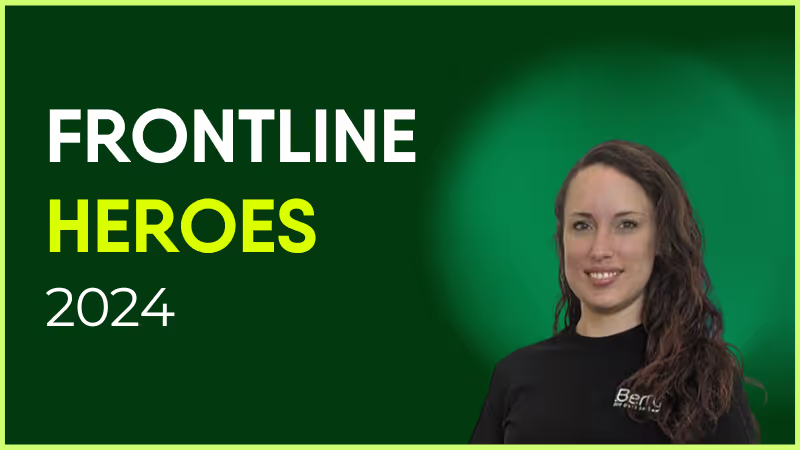
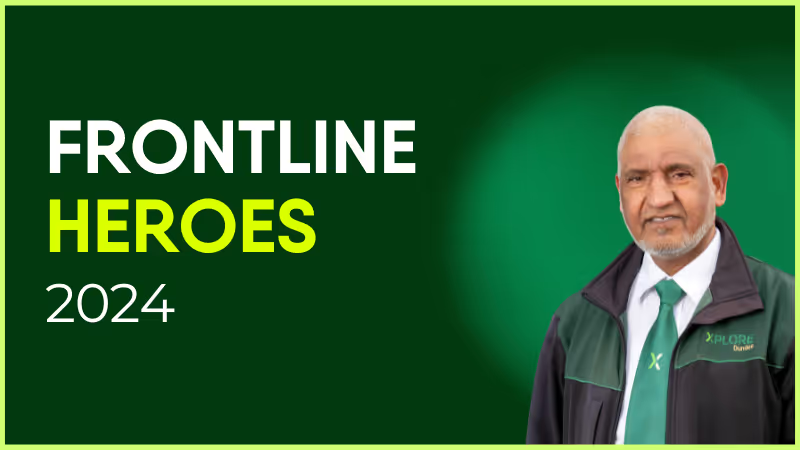
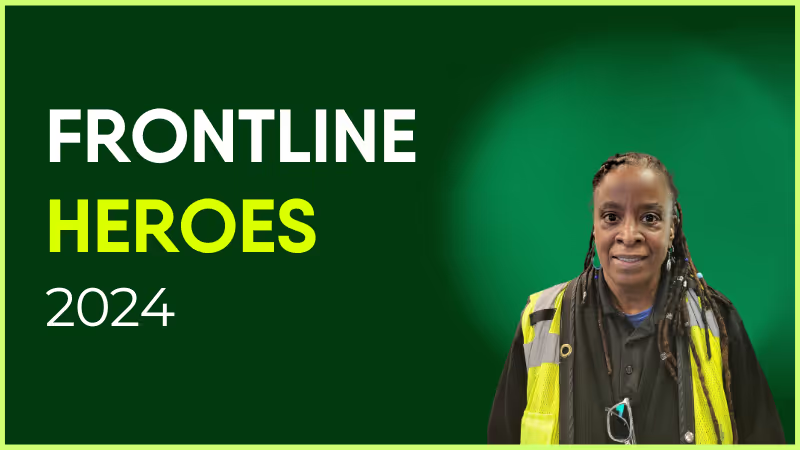
Dee has been with Arriva since Christmas 2016, working 3 days a week so she could care for her three children. When the 2019 Covid pandemic hit, Dee started to work 6 days per week and stepped up to become acting supervisor. During this time, the team was nominated for (and won bronze at!) the Made A Difference Awards for the initiative and depot leadership they showed. They were also recognized for having the fewest rates of drivers contracting the virus within the area.
After the pandemic, she continued to work 6 days each week — her children were getting older, and she had a lot of ideas to improve the standards! She continued to invest in herself and in Arriva: In 2023, she passed the passenger-carrying vehicle test, and when the previous supervisor retired, she became the supervisor in April 2024.
She gives immense credit to her team. In her own words:
“The two ladies I work with, Abby and Megan, are not only colleagues but friends as well, and that makes a difference. The friendship and team spirit within the team is very high and we all work together brilliantly. The goals and cleaning standards are at a high standard and we all work together to achieve this — when drivers compliment the cleanliness and difference is what I love most about the work we do.”
Nominated by: Lee Coleman

What makes her awesome?
Dee has been with Arriva since Christmas 2016, working 3 days a week so she could care for her three children. When the 2019 Covid pandemic hit, Dee started to work 6 days per week and stepped up to become acting supervisor. During this time, the team was nominated for (and won bronze at!) the Made A Difference Awards for the initiative and depot leadership they showed. They were also recognized for having the fewest rates of drivers contracting the virus within the area.
After the pandemic, she continued to work 6 days each week — her children were getting older, and she had a lot of ideas to improve the standards! She continued to invest in herself and in Arriva: In 2023, she passed the passenger-carrying vehicle test, and when the previous supervisor retired, she became the supervisor in April 2024.
She gives immense credit to her team. In her own words:
“The two ladies I work with, Abby and Megan, are not only colleagues but friends as well, and that makes a difference. The friendship and team spirit within the team is very high and we all work together brilliantly. The goals and cleaning standards are at a high standard and we all work together to achieve this — when drivers compliment the cleanliness and difference is what I love most about the work we do.”
Nominated by: Lee Coleman

What we'll cover
Start your free trial today
See how Blink helps frontline teams stay connected, informed, and engaged.
Employee engagement in retail requires more than a staff discount
Sure, that discount code is a great perk. But on its own, it’s not enough to keep your retail team engaged long-term.
Retail work is fast-paced, seasonal, and demanding — and staff don’t tend to stick around for long. Currently, the retail staff turnover rate is hovering around 60%.
These realities make retail employee engagement tricky — but also crucial. When teams are engaged, they’re more productive, more efficient, and more likely to stay working for your store.
They also provide a better service to customers. Companies with the best employee experience (EX) are more than twice as likely to achieve a top customer experience (CX).
So how do you engage retail staff — from team stalwarts to seasonal staff? Here, we look at what retail managers can do to inspire the loyalty and motivation of their teams.
Why is retail engagement so hard? Understanding retail team dynamics
First, what are retail managers up against? Retail teams don’t operate like office teams. They face a set of unique engagement challenges:
Part-time and seasonal staff. Store staff come and go. Managers spend a lot of time getting new hires up to speed — and retail employees don’t always know their coworkers well.
Changing shift schedules. Employees can go weeks without seeing some team members, simply because their shifts never line up. So building a sense of teamwork and community isn’t easy.
Varying digital access. Many stores still use outdated word-of-mouth and paper processes. Staff don’t always have access to the digital platforms and communication channels they need.
The head-office gap. In many retail chains, there’s a disconnect between those making the decisions and those on the shop floor. Messages get lost or delayed. Employee insights are overlooked. Initiatives feel irrelevant because the context isn’t always clear.
In short, retail engagement — like most frontline employee engagement — is tough. But crack it, and you keep staff motivated, connected, and delivering their best.
{{mobile-main="/image"}}
The core pillars of employee engagement in retail
So what moves the needle for employee engagement in the retail industry? Here’s what your team is looking for.
Accessible tools
If internal communications only live on a traditional company intranet platform, retail employees aren’t being kept in the loop — especially if that intranet is only accessible via desktop. Retail staff need mobile-first internal communication tools with a fast, frictionless user experience.
Look for internal communication software where employees can access workplace resources, instant messaging with coworkers, and company policies — all from the same user-friendly custom dashboard.
Relevant and bite-sized updates
Retail employees don’t have time to wade through a wordy email or a multi-page PDF. They’re serving customers, restocking shelves, and juggling a dozen different priorities. So employee communications need to be short, visual, and easy to digest. Think quick videos, infographics, and bullet-point news feed posts. The faster someone can read and act on a message, the better.
Recognition and celebration
From hitting sales goals to nailing a tricky customer request to earning glowing customer feedback — employees deserve recognition for their wins. Employee recognition doesn’t have to be big or expensive. It just has to be genuine. A public thank you in the team chat, a mention in the morning huddle, or a Story celebrating a shift’s success can lift morale and encourage other employees to bring their A-game.
Well-being support
Retail work is demanding — physically, mentally, and emotionally. Employees spend long hours on their feet. They have to cope with huge spikes in demand during busy seasons. They’re also — sadly — subjected to high levels of customer abuse. To ensure employee engagement in the retail sector, staff need well-being support, stress-busting resources, and a corporate culture that respects work-life balance.
Meaningful work
Frontline retail employees who feel connected to their company’s mission are 76% more likely to stay and more likely to put in discretionary effort, too. When they see how their work shapes customer experiences, store success, and company goals — and get a say in decisions that affect their day-to-day — effort and commitment increase.
Retail managers matter. In fact, research shows that managers account for 70% of the variance in team engagement. That’s huge.
You set the pace, tone, and culture of your store — and your actions have a direct impact on how connected and valued your team feels.
While you may have to get head office approval for some engagement initiatives, there’s plenty you can do right now to engage your retail workforce. Let’s take a look.
If you want your team to show up on your digital tools, you have to do the same. So comment on employee posts. Respond to that company-wide poll. Be active in the team chat. When your team sees you using digital channels, they’re much more likely to join in.
#2. Keep your team up-to-date
Improve internal communication and you improve employee engagement. So commit to a regular schedule of team-specific comms. Whether it’s a new promotion, a new hire, or the latest sales stats, keep employees in the loop through push notifications, using channels that everyone can access. That way, no one has to rely on the grapevine for essential updates.
#3. Encourage peer-to-peer communication
Coworker connection helps to create a sense of belonging. But some retail staff might never work the same shifts. You can build stronger team relationships by encouraging group chat on digital channels. Pose questions. Ask for input. Get conversations started. In doing so, you facilitate the sharing of knowledge and workplace hacks — and help employees feel part of your store community.
#4. Say thank you
Engagement thrives when you show appreciation for employees. And recognition doesn’t have to be extravagant — a public thank-you in your team feed, a quick shout-out in the morning huddle, or a Story celebrating a team win can make a big impact. If you want to boost employee morale, the key is to be specific, so recognition feels genuine.
#5. Act on feedback promptly
Whether it’s a broken fitting room light, a problem with the cash register, or an employee’s ideas for your new store promo, showing you listen and act on employee feedback quickly builds trust. Make sure every employee has a way to share their ideas, concerns, and frustrations — via employee surveys, polls, or a regular 1-to-1 meeting. Then, close the feedback loop by letting them know what’s being done.
{{mobile-survey="/image"}}
#6. Provide training and development opportunities
Your best employees are the ones who want to grow and learn. And if they don’t get training and development opportunities with your company, they’re likely to hit the job boards. So offer shadowing opportunities, targeted training, and stretch assignments — and make sure they know about career paths available within your retail organization.
#7. Connect the dots
Help your team see how their work impacts the business, the customer, and even the local community. Connect daily goals to larger company objectives — with the help of customer stories, business updates, and store performance stats — so employees feel part of something bigger.
#8. Facilitate shift swaps
Making shift swaps simple and fair helps employees take control over their schedules. If your company offers a self-service shift swap app, lean into it. This is the easiest way to reduce your workload and help employees manage their work-life balance. No fancy system? You can still make swaps straightforward by posting the weekly schedule, in advance, in the break room — and by establishing a clear system for swap requests.
#9. Run well-being check-ins
Do you know how your team’s doing? This is where instant messaging and video conferencing for mobile access makes a difference. Take 60 seconds to ask how they’re feeling before diving into KPIs or tasks for the day. A genuine check-in can make an employee feel seen and valued. Plus, their responses can give you valuable insight into how to improve employee engagement in your retail store.
#10. Set mini challenges
Create a spot of friendly competition to drive team collaboration and inject energy into slow shifts. You can set targets for speedy restocking, positive customer feedback, or product knowledge. Then offer rewards. These can be as simple as picking the music for the next shift or a favorite snack from the local café. Done right, challenges can boost workplace engagement and help your team hit business goals.
#11. Keep track of engagement metrics
It’s hard to improve what you can’t measure. Whether it’s mandated from HQ or not, it pays to understand and track employee engagement KPIs with a dedicated analytics tool. Look at metrics like absenteeism, staff turnover, and employee net promoter score (eNPS) — if possible, broken down by employee segmentation — to understand how your actions are impacting team engagement over time and to find new ways to boost morale.
{{mobile-shifts="/image"}}
From stockroom to shop floor, retail engagement that drives results
An engaged store is a productive store — and it all starts with the manager. When managers understand the importance of employee engagement in retail — and how to inspire it — teams are happier, more loyal, and deliver better customer experiences.
There are plenty of employee engagement activities you can put into practice in your store. From wellbeing checks to shift swap tools to regular company updates. But the right retail employee engagement and retention tools makes connecting and motivating your team a lot easier.
An employee app like Blink — designed for frontline employees — puts recognition, real-time feedback, scheduling, and comms in one central hub. Retail employees can access the Blink dashboard from their smartphones. So it’s easy to connect workers across shifts, bring seasonal workers into the fold, and make everyone feel part of company culture.
Our retail partners, including McDonald’s and Domino’s, are already seeing the difference that digital-first comms strategy can make. Will you be next?
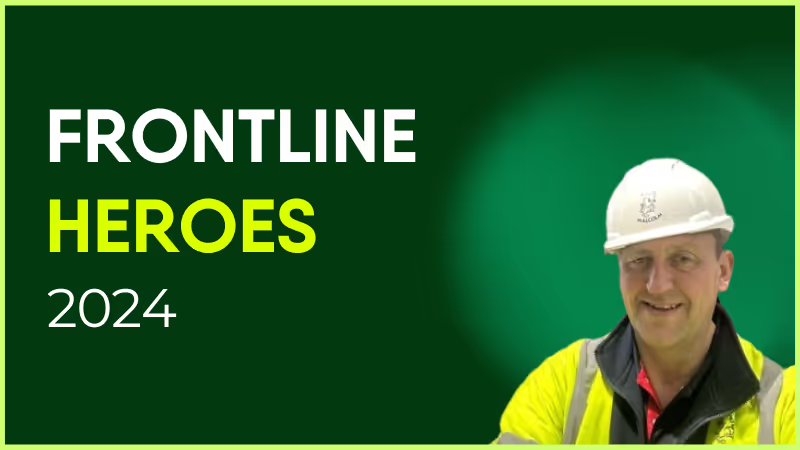
Phil has been with Malcolm group since 2017, working on the logistics side of the business. It’s been challenging to get our Drivers on board with Blink, but Phil has been a true champion of the app from the start. Sharing pictures on the road, offering guidance to fellow drivers, and now he is a trained Mental Health First Aider for Haydock, he uses the platform to communicate and support with his peers who might be struggling.
How has Blink helped in his role?
We have drivers on roads all over the UK and Blink allows Phil to reach them when he otherwise couldn't. It also means drivers can easily reach office colleagues and others across the business.
What does he want to do next?
Phil loves driving so I’m sure he’ll keep trucking on!
A survey conducted by the American Association of Critical Care Nurses reported that 66% of respondents considered leaving their job due to the pandemic.
At first glance, it may seem like the pandemic is what caused frontline workers to feel burned out and leave their jobs, but Amanda Bettencourt, Ph.D. of the association, says,
“This was the stress test for an already stressed system.”
The employee experience for frontline workers has been overlooked for a long time. Finally, businesses are paying attention to how to improve internal communication for their frontline workers.
The truth is that frontline workers love creating a good customer experience. Matthew, a Registered Nurse at Denver Health, says,
“I love what I do. I chose this profession because I wanted to be on the frontline doing this, and there’s nothing else I want to do.”
But how can businesses make the work experience better for frontline workers?
Keep reading to learn how to motivate frontline employees and support them so they can do what they do best – taking care of your customers.
Here’s what we’ll cover:
Benefits of empowering frontline staff
How to improve internal communication on the frontline
1. Make communications accessible to everyone
2. Personalize communication
3. Make it easy to give and view feedback
4. Create a single source of truth
5. Streamline manual processes
6. Provide ongoing training opportunities
7. Ask frontline employees for their ideas
8. Check in regularly and in person
9. Celebrate achievements
10. Put yourself in their shoes
Final thoughts: how to improve internal communication on the frontline
Benefits of empowering frontline staff
Many frontline workers love the work they do. Their job satisfaction comes from helping patients and creating a positive impact on customers.
“We get a sense of accomplishment doing our part to keep folks safe. We find the supplies that they need and get it to them as quickly as possible.”
When your frontline staff feels connected and empowered, they can focus on delivering an excellent customer experience.
But, if your frontline workforce feels unsupported and unheard, employee morale can plummet and lead to burnout and a higher employee turnover rate.
If you want to improve customer satisfaction, it starts by caring for the employees who interact with customers and patients every day.
How to improve internal communication on the frontline
Make communications accessible to everyone
Personalize communication
Make it easy to give and view feedback
Create a single source of truth
Streamline manual processes
Provide ongoing training opportunities
Ask frontline employees for their ideas
Check in regularly and in person
Celebrate achievements
Put yourself in their shoes
1. Make communications accessible to everyone
According to a Frontline Employee Workplace Survey conducted by Yoobic, one in three frontline employees feel disconnected from the company. During the COVID-19 pandemic, companies had to make fast changes to business strategies and operations.
While these changes often affected frontline employees, they didn’t feel included or well-informed. More than 75% of respondents say that receiving internal communications through a mobile app would make them feel more connected to HQ.
2. Personalize communication
Including frontline employees in internal communications is an excellent start, but it won’t solve the problem entirely. More messages don’t automatically equate to higher employee engagement. You need to make sure that your messages are meaningful to frontline employees.
When you communicate significant changes to essential workers, make it easy to understand how any new initiatives will affect their daily work. Anticipate possible questions from frontline employees and answer them in your original message. This should be a key part of your internal communication plan anyway.
For example, if you’re implementing COVID-19 precautions in-store, let employees know how you’ll be supporting them with signage or website updates so they feel supported.
3. Make it easy to give and view feedback
Some initiatives look great on paper, but they don’t work in real-time with customers.
Ben Davis, a social worker in New York, told Time Magazine of a time when top-down pandemic precautions like remote contact made it more challenging to work and connect with individuals who suffer from mental illness symptoms like paranoia.
What seemed like a good idea at first was ineffective and became the source of concern for many frontline workers.
According to Davis,
“It was all very different and very confusing. I don’t know how well he – a patient – understood that I was doing it to help keep him safe.”
In this case, Davis’s feedback was heard. His team implemented changes focused on the long-term protection of frontline workers, such as allowing them to stop administering medication if gloves run out.
Employees on the frontline can feel frustrated if they don’t have access to the resources they need to do their jobs.You must give frontline workers a place to provide feedback and ensure they see that the feedback has been taken and processed.
4. Create a single source of truth
Consider using a mobile app to deliver your intranet or knowledge Hub so your deskless employees can access the right resources.
5. Streamline manual processes
A whopping 71% of frontline workers feel bogged down by repetitive manual tasks and paperwork. One part of motivating frontline employees involves letting them focus on work that creates impact, such as working with customers.
It may sound small, but spreading your admin work across multiple platforms means your frontline workers have to log into several websites to take care of repetitive work.
Respect your frontline workers’ time by consolidating administrative work into a single portal and automating manual processes.
6. Provide ongoing training opportunities
There’s a direct connection between growth opportunities and employee retention. Team members who see a future with your company are more likely to stay engaged and experience high levels of job satisfaction.
During onboarding, show your frontline workers there’s a clear path to growth in your company. Then, make sure they can easily access resources to help them build the skills they need to advance.
For example, clinic receptionists can develop skills to become Medical Assistants and then continue to advance to higher Medical Assistant levels (MA II, MA III) to earn a higher salary.
7. Ask frontline employees for their ideas
Take time during meetings to let people provide an overview of their projects, goals, and progress.
When dealing with customer feedback issues, you can also show your frontline staff you value their expertise by asking for their opinions and suggestions. Use polls and surveys to stay tuned into the customer experience through your frontline workforce.
8. Check in regularly and in person
Too many business leaders underestimate the importance of frontline workers. A grocery store bookkeeper describes his experience to New America as, “bosses come through. They don’t speak to you. They think they’re better than you…We are the ones that are helping you make this money.”
Leaders must schedule regular site visits, but you have to remember to acknowledge on-site and remote employees and genuinely listen to them.
Treat site visits as an opportunity to build relationships with frontline staff, show them that you’re there for them, and reinforce the idea of teamwork.
9. Celebrate achievements
Employee recognition is an integral part of motivating frontline employees. Take time to celebrate work-related achievements like promotions and personal milestones such as birthdays and anniversaries.
10. Put yourself in their shoes
Learning to empathize with your frontline workers creates a better work environment for everyone. Don’t assume the challenges you face in the office are the same your remote employees deal with every day.
Instead of making assumptions, ask your frontline employees questions about their experience and really listen when they tell you. Use questions like “How can I make it easier for you to get your work done?” to get actionable feedback from your frontline workforce.
Lead by providing support and proactively removing the obstacles that make it difficult for frontline workers to succeed.
Final thoughts: how to improve internal communication on the frontline
How many businesses could survive without their frontline workers? And still, they’re often overlooked and misunderstood.
Learning to motivate your frontline employees through empathy, communication, and support can transform your customer experience and overall business. Discover employee engagement for modern workforces with Blink today.
MangoApps is a well-known name in the internal communication and collaboration space, offering an all-in-one platform for employee intranets, communication, and task management. But for many organizations—especially those with deskless or distributed teams—it’s not always the best fit. Whether you're looking for a more intuitive interface, stronger mobile capabilities, or better support for real-time communication, you're not alone in your search.
In this guide, we break down the top 12 MangoApps alternatives to consider in 2025, based on usability, features, employee engagement, and scalability.
What to look for in a MangoApps alternative
Before diving into the list, here are the key factors to consider when evaluating alternatives:
Mobile-first experience: If your workforce includes frontline or non-desk employees, you’ll need a platform that works seamlessly on mobile devices.
Ease of use: Platforms with clean interfaces and intuitive navigation drive higher adoption across all levels of the organization.
Real-time communication: Look for tools that enable instant updates, alerts, and chat, not just static content.
Integration flexibility: Your platform should connect easily with tools like Microsoft 365, Google Workspace, Workday, and HRIS systems.
Employee engagement tools: Polls, surveys, recognition features, and content targeting help drive connection and culture.
Scalability and support: Whether you’re a company of 500 or 50,000, ensure the platform can scale with you—and that help is readily available.
Here are the best alternatives to MangoApps in 2025
#1. Blink – The all-in-one employee experience app
Best for: Enterprise organizations that want to streamline communication, drive engagement, and boost productivity.
Blink stands out as the most powerful MangoApps alternative — especially for organizations looking for a modern, mobile-first platform that actually gets used. Unlike traditional intranet tools that sit in the background, Blink puts everything your employees need into one intuitive app: communications, schedules, forms, HR systems, and more. With real-time chat, content targeting, newsfeeds, surveys, and recognition features, Blink doesn’t just inform employees — it activates them.
The platform is designed for engagement, boasting adoption rates of over 80% across industries like retail, healthcare, logistics, and manufacturing. It also integrates effortlessly with tools like Microsoft 365, Workday, UKG, and ADP, making it a true hub for the digital employee experience. Plus, Blink’s admin tools give Internal Comms, HR, and IT full control over what content is delivered to whom — so you’re always reaching the right people with the right message.
For companies tired of legacy platforms that don’t connect with modern workforces, Blink is a clear upgrade.
{{watch-video="/callouts"}}
#2. Staffbase
Best for: Large enterprises that want to build branded employee apps.
Staffbase specializes in custom-branded employee communication apps, with a strong focus on top-down messaging and internal news delivery. It’s a good fit for enterprises with a strong emphasis on company-wide updates, although some users find its collaboration features limited compared to more integrated platforms.
#3. Unily
Best for: Enterprises seeking a polished intranet with strong SharePoint integration.
Unily delivers a sleek and customizable intranet experience, particularly suited to companies already using Microsoft tools. It shines in content publishing and brand personalization, but may require a significant implementation timeline and budget.
#4. Simpplr
Best for: Companies looking for an intranet focused on content discovery and employee engagement.
Simpplr offers a modern, AI-powered intranet designed to help employees find the information and people they need quickly. Its strengths lie in personalization, integrations, and employee feedback tools, though smaller teams might find it more than they need.
#5. Haiilo
Best for: Social-first communication and employee advocacy.
Haiilo blends internal communication with social sharing, making it a great option for organizations that want to empower employees to become brand ambassadors. It supports news distribution, surveys, and analytics, but collaboration tools are more limited.
#6. LumApps
Best for: Organizations embedded in the Google Workspace ecosystem.
LumApps integrates deeply with Google tools and offers features like personalized news feeds, social communities, and knowledge management. It’s well-suited for content-heavy communication but may not be ideal for frontline teams.
#7. Jive
Best for: Enterprises looking for a community-driven intranet.
Jive is a mature platform known for its collaboration and knowledge-sharing capabilities. It supports employee communities and forums but may feel outdated compared to newer, more agile platforms.
#8. Igloo Software
Best for: Mid-size businesses seeking a flexible digital workplace solution.
Igloo offers pre-built templates, collaboration tools, and strong document management. It’s a solid choice for knowledge workers but lacks the modern mobile experience many organizations now require.
#9. Workvivo
Best for: Organizations prioritizing culture, recognition, and employee social engagement.
Workvivo turns your intranet into a social space where employees feel more connected to their company. Its strength lies in fostering real-time interaction and transparency. Many teams choose it to reinforce culture and encourage engagement beyond standard top-down messaging. It’s engaging and user-friendly, though companies may need to pair it with additional tools for workflows, operations, or integrations.
#10. Happeo
Best for: Google Workspace-centric companies wanting a fast, social intranet.
Happeo blends social features with knowledge sharing and is known for its fast deployment and Google integration. It’s ideal for remote or hybrid teams who need an intranet without the complexity.
#11. Speakap
Best for: Deskless workforce communication, especially in retail and hospitality.
Speakap is built for frontline teams and focuses on secure, real-time updates. It’s easy to use and offers role-based content delivery, though it lacks the depth of features found in all-in-one platforms like Blink.
#12. Interact Software
Best for: Enterprises wanting a structured, content-rich intranet.
Interact offers strong content management, personalization, and search capabilities. It’s geared toward knowledge sharing and compliance-driven industries but may not offer as fluid a mobile experience.
Final thoughts on choosing a MangoApps alternative
If you're searching for a MangoApps alternative that delivers better engagement, faster communication, and a user experience your employees will love, Blink should be at the top of your list. While other platforms have their strengths, Blink combines everything you need — mobile access, real-time updates, integrations, and workforce-wide engagement — into a single platform that scales with your business.
If you’re in internal communications, you’ve heard that sentence more times than you’ve heard “quick question” (which, as we know, is never actually quick).
The shift is real. Five years ago, a lot of comms tech lived in the “nice to have” bucket. In 2026, it’s a boardroom conversation — and boardrooms don’t buy “nice.” They buy outcomes: efficiency, reduced risk, better retention, higher adoption of expensive tech investments, and measurable operational wins.
In our recent webinar, Proving internal comms ROI in 2026: Lessons from the other side, Ricky Sickelmore shared what he learned after 24 years in transport (including launching Blink at Stagecoach and introducing it at Arriva) — and what consistently held up when leadership came knocking for ROI.
Here are the six takeaways internal comms teams can apply immediately.
1. Ditch vanity metrics for outcomes
Email opens. Page views. Likes.
They’re not useless… they’re just not convincing.
Ricky’s rule: stop leading with activity metrics and start leading with business value. Executives don’t want to hear that “people saw the message.” They want to know: did anything change, and did it matter?
So translate comms problems into operational and financial realities:
Safety reporting increases (e.g., digital near-miss reporting vs. “find the form somewhere and hope someone bothers”)
Turnover movement (not because comms magically fixes attrition — but because comms can remove friction, improve onboarding, and drive consistency)
A useful gut-check: If your metric can’t be repeated in a budget meeting without you adding a 3-minute explanation, it’s not your headline metric.
Executives aren’t interested in open rates. They’re interested in the financial reality.
- Ricky Sickelmore, Blink
2. Start with hard costs and operational efficiency
If you want CFO attention, lead with the stuff they can smell from three floors away: tangible savings.
Ricky shared a simple example that’s painfully common in frontline-heavy orgs: printing and distributing documents at scale. One organization saved over £200,000 by moving payslips from print-and-post to digital distribution.
But don’t just stop at “printing costs.” The strongest ROI cases widen the lens:
Printers and maintenance
Paper, postage, distribution
Staff time to print, collate, deliver, reprint
Support tickets created when things go wrong
And when you talk about “time savings,” make them real. Not “we saved time.” Instead:
“We reclaimed 10 hours per week of manager time previously spent manually filling shifts.”
“We reduced password reset requests because employees access systems through one authenticated front door.”
Pro tip from Ricky: Do a basic “time and motion” study. Follow one process end-to-end and document every human touchpoint. That one form might bounce across 8–10 people, with delays that never show up on a neat process map.

3. Build a cross-functional case, not a “comms case”
One of the biggest mistakes internal comms teams make is trying to win budget alone — with a comms-only story.
Ricky put it bluntly: ROI gets easier when internal comms stops being “the comms team’s project” and becomes an operations, safety, engineering, and HR win.
That means stakeholder interviews early — not once the deck is already written.
Ask department heads:
What’s your biggest friction point right now?

What manual work is wasting your team’s time?
Where do you have compliance risk?
What’s the cost of not fixing this?
Example Ricky gave: if a safety leader can’t reliably get 20 drivers in a room for a briefing, that’s not a comms problem — it’s an operational risk. A digital “mandatory read” gives you trackable compliance without the logistics circus.
Make it tangible: Form a small steering committee with reps from the functions that will benefit most. When you go for sign-off, you’re not walking in alone — you’re walking in with allies.
You’re not in it alone — get the right stakeholders in the room early.
Ricky Sickelmore
4. Prove time-to-value through onboarding
Want a metric that operations leaders actually care about? Onboarding efficiency.
Ricky called this one “underestimated” — and he’s right. Onboarding is where friction shows up immediately, and where improvements are easy to translate into time, money, and productivity.
If employees can receive policies, procedures, training content, and day-one essentials before they even start, you can often get people productive an entire day sooner.
That’s not “engagement.” That’s time to value.
And onboarding improvements have a bonus effect: they reduce downstream errors, reduce manager time spent repeating the same information, and improve early retention (again — comms isn’t the sole driver, but it’s a meaningful part of the system).
5. Position your platform as the digital front door
One of Ricky’s biggest reflections: early on, it’s easy to think you’re buying “a comms tool.”
But the strongest ROI cases position the platform as the gateway to your digital estate — the place employees actually start their day.
This matters because most organizations are already paying for expensive systems (HRIS, scheduling, payroll, benefits, learning, etc.). The problem isn’t always the tool — it’s access and adoption.
If your internal comms platform:
Uses SSO
Reduces password resets
Gives employees one place to find and access tools
Increases self-service
…then your comms investment is also protecting and amplifying other investments.
Ricky shared a real pattern: Once access is simplified through a single front door, usage of other systems can jump dramatically — and suddenly your internal comms platform isn’t “another tool.” It’s the tool that makes the rest usable.
6. Establish a baseline — and sell the cost of inaction
You can’t prove improvement if you don’t know where you started. And you can’t create urgency if you can’t show what “doing nothing” costs.
Ricky’s advice: Baseline early — and don’t just baseline comms metrics.
Baseline business realities that leadership recognizes:
Turnover / attrition
Survey participation rates
Safety reporting volumes
Time spent on manual processes
Printing, distribution, and support costs
Operational delays caused by information gaps
Then translate that into the cost of inaction: the money currently leaking from the business because processes are manual, access is fragmented, and frontline teams can’t reliably get what they need.
When you can credibly say, “Here’s what it costs us to do nothing,” the investment stops feeling optional.
Common mistakes to avoid when proving internal comms ROI
A few “don’t step on this rake” moments that came up in the conversation:
Don’t lead with outputs. “We sent 12 newsletters” isn’t ROI.
Don’t build the case in isolation. Cross-functional pain points = stronger case.
Don’t ignore hard money. The “soft” story matters, but hard savings gets you in the door.
Don’t skip the frontline reality check. Spend time with frontline teams. Watch the work. Learn the friction.
Don’t assume leaders know what to ask for. Often the first job is clarifying the real question behind “prove ROI.”
{{mobile-desktop-main="/image"}}
Be the change maker
Internal comms ROI in 2026 isn’t about becoming a finance team overnight. It’s about learning to translate.
Translate comms into outcomes.
Translate friction into cost.
Translate “this would be helpful” into “this will reduce risk, save time, and speed up productivity.”
Frontline employee engagement is no easy task. Your frontline employees work varying shift patterns and spend limited time at head office. They don’t tend to get much downtime during their working hours. And they aren’t always kept in the loop when it comes to company comms.
These obstacles get in the way when you’re trying to connect frontline workers to company culture — and each other. And it’s why standard team-building activities usually fall short.
To make a success of your employee engagement strategy, you have to tailor activities to your deskless workforce. Otherwise, you risk disengagement, plus the productivity and retention issues that go with it.
That’s why we’ve created this list of 18 employee engagement activities. These ideas are suited to busy frontline workers and their schedules. They’re designed to boost engagement and offer meaningful benefits to your employees.
This can lead to lower levels of productivity. It can also cause increased staff turnover rates, which already tend to be pretty high in frontline organizations.
Employee engagement activities, like the ones we’ve included below, help frontline employees feel more connected to their company, role, and co-workers.
And, according to Gallup, improving your employee engagement rates can lead to a range of business benefits. Besides increased productivity and employee retention, these benefits include:
A reduction in safety incidents
A decrease in absenteeism
An increase in customer loyalty
An increase in profitability
Employee engagement is good for employees — and it’s good for business. So let’s take a look at the activities that will help make it happen.
18 employee engagement activities (that work for a frontline workforce)
To engage your frontline workforce, you can incorporate any of the following employee engagement activities into your work days:
1. Engage with employees from day one
2. Celebrate employee milestones and contributions
3. Incentivize goals
4. Create a mentorship program
5. Offer perks that boost employee wellbeing
6. Give regular feedback
7. Encourage group chat
8. Provide shift swap tools
9. Plan a money management month
10. Launch a poll
11. Create online communities
12. Offer professional development opportunities
13. Launch a competition
14. Use video tools
15. Organize a volunteering day
16. Hand the mic to your leaders
17. Run Lunch and Learn sessions
18. Measure employee engagement
Team engagement ideas for frontline workers are different than for other workers. With their variable schedules, you can’t arrange lunch dates or after-work get-togethers.
Here are a few employee engagement initiatives your frontline workers can benefit from.
You can start with employee engagement activities like:
Introducing new co-workers (digitally if it’s not possible to introduce everyone in person)
Supporting new hires to login and familiarize themselves with your engagement tech tools
Sharing a library of online resources that explain the company, their role, and company culture
Assigning them a buddy or mentor
New hires need regular guidance, especially from managers. So don’t assume your workers are done onboarding after a few days or weeks. Instead, design a process that lasts for at least 90 days.
2. Celebrate employee milestones and contributions
Employee recognition improves engagement. Everyone likes to feel appreciated and valued by their employer.
So make recognition a regular feature on your company intranet or newsletter. Celebrate birthdays, volunteer work, and project milestones. Recognize the hard work and successes of employees.
You can also encourage peer-to-peer recognition. 75% of employees say that giving recognition makes them want to stay at their current organization longer.
Get co-workers to nominate each other for awards, then hold an award ceremony. Or simply get them to appreciate each other by sending a message on the company news feed.
3. Incentivize goals
Gamify the work environment by offering rewards in return for meeting goals. When employees perform well and meet targets, give them a gift you know they’ll like. Company rewards can include gift cards, discounts, cash prizes, an extra day of paid vacation, or the option to give a charitable donation.
But don’t dive right in. Before you announce your reward program, it’s a good idea to survey employees. Ask them which rewards they’d prefer so you can be sure that workers will be motivated by the prizes on offer.
4. Create a mentorship program
Do you want your employees to engage with each other, learn valuable skills, and help each other at the same time? Try rolling out a mentorship program.
Assign frontline workers a mentor within your organization. You can pair people from different departments and different levels of the company.
Then, set a regular schedule of mentor meet-ups. Mentors and mentees might like to conduct meetings online to better suit their work schedules.
Also, offer guidance on how constructive meetings should be run. The aim is for mentees to set workplace goals and come up with a plan for achieving them.
5. Offer perks that boost employee wellbeing
A healthy worker is a productive worker. So encourage fun runs, offer free healthy snacks, and provide discount gym memberships.
Also, try to provide flexible scheduling when possible to give employees a better work-life balance. You’ll reduce employee stress and their risk of burnout.
To ensure frontline employees can access wellbeing activities, you can use a wellbeing app. Via this type of tool, you can provide employee engagement activities. Things like mindfulness and meditation sessions, nutrition planning, and health tracking, all via an employee’s mobile device.
6. Give regular feedback
Gallup research shows that 80% of employees who say they’ve received meaningful feedback in the past week are fully engaged in their work.
So schedule activities where employees receive regular feedback from managers. Make it constructive and useful for employees, so it’s not an appointment they dread.
Also, take a few hours each week to run an online open-door session. This is a time when employees can meet with managers digitally to ask questions and express any concerns.
7. Use the company news feed
A user-friendly employee app with a company news feed acts as a virtual water cooler. It’s a place where frontline workers, who may spend little time with co-workers, get to build stronger workplace relationships.
The comms team can support engagement by using the news feed to share a mix of essential and informal posts. They can announce news, celebrate birthdays, and share tips — encouraging workers to comment, like, and post.
Also, consider these engagement-boosting ideas:
A weekly challenge — a photo contest, a trivia quiz, or a step-count competition
Employee spotlight — highlight a different employee each week, describing their achievements, personal stories, and contributions
A survey — whether the topic is something fun or something more serious, surveys are a great way to engage your workforce
Health and wellness tips — share tips and articles related to physical and mental health, all suited to the demands of frontline roles
8. Provide shift swap tools
Frontline employees want greater levels of flexibility. It’s not always easy for frontline organizations to provide this when there are fixed shifts to fill.
But with shift swap tools, you make it easy for workers to achieve a little more work-life balance. They can swap shifts with co-workers without HR or managers having to get involved.
You can provide other self-serve tools, too. For example, via the Blink interface, employees can access their pay stubs, request time off, and view their shift schedules.
Automating HR tasks like this gives more control to your frontline workers and lightens the load for your HR team.
9. Plan a money management month
Money worries can affect an employee’s wellbeing and their engagement with work. And employee engagement activities are most effective when they provide real value for your workers.
So plan a money management month to help employees make informed financial decisions. Use quizzes and polls to engage employees in the conversation. Challenge employees to a low or no spend day. Provide money advice over 1:1 chats or via your company resource center.
This is exactly what they’ve done at supermarket chain, Tesco, where they recognized the strain that the cost of living crisis has put on employees. In response, they introduced a range of new initiatives:
Skills training activities so employees develop store-wide skills and can pick up extra shifts
A Pay Advance scheme that allows workers to access earned pay ahead of payday
Personalized videos explaining to every worker how much their pension will be worth
10. Launch a poll
Polls give employees a chance to share their ideas and opinions. It’s a way to make their voices heard.
You can launch polls online, with the help of a tool like Blink Surveys. This allows you to quickly and easily find out what frontline employees are thinking about your chosen topic.
You might like to ask questions related to internal communications, company change, employee engagement, or simply the layout of the break room. Using this insight, you can make changes that make a real difference to your employees.
Just be sure to keep them updated with poll findings and your plan of action so they know that you’re really listening to what they have to say.
11. Create online communities
It’s easier to build connections with co-workers when you have something in common with one another. Online communities — based around shared interests — make it easy for frontline workers to find like-minded work friends.
So create space on your intranet for these types of communities. Perhaps you have a group that loves to run in their spare time. A gaggle of gamers. Or a bunch of bookworms. An online community helps bring these co-workers together.
12. Offer professional development opportunities
Training is a great way to improve workplace engagement. 71% of frontline workers have a strong desire for more learning opportunities at work. But a third of workers say that employers don’t invest enough in their growth.
Try to make training more accessible to your frontline workforce. Remember that it doesn’t have to take place in a classroom. You can put training resources into the palm of frontline workers’ hands with the help of the right technology.
You can offer micro-learning modules that workers can complete on mobile devices during a break. And provide fun online courses, with competitive and gamified features.
Also, remember that a lot of worker engagement can be tracked back to your managers. So ensure that managers get the employee engagement training they need, too.
13. Launch a competition
Pit teams of employees against each other with a fun company-wide competition. For an engagement boost, link your competition to company goals and values.
For example, if you’re championing employee wellbeing, set workers a steps or fitness challenge.
If you’re focused on employee development, encourage workers to complete training modules by setting them a training challenge.
To highlight your commitment to a chosen charity, set a fundraising contest.
Alternatively, improve engagement on the company app with a quick photo caption competition.
Pick challenges that can be completed remotely, without teams having to meet up in person. Also, plan rewards for the winners and give regular updates via your comms channels to keep competitors engaged.
14. Use video tools
When you can’t meet face to face, video is the next best thing. You can film leadership updates, company events, and new product demos to give employees more insight into the organization and their roles.
Videos are a great option for town hall meetings. Post the video on your employee news feed and employees who can’t attend in person can watch the video back later.
Similarly, get new hires to film a video to introduce themselves and post it to the news feed. Their co-workers can comment on the post to say hello and help their new co-worker feel more at home.
15. Organize a volunteering day
Offering employees opportunities to volunteer is good for their wellbeing and engagement levels. You can make this activity more appealing to frontline workers by giving them paid time off to volunteer and by giving them flexibility over the days they choose.
Salesforce leads the way on this. They give employees seven business days every year to volunteer for one of the non-profit organizations that Salesforce formally supports — or one of their own choosing.
Jamie Olsen, senior director of Citizen Philanthropy at Salesforce says:
“These are the types of programs that people want and that are attracting them to companies right now. They better the community. They improve people’s happiness.”
You can ensure everyone is on the same page by conducting a virtual Q&A session with one of your leadership team.
This type of event gives employees direct access to leadership. It bridges the gap between the frontline and head office. It also helps employees make their voices heard, which makes them feel valued and motivated.
The prospect of a Q&A can be a little daunting for leaders. But remember, a moderator can facilitate the session, reading out pre-submitted questions and managing live questions.
Also bear in mind that there are huge benefits to be gained. These include frontline insights, improved communication, and a stronger workplace culture.
17. Run lunch and learn sessions
When employees have all the information they need to do their jobs well, they feel more engaged. So give employees access to an online library of resources, transferring any old paper documents to a digital format.
With this library, you can then run virtual Lunch and Learn sessions. This is where a group of employees watches or reads a selected resource. Afterwards, they discuss their reflections either over video call or via group messaging.
18. Measure employee engagement
The last on our list of employee engagement activities is one for your people team, not your frontline employees. And it’s a really important part of any employee engagement strategy.
Find out how you’re doing by tracking employee engagement KPIs. Track your employee net promoter score (eNPS), engagement with your intranet platform, or employee survey results.
You can then set goals and — by drilling down into the data provided by your platform analytics — find actionable areas for improvement.
Final thoughts: employee engagement activities and ideas
To make a success of frontline employee engagement, you need to:
Provide employee engagement activities that offer real benefits for frontline employees
Make these activities accessible to the frontline with the help of flexible, digital solutions
You then create a culture that employees can play an active part in, no matter their schedule or location. You also motivate frontline workers to engage with company culture out of choice, making time for it in their busy days.
Incorporating the activities above into your frontline workplace is much easier when you have the right technology. And an employee engagement app comes in very useful. It’s a way to put all content and communication into the palm of every employee.
By creating online spaces where employees can gather, chat, share knowledge, and connect with company culture, you extend employee engagement to your hardest-to-reach employees — those on the frontline.