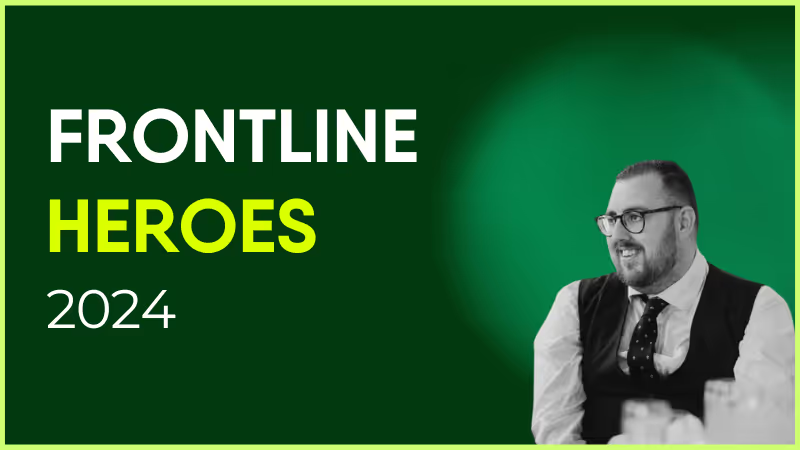
Tom has been with Realise Training, a leading provider in the apprenticeship, adult learning and vocational training market, since October 2018. Realise supports people to fulfill their potential and help businesses upskill their workforce, and this year around 16,000 learners benefit from apprenticeship and adult education programs through Realise. Most of their training is done onsite, so their tutors are often traveling and working remotely.
Tom is part of the operational support team. There is not a job he doesn’t do — and if there is, he still gives it a go to try and help someone else out. What makes him awesome? EVERYTHING! He literally keeps the business moving from events to transport to decorating, his talents are endless. He even took up modeling some new Realise-branded clothing at one point… We need more Toms in this world!
How has Blink helped in his role?
Blink really aids in communication, from those quick instant messages when you need some last-minute train tickets to Tom being able to notify the business of operational notifications.
What does he want to do next?
I think building our own driving school sounds like something he would like to participate in! All those vehicle insurance documents and building regulations… he'd love it!
Nominated by: Aimee Mcvittie, Performance Manager
What makes him awesome?
Tom has been with Realise Training, a leading provider in the apprenticeship, adult learning and vocational training market, since October 2018. Realise supports people to fulfill their potential and help businesses upskill their workforce, and this year around 16,000 learners benefit from apprenticeship and adult education programs through Realise. Most of their training is done onsite, so their tutors are often traveling and working remotely.
Tom is part of the operational support team. There is not a job he doesn’t do — and if there is, he still gives it a go to try and help someone else out. What makes him awesome? EVERYTHING! He literally keeps the business moving from events to transport to decorating, his talents are endless. He even took up modeling some new Realise-branded clothing at one point… We need more Toms in this world!
How has Blink helped in his role?
Blink really aids in communication, from those quick instant messages when you need some last-minute train tickets to Tom being able to notify the business of operational notifications.
What does he want to do next?
I think building our own driving school sounds like something he would like to participate in! All those vehicle insurance documents and building regulations… he'd love it!
Employee messaging is broken — but it’s not because people “don’t engage.”
It’s because most workplace messages are slow, noisy, and buried in channels employees never asked for. Email is where urgent notifications go to disappear. Unofficial tools like WhatsApp create risk and chaos. And legacy intranets were never built for real-time conversation — especially for frontline teams.
Meanwhile, employees are used to fast, visual, social communication everywhere else in their lives. If your internal messaging doesn’t meet that bar, it’s not being ignored — it’s being outcompeted.
The good news? Employee messaging isn’t doomed. But it does need new rules.
Let’s break them down.
{{mobile-chat="/image"}}
The new rules of employee messaging
Rule #1: Messaging should mirror how people already communicate
Away from work, employees are chatting over WhatsApp and TikTok. They’re sending short, visual, highly engaging messages in real-time. This is their norm.
Voice notes, GIFs, emojis, attachments, and the option to hop on a video call straight from the chat thread keep conversations flowing naturally — just like they do on personal apps.
Rule #2: Keep it safe, centralized, and compliant
Struggling to follow rule #1 because you don’t have modern comms tools?
Unofficial employee communication channels, like WhatsApp, are a tempting alternative. This is especially true if you have frontline employees who cannot access desktop-based communication channels.
But shadow IT like this poses a risk to your business. Beyond the sheen of convenience, there are issues with data privacy and device security. Your comms team has zero oversight and no analytics, so it’s hard to use employee messaging to build company culture.
In contrast, a dedicated messaging tool like Blink is secure. It offers end-to-end encryption, admin controls, and content moderation tools.
Centralized identity management comes as standard. So you can automatically end platform access when someone leaves your company — and get new hires onboarded with ease.
{{childrens-of-alabama="/callouts"}}
Rule #3: Everyone sees only what they need
It’s hard to surface relevant details in a flood of information. So if you want employee messaging to cut through, people should be able to find the messages that matter to them, in an instant.
For this, you need targeted channels that reduce noise and prevent notification fatigue. That means role, location, and interest-based groups. It also means giving employees control with searchable chat, pinned messages, and notification settings.
With Blink, you get all the above, plus the added benefit of employee journeys. This feature lets you deliver personalized content pathways, ensuring the right content reaches the right person at the right time. It’s perfect for onboarding, training, and other key touchpoints within the employee life cycle.
Rule #4: Make your feed worth scrolling
Messaging tools + company news feed = the magic combo. Employees can chat with their team over communication tools, then head over to the news feed for company-wide connection and insight.
So, how do you make your news feed successful? Remember: To stand out in a crowded digital landscape, your feed has to compete with employees’ personal mobile apps.
Think photos, short-form video stories, and infographics. Messages that ditch the corporate tone. Employee recognition, celebrations, behind-the-scenes peeks, and quick-fire polls.
A scroll-worthy feed does more than entertain. It amplifies big company messages, strengthens culture, and keeps employees engaged, productive, and feeling part of something bigger.
{{mobile-main="/image"}}
Rule #5: Measure everything
You know you’re sticking to the new rules of employee messaging when the stats back you up.
So track what lands, what gets ignored, and which teams are engaged. Use these data to tweak content formats, timing, and style (and educate other content creators within the company), so messages land better every time.
With BlinkIQ, you can track read rates, workforce engagement trends, and even employee sentiment to get a full picture of your internal comms performance. You get the insight you need to make meaningful changes to comms and the wider employee experience.
Your employee messaging playbook
If you’re keen to give your workplace communication strategy a glow-up, you’ll get the best results by following this playbook.
Establish your purpose and principles
First, get the fundamentals straight.
Why is employee messaging important to your organization? Perhaps it supports speedy communication, connection, alignment, or frontline access to comms.
What are your guiding principles? Is it clear, informal, transparent, and useful?
And how does messaging fit within the broader comms ecosystem? What types of employee communication belong on your team chat app, and which are better suited to your news feed or content hub?
Decide on your tools
These days, traditional intranet platforms, email, and shadow IT aren’t up to the task of effective employee messaging. You need a tool that mimics the experience of text and social apps, while offering next-level security features.
If you don’t currently have this kind of tech on your team, it’s time to gather cross-functional consensus on what your messaging tool should look like. Draw up a shortlist of tools that meet your requirements. Demo these tools and decide on the best fit.
Organize your channels
To keep things shipshape in your messaging tool, you need to decide the following:
Naming conventions for channels or groups (so they’re easy to search)
When to create a new channel
Who is permitted to create a new channel
You may then want to create (at a minimum) channels for specific departments, locations, and teams.
Create chat guidelines and governance
Create guidelines on the kind of content that people can share over company messaging channels. Establish emoji, GIF, and reaction etiquette.
Also, decide who’s responsible for governance — your IC team, HR, managers, or designated channel moderators? In the unlikely case that someone posts something inappropriate, moderators can then flag and remove the content.
{{mobile-hub="/image"}}
Create training materials
Teach employees how to get the most out of chat functions by offering step-by-step instructions for new employees and top tips for existing ones.
Let them know how to manage their notifications, how to share their location, how to set their status, and how to favorite a message.
Go further by training managers in good messaging practices. Offer advice on how to keep the digital conversation flowing, how to use AI assistance, and how to ensure their comms are accessible, engaging, and inclusive of all employees.
Decide on your success metrics
What does good look like when it comes to your employee messaging channels? Decide what metrics you want to track, and benchmark performance to see what impact any improvements make.
You might like to track:
Read rates
Message reactions
Employee sentiment
Operational efficiency
Compliance rate
Then, segment data by team or chat channel to find out where additional IC support may be needed.
{{less-is-more="/callouts"}}
Upgrade employee messaging with Blink
Playing by the new rules of employee messaging doesn’t just improve workplace communication. It powers knowledge sharing, team building, and productivity across your organization.
To achieve this, you need a modern messaging tool that meets the expectations of employees and the needs of your organization.
Blink is a secure, mobile-first messaging platform. It delivers consumer-grade chat and a personalized news feed, perfect for information sharing and co-worker connection.
But Blink doesn’t stop there. It offers a content hub, analytics, and deep integrations with other software you use. It is a complete solution for internal communications, employee experience, and employee engagement.
A record 50.5 million people living in America quit their jobs in 2022 — and a further 40% of US employees considered leaving their jobs. Organizations need to step things up a notch if they want to start engaging both their desk-based and frontline staff.
The good news is there are many employee engagement strategies, tactics, and ideas you can implement to turn around the situation. The 12 strategies we discuss in this guide will help you create an engaging workplace experience and drive employee engagement for both desk-based and frontline employees.
Frontline Employee Engagement in 2024
Blink created this guide after working with hundreds of frontline organizations. Now, these insights can help other leaders prepare for a year that promises both challenge and opportunity.
Download to learn more: The top eight frontline engagement trends to watch out for and the six key strategies for success
A quick recap: what is employee engagement?
Employee engagement is the ongoing process of ensuring your workforce feels:
Emotionally connected to their job, coworkers, and organization as a whole
Satisfied with their job role and function
Aligned with your company’s values
Able to give 100% during work hours
Industry statistics cite employee engagement as a key factor in employee satisfaction, retention, and even company profitability. Employee engagement should be a number one priority for businesses globally — and yet, as of 2023, only 23% of employees globally are engaged.
You can use a number of methods to measure employee engagement levels in your business. Think surveys, metrics, and other engagement KPIs that will help determine how motivated, satisfied, and fulfilled your employees are in their work.
Remember, employee engagement is often the byproduct of a great employee experience. If you provide a fulfilling, enjoyable, and inspiring workplace experience, you enable and encourage engagement.
With this in mind, you need to tailor and adapt your employee engagement strategies to meet the needs of different types of employees, including frontline workers. This will make their overall experience positive and rewarding.
The foundations of effective employee engagement strategies
Engaged employees can be your greatest business asset. They are more focused and committed than disengaged workers, encourage their coworkers, and positively impact your bottom line.
But improving employee engagement is not about what you do. It’s about what you are as an organization, the culture you cultivate, and the values that you live by.
So before we jump into the employee engagement strategies, it’s important to look at the key values of employee engagement that form the foundation for those strategies. Those core values are:
Respect
Respect is an essential consideration for all your high-level decisions about managing employees. For your workers to be engaged at work, they should be able to trust that they are being treated with fairness and respect.
So how do you convey this in your processes and policies? You pay competitive wages, allow enough breaks, listen to their ideas, and formally recognize excellent performance and value-abiding behaviors.
Transparency
If your employees aren’t aware of anything about your organization that’s beyond their scope of work or immediate team, you can’t blame them for feeling like an outsider. Sooner or later, they’ll feel isolated and disengaged.
Being in the loop doesn’t just help them do their jobs in a better way, but also makes them feel like they belong. So it’s essential to communicate openly and regularly with all your employees.
The more transparent your communication, the higher level of trust you’ll build with your workers. And the more comfortable they’ll feel sharing their thoughts and concerns, which brings us to the next pillar of employee engagement.
Two-way communication
Most organizations follow a top-down approach to employee communication in which frontline employees hardly ever have a say. But these workers often have the best insights because they work directly with customers day in and day out.
So one of the best values to nurture and cultivate for high employee engagement is two-way communication. Give your workers ample opportunities to raise their voice and share what they think. Then act on this feedback to take your employee engagement to the next level.
12 actionable employee engagement strategies
Here are 12 employee engagement strategies & tactics you can implement today:
1. Foster co-worker relationships
When employees have friendly relationships with immediate team members and other people in the organization, they are more likely to enjoy the day-to-day.
Workplace relationships don’t just help with networking, they also provide the guidance and motivation a worker needs to succeed in their role. And creating opportunities to build and nurture these connections is one of the best employee engagement strategies.
Co-workers don’t always cross paths throughout the working day — especially in frontline organizations. It might be up to you to encourage better intra-department connections through organized events. You could create a program to encourage workers to collaborate, socialize, or train each other on the parts of the job that they know best.
Workers from different departments can connect, share notes, and exchange best practices. This way, they can also try out a recently learned skill or explore different options they might want to pursue in the future.
In fact, there are many cases in which employees consider leaving their organization to pursue a different career path. This program will help you facilitate the lateral moving of an employee to a different department, so they aren’t forced to look elsewhere. This way you hit two goals with one stone: high employee engagement and better employee retention.
2. Have a thorough onboarding process
Onboarding is essential for setting the right tone and expectations when a new employee joins your team.
As the statistics in the video above highlight, around 20% of new hires leave in the first seven weeks of employment, but organizations with a strong onboarding process have improved retention rates by 82%.
A strong onboarding experience is achieved by:
Making sure your onboarding process covers not only organizational policies, but also the company’s core values, mission, and vision
Giving your new employees mobile accessto relevant materials and resources to learn from, and encouraging all employees to provide their feedback
Acknowledging the importance of connection during onboarding. Introduce new hires to their team members, leadership, and coworkers. For a dispersed workforce, this can be done by ensuring your employees have the right digital tools and channels to connect from wherever they are
A sense of belonging from day one is integral in order to improve employee engagement — particularly for the frontline, where80% of workers feel they have few connection opportunities at work.
See how Go North West is using Blink to make new team members feel part of the organization right from day one.
3. Rethink physical spaces
Frontline employees power the global workforce. With no central break room or day-to-day opportunities for office chat, dispersed workers can become increasingly disconnected from the rest of the organization.
While team building and other social events may be organized with the best of intentions, they often miss the mark for frontline workers, putting more pressure on employees instead of providing a channel for enthusiastic engagement.
If you’re a frontline leader, you need to rethink your social spaces and channels to meet the engagement expectations of all your employees. This might mean creating dedicated digital channels, Feeds, or groups for frontline workers who would otherwise never have a chance to interact.
Deliberately creating space for accessible social interaction can help build relationships, increase engagement, and create an environment of inclusion and positivity throughout your organization.
Career growth has a positive impact on knowledge workers’ organizational engagement
Career goal progress and professional ability development promote job engagement
Career growth has a positive effect on affective commitment, which in turn influences employee engagement.
If you can make workers feel that they can advance their careers without leaving your company, you’ll see a big boost in employee engagement. Workers at every level of your company should be able to view a clear-cut career path ahead and the map to follow that path.
So when formulating employee engagement strategies for your company, see how you can help workers get in complete control of their careers. The more assured they are about achieving their future goals, the more engaged you’ll find them to be.
How to accomplish this? Take your workers’ input on where they see themselves in the future. Here’s a career development plan template that might come in useful, as you do.
When you empower employees to take charge of their goal setting in alignment with team objectives, they’ll be more invested in working hard to hit those goals. And they won’t need tight schedules to do the same, leading to an improvement in overall satisfaction.
5. Provide training and learning opportunities
Helping workers learn new skills and investing in their professional development is crucial to their engagement.
In fact, 35% of millennial employees (who also make up around 35% of the US workforce) said they were attracted to employers who offer excellent training and development programs for this reason and saw it as the top benefit they wanted from an employer.
There are many measures you can take to facilitate employee education:
Conduct online workshops that support employees’ learning goals
Provide reimbursements for courses workers enroll in
When you invest in employees’ learning and development, you are sending a message that your company is committed to them for the long term. And this demonstration of commitment makes them far more likely to give their 100% on the job.
6. Clear and consistent communication
Dispersed staff need a tool that allows them to interact with each other as if they were in the same room. This is key for breaking down barriers, unifying teams, and working productively, no matter where your team is located.
At Blink, communication is part of our culture and we are strong believers in its power. This is something that you must emphasize too if you wish to engage your employees. When you build a culture of trust and open communication, you help create an environment of transparency, respect, and collaboration.
You also need to make sure your team members are able to communicate with each other. Every team member should be aware of the communication channels that the organization uses and how to use them.
As leaders, don’t forget your own role in communication, either. Simply providing employees the channels to communicate and actually engaging employees through these channels are two different things.
To ensure a clear and consistent communication strategy, consider:
Frequent News Feed updates to keep team members in the loop
Regularly scheduled 1-1s and ongoing two-way feedback loops
Targeted posts in group chats and forums for sharing ideas and gaining insights
When someone asks where they work, your workers can feel absolute pleasure, cold apathy, or even disdain or embarrassment answering that question. It all depends on your company’s reputation inside and outside the premises.
Money is undoubtedly a strong motivator, but employees also want to feel proud of where they work. The strength of your organization’s brand and what it stands for is directly related to your workers’ level of engagement.
That makes internal branding one of the most crucial employee engagement strategies. It means you need to ensure that your workers understand, support, and feel connected to your mission, vision, and values. The more convinced they are of what your brand stands for, the more likely they are to emulate behaviors that speak to the same values.
The supermarket chain Trader Joe’s is a great example. It has designed a fun and quirky environment for both workers and customers, with the workers conveying its brand values through different aspects of their job. The way they name products, design signage, décorate the store, and interact with customers — everything aligns with the Trader Joe’s brand.
The checkout process is just as warm, friendly, and casual. Workers display enthusiasm and a genuine desire to help with their feedback and expertise on the products.
This goes on to show that when done correctly, internal branding can create a virtuous cycle. It will attract workers who love your brand, who will further communicate their passion to your customers and partners, thereby enhancing the brand and attracting more top talent.
8. Encourage diversity and inclusion
D&I initiatives are crucial to the overall employee experience, making them a great place to focus your efforts for improving engagement levels. Research by ADP states:
“Studies have shown that employees who are satisfied with their organization’s commitment to diversity and inclusion (D&I) are twice as engaged as dissatisfied employees. Changeboard adds that diverse and inclusive organizations work 12% harder, are 19% more likely to stay longer with the organization, and collaborate 57% more effectively with peers.”
What does this look like in action? Bentley University highlights some key actions that can help you better promote diversity in the workplace, including to:
Address implicit bias: Make sure everyone in the company, starting with your C-suite and leadership teams, is aware of their unconscious bias and take proactive steps to address it
Acknowledge intersectionality: D&I initiatives must not ignore or sidestep the fact that all individuals have nuanced social identities and backgrounds that can confer or deny privilege in accordance with cultural norms
Invest in Employee Resource Groups (ERGs): Investing in ERGs, or affinity groups that provide social support for employees with shared backgrounds, interests, and/or experiences is one of the most effective ways to ensure diversity initiatives remain top-of-mind
Offer mentorship programs: Mentorships encourage both personal and professional growth, and provide a pipeline for leadership development. For groups with fewer role models in senior positions, mentorship can be crucial to cultivating diverse leadership
Communicate with transparency: Be open and transparent about the goals of your D&I initiatives. Communicate progress towards achieving measurable objectives, ensure everyone is informed about key developments in the initiative, and most importantly, be open to feedback from all employees on how you can improve it
In addition to these diversity strategies, every segment and every department of your organization must also feelincluded to foster true D&I and, in turn, boost engagement.
In fact, studies show that belonging is one of the most powerful predictors of D&I efficacy in the workforce. Organizations with high levels of belonging also have higher employee net promoter scores (eNPS), which are correlated with higher engagement levels.
Frontline workers can experience the very opposite. Warehouse workers, for example, are typically secluded from other employees — and that goes double if they work the night shift as well. If a frontline worker continues to feel left out, then their engagement is likely to suffer. It’s crucial that you take the necessary steps to ensure that everyone has a sense of belonging and inclusion, starting with your frontline employees.
9. Survey, listen, and act
12 best employee engagement strategies & tactics that work 2
Your employees all have improvements they’d make to their roles, whether it’s a better work-life balance, tools that they can actually use in their roles, or more contact with management. You need to collect these insights — and act on them — to keep your employees engaged long-term.
An employee engagement survey can help you gain this valuable feedback from workers. An employee survey gives you insights into employees’ opinions, attitudes, and experiences — and you can use this data to identify areas for action.
You can also use surveys to recognize areas of improvement and understand what makes employees proud of their work.
Make sure you follow through on survey results with actions that address the employee feedback provided. Additionally, keep your workers in the loop with regular updates on progress and changes made as a result of their input. This will help build trust between your team and management, and demonstrate your commitment to employee engagement.
10. Recognize and reward
Rewards and recognition are essential for employee engagement. In fact, one 2022 Harvard Business Review study found that when anemployee says their manager is great at recognizing them, then that employee is 40+% more engaged than those with managers who were not.
Recognition is an effective way to keep employees motivated. It also reinforces the behaviors you want more of in your organization.
For example, if you want to encourage team collaboration, reward teams that work together on a project or present a unified front during client meetings. If you need increased productivity, recognize employees who go above and beyond to get the job done.
Remember, rewards don’t have to be expensive or elaborate. Digital recognition tools or Kudos are both an effective and cost-effective way to show appreciation for your team’s hard work.
11. Provide incentives and perks
While closely related to your rewards and recognition schemes, incentives and perks work slightly differently. Typically, incentives are used to elicit a particular action from your employees. For instance, you might offer bonus pay for completing a project before the deadline or reaching certain on-the-job targets.
Unlike as-and-when recognition and rewards that react to a job well done, with ongoing incentives, workers will often know what they will get for completing the challenge ahead of time, and exactly what is required in order to receive that incentive.
Perks are more general benefits that make working in your organization more desirable. Some basic examples could include flexible work hours, subsidized gym memberships, and free snacks or coffee. You really need to get more creative than this, however, if you want to provide perks that your employees really want.
For example, factors such as compensation, growth through promotion, paid training, and high-value traditional benefits have the largest impact on frontline employee preferences when choosing a new role. However, employers do not value the same factors, according to the same research by McKinsey. The study states:
“When it comes to growth-oriented attributes, employers tend to emphasize a higher job title (among the bottom five attributes for frontline employees) over job growth and learning opportunities (both top-five attributes), which may help explain why frontline employees cite a lack of employer-provided development opportunities as a primary barrier to their advancement.”
To align your company perks with the needs of your frontline workers, you should consider providing opportunities for a yearly raise or promotion, advanced learning and employee development opportunities, and ongoing upskilling.
McKinsey: What frontline employees want—and what employers think they want
12. Implement employee engagement tech with analytics tools
Analytics are essential for a successful employee engagement strategy. With the right engagement analytics tools, you can gain insights into how employees are engaging with company messages, what topics they’re most interested in, and how to best tailor future activities to their needs.
For example, use feedback or survey tools on mobile devices to collect real-time data from employees. This data can then be analyzed to reveal the most critical areas of focus for your engagement strategy.
You can also use dedicated analytics features to tailor specific messages or activities that best meet the needs of individual employees. This helps you create a more personalized, effective experience for workers and drive more meaningful engagement within your organization.
Using technology to monitor employee engagement is also one of the best ways to ensure that initiatives are tied directly to overall business objectives. Analytics help you understand if there are any engagement gaps that you need to fill.
Are there certain teams that consistently fail to engage with your content, for example? Tracking open rates, comments, will help you identify any disengaged teams or employees, so that you can work to address and improve their experience.
How to create an employee engagement strategy
Set goals
You need goals that are specific and measurable when creating a successful employee engagement strategy. This provides the foundation for your efforts, ensures everyone is on the same page, and helps you assess progress along the way.
Identify your issues
Once you have established your goals, determine what obstacles stand between you and achieving those objectives. Communication issues, lack of motivation, or a disconnected team can all put your progress at risk. Knowing what might stand in your way will help you tailor activities to your organization’s needs and develop solutions that are relevant and effective.
Build your plan
Next, you need to create a plan of action for achieving your engagement goals. You should include activities such as tailored employee surveys, tech and communication refreshes, and analytics implementation in this plan.
Analyze and adjust
Finally, track the progress of your employee engagement efforts with analytics tools and review how well they worked. Adjust activities based on the findings, and move forward with more tailored initiatives.
Why your employee engagement strategy might fail
Not listening to feedback
If you don’t listen to what your employees are telling you, then your engagement activities will be misguided and ineffective. You need to respond quickly and effectively to feedback in order to ensure that your initiatives meet their needs.
Not having the right tools
Communication and engagement tools are essential in today’s workplace, and even more so if you want an engaged workforce. Without the right tools, you won’t be able to track progress or employee engagement scores accurately — let alone ensure that everyone is on the same page.
Plus, if your tools aren’t fit for mobile, you will be missing out on the chance to engage with your key employees when they are on the move.
Not having leadership buy-in
Employee engagement strategies rely on strong leadership support. Without it, your initiatives can easily be overlooked or deprioritized as other programs take precedence. Make sure that your leadership is involved and invested in the process to ensure success.
But who are your most engaged allies?
How would greater employee engagement help them meet their targets?
How do you bring the opportunity to life for your wider leadership team?
What are the risks they’ll ask you about, so that you can prepare in advance?
Employee engagement strategies only work when teams are communicating effectively. Invest time into making sure that communication channels are clear and regularly updated with relevant content so that everyone can stay in the loop.
Final thoughts
No one wants employee disengagement. It’s costly and damaging to morale. Plus, disengaged workers make errors at a 60% higher rate.
But still, many companies turn a blind eye to the issue. They wait to take concrete action and implement employee engagement strategies until things get out of hand.
The good news is that improving employee engagement is both possible and measurable. You need the right steps, the right engagement tools, and serious execution. So take a good look at your present culture and see which of these strategies will be a good start for you.
Remember, your company is a community. And communities prosper only when every member and segment feels valued, trusted, and respected.
Blink is an internal communications tool that can help take your employee engagement to new heights.
Is your internal comms tech stack bursting at the seams?
Technology should make work easier. The right internal communications tech has the power to transform the employee experience and get everyone pulling in the same direction.
But when your internal comms tech stack is bursting with tools — all pinging, updating, and overlapping — things get messy.
With different tools for communication, collaboration, engagement, and more, employees get a fragmented digital experience.
And for the IT team behind the scenes? It’s a constant juggling act of integrations, logins, security, support tickets, and updates — plus eye-watering costs for all those subscriptions.
Of course, each one of those digital tools serves a purpose. But used together, they can create friction, silos, and a digital employee experience that doesn’t live up to expectations.
Overwhelmed by your tech stack? There’s a better way.
Let’s explore how to consolidate your tools without compromise — and why a single, mobile employee app can simplify your stack, save your budget, and elevate the experience for everyone.
The current state of internal comms tech: A tool for every need
Internal communication teams wear a lot of hats. They’re responsible for amplifying company culture, keeping track of employee sentiment, sharing essential company updates, and boosting employee engagement.
To tick all those boxes, many organizations end up with a patchwork of internal communications platforms. A survey tool here. A chat app there. A weakness in one tool is fixed by bringing another software solution into the mix.
In any given organization, there are often separate tools for:
Real-time chat and collaboration
Social media-style engagement
Critical communications
Employee surveys and feedback
Employee training
Virtual meetings and town halls
AI content support
Employee journeys
Peer recognition
Task management
Before you know it, these tools are fighting for employee attention. They’re adding to the noise and making it harder for comms teams to cut through with vital messages. Maintaining multiple, overlapping solutions is also costly — and it creates a real headache for CIOs and IT teams.
{{mobile-hub="/image"}}
The CIO’s challenge: Complexity, cost, and employee fatigue
If you’re managing a complicated internal comms tech stack, you’re probably experiencing one, if not all, of the following challenges.
IT burden
Managing integrations, security, compliance, and maintenance for multiple tools puts a strain on your IT team. Help desk tickets mount up because users struggle to learn each new platform and remember all those login details. For companies with high employee turnover rates, onboarding and offboarding staff across different platforms takes up a huge amount of time.
Cost overload
A bloated internal comms tech stack eats into your budget. When different tools cover similar ground, you pay multiple times for the same features, many of which aren’t even used by your comms team or employees. Costs mount up, draining resources that could be better used elsewhere.
Employee disengagement
App overload kills engagement. Employees bounce between platforms. They miss messages. Some tune out completely. You get poor usage and adoption rates — and a tech ROI that simply doesn’t add up. Despite (on paper) covering all the bases, your internal communication tools don’t provide the seamless digital experience employees have come to expect.
{{mobile-desktop-main="/image"}}
The solution: An all-in-one employee app
With new and improved internal comms tech tools on the market, it doesn’t have to be this way. You don’t need to make do with a hotchpotch of platforms, each fulfilling a slightly different internal comms function.
Instead, you can consolidate all internal communications andworkplace tech into one software solution. And you can do this without compromising on security, functionality, or the employee experience.
With a unified employee app, you have one platform, one login, and one powerful digital workplace for all your internal communication needs. Here’s what consolidation can do for your organization.
One hub for all communications
The best employee communications apps bring all comms under one digital roof. So everyone can stop toggling between tabs!
Employees can access a news feed, instant messaging, alerts, surveys, and videos from the same dashboard. Comms teams can unify their messaging across integrated communication channels. IT teams have just one comms platform to manage and maintain.
Streamlined integrations with existing enterprise tools
The right employee app acts as a hub for all workplace tech. It offers seamless integrations with tools like Workday, ServiceNow, and Microsoft 365.
Your team doesn’t need to spend time creating and customizing integrations from scratch. And with one command center, it’s easy to maintain, secure, and scale your tech ecosystem.
Improved user adoption and engagement
Fewer internal communication tools means less friction and high levels of user adoption. What’s more, with single sign-on (SSO) and deep integrations, users can access all workplace tools via one central, user-friendly dashboard.
Everything from HRIS tools to L&D programs to pay stubs is right at employee fingertips. So adoption of other workplace tech improves too. And — if you pick a mobile-first solution — you improve uptake among frontline employees, which means better comms engagement across your entire workforce.
Reduced costs and complexity
By eliminating redundant software and establishing a single employee app you reduce costs and complexity. Your budget goes further — and your IT team is less stretched, so they can focus on value-add activities instead of tackling endless support tickets.
{{mobile-main="/image"}}
Why Blink? The all-in-one employee app
Blink was built as an all-in-one workplace solution — everything your workforce needs in one intuitive platform designed for easy use on mobile devices.
Wondering whether our employee app is the answer to a sprawling internal comms tech stack? Take a look at what Blink can bring to your organization.
Real-time chat and collaboration
Blink makes a great alternative to Slack and Microsoft Teams, particularly if your organization has a lot of frontline workers. As a mobile-first solution, Blink gives all employees easy mobile access to secure chat and collaboration tools via both desktop and smartphone apps.
Social-style news feed and engagement
Workplace from Meta will soon be defunct. But your workforce can still enjoy an engaging social-media-style experience with Blink. You get a news feed and other modern social features, like Stories, Communities, live streaming, and user profiles.
Mobile alerts and push notifications
Say goodbye to a tangled web of email and SMS communication (which most employees ignore anyway). With Blink, you can use mobile-first alerts and push notifications to share critical updates with your workforce.
Surveys and pulse checks
Surveys and polls are another built-in Blink feature, so you don’t need a third-party tool to find out what your workforce is thinking and feeling. Your comms team can seek regular feedback from employees and view survey data alongside platform usage stats.
Video and live updates
Blink offers integration with Zoom. But you can also use native tools for video and live updates. Users can video call from within chat. Leaders can use the live stream feature to host company-wide meetings from the news feed, giving employees the option to comment and interact during the event.
AI-powered content
Another big benefit of Blink is its built-in AI functionality. Users don’t have to switch between ChatGPT and your employee communications platform. Instead, they can keep their data safe and sound by getting Blink to create, improve, or summarize content, right within the feed.
A wide range of integrations
Blink’s App Marketplace contains integrations with many of the most popular workplace tools. You can set up integrations with your learning and development, project management, CRM, payroll, HR software, employee scheduling, time tracking, and more. One app, one seamless experience: Get one-click access to what you need, when you need it.
Easy identity management
Another way Blink eases the load of your IT team is with user management tools. Rather than using another external identity management provider like Okta, you can use Blink to automate user administration, assigning permissions based on groups, job roles, location, and more. You can use single sign-on right in the app, reducing the number of accounts and login details you’re responsible for.
Rock-solid security
Blink can handle authentication, including secondary biometric authentication, for you. You can also fence particular functions, controlling the areas that workers can access in integrated tools. Blink gives you everything you need to keep company data safe on employee devices.
{{less-is-more="/callouts"}}
Simplify, save, and strengthen employee experience with an employee app
Lately, the internal comms text stack has become a little… unwieldy. In many organizations, a complex network of tools is harming the employee experience, complicating internal communications, and stretching IT teams to the limit.
But with the help of an employee app, you can fix all that.
Employees get a dynamic digital workplace, where they can access multi-media company news and time-sensitive critical updates. It’s easier than ever for them to connect with co-workers, launch video calls, and respond to surveys.
Your internal comms team has tools to share information and gather feedback on employee experience. They can unify their messaging and keep a close watch on employee engagement figures across all workplace software.
And last but by no means least, an employee app brings benefits for your IT team too. Streamlining your tech stack reduces tickets and software maintenance tasks. It frees up your budget while bringing comms clarity to your entire organization.
Blink. And create a streamlined digital experience for every worker and every team.
Engaged employees are more productive, more collaborative, and more likely to stay working for your company. And with 33% of hiring managers predicting that employee turnover will increase in 2024, there’s never been a better time to get the right employee engagement tech on your team.
Employee engagement apps are intuitive and easy to use. They enjoy high rates of adoption. And they offer a range of features that support employee engagement.
But which are the best of the many employee app options available? In this guide, we look at the seven best employee engagement apps for 2024 and explain a little more about why an app could benefit your business.
Best employee engagement apps for 2025
The best employee engagement solution varies depending on your industry, the functionality you need, and the engagement metrics you want to improve. Here are our top picks for this year.
Blink: best employee app for frontline workers
Workleap Officevibe: best employee app for EX data
Engagement Multiplier: best employee engagement app for small businesses
Bonusly: best employee app for rewards and recognition
WeThrive: best employee app for mental health support
Culture Amp: best app for performance management
Workvivo: best employee app for large, multi-lingual organizations
1. Blink — best employee engagement app for frontline workers
Blink is an employee engagement app built specifically for frontline workers. It brings employee engagement tools to every employee smartphone.
Frontline workers don’t need a desktop computer or even a company email address to access the Blink app. Instead, a simple sign-on process gives them access to an intuitive, user-friendly dashboard.
Here, they can view employee communications, respond to surveys, read policy documents, and use the newsfeed to take part in the company conversation.
They can also use the Blink Hub to access the other workplace tools you use. With a couple of clicks, they can view their current training module, their pay stub, or their upcoming shifts.
Managers get lots of useful engagement features too — like recognition and survey tools. They can also use Blink’s workforce analytics to measure engagement and make data-driven decisions.
All in all, the Blink employee app helps frontline teams to connect with each other and with leadership. It ensures they have access to the people, comms, and tools they need to do their jobs well.
2. Workleap Officevibe — best employee app for EX data
Performance management and recognition tools are part of the Workleap Officevibe employee app. But its most impressive features revolve around employee feedback. This app has a range of tools to help your HR team understand employee sentiment and make data-backed improvements.
Pulse surveys, onboarding surveys, eNPS scores — there are plenty of ways to find out what employees are thinking. You can also launch anonymous surveys so you know you’re getting honest, unfiltered feedback from employees.
Officevibe then helps you make sense of the feedback you’ve gathered. You can use reports to identify trending feedback topics. And use well-presented survey data to benchmark employee experience (EX) results and set targets.
Pricing
Workleap Officevibe has a free version with limited functionality. Prices for paid plans start at $3.50 USD per user per month.
Reviews
Capterra: 4.6/5
G2: 4.3/5
3. Engagement Multiplier — best employee engagement app for small businesses
Engagement Multiplier is a reasonably priced app aimed at small to medium-sized businesses. It’s not as in-depth as some of the other employee engagement software on this list. But it can be really useful for new companies and start-ups wanting to learn more about their engagement levels.
Features include benchmark assessments, anonymous data collection, recommended actions, and the ability to create custom employee engagement surveys.
Pricing
Prices start from $7.20 USD per user per month.
Reviews
Capterra: 4.8/5
G2: 4.3/5
4. Bonusly — best employee app for rewards and recognition
Bonusly is all about motivating your teams with employee recognition and rewards. The app lets you give each employee an allowance of points. They allocate these points to co-workers, appreciating them for their support, for doing a great job, or just for being an awesome work friend.
Recipients can then exchange their points for a variety of different rewards, choosing between big brand gift cards, company merchandise, and custom rewards chosen by your company. Employees can also convert their reward points into charitable donations.
Bonusly supports the kind of peer-to-peer recognition that engages employees. It also allows you to share recognition in a company-wide feed, so you improve motivation and amplify company culture to every member of every team.
Pricing
Bonusly offers new users a free trial. Paid plans start from $5 USD per user per month, plus the cost of employee rewards.
Reviews
Capterra: 4.8/5
G2: 4.8/5
5. WeThrive — best employee app for mental health support
WeThrive is an employee engagement platform focused on the mental health of your workers. It helps you create surveys to check on employee wellness and take action to safeguard it.
The app’s mental health and wellbeing survey helps you to identify the root causes of stress, burnout, and anxiety. An easy-to-use feedback dashboard segments results by team, location, department, tenure, and manager so it’s easy to see where improvements need to be made.
The app also uses feedback data to suggest wellbeing actions for your managers so it’s easy to decide the next steps.
Pricing
Pricing is available on request.
Reviews
Capterra: 4.7/5
G2: 4.6/5
6. Culture Amp — best employee engagement app for performance management
Culture Amp is an employee platform built around employee feedback and analytics. It also has some excellent performance management tools.
You can use 360-degree feedback to find out how employees are doing. You can use goal-setting functions to align employee work with company strategy. And you can use 1-on-1s to encourage meaningful communication between managers and employees.
With tools that support regular coaching and feedback, Culture Amp aims to provide organizations with everything they need to build a culture of continuous improvement and high employee engagement.
Pricing
Pricing is available upon request.
Reviews
Capterra: 4.7/5
G2: 4.5/5
7. Workvivo — best employee app for large, multi-lingual organizations
Workvivo is owned by Zoom. It’s a desktop intranet that comes with a user-friendly employee app.
There are lots of community and social features for employees to engage with. You have the option to live-stream company updates in real-time. And, with Spaces, users can create their own community groups
For large organizations with employees who speak a range of different languages, Workvivo has some particularly useful tools. The auto-translation feature allows you to easily translate posts into a user’s preferred language. There’s also the option to auto-translate video subtitles.
Pricing
Pricing is available upon request.
Reviews
Capterra: 4.7/5
G2: 4.8/5
6 advantages of an employee engagement app
The best employee engagement software meets employees where they are. These days, that tends to be on their smartphones. And that’s why employee mobile apps are an increasingly popular choice.
Apps are inherently engaging and very easy to use. In fact, 53% of frontline workers already use messaging apps like WhatsApp and Facebook Messenger for work-related conversations.
When you replace those apps with your own user-friendly employee app, you make communication more secure — and make it a key part of company culture, too.
1. An employee app reduces costs and improves profitability
Construction giant Caterpillar found increasing engagement helped save $8.8 million at one of its European factories in just one year. The company also improved customer ratings and increased profits by $2 million.
Gallup research shows that Caterpillar’s cost savings aren’t an anomaly. They looked at thousands of teams and found that highly engaged businesses experience:
A 43% decrease in employee turnover
A 10% improvement in customer satisfaction
An 18% uptick in sales
A 23% increase in profitability
Employee engagement has a big impact on a company’s bottom line. So an employee engagement app tends to have a high return on investment.
2. An employee app improves communication without adding to the noise
An employee app streamlines company communication by putting everything in one, searchable location.
A social-style news feed. Employee surveys. Messages from management. With an app, teams know exactly where to go to get the information they need.
Managers also get the tools they need to highlight critical messages and ensure employees read them.
3. You connect every member of your workforce — including those on the frontline
To make a success of employee engagement, you need to take every member of the workforce with you. That includes those hard-to-reach employees working on the frontline of your organization.
Deskless workers get the raw end of the deal in terms of engagement tech. Only 10% of frontline workers say they have high access to the tools, tech, and opportunities they need to connect and advance in their workplace.
But these workers are in greatest need of engagement intervention. Deskless employees are less trusting and engaged, and more likely to experience burnout than their desk-based peers.
An employee app ensures frontline workers aren’t excluded from company comms and culture. You take engagement beyond the office and a desktop computer and put it in the palm of every employee’s hand.
A good app is also easy and intuitive to use. It enjoys high rates of user adoption. So by using an employee app, you make engagement tech more accessible than ever to all employees.
4. You make work more engaging and efficient
The best employee engagement apps put the most effective engagement tools in one, single place. You give employees access to the things we know help to improve employee engagement:
Training and development
Recognition
Two-way communication and collaboration
Feedback opportunities
You also remove friction and frustration from the work day. Because employees can access all the comms, tools, and resources they need via your employee app, they become more efficient and productive.
Employees can get on with doing their jobs to the best of their ability. Managers save time thanks to improved communication channels and employee self-serve resources. That translates into increased levels of staff satisfaction.
5. Employee engagement apps support frontline safety
Employee engagement makes for better workplace safety and fewer workplace accidents. According to Gallup, companies with high engagement experience 64% fewer safety incidents than those with low levels of engagement.
An employee app supports frontline safety because workers have all policy documents and safety procedures at their fingertips. They also have a direct line to managers, so it’s quick and easy to report safety or maintenance concerns.
6. Managers get access to data and analytics
When employees engage with your organization via an employee app, managers get access to valuable user data and analytics.
They get insight into how people are using the app and how they’re engaging with company communications. They get to know what engagement looks like for different teams, locations, and managers. Use an app with great integrations and you get insight into how employees are using other workplace tools, too.
The best employee engagement apps present this data in a way that is easy to understand and act upon. So your teams have everything they need to make employee engagement improvements going forward.
Does your company need an employee engagement app? 3 key questions
Staff engagement apps aren’t the best fit for every company. You can figure out if your organization would benefit from this by answering the following questions.
Do we have a communication channel that reaches everyone?
Effective internal communication is the foundation of engagement. So you need a reliable communication channel for all employees, particularly when there’s a time-sensitive update to share.
Email may not be a viable internal communication strategy if some workers don’t have email addresses. Getting managers to make phone calls and send text messages takes up a lot of time. Paper notices up on a board are easy to miss.
If you have a patchwork of different communication channels, an employee mobile app is a great streamlining tool. It saves your comms team time — because they have fewer comms channels to maintain. And it makes communication more efficient, relevant, and reliable.
Are employees treated equally?
Fairness is really important for employee engagement. If an employee feels like someone else is getting preferential treatment, it’s unlikely they’ll bring their A-game. So when it comes to opportunities for engagement, it has to be a level playing field.
Use surveys to find out if frontline staff and office workers enjoy the same level of engagement and the same access to company comms, culture, and connection.
If some workers are feeling overlooked, an app can help you treat employees equally. Ditching a two-tier engagement strategy means everyone feels valued and like they belong.
Do we need to lighten the load for managers and HR teams?
When there isn’t an easy way to share company policies, resources, and comms, managers and HR teams often end up acting as gatekeepers. Employees have to ask for the information they need, which adds to the HR and management workload.
An employee app removes this bottleneck by allowing employees to access relevant information for themselves. They can view their schedule and vacation time. They can read the most recent safety policy and get details of the next company social event.
HR and management spend less time answering the same questions. And employees — with resources in the palm of their hands — feel more engaged with the organization.
Final thoughts: The best employee engagement apps
An employee engagement app can be a game-changer when it comes to your employee engagement strategy. Whether you’re a small office with a few dozen employees or a multinational corporation with hundreds of stores, the best employee engagement apps help your workers feel more connected.
At Blink, we’re passionate about helping companies connect with their frontline employees. And our frontline employee engagement solution will help your workforce thrive in 2024 and beyond.
Blink’s employee app offers the same great features across mobile and desktop. A company newsfeed, recognition, secure chat, surveys, analytics, and more. So your teams have everything they need to improve employee engagement — along with staff satisfaction, productivity, and retention.
This article is part of Blink’s “frontline first” series: content created specifically for leaders of deskless or distributed teams. We know that the job of frontline leadership is entirely different from managing ‘desk-based’ teams, so this is for you and your unique set of challenges.
Every leader in an organization that has frontline workforce has likely experienced the 'Frontline Connection Gap' - it's the root cause of thousands of wasted hours and measurable negative impact on key business metrics like retention and productivity.
But what exactly is this 'gap', and how do you know if your organization is one of the ones experiencing it? And if it turns out that you are, how do you go about closing it (and is it even worth the effort)? In this article, we'll explore all of those questions and give you some simple answers.
What is the Frontline Connection Gap?
In a nutshell, the Frontline Connection Gap is the failure to enable frontline workers to communicate with the same ease, scale and speed as desk-based workers.
If it sounds simple, that's because it is. Think about how the average desk-based worker gets to communicate at work:
Easy access to their co-workers via email, work apps such as Slack and video conferencing tools such as Zoom or Microsoft Teams
Easy access to key information and updates via intranets and cloud-based drives
Easy access to key HR processes such as booking time off and downloading paystubs through tools such as Deel or Workday
Easy access to learning and development through dedicated Learning Management Systems
Easy access to other parts of the organization (including leadership) through shared directories
Easy access to feedback portals through tools such as CultureAmp or Peakon
There's more where this came from, but the key point is that desk-based workers have access to a wealth of people, processes and information within just a few clicks.
For deskless workers, the picture looks very different - let's look at those same areas again:
Limited access to co-workers beyond those in the same physical space, often leading to isolation
Limited access to key information, often still delivered through paper memos as many frontline workers don't have access to a company email address.
Limited access to key HR processes such as booking time off and arranging shifts, which often requires making phonecalls or messaging managers via text and WhatsApp. Processes such as claiming expenses often still involve using paper forms.
Limited access to learning and development, as access to computers is infrequent
Limited access to management and leadership, leading to disengagement
Limited ability to deliver feedback or whistleblow on critical problems
The stark difference in these two worlds all comes down to communications infrastructure (or lack thereof): without continuous access to computers and email addresses, frontline workers are in a world that desk-based workers haven't experienced in more than twenty years.
The impact of the Gap
The way to know if your organization has a Frontline Connection Gap is by seeing if anything 'disappears' into it.
For the best examples of this, look to what your Human Resources team are doing. Let's take Diversity, Equity and Inclusion (DEI) programs as a key case - these critical initiatives are often planned and tracked at board level, and in order for them to be effective they need to impact every single member of an organization. The roll-out of these will often work well for desk-based teams thanks to regular communications such as emails, chat groups, in-person Employee Resource Groups and video calls.
However, getting to the frontline is a different matter. Without reliable channels for communications, People leaders will often find that promoting DEI programs is restricted to a flyer on a noticeboard, curtailing awareness and participation from the very start. In other words, the DEI program has fallen into the Frontline Connection Gap.
So we see just how big a problem the Gap can be: company policies and programs might as well not exist, for all the frontline are able to engage with them. As a result, the impact of the Gap can be felt on almost any core business metric - for example:
Retention drops because frontline employee engagement is low
Recruitment faces challenges as the organization is unable to offer an ideal employee experience
Customer experience is impacted when employees are ill-informed and disengaged
Productivity drops through inefficiencies in processes such as filling empty shifts and inconsistent onboarding and training
Safety is put at risk through failures to communicate critical information at scale
Employee wellbeing suffers as a result of isolation and inability to access support
The list could go on - and it does. If any one of these key metrics looks different in the frontline part of your organization in comparison to the desk-based part, then the likelihood is that you have a Frontline Connection Gap to bridge.
How to close the Frontline Connection Gap
It's important at this point to remember that the Frontline Connection Gap is rarely caused through neglect or intention - in fact, many organizations have tried (and are still trying) to close it. The problem is that the strategies that they employ usually fail, and it's for one important reason: the kind of communications infrastructure that works for the desk-based will not work for the frontline.
A key example of this is using intranets. Many organizations find intranets to be a useful means of sharing information with their desk-based workers, and so attempt to roll these out to their frontline workers through a mobile-based approach. In theory, this should work: most frontline workers have access to a smartphone and are confident enough in using them to download an intranet app.
However, this strategy comes across a number of roadblocks:
Firstly, it requires frontline workers to remember a new login and password (IT teams often find themselves facing high volumes of password reset requests as a result).
Secondly, engagement with intranet apps will usually be disappointingly low - but the reason for this poor uptake will help you unlock the secret of successfully crossing the Frontline Connection Gap (keep reading to find out).
To close the Frontline Connection Gap, there are three simple principles to follow:
Go mobile. With smartphone adoption having reached a critical tipping point, this is a no-brainer.
Consolidate where you can. The more systems and apps you ask a frontline worker to instal, the more you dilute your success. If you're asking your frontline to download and login to separate systems for accessing paystubs, receiving communications, giving feedback and arranging shifts, you're adding friction with every step. Create a single point of access wherever you can.
Put daily value at the centre of your solution. This is the crucial secret behind adoption, and the last mile of closing the Frontline Connection Gap. Busy frontline workers need a reason to engage with HQ, and that's the problem with simply rolling out an intranet on mobile: there's little in it for a frontline worker, so even if they have an app in the palm of their hand, they'll rarely take time out to log in. Success lies in inverting this, by making sure that at the heart of your communications infrastructure are processes that the frontline always need - for example, access to shifts and paystubs. By placing value at the heart of your system, you get the consistent engagement you need to close the Gap (we call this 'Chips and Dip theory'.
Despite the seriousness of its impact, the Frontline Connection Gap is actually a relatively simple problem - which thankfully means relatively simple solutions. If you're ready to get started, check out some of the best solutions on the market over here.
New employee journey maps can take time to develop. But when adding more smiley faces isn’t enough, how do you get an employee journey map to work better for your organization?
The concept of employee experience maps has been gaining traction as a way to boost employee engagement and improve your onboarding process.
The template follows a pretty straightforward path from hiring, through training, and eventually exiting, but it’s the way you use these maps that makes them valuable.
You know your workers will have training at a particular stage, but how helpful is it? Do you see an increase in turnover at any stage? These are the types of questions your employee journey maps should help you answer.
Why use an employee journey map?
An employee journey map can be a helpful tool for improving the employee lifecycle. This concept visualizes the entire employee experience through your organization, from onboarding until their last day.
There are a few different ways to name each stage of the journey, but every employee experience map follows the same basic flow:
Recruitment and hiring
Onboarding
Engaging and training
Development
Progress and performance
Exit or offboarding
These employee journey touchpoints describe the main stages a worker might be at within the company.
You can track the average time it takes to complete each step, assign different training and feedback for different stages, and look for patterns within your journey maps.
An employee journey map can help with engagement as you can better address the needs and concerns a worker will have by knowing where they stand in the organization.
Making the most of this tool will help you actually get some use from it.
How to make a better employee experience journey map
Don’t worry. Not all good employee experience journey maps lead to Manchester. They just have to lead to happier workers.
Whether you already use an employee journey map template or are just starting to look into the idea, there are some steps you can take to make your maps work better.
They are the following:
Create different maps for different roles. The map for a frontline manager will look different from a warehouse worker, with different training and onboarding for each position. Depending on your organization, you may need a few maps or a few dozen.
Analyze your employee journey maps and look for patterns. Do many employees have trouble at the same part of the training? That may become more obvious when you compare maps and visualize the issue at hand.
The latest report from the Bureau of Labor Statistics shows an average tenure of 4.1 years, and 22% of workers had been with their current employer for a year or less.
Looking up industry-specific numbers can help you further pinpoint areas to focus on when planning out your journey maps.
Time feedback to the stage in the journey your employee is at. Look for onboarding feedback while the process is still fresh in their mind.
Provide appropriate feedback to your employees as well. Let them know how they’ve improved after training, or likewise what they could concentrate a bit more on.
Remember, journey maps are a tool that can help predict how an employee’s experience will look, but it’s not set in stone. There can be unexpected events that change their journey map.
Like a global pandemic that reduced working hours by 17.3% in 2020. Most of us are still trying to get back on track after that one.
Make sure your organization learns from the tool. These aren’t coloring book pages for employees to fill in while HR processes their paperwork. Learn from them.
Did you know only 12% of employees strongly agree their company did a good job at onboarding?
Using an employee journey map, you can analyze your new hires at this stage and see why they might feel that way.
Wrapping up — Making employee journey maps better for your workers
Employee journey mapping is one of those tools with lots of potential. It can help you improve different processes in your organization, increase employee engagement, and create an easy-to-follow workflow for various roles.
Or you can spend an entire quarter making everyone fill these in and then promptly lose them in a subfolder that was last opened three years ago.
Just keep in mind that creating an employee journey map is the first step. You also need to make it easy to access for employees and have them provide feedback.