
Frontline workers keep cities moving long before the traditional workday begins, and long after it ends. For frontline workers preparing for the night shift, working early mornings, weekends, or rotating shifts, the environment around them can make a real difference. From whether public transit is still running to whether everyday services like grocery stores remain open outside of traditional hours, this can all impact personal lives and prevent frontline worker burnout.
For employers, supporting their workforce across different locations and shift patterns also means providing consistent, easy-to-access internal communications for all of their frontline teams, wherever and whenever they’re working.
To find the best U.S. cities for frontline workers, we ranked 150 cities on non-traditional working hours, late-night businesses, public transit availability, and more. We also compared frontline industries across factors like pay, employment growth, working conditions, and more to determine which frontline industry is most ideal.
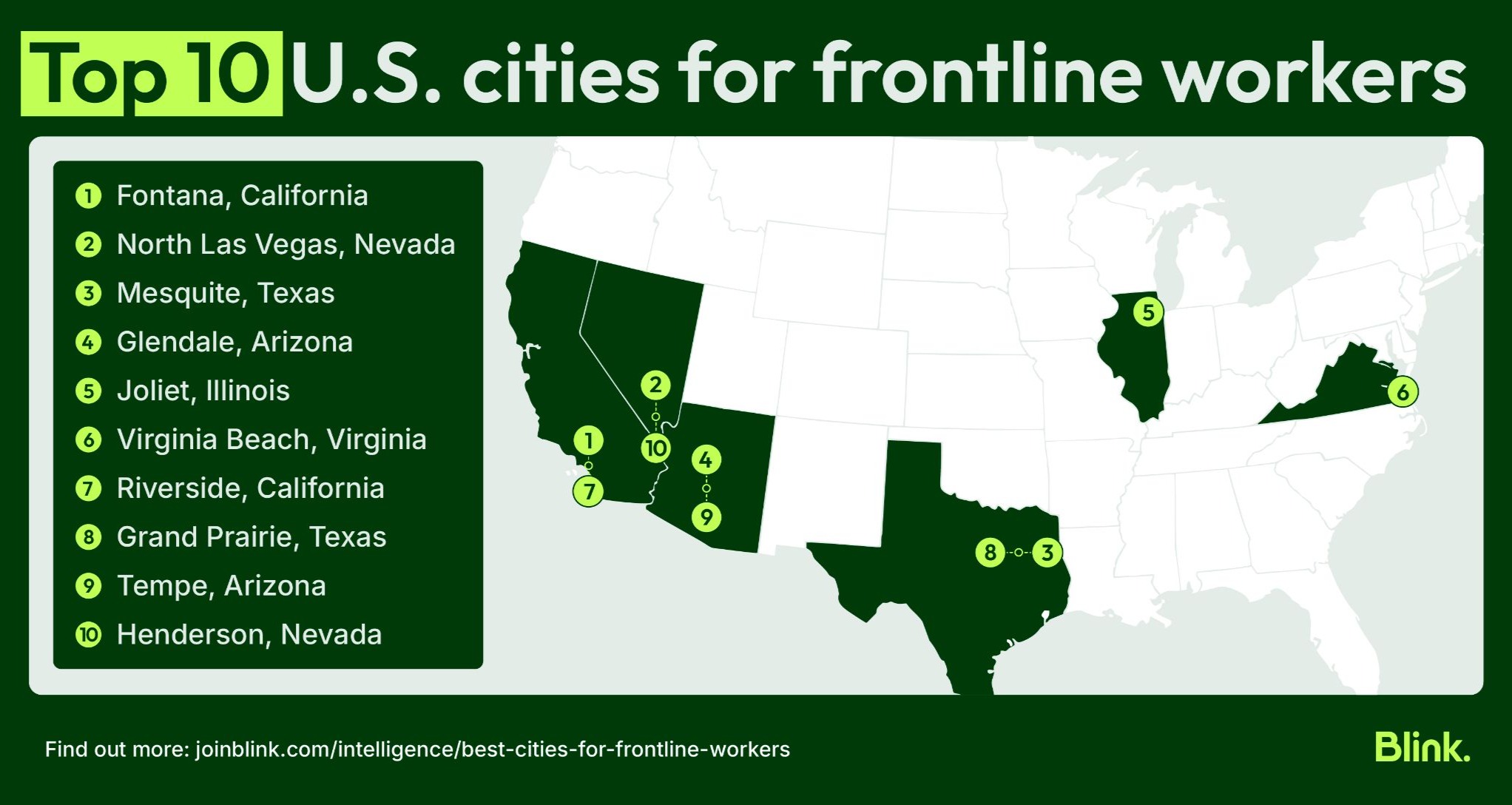
The top 10 best U.S. cities for frontline workers
1. Fontana, California
Fontana takes the #1 spot with an overall score of 72.2. More than 19,300 residents work non-traditional hours, equivalent to 864 per 10,000 people, which is the highest rate among the top 10 cities. The city’s employment base gives some indication of what may be behind this, as Fontana is a major supply-chain hub positioned around major highways. Home to key healthcare, warehousing, distribution, and transport businesses, this California city is ideal for frontline workers.
Public transit in this San Bernardino County city also operates for 21 hours a day, making it easy for frontline workers to get to and from work for most of the day. However, with just nine open-late or 24-hour businesses in the area, the #1 result is driven less by around-the-clock amenities and more by its high concentration of residents whose workday falls outside of the traditional 9-to-5.
2. North Las Vegas, Nevada
North Las Vegas ranks second with a score of 70.1, with more than 21,000 residents working non-traditional hours, or 692 per 10,000 people. Public transit operates around the clock, and 24 businesses stay open late or 24 hours a day. While its location in the Las Vegas Valley means hospitality and food service form part of the bigger picture of frontline work, North Las Vegas itself has become a developed industrial and logistics hub that’s perfect for frontline workers. Transportation and warehousing jobs have also increased locally, pointing to a strong labor demand in a sector where early, overnight, and rotating shifts are common.
3. Mesquite, Texas
Mesquite takes the third-place spot with a score of 70. Around 680 residents per 10,000 work non-traditional hours (over 10,200 total), while public transit operates all day long, and there are 30 open-late or 24-hour businesses in the area. Here, the city’s major employers suggest a broad mix of frontline work rather than one dominant industry. The combination of logistics, manufacturing, retail, and healthcare industries provides plenty of roles that can begin early, finish late, or operate across multiple shifts.
This mix of frontline workers, public transport availability, and access to services outside of traditional hours helps Mesquite rank highly for those whose days start early or finish late.
4. Glendale, Arizona
Glendale ranks fourth with a score of 69.3. Nearly 18,000 residents work non-traditional hours– 685 per 10,000 people–and public transit operates all hours of the day. This Arizona city also has 24 businesses that operate on non-traditional schedules. Glendale also has several major employers across sectors such as healthcare, retail, hospitality, and security. All in all, these factors help to better accommodate residents working beyond conventional office hours.
5. Joliet, Illinois
Joliet rounds out the top five with a score of 69.2. With over 11,000 residents working non-traditional hours, 721 per 10,000 people, this Midwestern city has the third-highest concentration in the top 10. Public transit operates 24 hours a day, despite there only being four late-night businesses in the area. The city is a major logistics and manufacturing center built around interstate and rail lines, helping to explain why the non-traditional hour worker figure is so much stronger than its late-night amenity count.
6. Virginia Beach, Virginia
Virginia Beach ranks sixth, with a score of 68.7. Although its rate of residents working non-traditional hours (20,800, or 480 per 10,000) is the lowest among the top 10, this seaside city has plenty to offer frontline workers. There are a whopping 65 open-late or 24-hour businesses in the area, and public transit operates nearly all day long. This seaside city is home to many businesses across the hospitality, food service, and healthcare industries that operate beyond a 9-to-5, making it a great place for those who work overnight, weekends, or early mornings.
7. Riverside, California
Riverside ranks seventh with a score of 68.5. More than 26,000 residents work non-traditional hours, 804 per 10,000 people, making it the second-highest concentration in the top 10. Public transit operates for 22 hours a day, and 12 businesses are open late or 24 hours a day. The healthcare industry is a huge player in this California city, providing a great opportunity for residents living and working in the area to grow in their careers in this sector.
8. Grand Prairie, Texas
Grand Prairie ranks eighth with a score of 68.2. More than 12,000 residents work non-traditional hours (576 per 10,000 people), while public transit operates all day and 16 businesses stay open late or around the clock. With some of the country’s major manufacturing and aerospace companies calling the city home, this combination creates plenty of roles that don’t follow conventional office hours.
9. Tempe, Arizona
Tempe ranks ninth with a score of 67.6. Around 11,200 residents work non-traditional hours, equivalent to 587 per 10,000 people, while public transit operates 24 hours a day. The city also has 27 businesses that stay open late or for 24 hours, giving workers more options for accessing everyday services outside the traditional working day. With Arizona State University calling the city home, Tempe supports a large hospitality, food service, and retail economy that makes the city ideal for workers who work beyond the limits of a traditional 9-to-5.
10. Henderson, Nevada
Henderson rounds out the top 10 with a score of 67.5. While its rate of non-traditional working is lower than several of the other top cities, at 473 residents per 10,000 (17,000 total), it has great after-hours infrastructure. Across the city, there are 43 businesses that are open late or all day long, and public transit operates all day, offering Henderson residents plenty of accessibility to services if they work outside of the standard 9-to-5. From healthcare, hospitality, security, and more, the city has a sizeable presence of frontline industries that attract workers seeking out unconventional hours to work.
The top 3 best industries for frontline workers
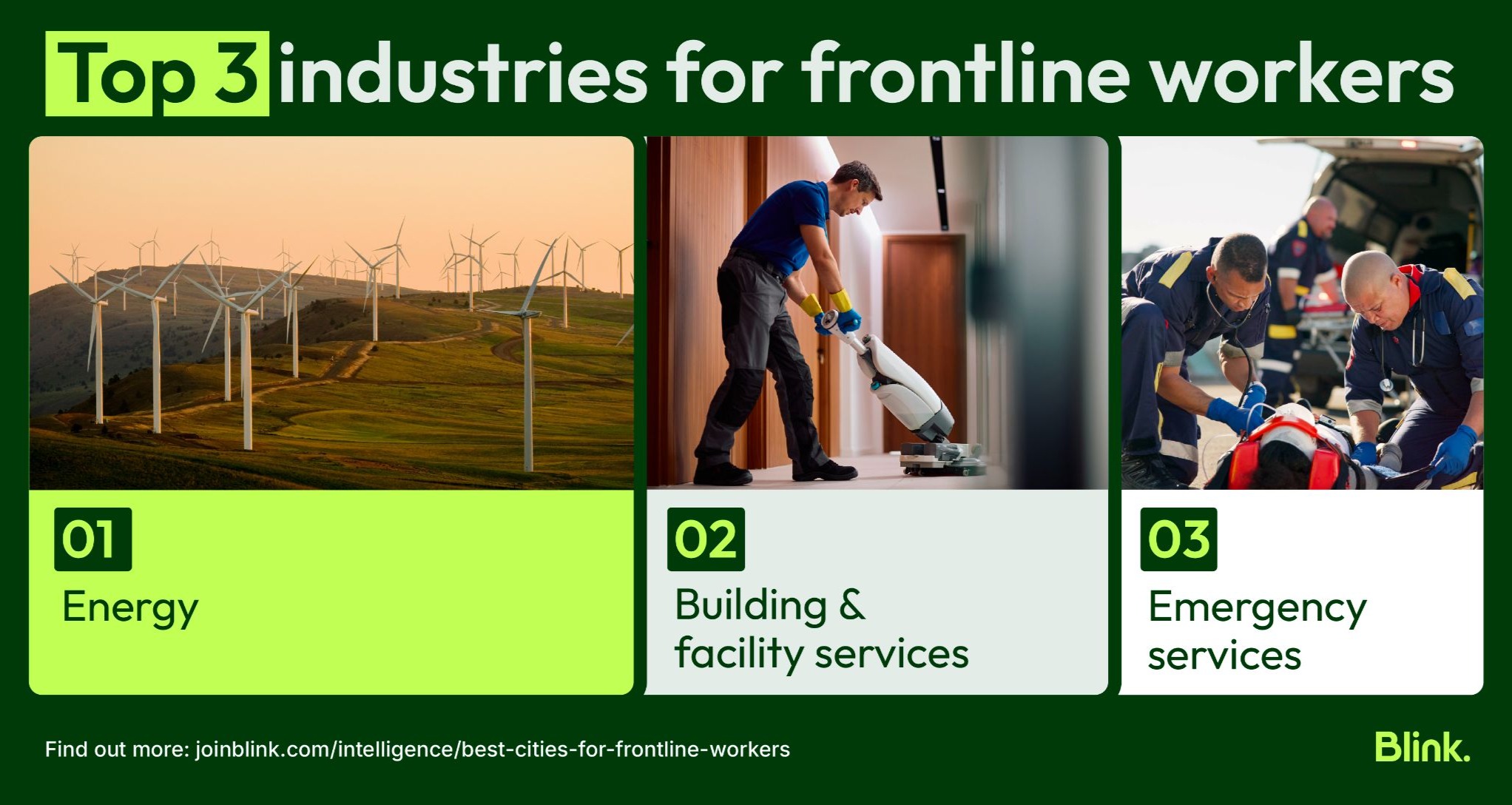
1. Energy
The energy industry ranks as the best industry for frontline workers. Employees have a median wage of $103,338, and the strongest wage-to-rent ratio at 5.18. The sector also records the lowest workplace injury rate at 1.9 incidents per 100 full-time workers. With more than half a million employees working in the industry and projected growth of 2.35% through 2034, the energy industry’s combo of pay, affordability, and working conditions makes it clear why it ranks as the best industry for frontline workers.
2. Building & facility services
Building and facility services ranks as the second-best industry for frontline workers, supported by its workforce of around 7.6 million people and projected employment growth of 3.35% by 2034. However, median pay is $53,770, so the industry’s scale and future growth help to secure its second-place spot.
3. Emergency Services
Emergency services round out the top three best industries for frontline workers. Median pay is $72,750, while its wage-to-rent ratio is 3.65. The industry also employs over 1.9 million people, but sees a slower projected growth compared to the top two industries at 0.73% by 2034.
Curious where your city ranks? Check out our interactive table below
What the best cities for frontline workers have in common
There isn’t one single formula for a city that works well for frontline workers working outside of a traditional 9-to-5. Fontana and Riverside stand out for their high concentrations of residents working non-traditional hours, while cities like Virginia Beach and Henderson stand out because of access to 24-hour businesses, highlighting the importance of accessibility when the workday starts or ends at odd hours.
For employers, creating a better frontline experience goes beyond the city or industry workers happen to be in. Giving employees straightforward access to communications, resources, schedules, and workplace tools can make day-to-day tasks simpler for teams spread across different sites and shifts. Blink’s frontline employee platform can help organizations build a more connected experience across teams. At Blink, we understand that the daily issues of employees can influence the bottom-line, explore the top 10 challenges faced by frontline workers and how to fix them.
Methodology
To determine the most frontline worker-friendly cities in the U.S., we ranked 150 cities with populations of 500,000 or fewer on the number of residents working non-traditional hours per 10,000 people, the number of open-late and 24-hour businesses, the number of hours in a 24-hour period during which public transit operates, and the violent crime rate per 100,000 people. Each measure was normalised from 0 to 100 against the highest-scoring city, with crime inverted so that a lower rate scores higher, then weighted: non-traditional hours (35%), public transit operating hours (25%), 24-hour businesses (20%) and violent crime rate (20%).
We then ranked the seven most common frontline industries on median wage, projected employment growth from 2024 to 2034, an occupational demand score, the workplace injury rate, the ratio of median wage to annual rent, and the union membership rate. Scores were normalised the same way, with the demand score and injury rate inverted, then weighted: wage-to-rent ratio (25%), projected growth (20%), union rate (20%), median wage (15%), demand score (10%), and injury rate (10%). Data accurate as of August 7, 2026.
*Nontraditional hours are defined as workers departing between midnight and 4:59 a.m. or between 4 p.m. and 11:59 p.m., and cover all workers in a city rather than frontline workers alone. Census figures are five-year estimates covering 2019 to 2023.
Twenty-four-hour business counts come from OpenStreetMap, a volunteer-maintained database, and are raw counts rather than per-capita figures, which favours larger cities.
Violent crime uses FBI 2024 data where available. As reporting to the FBI is voluntary and incomplete, figures for Florida come from state data, and for New Orleans, Baton Rouge, Augusta, Savannah and Worcester from other years or state sources. In each case, violent crime was calculated from murder, rape, robbery, and aggravated assault counts to match the FBI definition.
Cities without their own transit agency were matched to the regional operator serving them; intercity coach and rail operators were excluded.
Wage, employment and growth figures for emergency services, and wages for the agricultural portion of food and agriculture, are drawn from occupation-level data, as the Occupational Employment and Wage Statistics programme does not publish industry estimates for those areas. With only seven industries, normalisation places one at zero and one at 100 on every measure, widening the apparent gap between the highest and lowest scoring sectors.