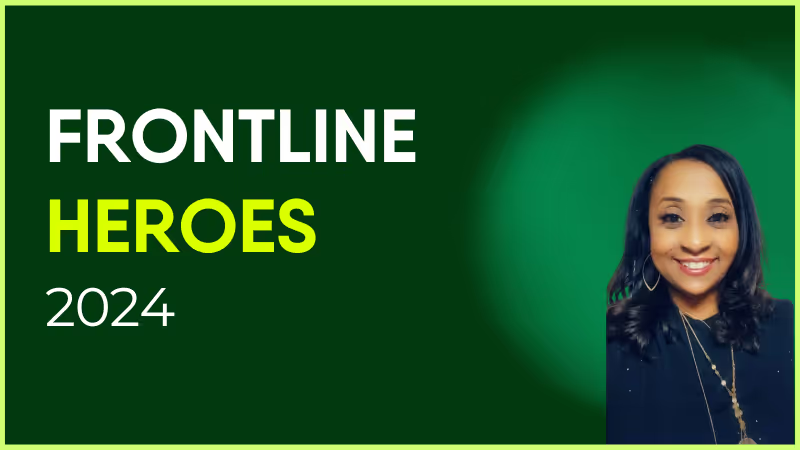

Chandi has been instrumental in representing the company and its bus drivers in cases related to traffic penalties. By thoroughly reviewing and addressing these cases, she has substantially reduced costs for both the business and individual drivers.
It is very common for bus drivers to face fines and prosecutions while doing their essential job for the communities of London. Chandi appears in Courts and Tribunals to represent the business and has successfully challenged almost 50% of the cases that come in. In years gone by the business was facing charges of up to £10k per month which have now been reduced by 70%. This is a massive saving both financially and reputationally to the business.
Most importantly, Chandi’s work provides crucial support to drivers, alleviating their stress and ensuring they feel valued. She is a quiet and meticulous professional who has created so much good in the department since her arrival in April 2024.
How has Blink helped in her role?
Blink has been used to advertise “money boxes” YBJ where fines are received. Chandi has also used the platform to share guidance and resources about observing traffic regulations, as well as demonstrating the team’s support for drivers.
What does she want to do next?
Continuing to reduce penalties, with the ultimate goal of eliminating them, would be a massive achievement, maybe seen as impossible — but what Chandi has achieved would have been seen as impossible six months ago. Chandi is keen to communicate with drivers using Blink as well as garage roadshows to raise awareness and help bus drivers avoid fines and better serve the communities of London.

Nominated by: Phil Thornton, General Manager Central Operations
What makes her awesome?
Chandi has been instrumental in representing the company and its bus drivers in cases related to traffic penalties. By thoroughly reviewing and addressing these cases, she has substantially reduced costs for both the business and individual drivers.
It is very common for bus drivers to face fines and prosecutions while doing their essential job for the communities of London. Chandi appears in Courts and Tribunals to represent the business and has successfully challenged almost 50% of the cases that come in. In years gone by the business was facing charges of up to £10k per month which have now been reduced by 70%. This is a massive saving both financially and reputationally to the business.
Most importantly, Chandi’s work provides crucial support to drivers, alleviating their stress and ensuring they feel valued. She is a quiet and meticulous professional who has created so much good in the department since her arrival in April 2024.
How has Blink helped in her role?
Blink has been used to advertise “money boxes” YBJ where fines are received. Chandi has also used the platform to share guidance and resources about observing traffic regulations, as well as demonstrating the team’s support for drivers.
What does she want to do next?
Continuing to reduce penalties, with the ultimate goal of eliminating them, would be a massive achievement, maybe seen as impossible — but what Chandi has achieved would have been seen as impossible six months ago. Chandi is keen to communicate with drivers using Blink as well as garage roadshows to raise awareness and help bus drivers avoid fines and better serve the communities of London.

Nominated by: Phil Thornton, General Manager Central Operations
We slip words like these into conversations with ease. New technology has become part of our bread-and-butter vocabulary, without quotation (or question) marks.
Healthtech, on the other hand – that feels a bit more niche. Or it did, until Covid-19 made us sit up and pay attention.

24 months into the pandemic, nobody needs a lecture on the importance of healthtech; it’s staring us in the face. But health tech didn’t emerge on-the-fly in response to the Covid crisis. It’s been around for a long time.
And it’s big business. In 2017, Forbes valued the digital healthcare industry at an astounding $25 billion globally. They believe that number will skyrocket above $379 billion by 2024.
We all know that healthtech helps predict the spread of diseases, track pandemic outbreaks, and contain them. But there are other new developments in the future of healthcare that will change the way we live.
What is healthtech?
Right now, healthtech (also known as digital health) is the fastest-growing verticle in healthcare. It refers to any product or service that's enabled, or revolutionized by, technology. So far, so Sci-Fi. But healthtech is all around us already...
Wearables
Yep, you’ve already got this one. Fitness trackers (like FitBits) are health wearables. We like knowing we've put in my 10.000 steps. But other types of knowledge about what’s happening in our bodies can be more vital. For some people, it’s their heart rate; for others, their blood pressure, or their oxygen supply.
Continuously measuring these things makes a huge difference for people with chronic conditions. And these wearables don’t just make the invisible visible; they also act as a kind of coach. They empower wearers to become active participants in managing their health condition. Immediate feedback from a wearable can change habits; habits can change health; and health saves lives.

Wearables are particularly relevant in the time of Covid-19. But they will continue to be so well beyond it, as part of a bigger drive towards preventative or pro-active health care.
3D-printed prototypes
3D-printing technology still sounds far-fetched. But it’s here, and it’s a quiet revolution in healthcare. Technology like this can create everything from personalized prosthetics to bio-tissues and blood vessels, at a fraction of the past cost. It transforms organ transplants and tissue repair. It can even produce realistic skin grafts for burn victims.
In 2020, researchers at the Rensselaer Polytechnic Institute in Troy, New York, managed to develop a method for printing 3D-print living skin, along with blood vessels.
Blockchain for electronic healthcare records
Blockchain and the future of healthcare? Not obvious at first. But think of electronic health records, and how important it is to keep those accurate and safe.
Blockchain technology can play a key role in ensuring that medical records are 100% accurate. It also makes them significantly harder to hack. Conflicting information is automatically detected, thanks to a decentralised network of computers. And blockchain not only helps prevent data breaches; it also cuts costs.
So it’s no wonder that many health and pharmaceutical companies are investing in blockchain technology. A recent report put the blockchain health market at $890.5 million by 2023.
Artificial Intelligence
Artificial Intelligence (AI) is a key driver in health tech. We already see it in chatbots and virtual health assistants that act as diagnostic tools, and even as therapists.
But the real power of AI becomes clear in areas like precision medicine. In the past, many cancer patients received cookie-cutter treatments with high failure rates. Because of AI, we now have more personalised treatments, based on individual genetics and lifestyle factors, amongst other things.
And finally, two of the things AI is exceptionally good at is Pattern Recognition and optical character recognition. That means it can analyse large amounts of cancer images that help recognise and diagnose cancer. One famous example of this is Google’s DeepMind, which created an AI for breast cancer analysis. The algorithm outperformed human radiologists on pre-selected data sets to identify breast cancer, on average by 11.5%.
The market value of AI for future of healthcare worldwide? $34 billion by 2025.
VR/AR
Most of us are already familiar with this technology. Immersing yourself in a simulated environment is fun. But it can also be a therapeutic tool. For instance, VR environments help train people to deal with mental health triggers safely. Post-Traumatic Stress Disorder (PTSD), Bipolar Disorder. Covid-related Stress and Anxiety are now being treated this way.
The training potential of VR is – well, awesome. Take surgeons, for instance. A recent Harvard Business Review study showed that VR-trained surgeons had a 230% boost in their overall performance.
Compared to their traditionally-trained counterparts, they were both faster and more accurate. At Case Western Reserve University, students learn via a VR-based HoloAnatomy app. This offers detailed and precise experience without the need for real bodies.
Top 4 emerging healthtech trends for 2022
In light of the Covid pandemic and rapid growth in remote work, safeguarding your workers has become a mandatory part of doing business. This means you’re now also looked upon to bring in measures like:
By making these types of smart technologies accessible to your workforce, you can give way to improved safety standards and early alerts that reduce the risk of contagious threats. Keep track of these trends to keep your employees safe in 2022 and beyond.
identify opportunities to leverage them for your organization going forward.
Virtual care and remote medicine are on the rise
You drive to the doctor. You sit in a waiting area for ages until your name's called. When your appointment finally happens, it's a few questions, a prescription, and you're sent on your way. You wonder why you spent so long commuting for a matter of minutes.
Sound familiar?
That's why virtual care is replacing minor in-person appointments. The past two years have further accelerated this trend, leading to an increase in virtual visits or telephone consultations.
According to a recent McKinsey study, the number of people using telehealth rose from 11 to 46% during the pandemic. It further predicts that telehealth would account for $250 billion — 20% of the US healthcare spending in near future.
Virtual care not only reduces the risk of spreading contagious diseases but allows healthcare professionals to fit more consultations into their daily schedules. This is a vital factor for highly populated nations facing a shortage of medical professionals, such as India and China.
Genomics and gene editing lead to further breakthroughs
Before you get all excited — no, we haven’t figured out how a spider’s bite can turn a normal kid into spiderman.
But the good news is that there've been significant breakthroughs in gene editing, accelerating the development of different types of "precision medicine."
This means drugs can be tailored to the genetic profile of each patient, enhancing their effectiveness and minimizing side effects.
Precision medicine is already used in many ways, one of which is 'lab on a chip' — a technology that allows fast detection of Covid. It’s a hand-held device that can detect if someone is infected with better accuracy than conventional signals such as fever and coughing. So, it can go a long way in getting our lives back to normal.
Data and AI drives shift to fairer healthcare insurance and coverage
With all the strain that the coronavirus pandemic has put on our healthcare resources, you’d think it must have grown the bottom line too. Surprisingly, that’s not the case. In the US, healthcare revenues fell by 50% as patients avoided surgeries and hospitals.
But the silver lining in midst of all this is the revelation that people are willing to share their personal data when it’s a matter of their health. This is evident from how much people have engaged with track-and-trace systems.
The more data people share with health services, mobile apps, and online systems powered by AI, the more accurate picture healthcare providers will have of their well-being, along with a sense of when they should intervene. Not just that, it helps healthcare providers forecast the most efficient way to deliver their services.
This also matters from a financial perspective because other entities such as insurance companies can use advanced predictive technologies to measure risk and set premiums more accurately.
AI, IoT, and Smart Cities improve our ability to detect and respond to future outbreaks
If the pandemic has taught us anything, it’s that we were embarrassingly unprepared to deal with an outbreak. And we should have a collective, predetermined strategy if something similar happens in the future.
A key part of this strategy is the concept of “Smart Cities," powered by artificial intelligence (AI) and the internet of things (IoT). According to Statista, global revenue from smart city projects is estimated to reach $129 billion in 2021.
The idea of a smart city is based on incorporating digital connectivity and data-driven decision-making at our respective locations. And its applications extend to many areas such as:
Energy distribution
Public transportation networks
Refuse collection
Environmental health initiatives
It’s not just the organizations that are becoming health-care oriented, but also city planners and municipal authorities. These government bodies are now allocating resources to develop technologies that can help us predict, detect and prevent pandemics.
Another major focus is environmental health. Tech-driven initiatives are being put in place to reduce air pollution and build resilience to the effects of climate change, including the rise in sea level and temperature..
Conclusion
Even if most of your workers are remote, don’t think for a second that your health concerns are over. They now require even more attention because you don’t have the luxury of regular, face-to-face contact. It’ll be hard for you to tell when your employees are burning the candle at both ends. So you still need to support the mental health of employees as they perform their duties in the field, or from home.
That’s where the healthcare technology trends we outlined can help. There are several health apps available for professionals to monitor physical activity, practice meditation, set reminders for breaks, water and exercise, and so on.
The only way to avoid setbacks that can take you by surprise is to stay on top of the latest trends and innovations. The faster you can respond to relevant changes in your industry, the better for your organization.
The average person will work 35 hours per week. That adds up to 84,365 hours over their lifetime. Yet just over one-third of employees (34%) are engaged, and 16% are actively disengaged in their work and workplace.
If you’re reading this, the chances are you want to make sure your employees don’t feel like they are wasting a large portion of their life at work. We’ll do our best to help you do just that.
In this handy guide, we’ll break down the key steps you need to take when creating an employee engagement strategy.
From understanding why your organization truly needs an employee engagement strategy, to the actionable steps you can take to create your own strategy, we’ll cover everything you need to know right here.
Why you need an employee engagement strategy
Creating an employee engagement strategy can seem daunting, but it’s important for any business. Having a strategic approach to your employees’ happiness and engagement will help you retain top talent, keep them motivated and productive, and ultimately grow your business.
Effective employee engagement strategies will outline exactly how you are going to improve employee engagement within your organization, allowing all team members to stay on the same page when it comes to their roles and responsibilities.
In short: by creating an employee engagement strategy, you can strategically work to improve your employee engagement. And with improved levels of engagement, come a number of organizational benefits, including:
Higher Productivity: Employee engagement is closely linked with productivity. Engaged employees are more motivated to do their best work and achieve their goals. In fact, research has shown that engaged employees are up to 202% more productive than disengaged employees.
Reduced Staff Turnover: Low employee retention is costly and disruptive for any business, and one of the most decisive factors for employee retention is employee engagement. Engaged employees are less likely to leave their job, which reduces the need for costly and disruptive staff turnover.
Improved Morale: A happy workforce is a productive workforce. When employees feel engaged and valued, they are more likely to be happy at work and less likely to experience stress or burnout. As such, a staff engagement strategy can motivate employees and improve morale, job satisfaction and overall company culture.
Greater Loyalty: An engaged employee is more likely to be loyal to their company, in fact 90% of workers said they are more likely to stay at a company that takes and acts on feedback: AKA one that engages them. They are less likely to look for jobs elsewhere and are more likely to recommend their company to others. Therefore, the right employee engagement strategies can drive your staff retention rates and encourage employees to stay with your company for longer.
Employee engagement strategies & business types
What your employee engagement strategy needs to consist of will change depending on your business type. For example, a software company will need to focus on ways to motivate and engage product designers and developers in order to compete for top talent in a competitive Silicon Valley environment. A healthcare organization, on the other hand, will need to come up with innovative ways to engage their nursing and medical staff to combat physician burnout and the growing nursing shortage.
What's important is that you provide your workforce with strategies that are designed for them specifically. Ultimately, your strategy will depend on the type of employees you have, the unique challenges facing those teams in your market, their day-to-day tasks, and how your organization operates as a whole.
Employee engagement for the frontline
Creating an employee engagement strategy can be especially important for frontline organizations. With 80% of the global workforce working on the frontline, it’s important to have strategies in place that will help keep these workers engaged, productive and motivated.
Additionally, employees in frontline positions often have more direct contact with customers and are more likely to represent the company to the public. As such, it is important for these employees to be engaged and motivated, so they can provide positive customer service experiences.
Remember: whatever strategies you use, it’s important to tailor them specifically to your industry, business type and workforce.
How to create your employee engagement strategy
In order to have engaged employees, you need a plan in place, outcomes in mind, a clear outline of responsibilities and a culture that takes participation seriously. You also need a toolset available that is able to execute your plan, close distances, track results and simplify operations.
To make this a little easier to understand, we've broken the process down into 7 simple steps.
1. Define - Your purpose, values & mission
Defining your own purpose, company core values, and mission statement is a crucial step in creating your employee engagement strategy. In fact, when teams know your goals and expectations of them, they are 2.8 times more likely to be engaged in their roles, according to research from Quantum Workplace.
By clearly articulating what you stand for as an organization, you can align your staff with these values and give them a reason to be invested in the success of your business in the long-term.
To ensure that all employees are on the same page here, you should provide an easy-to-access Hub containing all company policy and procedure documents, along with a thorough onboarding process for new hires.
2. Listen - Conversations and research
Direct, two-way conversations and further research into your employees’ needs and wants will help you to create a more personalized engagement strategy, making this a core step in the strategic process. One way to do this is through pulse surveys.
Pulse Surveys are short, regular surveys that ask employees about their engagement levels and how they feel about their work. This can help you to identify any areas where your employees may be struggling, and can help to ensure that your employee engagement strategy is constantly evolving.
Whether it’s through surveys, focus groups, one-on-one interviews or anonymous staff feedback tools, gathering data and hearing directly from your employees can give you valuable insights into what they need from an engagement strategy, and help you identify your organisation's key engagement drivers, in order for staff to stay engaged at work.
3. Review - Analyze and plan
Once you have gathered data from your employees, it’s time to analyze this information and determine what action needs to be taken. You may find that certain areas of your workplace are in need of improvement, or perhaps a company-wide change is necessary to boost employee engagement.
Whatever the results of your employee research, it’s crucial to identify specific targets and actions that will make your plan a success. What’s working, what's not? Are there specific issues that need to be addressed? What are your engagement goals as a business leader?
Key goals for your employee engagement strategy could include:
Lower staff absenteeism
Better employee retention rates and lower turnover
Improved productivity
Enhanced employee motivation and happiness
Increased customer satisfaction
More positive organizational culture.
By reviewing and analyzing the data you have gathered, you can gain a clear understanding of how to better engage employees in order to achieve these goals. This will help you to build a more effective employee engagement strategy that your employees want to respond positively to.
4. Commit - Actions speak louder than words
Strategy is important, but actions always speak louder than words. Employee engagement strategies that work, only work if you plan to back them up with core actions, processes and real change.
Below, we have outlined some key ways to commit to your employee engagement strategy. By truly committing to all of these actions, you can bring your employee engagement strategy to life and start seeing real results.
Tools & technology
Digital tools are essential for any organization looking to boost engagement. By providing your employees with the right tools, you can make it easier for them to connect with each other and with your company. This can help to improve communication and collaboration within your team, leading to higher job satisfaction, and a more engaged workforce.
There are a variety of different digital tools that you can use to engage your employees, including great employee engagement apps, online chat software and team collaboration tools.
It’s also important to consider using technology with frontline-specific features in deskless organizations. With52% of frontline workers claiming they would leave their job over tech tools, better digital commitments are clearly needed here. By providing your employees with tools fit-for-purpose on the frontline, you can ensure that your employees feel supported and engaged no matter where they are in the organization.
Assuming that you have already begun the process of gathering data and analyzing it, you should now begin to take actions across the board in order to improve employee engagement. One way to do this is through better recruitment practices.
People who match your ideals and company culture, who will add value, and who are onboarding engagement are more likely to be engaged employees. Therefore, it is important to take care in the recruitment process, and to ensure that you are hiring people who will be a good fit for your company. You can use interviews, personality tests and job simulations to get to know a candidate better, and to see how they would fit into your team.
It is also important to provide a thorough onboarding process for new hires in order to establish a culture of engagement from day one. This can help them to feel welcome and comfortable in their new role, and can help them to learn about your company policies and procedures.
Communication
Regular communication is key to keeping employees engaged. Employees need to feel like they are part of the bigger picture, and that their voice is heard. By establishing a regular communication schedule – whether it be through Secure Chats, email, newsletters, team meetings or other methods – you can ensure that your employees are kept in the loop.
It’s also important to have a clear internal communications strategy in place. This should outline who is responsible for communicating with whom, and what methods will be used. This will help to ensure that everyone is on the same page, and that important messages don’t get missed.
It’s important to tailor communications to the needs of your employees. For example, if most of your employees are frontline workers who don’t have access to a computer, you may need to adjust your communications methods so that they can be accessed on mobile devices – think mobile employee engagement apps. You may also need to consider using different methods for different departments or locations within your company.
Surveys
Although surveys are important when drafting your strategy, it’s also important to gather feedback from your employees on a more regular basis if you want to walk the walk of employee engagement. By conducting regular Employee Surveys, you can get a sense of how your employees are feeling at any given time – and if things need to change.
An employee engagement survey can help you to gather valuable data and feedback from your employees, which you can use to improve your strategy. You may want to consider including questions about work-life balance, employee engagement initiatives, training and development, and other areas.
Frequent surveys are a great way to get ongoing feedback from your employees and to see how they feel about various aspects of their job or the company as a whole. You can also use surveys to measure the success of your employee engagement strategies, obtaining valuable insight into what is working and what needs to be changed or improved.
Managers
“Leadership has an important role to play when it comes to employee engagement, and this is especially important given nearly half (45%) of workers say leadership is “minimally” or “not at all” committed to improving company culture. In fact, 78% of employees confirmed that any change to culture needs to be driven by the CEO.” — Jeff Cates, CEO of Achievers.
For business leaders, mid-level management is often the first step towards employee engagement. By ensuring managers are supported from the top level, given the budget, training, tools and support they need, you can set them up for success as well as help to create a culture of engagement across your entire organization.
Effective managers have many important roles when it comes to employee engagement. They are responsible for setting expectations, holding people accountable, and providing feedback. They are also responsible for coaching and mentoring their team members, as well as helping to resolve any issues or conflicts that may arise.
5. Measure - Analyze and report
To measure the impact and see if their employee engagement activities and strategy is working, businesses should use employee engagement analytics via the right tools, at the right time.
It’s important to use analytics at different points throughout your engagement strategy, as this will help you to gain valuable insight and data that can be used to adjust what is working and improve the areas that need improvement. For example, you may want to analyze employee satisfaction levels before implementing a new training program, or track engagement levels over time to see if your initiatives are working.
There are many different types of analytics tools that you can use to analyze and report this data, for example Blink'sFrontline Intelligencetool. Our powerful analytics offer insight into the people and relationships that make your organization tick.
By analyzing data from people, places, and things on a regular basis, you can gain real-time intelligence into your employee engagement strategy that you can use to better support and understand your workforce.
6. Reward - recognition & progression
When used effectively, recognition can be an extremely powerful tool for improving employee engagement. Employees need to feel appreciated for their efforts, and recognition is one of the best ways to show your most engaged employees that you appreciate them.
However, simply giving employees a pat on the back isn’t enough – recognition needs to be meaningful, memorable and measurable. By taking the time to recognize employees in a meaningful way, you can show them that you truly value their contributions, and make them want to engage and contribute more.
There are many different ways to recognize employees, and it’s important to find what works best for your organization. Some popular methods of recognition include offering Kudos or Employee Recognition, awards ceremonies, Feed shout-outs, gift cards or vouchers, and thank-you notes.
It's also crucial that you back up recognition with opportunities for growth and career development. This may include promotions, opportunities to learn new skills, a stronger compensation and benefits package, or simply more responsibility. By providing employees with opportunities for growth and progression within the organization, you are helping them feel valued and motivated to continue performing well.
7. Repeat - Regular check-ins and adjustments
To truly maximize the impact of your employee engagement strategy, it’s important to take a regular and systematic approach. This means that you should regularly check in on key metrics, analyze the data you gather, and make any necessary adjustments based on what you find.
Stay on top of your engagement. Track key metrics such as employee satisfaction and engagement levels, and conduct regular check-ins to analyze the data you gather. This will help you make any necessary adjustments to your strategy in a timely and effective manner, ensuring that your employees are engaged and motivated at all times.
Final Thoughts
At Blink, we provide the all-in-one solution to employee engagement. Designed for the frontline, our easy-to-access, intuitive employee engagement app delivers real-time data and communications, actionable insights and intelligent recommendations.
Inspiring engagement in your employees has never been easier. With our powerful analytics tools and customizable recognition programs, you can gain valuable insight into your workforce and take the steps needed to boost engagement levels across the board.
Whether you’re looking for a way to track employee performance, improve communication and feedback, or simply create a more positive work environment, Blink has everything you need.
We’ve rounded up the seven top training programs that will help boost morale, foster collaboration, and increase productivity for your staff. From interactive workshops to online employee engagement courses, these programs offer something for everyone.
Whether your team is new or experienced, office-based or deskless, there are plenty of options available to help create an engaged workforce.
So let's dive into what the best employee engagement training programs are, what they offer, and how they can benefit your organization.
Choosing the best employee engagement training courses
A great employee engagement course should provide teams with a comprehensive understanding of how to create an engaged workplace environment.
It may include a range of topics covering effective communication practices, problem-solving strategies, team-building exercises (that don’t make employees squirm), and more strategies that create highly engaged employees.
They may also offer special features such as a dedicated tutor support service, unlimited online email support, certification upon completion, real-time feedback on learning, resources to help employees create tangible goals and objectives, and interactive tools that can be used in the workplace.
To choose the right employee engagement program for your organization, you should assess and compare who the course is made for and what the content of the course is, alongside the:
Cost
Length
Location
Credit awarded
By assessing these four elements, you can make a more informed decision about which program is best suited to your team’s needs.
What to look for in employee engagement training for managers
Before you can select a training program for managers, it’s important to know what factors to consider for your leadership team. Employee engagement training is essential for even the most high-performing managers, especially frontline managers, as their impact has the unique advantage of cascading effects throughout their entire team.
Cost varies greatly, especially given the number of remote learning and development options available. While eLearning courses are typically more affordable and easily worked into a manager’s schedule, in-person courses offer the benefit of interaction, personalized feedback, and, often, more in-depth practice.
It’s also important to consider whether you, your C-suite, management teams, and HR professionals value certification or credit hours for the time undertaken. The accreditation may add value and incentive for course engagement, as well as the name of the institution offering the training.
Two common HR management organizations that accept credit hours for professional certification are SHRM and HRCI.
You should also consider whether your managers will feel more compelled to complete the learning experience offered by a big name like Harvard to make up for the additional expense.
Additional considerations for choosing an employee engagement program
If you have a frontline workforce, be sure to look for a program that can be easily accessed on mobile devices or through an app with audio lessons available. This will ensure employees can access the course anytime, anywhere, helping you bridge the frontline connection gap.
Additionally, consider the size of your organization and budget. If you have a large team, you may want to look into programs with bulk discounts or offering free training resources. On the other hand, if you’re a smaller business without many resources, eLearning courses may be more cost-effective due to their convenience and lower investment needs.
With digital inclusion now crucial to the modern workplace, it's important to assess the ease of use and accessibility of any courses you choose. Are they easy for team members to access and navigate, or do they require any specific software?
Now that you know what to consider before selecting a program for management let’s go over some of the best employee engagement training programs available today.
The 7 best employee engagement training programs
1. Gallup engagement champions
Workplace advisory and polling group Gallup offers a Creating an Engaging Workplace for Engagement Champions course to help anyone in a leadership position foster a more engaging workplace and support higher productivity.
The course's primary focus is educating higher-level leadership on how to best help their mid-management increase team engagement. There are also practical takeaways for HR professionals or managers themselves.
Cost: $3,000.
Length: Two days.
Location: In-person and virtual.
Credit: The in-person course earns professional credit hours from HRCI (14.5) and SHRM (14.5).
The six-hour course focuses on actions managers can undertake that inspire workers to put forth their greater discretionary effort. The emphasis is on practicing emotional empathy that delivers a long-lasting culture of engagement.
Cost: $699.
Length: Three two-hour sessions.
Location: Virtual.
Credit: It offers professional credit hours — 5.5 HRCI (5.5) and SHRM (5.5).
3. LSA Global
LSA Global’s employee engagement training personalized course focuses on accountability, change-readiness, and engaging purpose (ACE) as the foundation for a greater level of engagement and business clarity.
Cost: Available upon request.
Length: Two-day workshop.
Location: In-person.
Credit: None.
4. DecisionWise
Engagement technology provider Decision Wise offers an online engagement training program called Engagement Magic.
The training covers the importance of employee meaning, autonomy, growth, impact, and connection for engagement and educates learners on fostering these attributes through various employee engagement strategies.
There is a large emphasis on building positive company culture through effective communication and conflict resolution.
Cost: $2,895.
Length: Two consecutive days.
Location: In-person.
Credit: Credit towards Harvard’s Certificate of Leadership Excellence in Leading Teams.
6. eCornell
Cornell’s online educational division strategic engagement course is ideal for managers looking for more training in the quantifiable aspects of employee engagement.
The course teaches methods of measuring employee engagement, like employee engagement surveys, and guides managers through building engagement initiatives to combat disengagement based on organizational data.
Cost: Available upon request.
Length: Two weeks, two-to-five hours per week.
Location: Virtual.
Credit: Credit towards Cornell’s Strategic Human Resources Leadership Certificate.
7. LinkedIn Learning
LinkedIn Learning offers various employee engagement training courses for managers through its catalog of user-generated lessons.
Self-paced pre-recorded lessons like this one on Employee Engagement are a highly accessible training resource for organizations of all sizes.
Cost: $34.99 for a single course or $19.99/month.
Length: Varies.
Location: Virtual.
Credit: Online certification and continuing education credit to SHRM (1.25) and HRCI (1.25).
The value of employee engagement training for managers
According to Gallup’s State of the Global Workplace: 2023 Report, just 31% of employees in the US and Canada are engaged – and that's the second-highest in the world! As such, it makes sense for implementing engagement strategies to be one of your organization’s largest retention priorities.
Typically, most think of across-the-board engagement tactics like benefits, salary, and advancement opportunities. But when it actually comes down to increasing everyday engagement and profitability, as Gallup explains, the best bet is focusing on some of the most critical players in your team: your managers.
They understand each employee’s career goals, strengths, and opportunities for improvement. Managers help shape the culture that can make or break an employee’s experience.
Despite their essential role in increasing the number of engaged employees, few managers are naturally good at navigating the nuances of managing people.
Why? Well, we know that many managers make their way to a management role because of experience in their industry (as practitioners) rather than their experience leading people.
They might be a very experienced warehouse manager, but if they haven't got years of experience managing other warehouse managers, then this kind of training can add a huge amount of value in increasing team-wide employee engagement.
With nearly 70% of frontline leaders expressing interest in developing their leadership skills, a lack of this training can cause growing leadership development gaps in your organization.
On top of this, without training to improve the specific leadership skills required to be a strong manager, there can be potentially disastrous consequences when it comes to engagement and overall employee retention.
In fact, after surveying 3,000 American workers,GoodHire found that 82% of them said they would potentially quit their job because of a bad manager. For that reason alone you may want to consider management employee engagement training as part of your wider L&D efforts.
After all, if you can train managers to increase employee engagement, then you can unlock all the key business benefits that come from having a more engaged workforce, making employee engagement training for managers well worth the investment.
What’s next for frontline managers?
Choosing the right employee training method and investing in the right technology are crucial actions for business leaders wanting to boost engagement.
Hopefully, this guide gave you a better understanding of the considerations to keep in mind when selecting an employee engagement training program and highlighted some of the best ones available today.
After equipping your employees with the right training programs, the next step is to seek the best tools in the industry. Blink’smobile-first frontline engagement super-app is the perfect all-through tool for any organization wanting to boost employee engagement.
With a suite of features designed to connect your entire workforce, Blink can help your business drive optimal performance and engagement from every member of your team.
With Blink’s Content Hub, employees and managers can access any training documents and company procedures from the palm of their hands, making any employee engagement training initiatives more effective and accessible for you in the long-run.
An intranet is a private internal network a company uses to share information, tools, and documents with its own employees. It looks and feels like the public internet, except only people inside the organization can see it.
Here's the catch. Gallup's State of the Global Workplace 2025 puts employee engagement at 20% worldwide, the lowest since 2020, and most workers, especially the 80% who don't sit at a desk, still can't reach the information they need when they actually need it. A modern intranet is how you close that gap.
This guide walks through what an intranet is in 2026, how it differs from the version your IT team built a decade ago, the features that actually matter, and why most intranets still quietly fail the people who need them most.
What is an intranet?
An intranet is a private digital workspace for employees. It holds company news, policies, HR documents, team directories, knowledge bases, and internal chat in one place, behind a login only employees can reach. Think of it as the company's internal version of the internet: the same browsing and search experience, restricted to your organization.
A modern intranet runs in the cloud, works on mobile, and plugs into the tools employees already use, from payroll and scheduling to Microsoft 365 and Google Workspace. It gives people a single place to find what they need, sign off on policies, and stay in the loop on company news.
Gallup's 2025 research ties engagement directly to whether employees feel informed and connected, and 31% of US employees are engaged, the lowest in a decade. An intranet that actually gets used is one of the fastest ways to move that number.
Types of intranet: Which one fits your company?
Most intranets fall into one of four categories. The right choice depends on who needs to use it and how they work.
The last category is the newest and the fastest-growing, mostly because the others were built for people at desks. If your company is mostly frontline, deskless, or multi-site, anything other than a mobile-first intranet will underperform on day one.
How does an intranet actually work?
Under the hood, an intranet is a secure web application. It lives on a server, either on-premises or in the cloud, and is accessible only to authenticated users inside the organization. Employees log in through a browser or mobile app using single sign-on, a company password, or, for frontline workers, a phone number-based identity that doesn't require a corporate email address.
Content is organized into spaces: company-wide feeds, team channels, knowledge bases, policy libraries, and directories. Admins control who sees what by role, location, shift, or department. Search pulls results across everything, and integrations surface data from HR systems, payroll, rota tools, and document stores.
The main thing that separates a 2026 intranet from a 2006 one is identity. Older intranets assumed every employee had a work email. Modern ones don't, because most frontline workers don't. That one architectural shift is why mobile-first intranets reach adoption rates the older generation never could.
What are the key features of a modern intranet?
Features matter less than the question they answer: Would every employee, even the ones without a desk, actually use this? Strip it back to essentials.
A personalized news feed. Company announcements, team updates, and peer recognition, filtered by role and location.
A searchable knowledge base. Policies, how-tos, benefits, and training in one place, findable in two taps.
Team chat and group channels. Direct messages, team chats, site-specific groups.
Policy sign-off with audit trail. Read receipts, confirmations, timestamps.
Integrations with HR and payroll. Pay slips, shift rotas, holiday requests.
Working remotely hasn’t stopped Jessica from immersing herself in Blink’s vibrant culture. As a solution consultant for our US enterprise accounts, she’s been making waves since joining over two years ago. Whether visiting our Boston or London offices — or collaborating from her home in Pennsylvania — Jessica loves Blink’s agile, innovative, and positive environment.
Which Blink office do you work out of?
I'm one of the few fully remote employees, but I’ve still managed to visit both offices. I go to Boston more often — probably three or four times so far — and I’ve been to London twice. I’m based in Pennsylvania, roughly in the middle between Philadelphia and New York City.
I lived in New York City for ten years, but now I have three young kids, so we needed more space. Right now, for example, it's snowing outside and there are deer in my front yard — quite a change from the city!
What's your position at Blink?
I'm a solution consultant for enterprise accounts in the US.
How long have you been at Blink?
Just over 2 years now.
What initially attracted you to join Blink?
What drew me to Blink was partly the people I knew here — people I really respected. I thought if they were at this place called Blink, then I should be here, too. On top of that, Blink’s overall mission resonated with me. I’ve been selling software for a long time, usually to IT departments, and I never really saw the broader impact beyond making some people more productive.
But hearing how Blink improves the lives of frontline workers, who often receive little support — especially after everything that happened with COVID — made me realize how crucial they are. Unfortunately, many companies aren’t investing much in improving their experience, and that’s what we’re aiming to change: enhancing their work lives.
What's a project you are proud of from your time at Blink?
I have to say, there’s a major deal I worked on (which we haven’t announced yet) that was incredibly exciting from start to finish. I felt like we were entering the next phase of Blink. Just the fact that this huge company even considered us — and ultimately chose us — was amazing.
I loved seeing the teamwork and effort everyone poured in. At some point, every single team played a role — marketing, product, implementation, sales, pre-sales, legal, and more. So many people came together, and it was really fun to witness. It took about six months, with hundreds of meetings and around 20 demos — truly unbelievable.
How would you describe the company culture at Blink in 3 words?
I would say it's fast-paced, super-positive — which you don't see everywhere — and agile.
I chose “super-positive” because everyone is always open and happy. You never join a meeting — whether it’s an internal call or a customer call — without seeing smiles on people’s faces. Even though everyone’s busy, they’re still great to talk to and easy to connect with.
People here are also eager to help, and I think our customers pick up on that. They know we’re not just going to deliver reliable work — we’re going to brighten their workday, too. That positivity really carries over into our relationships with them.
What's one thing you're excited about for the future of Blink?
I'm excited to see how quickly we're growing in the US and how we'll continue to expand. I’m also really thrilled about what we've already accomplished and what we’re planning to do in retail and hospitality.
When I first joined Blink, we only had a handful of customers in that sector — some of them quite small. Now, seeing what we've achieved, what we're currently doing, and what we have planned for the future is incredibly exciting, especially in that space.
We've done amazing work in transit and healthcare so far, but retail and hospitality brands are more widely recognizable. I feel like this will bring greater awareness to all the good Blink is doing, and more people will hear about it simply because they can relate more to these public-facing companies.
Can you tell us about a recent initiative or program launch at Blink that you found particularly exciting?
Our internal 12 days of Blinkmas gifts campaign was amazing — I’ve never seen another company do anything like it! The gifts were great, and I loved how excited everyone was to participate. I looked forward to it every morning, eager to see who won the previous day’s gift and what the newest gift was. It really made the lead-up to the holidays special.
I actually ended up winning a really cool prize: a donation to a charity of my choice. I chose a local charity that helps families in Bucks County, where I live in Pennsylvania.
Why do you work for Blink?
I love the people here — my daily team, my manager, and the fact that I can easily reach out to anyone in another department when I need something. I always know exactly who to contact, and they typically respond quickly, no matter the time of day. It’s a refreshing change from bigger companies, where requests can just vanish. At Blink, everything gets done efficiently.
I also work here because our product is amazing. I’m in it day in and day out, and it’s so fun to envision solutions for our customers — our product is incredibly straightforward to use. I’m impressed by how fast we roll out new features and develop enhancements, whether it’s based on our own plans or customer feedback. I’ve never been at a company that does it so quickly and so well. We work together to figure out what’s best for the next phase of Blink, always keeping our customers’ needs at the center.
This article is part of Blink's "frontline first" series: content created specifically for leaders of deskless or distributed teams. We know that the job of frontline leadership is entirely different from managing ‘desk-based’ teams, so this is for you and your unique set of challenges.
When you think of board-level management metrics, most people think along the lines of growth, market share, profit and efficiency. For frontline organizations, there’s another that’s just as critical: safety.
Frontline safety is front-page news
Where an organization’s success is built on distributed workers, there’s an inherent - and very human - vulnerability. The business’s success or failure hinges on these people and their ability (and will) to get to work - and so protecting their capacity to do so isn’t just a pastoral concern, but a fundamental one.
The COVID-19 pandemic brought this into sharp relief and public consciousness in an unprecedented way. When the desk-based world was able to retreat to working from home, frontline workers in healthcare, transit and retail were suddenly facing considerable risk simply by showing up. The scramble to give these workers - who had quickly (and deservedly) acquired ‘hero’ status - adequate protection shone a spotlight on what a lack of preparedness can do.
Although the pandemic is largely over, the key principle of frontline safety as a critical concern rightfully remains. Many frontline roles are intrinsically hazardous, involving operating dangerous equipment or working in environments such as construction sites where the potential for harm and injury is commonplace.
For anyone responsible for the performance of a frontline team, this article gives you some key principles to ensure that your people - and by extension, your organization - are protected.
Poor safety risks more than injury
The list of potential failures to deliver on frontline safety is long, including everything from trips and falls to crashes, cuts and even inhaling toxic fumes. These consequences should be reason enough to put frontline safety first, but it's worth talking about what else an organization risks by failing to do so.
1. The legal risk
As noted by the Occupational Safety & Health Administration, workers have many rights, including the right to:
Refuse dangerous work
Training and protection from dangerous equipment
Report and record injuries and receive treatment for those injuries
Request an inspection
A failure to adhere to local, state, or federal laws can result in legal liability, major fines or a license suspension. In extreme cases, upper management can be personally held civilly or criminally liable.
2. The union risk
Many organizations with large frontline workforces will have strong union representation, one of whose major responsibilities is to act if they perceive threats to the safety of their members. A failure to act quickly and visibly on any risks to safety could result in union action, causing disruption that invariably impacts the bottom line.
3. The reputational risk
Risks to frontline workers during COVID-19 were a public relations disaster for hundreds of organizations who fell behind on providing Personal Protective Equipment (PPE) or failed to provide adequate protection. From workers in factories for brands like Boohoo to the reporting of 20,000 cases of COVID-19 among Amazon workers, media and consumers alike were quick to rally behind frontline workers. While these levels of scrutiny may be now less acute post-pandemic, they remain a key concern for any business.
4. The performance risk
COVID-19 showed the frightening impact that safety has on the ability for a frontline business to operate effectively. Some reports suggest that up to one-third of US job vacancies are caused by long COVID, and every industry from transit to retail struggled to deliver services at times of high rates of sickness-related absence. For organizations to perform - particularly during the Great Resignation - they need a healthy (and therefore stable) workforce.
Four steps to create a culture of frontline safety
Frontline safety is more than just a worker's orientation at the start of a job. It involves the creation of a culture that values safety as a core pillar. Here’s how you deliver on it.
1. Start with strategy
COVID-19 showed us that a lack of planning can be devastating when it comes to safety. So review your frontline safety strategy - if it’s more reactive than proactive, it’s time to make a change.
You’re aiming for a comprehensive safety strategy that addresses and minimizes risks and dangers to workers, including preparedness and response plans for emergencies and adherence to all local, state, and federal worker safety regulations.
This is a major undertaking that demands buy-in from the highest leadership level and should involve third-party experts to assist in conducting audits and validating proposed policies for their effectiveness.
This strategy should cover the key areas of training, equipment and environment, and reporting as a matter of course. But another important consideration for this strategy should be policies on sickness and injury pay. This was another area that was found under the spotlight during the COVID-19 pandemic, when lack of adequate provision saw some frontline workers left with a choice between financial difficulty and putting themselves (and others) at risk.
Finally, a key - but often overlooked - aspect of building a safety strategy is to be highly demonstrative and communicative about it. Doing so allows team members to see that the organization is taking safety seriously and gives you the opportunity to start to build a safety-first culture.
2. Appropriate and ongoing training (for everyone)
Less than half of global frontline workers (44%) say they have received workplace health and safety training in the past year. This is a vital component of delivering on frontline safety, that should start with onboarding but be consistently reinforced and refreshed at regular intervals.
A critical concern here is to ensure that it’s not just the frontline worker who’s given high-quality, regular training - it’s also the manager.
Frontline managers are the critical point of failure for a safety-first culture: if they succeed, a team can be well-trained, issues can be effectively escalated and policies implemented properly. If they fail, this can allow policies and processes to fall into disrepair and for a culture of silence to be created, resulting in a ticking time-bomb for a safety issue. It’s therefore essential that manager training regularly reinforces the organization’s safety strategy, and that manager performance metrics ensure their accountability for its delivery.
3. Solicit safety-oriented feedback
Recent research by the Centre for People, Work and Organizational Practice at Nottingham Business School (NBS), in partnership with the Chartered Institute of Personnel Development (CIPD), revealed that people who work on the frontline were less likely to have access to channels which allow them to speak up about issues and worries. This worrying state of affairs should be cause for immediate attention by any frontline leader.
The report determined that in many cases, the ‘command and control’ structure of many operational roles often led to a culture that made employees afraid to raise concerns without fear of repercussions. Critically, office-based staff were more likely to feel confident to speak out and had communications channels, such as computer systems, which enabled them to access information and communicate to others.
The first part of this solution is cultural - working with management and the frontline to remove inhibitions about speaking up and ensuring that whistleblowers are protected - but the second is more technical. Which leads to our last point…
4. Make communications a priority
We saw that office-workers feel more comfortable to whistleblow on safety because they have the technology to do so subtly and directly. This is where the frontline situation is also in urgent need of change.
One of the perennial challenges for frontline teams is communication - many teams rely on paper memos, noticeboards and in-person briefings, all of which have obvious drawbacks in terms of effectiveness and scale.
Some organizations have attempted to move over to more digital communications, often using email and WhatsApp for team communications or an intranet for company-wide messaging. While these are an improvement, they're still not a watertight solution for safety, because the frontline often struggles with adoption - email engagement rates are low and intranets often go unchecked as neither are seen as a critical part of the job.
There’s also another problem - as a leader, you can never be sure that your message has been read and received. In the fast-moving and mission-critical world of safety communications, this should be a major concern.
This is where employee communication apps, like Blink, can help. Installed on a frontline worker’s phone, Blink allows for constant communication, enabling every worker to read important information, reply to questions, and digitally sign appropriate files and forms. It also has a mandatory reads feature that requires employees to acknowledge that they have read something, solving the problem of knowing whether communications have been effective.
While making leveling up how you deliver information to the frontline is mission-critical, there's another important communications consideration: how the frontline gets information back to you. As we've seen, this is where frontline workers are often disempowered. An app like Blink helps by enabling workers to report incidents with just a couple of clicks through digital forms, ensuring that important concerns and near-misses can be escalated quickly and efficiently.
Conclusions
Delivering on frontline safety is a make-or-break business issue, and should have equal priority with any other board-level discussion. As we’ve learned over the past two years, failure in safety can mean failure as a business - but for those teams that put in the work, it can be a critical support to a happy and therefore productive workforce.
Frontline safety might be at its most visible in equipment and guidelines, but making it truly effective starts with making it part of a company’s culture.