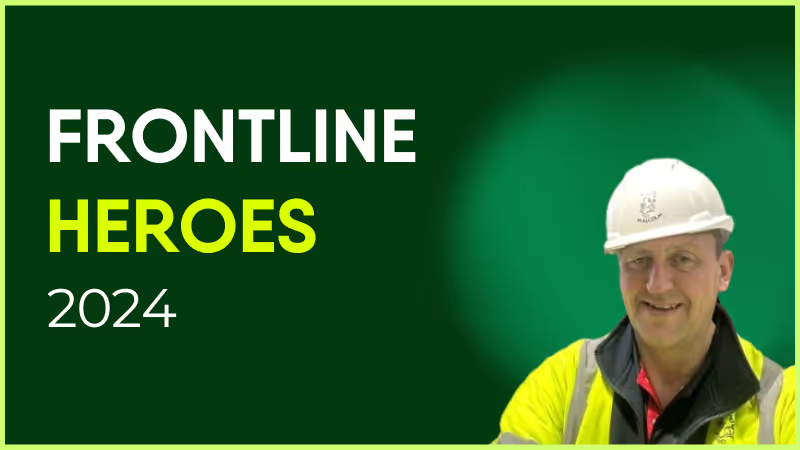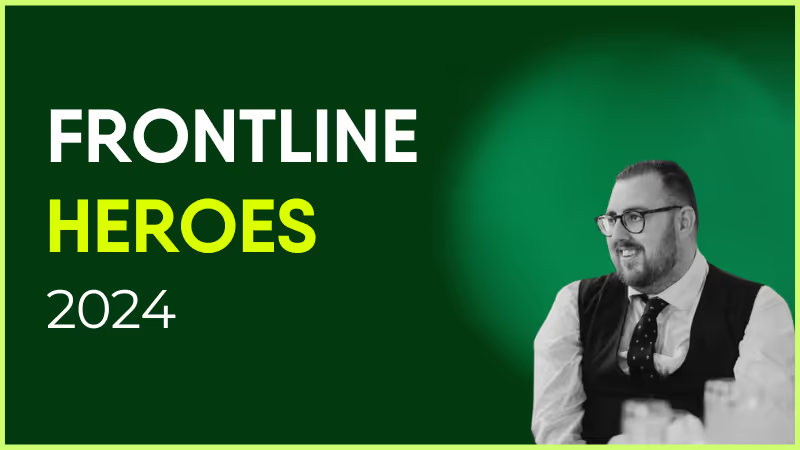
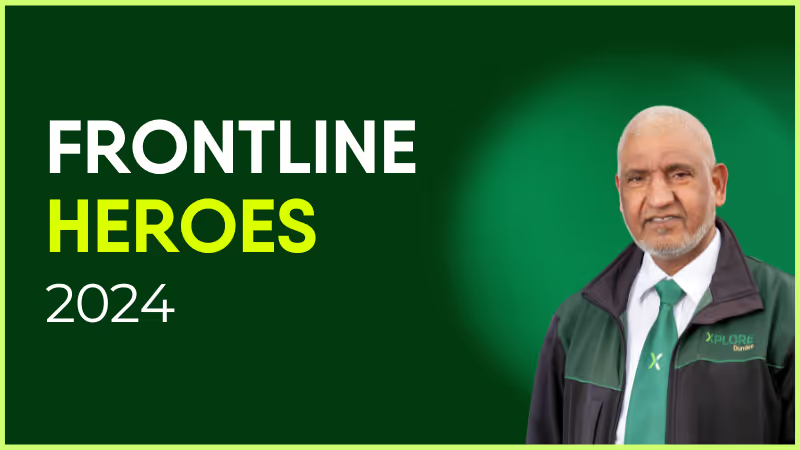
Mohammad Ramzan is one of Scotland’s longest-serving bus drivers. He began his journey with Tayside Passenger Transport in 1978 and continues to serve the Dundee community with unwavering dedication.
In addition to his regular duties, Mr. Ramzan has played a key role in Xplore Dundee’s “Did It for Me” recruitment campaign, emphasizing the supportive and friendly environment created by his colleagues. He credits this camaraderie for his long-standing tenure with the company.
Mr. Ramzan — most commonly known to his colleagues as Uncle Ramzan — has been a dedicated Xplore Dundee bus driver for over 46 years, and was even awarded the esteemed title of Frontline Employee of the Year at the Scottish Transport Awards 2024.
How has Blink helped in their role?
Blink has empowered Mohammad Ramzan to interact with his colleagues and provide them with additional support.
What do they want to do next?
Despite being past retirement age, Mr. Ramzan would love to continue his service to contribute to the McGill’s Bus Group.

Nominated by: Bethan Dooley, Marketing Team Leader
What makes them awesome?
Mohammad Ramzan is one of Scotland’s longest-serving bus drivers. He began his journey with Tayside Passenger Transport in 1978 and continues to serve the Dundee community with unwavering dedication.
In addition to his regular duties, Mr. Ramzan has played a key role in Xplore Dundee’s “Did It for Me” recruitment campaign, emphasizing the supportive and friendly environment created by his colleagues. He credits this camaraderie for his long-standing tenure with the company.
Mr. Ramzan — most commonly known to his colleagues as Uncle Ramzan — has been a dedicated Xplore Dundee bus driver for over 46 years, and was even awarded the esteemed title of Frontline Employee of the Year at the Scottish Transport Awards 2024.
How has Blink helped in their role?
Blink has empowered Mohammad Ramzan to interact with his colleagues and provide them with additional support.
What do they want to do next?
Despite being past retirement age, Mr. Ramzan would love to continue his service to contribute to the McGill’s Bus Group.

Nominated by: Bethan Dooley, Marketing Team Leader
Blink, the leading employee super-app, today announced a strategic partnership with LineZero, a leading provider of workplace community and culture solutions, and the largest Meta Workplace partner globally. This collaboration leverages the existing relationship between both companies, offering Meta Workplace customers a seamless transition and upgrade to Blink’s employee experience platform following Meta’s announcement to close its Workplace operations.
Meta’s decision to close operations of Meta Workplace by Q3 2025 has left many companies challenged in finding a modern solution that enables a smooth transition of their workforce and data while offering a more innovative approach to deepen employee engagement and strengthen ties between employees and their companies.
“Our goal is to support the thousands of Meta Workplace customers seeking new solutions to drive employee engagement through a great internal comms tool,” said Sloan Kendall, head of global partnerships, Blink. “Partnering with LineZero provides customers with an easy migration of workforce data and technology applications into Blink’s platform. With LineZero’s expertise and Blink’s proven track record, we are excited to empower companies to migrate smoothly from Workplace and upgrade to Blink to enhance their employee engagement experience.”
Blink is a mobile-first, all-in-one communication and collaboration platform designed specifically for frontline workers. It allows companies to connect their entire workforce, regardless of location or device, through a single unified platform. With Blink, employees can stay updated with company news, chat with colleagues, access essential tools, send personalized kudos, complete surveys, and much more. Blink boasts industry-leading adoption rates, reaching up to 95% of employees and decreasing employee turnover by 26% in some cases.
“Blink’s platform is an ideal Workplace replacement for customers looking to modernize the way they engage their people,” said Greg Sugar, president, LineZero. “While organizations valued the similarity between Workplace and Facebook, we often heard there was a need to engage workforces with a tool that better represents how they interact with technology today. Blink approaches the frontline with an employee experience that meets them where they are. We are so excited to help organizations smoothly transition from Workplace to Blink’s platform. This partnership reflects our shared commitment to creating better employee experiences and shaping the future of work.”
The partnership highlights both companies’ commitment to enhancing employee engagement and creating a positive work environment. The collaboration ensures that Meta Workplace customers can migrate easily to Blink’s platform that enhances their engagement strategies and aligns with their long-term goals.
For more details on working with LineZero and Blink for a migration or implementation, visit LineZero’s blog.
Why off-the-shelf internal comms tools win every time
Your internal communications tool isn’t working.
Employees miss important updates. Frontline workers feel disconnected. Your IT team is stretched thin, and now you’re faced with a big decision: Build your own solution from scratch or buy a ready-made platform?
Building might seem like the best way to get exactly what you want. Total control, custom features — it sounds great in theory. But in reality? It’s a massive undertaking. Development takes months (if not years), maintenance is a never-ending burden, and by the time your internal communication software is live, it’s already outdated.
The good news? You don’t have to reinvent the wheel. Today’s prebuilt corporate communication tool offers the perfect balance of speed, flexibility, extensive customization options, and a wide range of features tailored to your needs — without the cost and complexity of building from scratch.
Let’s dive into why an off-the-shelf internal communications platform is the smarter, faster, and more effective choice for connecting your entire organization.
The evolution of internal comms platforms
You may once have scraped by with a basic company intranet and SharePoint. But internal comms have come a long way — from bulletin boards and internal email blasts to mobile-first apps that deliver real-time updates and targeted, effective communication.
Today’s workforce demands consumer-grade experiences and a modern UX. So to improve your internal communications strategy and the employee experience, organizations now need platforms that are intuitive, engaging, and integrated with existing tools.
Big changes to your comms tech may feel like a daunting prospect. But if your existing internal comms platform is holding you back, remember that you don’t need to reinvent the wheel.
You can leverage prebuilt platforms to improve internal comms, share company content, and elevate company culture like never before.
6 reasons to buy an internal communication tool
Still on the fence about buying or building your internal communication tool? Let’s look at all the reasons why buying a solution provides everything you need and more.
#1. Easy activation
Building your own internal communication tool requires months (or years) of development, testing, and iteration. The process dominates the time of your tech team for a prolonged period.
When you buy a platform, on the other hand, you get instant access to a proven and reliable system with best-in-class key features and minimal training required. There’s no need to worry about designing UX, managing infrastructure, or fixing bugs.
You can simply configure and launch, counting on tried and tested functionality — and incredible speed, too. A bought platform can be live within months, if not weeks. So you can start making a big difference to your internal comms sooner rather than later.
{{mobile-activation="/image"}}
#2. Digital inclusion
In 2025, internal communication tech shouldn’t be reserved for your office-based team.
If you want to achieve high levels of employee engagement and retention across all sectors of your workforce, you need an internal communication tool that allows you to reach every employee — no matter where or when they work.
With a mobile-first employee app, you can send company updates directly to employee smartphones. Whether you have office-based workers, remote teams, or frontline employees, you can be sure that comms are getting to every corner of the company.
Staff can log in to your platform without a corporate email address and stay informed of company updates on the go. They get push notifications that alert them to critical news. And they can access advanced features that encourage an employee social network, like a news feed and instant messaging tools.
The best employee apps revolutionize workplace communication. But creating, launching, and maintaining your own employee app is no mean feat.
To ensure digital inclusion, your comms tool should be available across desktop, Android, and iOS devices. That means building and maintaining multiple apps in the app store, which is a significant burden for an internal IT team.
Opt for a turnkey solution, however, and you ensure that no employee is left out. With a dedicated tech team on hand, you can be confident that your internal communication tool will work perfectly across a range of devices and that all employees — no matter where and how they work — can onboard in just a few clicks.
{{mobile-main="/image"}}
#3. Customer success
When you create employee communication software from scratch, you’re on your own. Your internal team has to build an engaging platform — and inspire employees to use it.
A purchased platform tends to come with a dedicated success team. These experts can help to optimize platform engagement, adoption, and ROI. They can also take care of training and troubleshooting, removing the burden of support from your internal IT team.
Your platform partner has walked this road before. Rolling out their platform time and time again, they’ve built up a wealth of knowledge. So your employees don’t have to be guinea pigs for a completely new system and launch process.
A customer success team can provide on-site support during the launch phase — and advise on the best ways to drive adoption. Whether that’s through a teaser campaign, employee challenges, or the simple (but very effective!) bribery of giving free ice cream cones or lunch vouchers to every employee who downloads the app.
#4. Custom branding
A common concern about a bought internal communication tool? That it won’t look and feel like your brand. That you have to sacrifice brand identity for the convenience of a bought solution.
But with more comprehensive and robust customization options available, this is no longer the software sticking point it once was.
Modern employee communication platforms allow for full customization. You can add company colors, logos, and fonts. Your company name and logo will appear in the app store, on people’s phones, and inside the platform itself.
The best internal communication software allows you to apply this customization on a micro-level within your organization — by team, role, and geography — to provide a branded and personalized employee experience.
With extensive customization options, you can use your internal comms tool to create a company culture of belonging.
{{mobile-nokia-feed="/image"}}
#5. App personalization
Of course, it isn’t just the look of your internal communication platform that counts. The functionality it offers should be tailored to meet the needs of your employees.
This is why some companies choose to go down the build route. They see it as a way to get a custom solution that perfectly meets their requirements.
But again, bought solutions are keeping pace. They’re going beyond a one-size-fits-all approach to give customers a tailored tool, without the hassle of building it themselves.
With intuitive platforms that offer a user-friendly interface, you can create communication channels, custom workflows, control layouts, modify notifications, and ensure employees receive relevant content for them.
Features you don’t need? No problem — turn them on and off as you see fit. Concerned about real-time messaging? All good — set up alert and time zone parameters as needed.
Bought solutions are also agile. With your platform partner’s support, it’s easy to keep up with internal communication trends and employee expectations. And you don’t have to pay for ongoing development costs every time you need a new feature.
{{future-of-internal-comms-2025="/callouts"}}
#6. Integration
Internal communications don’t exist in a vacuum. Your platform needs to integrate with the other workplace software you use, including HR systems, payroll, scheduling, team collaboration tools, and much more.
Creating deep integrations for a self-build solution is time-consuming and costly. It often requires expensive API development and ongoing maintenance just to keep things connected.
But a purchased solution comes with prebuilt and seamless integrations for software like Workday, ServiceNow, Microsoft 365, and more.
Via secure, single sign-on technology, employees can access all the workplace tools they need. Your employee communication tool acts as a digital company hub, providing easy access to things like employee surveys, training, peer recognition and rewards, employee feedback forms, pay stubs, and shift swap tools.
{{mobile-hub="/image"}}
#7. Future-proofing
The right internal communications platform shouldn’t just solve today’s challenges. It should evolve with your organization and keep your workforce connected no matter how work changes.
Building an in-house solution may seem like a way to tailor communications to your exact needs, but without ongoing investment and dedicated resources, these systems can quickly become outdated. They can struggle to keep up with shifting workforce expectations, mobile-first engagement trends, and emerging technologies.
A prebuilt platform, by contrast, is continuously updated, giving you access to the latest and greatest capabilities without the burden of maintaining and upgrading the technology yourself.
Keep in mind: Not all prebuilt platforms are created equal. Some workplace tools are owned by larger corporations, where internal comms are just one of many priorities. This can leave customers vulnerable to shifting business strategies or product sunsets.
With the right internal comms partner, you get long-term stability, continuous innovation, and a platform designed to adapt and grow with your workforce — so you’re always ahead of what’s next.
Build or buy? Get the best of both worlds with Blink
Building an internal communication app may seem like a great way to get exactly what you want. But it’s often a long, costly, and risky investment.
In contrast, buying a prebuilt platform gives you speed, scalability, and best-in-class technology. You also enjoy the expertise of a team that lives and breathes internal comms tech.
Choose a comprehensive solution like Blink and there’s no trade-off. You get the best of both worlds. The ability to brand and white label the platform. Powerful integrations with other workplace software you use. And a speedy launch — most of our clients go live within 6 to 12 weeks.
Our support is also second to none. Our team comes onsite at your company to assist with the platform launch and ensure high levels of adoption. The proof is in the stats.
With Blink, Domino’s achieved a 94% adoption rate and 81% monthly active users. A company news feed, chat features, and integrations with benefits, payslips, and shift swap tools make it easy for Domino’s to cultivate an informed and motivated workforce.
Over at Stagecoach, Blink has helped increase employee satisfaction by 46% and reduce staff turnover by 26%. What’s more, 100% of employees said they would recommend Blink’s internal communication platform to a colleague.
Don’t spend months reinventing the wheel. Ask the right questions when choosing a new employee communication tool and you can find a single platform that meets your ever-evolving comms needs and builds human connection — today, tomorrow, and beyond.
Blink. And connect your workforce with a ready-made internal comms platform.
9 ways to boost employee engagement in manufacturing organizations
The manufacturing industry has an engagement problem. Just 25% of manufacturing employees are engaged at work, making it one of the least engaged occupations in the US.
Employee engagement is the extent to which workers feel satisfied with their jobs and are aligned with organizational values. It also influences how able and willing they are to give 100% to their work.
So the stat above is worrying. But it also presents an untapped opportunity for forward-thinking firms.
When you improve employee engagement, you create a stronger connection between employee and organization. This leads to better retention, productivity, and business results.
Take a look at our ideas for manufacturing employee engagement to swim against the tide, attract additional employees and motivate the ones you already have.
The importance of employee engagement in manufacturing
It is without question that employee engagement is important to every organization in every industry.
Engagement has a direct impact on talent acquisition and retention. Staff are less likely to take time off sick and productivity sees a 14% uptick. Happier, more satisfied staff produce better, more cost-effective results for your company.
But in manufacturing, employee engagement can help you to overcome a range of industry-specific challenges. There’s a link between manufacturing employee engagement and all of the following:
Quality management – engaged employees care more about company goals – they’re more likely to spot and report quality issues
Safety and risk management – engaged employees pay more attention to the critical comms sent out, which can often include safety and risk management documents. Engaged employees also hold themselves accountable for their impact on the team and work environment, which will lead them to paying more attention to health and safety.
Customer experience – there’s a link between employee experience (EX) and customer experience CX) – engaged employees manufacture better products and provide a better service
Business results – when quality, safety, and CX improve, you improve overall business results – costs go down, sales go up
Key factors influencing employee engagement in manufacturing
If you want to improve the manufacturing employee experience at your organization, you need a strategy. This plan sets out how every part of your company – not just your HR team – is going to work together to improve engagement.
Your strategy should also consider the key factors that affect employee engagement in the manufacturing workplace.
Communication
Internal communication within a manufacturing organization can be tricky.
To start, the majority of manufacturing frontline employees don’t have business emails. This creates an initial barrier to cross —of how to even communicate with these workers.
Then you have teams in the office and on the factory floor, plus a variety of login, language, and time constraints. To give updates on safety protocols and equipment issues, and to share company culture, you need communication channels that deliver the right information to every employee.
The physical work environment
Your workplace should be a safe and comfortable environment for employees. Equipment and protocols have to support the physical wellbeing of workers. And staff need easy-access communication channels so they can report hazards and safety concerns.
Training and development
Training and development are key in a fast-changing sector like manufacturing. So employees can deliver products to the expected standard. And so you can retain more of your workers by giving them new challenges and a clear career path.
Manufacturing employees are often responsible for repetitive tasks. And it can be hard for them to see how their work fits into the bigger picture. Workplace leaders bring meaning to employee work by recognizing their efforts and sharing company goals and values.
9 ways to improve employee engagement in manufacturing
Looking to improve employee engagement at your manufacturing firm? The following ideas will help you enhance the employee experience and reap business rewards.
1. Invest in technology
AI, automation, robotics – manufacturing tech is coming on leaps and bounds. But technology doesn’t just improve manufacturing processes. You can use it to boost employee engagement, too.
An employee app like Blink supports easy communication across your organization. As a mobile-first solution, available via smartphone, you can put mandatory reads, new safety protocols, and essential company updates at the fingertips of every employee.
You also bring together the tech tools your teams already use. With next-level integration capabilities, Blink puts information and resources in one easy-access location. You provide a friction-free, user-friendly interface that your employees enjoy using.
Technology streamlines work – and keeps employees in the loop. Just be sure to choose tools suited to both frontline and desk-based workers, and accessible for those with a company email or without. In doing so, you create an equitable working environment and raise the engagement bar for everyone.
You can put the rumor mill out of action and adopt a more open communication style by letting information move freely between all members of your organization:
Leaders keep employees in the loop, sharing key updates and supporting workers to understand the bigger picture.
Managers have an open-door policy and regularly connect with their employees, offering feedback, updates, and – crucially – listening to what they have to say, too.
Workers are encouraged to contribute – they collaborate with each other and feel comfortable raising issues and ideas with decision-makers
So how do you make this kind of communication a reality within your manufacturing organization?
Firstly, you need the right communication channels. These should be suited to your way of working and link every member of the workforce. In a large, modern workplace, a noticeboard crammed with paper memos simply won’t cut it.
Secondly, leaders need to leave egos at the door. Open communication means sometimes hearing things you don’t want to hear. Remember that negative feedback is often more valuable than good as it highlights areas for improvement. And encourage managers to lead by example.
Lastly, bear in mind that open communication can be taught. So train employees in information sharing, active listening, empathy, and teamwork. Teach them which communication channels are the most appropriate – and how often they should be using them.
3. Translation capabilities
Most manufacturing organizations have a diverse, multinational workforce. And many frontline employees don’t speak English as a first language. So if you’re not already translating company comms, this is a really easy way to boost employee engagement across the board.
Resources, information, and internal communication should be available in the languages your workforce speaks. That way everyone receives the same message and enjoys equal access to information. This also eliminates the bottleneck that managers create, having to be the translator themselves and spending their hours on managing the communication channels that their employees don’t have access to.
For example,The Blink app supports over 100 languages. Contributors can translate posts and resources at the click of a button, making all of your content accessible to everyone on your team, regardless of the language they prefer to use.
With effective, accurate translation, you get everyone on the same page – and include everyone in your company culture.
4. Recognition programs
Recognition makes employees feel valued. When you appreciate and reward employees who go above and beyond, you motivate them and inspire other employees to follow suit.
So when an employee hits a professional or personal milestone, when someone highlights a safety issue before it becomes a hazard, or when a team consistently meets their targets, give them the public recognition they deserve. And encourage co-workers to praise one another, too.
You can give recognition in company meetings, on the blog, or in the newsletter. Or ensure you reach every member of staff with recognition updates by using a digital solution like Blink.
With Blink’s recognition feature, you can post instant, personalized messages to highlight staff achievements. You add a recognition post to the company news feed and start building recognition into your company culture in just a few clicks.
Praise goes a long way. But you may also like to consider perks and prizes. Gift vouchers, an extra paid day’s leave, or a catered team lunch can all incentivize your teams. For manufacturing firm, JFE Shoji Power, sweepstake competition prizes helped them to fill overtime shifts.
But before you put a reward program into place, survey your staff. Find out what they really want in terms of recognition and reward. That way your recognition program stands to make the most impact.
5. Opportunities for advancement
It’s not just your office-based team who are keen to advance in their careers. 70% of frontline employees have applied for advancement opportunities. But this group doesn’t always get the resources or support they need to move up the career ladder.
When you’re looking to improve employee engagement in a manufacturing organization, allowing all employees to learn and advance within their roles is crucial. It gives employees something to work towards and feel excited about. And it makes them much more invested in doing a good job.
There are lots of things you can do to support career growth.
Map out clear career goals with employees, offering training and mentor support to help them achieve them
Give workers more responsibility during the standard work day, encouraging them to take ownership and make decisions where appropriate
Cross-train and rotate jobs to bring variety to an employee’s workplace experience
Ensure everyone is aware of training and career opportunities within your organization, highlighting typical career pathways and the perks of promotion
6. Regular, two-way feedback
As we mentioned earlier, open communication is an important part of employee engagement. You can facilitate this type of interaction by providing regular opportunities for two-way feedback.
Regular 1-to-1s between employees and managers help to maintain open lines of communication. These meetings are an opportunity to align goals, resolve conflicts, and identify areas for development.
Crucially, employees get the chance to raise queries and issues, too. They can provide insight into the manufacturing employee experience and any challenges they’re currently facing.
Just remember, this type of interaction needs to take place regularly, not just once or twice a year. To build trusting, open relationships, you need to build this type of communication into every single week.
That means managers spending time on the factory floor, seeing for themselves what excites, challenges, and frustrates workers. It means creating impromptu feedback opportunities. And it means using digital solutions to make feedback and communication easy, even when managers and workers aren’t based in the same location.
7. Create a safe environment
The manufacturing industry in the US has some of the highest rates of occupational injury and illness. But you don’t get high rates of manufacturing employee engagement unless staff feel safe at work.
When employees feel safe:
They can focus on their work
They feel a greater sense of morale
They feel valued and supported
They trust in workplace leadership
Prioritize workplace safety and you also create a virtuous circle. Safe environments lead to better employee engagement. And engaged employees help to improve workplace safety going forward. There are 70% fewer safety incidents in the most engaged workplace environments than there are in the least.
Leaders and managers should regularly reassess the safety performance of equipment and protective wear. Careful plant design can help to mitigate safety risks, while clear risk assessment and safety protocols help workers identify and rectify issues before they lead to a safety incident.
But workplace safety isn’t just about having the right equipment and protocols. It’s about fostering a company culture with safety at its core.
To do this, you need psychological safety in addition to physical safety. This is where people feel safe voicing their opinions because they’re not worried about being judged, blamed, or punished.
Give employees a sense of psychological safety – and the right communication tools – and they’ll be more likely to report safety issues. Digital tools, rather than pen and paper methods, help safety information to travel both ways, reaching decision-makers and factory floor workers quickly.
8. Invest in training and onboarding
Manufacturing processes are prone to change. Employees need to keep their knowledge of tech and equipment, as well as their skills, up-to-date. This helps to create a safe environment for everyone working on the manufacturing team. And it boosts employee engagement, too.
71% of manufacturing employees say that training and development is important to them in their work life
35% say they aren’t getting the quality of training and development they expect
28% said they would leave their employer soon because of poor training and skills development
Onboarding is not to be overlooked either. When new hires start working for a company, there’s lots to learn. Safety protocols. How to use equipment. Company values. Who they can turn to for feedback and support.
Some organizations, lacking manpower, don’t put enough time and effort into onboarding. But this is where you lay the foundations of employee experience. And it can make or break an employee’s engagement with your firm.
You can maximize onboarding benefits without spreading their staff too thin, with the help of a digital onboarding process.
Employees access guides, rules, and resources via the company portal. They can refer back to resources as and when they need them. It’s also easy for your teams to update resources with the most up-to-date information.
Managers and co-workers can then supplement this online learning with face-to-face input ensuring a positive experience for new employees.
9. Implement employee surveys
You can never really be sure how your staff are feeling unless you ask. So before you implement an employee engagement strategy for your manufacturing organization, it makes sense to conduct surveys.
As well as listening to employee concerns during manager 1-to-1s, surveys allow employees to give feedback on specific aspects of their role and on what they feel could be better within the organization.
Follow up with a regular schedule of surveys and you build a complete picture of the employee experience:
Annual surveys give you insight into employee engagement progress
Quick and easy pulse surveys give you an up-to-the-minute snapshot of employee sentiment
Lifecycle surveys help you understand the challenges facing employees at each stage in their journey
To get feedback from as many employees as possible, you need to communicate openly. Tell employees about the insights your surveys have uncovered. And share your plan for acting upon their feedback as well as any results.
By engaging employees in every stage of the feedback process, they’re much more likely to respond next time you send out a survey request.
You’ve read the tips. Now get some real-life inspiration! Aggregate Industries has already put these employee engagement tips into action. Find out how this manufacturing firm improved digital engagement across their frontline with Blink. Watch the webinar now.
In conclusion
In manufacturing, employee engagement can be transformational. When you improve the employee experience, you improve product quality, workplace safety, and customer service. You also find it easier to attract and retain staff in a tough labor market.
In an engaged workplace, information flows between all members of your workforce. Work is more meaningful thanks to clear company values and a sense of the bigger picture. Employees are empowered to do their best work, every day.
Getting to this point may feel like a challenge, particularly if you haven’t given much thought to employee engagement up to this point. But it’s a lot easier to make engagement improvements when you harness the power of technology.
With the help of a mobile-first employee app, you connect every employee, from your HQ office to the factory floor, regardless of their access to a company email or not. You can conduct surveys, give recognition, and provide easy-access training resources. You can translate information into a variety of languages.
Get an employee app on your team and you’ll find it easy to reach and engage every member of staff, whatever their preferred language and whatever their role.
When’s the last time you had a work-related question, opened your phone to Google it, and ended up down a rabbit hole of Tasty slow cooker recipe videos on Instagram?
If the answer is, “Not that long ago,” don’t worry. You’re not alone.
Many people consider social networks a productivity killer. Swiping through an endless stream of dog videos can make it hard to get work done.
Social media apps get a bad rap at work, but that’s because they’re so good at keeping people engaged and interacting.
What if you could harness the power of social media and use it to help your employees engage more at work?
You can use a social intranet to make your internal communications as engaging as a playlist of cats riding Roombas (well, almost).
With a social intranet, your employee network becomes more than a dumping ground for company documents — it’s a place where people can collaborate, learn, and feel connected to one another.
A social intranet is a private collaboration platform where workers can access content in one place. It offers social features like commenting and messaging so employees can interact and work together. And unlike traditional intranet solutions, social intranet software uses interactive elements to increase employee engagement and collaboration in the digital workspace.
Since intranets are networks only company employees can access, they serve as internal communications and knowledge management tools.
Why employee apps are the new intranet
Are intranets a thing of the past? In this eBook, learn how to engage with the deskless workforce effectively to build strong, happy frontline organizations.
Traditional intranet setups have more restrictions when it comes to posting and interaction. For most employees, it’s like having “read-only” access to company resources.
Yes, social intranets are still relevant — here's how to use one 1
On the other hand, social intranets give workers permission to create and engage with content. You can use social intranets to share company resources and encourage employees to connect with each other and the content.
Let’s take a look at some of the top benefits of choosing a social intranet over a traditional one.
Deloitte found that improving employee engagement can increase retention by up to 87%. The study also suggests that using social tools internally increases employee satisfaction by 20%.
Socializing intranet with features like instant messaging keeps your employees connected so they’re more likely to feel like they’re part of a team.
Better collaboration
Gone are the days when you had a question at work and you had to walk five desks over to get your answer. With remote working in a digital workspace, your employees may be spread over several states and countries. That can make collaboration a challenge.
Social intranets provide tools that make it easier for your employees to connect and work together by offering features such as status updates and commenting. Activity streams, which are similar to social media news feeds, keep everyone in the loop, and private instant messages (which work like, e.g. Instagram DMs) eliminate the need for lengthy email chains.
Increased productivity
If workplace interruptions get out of hand, they’re a killer on your team’s productivity.
Imagine your marketing department trying to work on a website update, but they keep getting calls from sales reps who can’t find the right assets. Or maybe your website developer is hard at work on that new layout, but they’ve got to field emails from marketing about text updates.
With a traditionally restricted intranet, your employees have to rely on constant calls and meetings to share information.
A social intranet with private messaging and commenting features lets your employees engage with updates on their own time, so they can focus on their priorities without interruption.
Enhanced security
Employees who can’t contribute to their intranet need to find other places to share documents and files. Unfortunately, file-sharing platforms like Google Suite or Dropbox aren’t as secure as your private network.
With a social intranet, you have an added layer of security on your internal knowledge and documents.
What your social intranet platform should include
As you review different social intranet platforms, look for features that help employees connect and collaborate.
Yes, social intranets are still relevant — here's how to use one 2
Here are some standard social intranet features to look for:
Commenting, tagging, and messaging for easy social interaction
Company news feeds and notifications for sharing updates
Information hub with powerful search capabilities for ease of access
Communities and forums for collaboration and knowledge-sharing
Polls and surveys for collecting feedback
Employee directory so people can get to know each other’s faces even if they haven’t met
Social intranet best practices
According to Prescient Digital Media, only 13% of employees use the company intranet every day. Most companies need to work harder to make their intranet useful for employees.
Here’s how you can set up your intranet to make sure your employees love checking in.
Make contribution easy
You can’t force employee engagement from the top down. Everyone in your organization has something to contribute, so make sure they can.
Businesses aren’t run out of a single headquarters anymore. Remote workers and frontline employees who interact with customers don’t always have access to a laptop or computer.
If you want a social intranet that everyone will use, it must be accessible to your entire workforce. Choose a platform optimized for mobile apps so your deskless workers still get the same online employee experience.
Look for a provider with analytics
How do you know if your social intranet is making a difference? Well, you won’t – unless you track its analytics.
Yes, social intranets are still relevant — here's how to use one 3
Marketers use engagement analytics to measure the success of every campaign. You should take the same approach to internal communications.
By tracking your workforce analytics, you can figure out what type of content works for your team and create more of it. Without them, you risk investing a lot of time for a small reward.
Final thoughts: what is a social intranet, and how does it benefit you?
Staying connected in the digital workplace is vital. But that doesn’t mean it’s easy. Businesses need tools that adapt to ‘new normals’ and still keep employees connected.
The best social intranet is also a modern intranet.
It helps you create an internal comms resource your employees will actually want to use. No matter where your people are, they can log on and feel connected to the company and supported in their work.
Unfortunately, this stat makes perfect sense. Workplace tech has traditionally been built with office-based workers in mind. So it tends to fall short for the frontline.
Some companies still use a traditional intranet. And others use a patchwork of different HR and IT apps. These tools may work well for desk-based employees. But they cause three common problems for frontline workers:
Limited access to tech. Frontline employees don’t have regular access to a computer and don’t always have a company email address. This means they rely on noticeboards, personal apps, and/or shared company computers to access the information and tools they need.
Access to poor quality tech. Frontline employees have access to a system that does some things, but not others. They can access tech tools via a mobile device but features are limited and the user experience is lacking
Access to too much tech. When employees use lots of different apps via lots of different interfaces, it creates as many problems as it solves. This piecemeal approach can cause friction and tech tool disengagement
Frontline organizations need streamlined tech that works for every employee. As Ian Gordon, former President of Administrative Operations at Elara Caring, said in an interview:
“Being a frontline worker can feel like you’re on an island by yourself, and the solutions that you need must be quicker and more succinct. You can’t spend a lot of time signing in and navigating. You need to get to your answer now.”
Currently, deskless workers waste time and productivity on tasks that could be streamlined. For example, finding their training documents, communicating with managers, or simply tracking down last month’s pay stub.
Thankfully, there’s a solution. A modern intranet takes into account the realities of today’s distributed workforce. It’s a mobile-first tool that provides the same seamless digital experience for both frontline and desk-based employees.
Here, we explore how the right type of technology can benefit your frontline employees andyour organization. We also reveal the three features you should be looking for when choosing frontline tech.
Benefits of a modern intranet for frontline employees
When your frontline has access to the right tech, everyone stands to gain. Let’s take a look at the benefits – for your organization and employees – of a mobile-first employee app.
Higher levels of productivity
When frontline employees don’t have the right tech, they waste a lot of time on tasks that could be streamlined.
They have to call their manager on the phone when they want to change shifts.
They have to use the shared computer on their lunch break to respond to a company survey.
They have to leaf through a paper handbook to find an answer to their question.
A modern intranet helps frontline employees complete tasks quickly and easily. This means productivity for your organization improves.
Streamlined workflows
A modern intranet helps streamline the workflow of every employee in your organization, not just those on the frontline.
That’s because frontline employees can use self-serve functions. They can view their pay stubs, launch an assigned L&D module, and request time off. Employees can book shifts and report faults or accidents. They can also chat with their managers via messaging features.
This helps to streamline the work of your frontline workers. But it also helps HR teams and frontline managers. They get fewer queries and fewer phone calls because frontline employees can achieve so much more using the right tech tool - removing the barrier to access and allowing your HR teams and managers to focus on the work they are meant to be doing.
Tech tool efficiency
The best modern intranets integrate with the software you already use for your business. It's not about adding another tool to your tech stack to be siloed, but increasing access to all of the other tools you already rely on. So employees can access all tech tools from the same, familiar interface.
When workplace tools are intuitive and easy to access, employees spend a lot less time looking for the resources they need. They also spend less time trying to remember different login details. A single click, a single password, and they’re in.
Learning and development
A modern intranet or employee app makes it easy for employees to access vital resources. Like workplace policies, guides, and training materials.
This means new hires get up-to-speed quickly. They can access all onboarding materials via their smartphone. Existing employees also find it easy to weave L&D into their usual workflow.
With access to resources that help them work smarter, not harder, employees become more effective and productive in their roles.
Improved internal communication
Good internal communication is the backbone of any organization.
Without it, trust in leadership suffers. And with it, engagement and loyalty increases. Employees in organizations with effective communication feel more connected to their jobs.
But we know that frontline teams usually don’t enjoy the same level of communication and connection as their desk-based co-workers.
Frontline employees tend to spend very little time at HQ and often spend their days working alone. So they risk missing out on:
Vital company updates
Co-worker collaboration
Recognition from managers
Opportunities to make their voice heard
The right tech helps to bridge the gap. It improves employee communication by connecting frontline workers to their co-workers, head office, and company culture.
Real-time communication
Information is often outdated by the time it reaches frontline employees. It’s hard to spot memos on a crowded noticeboard, and it’s easy to miss an important update in a long thread of messages.
The best modern intranets solve this problem by supporting real-time communication.
Employees can use newsfeed, group chat, and 1-2-1 chat functions to get up-to-the-minute information.
Managers can send smartphone notifications to highlight vital updates. They can post a video of today’s company standup. They can also create and pin mandatory messages to the company newsfeed, ensuring that essential information cuts through.
With access to relevant, timely information like this, employees make better decisions and solve problems more quickly.
Two-way communication
Top-down communication is useful for establishing company culture and sharing updates. But for truly effective internal communication, information needs to move in all directions.
Modern intranets support peer-to-peer connection. Co-workers can interact via the newsfeed or chat functions. They can recognize a peer’s hard work. Or wish their work bestie a happy birthday.
The intranet also supports bottom-up communication. With a newsfeed, direct messaging, and company-wide surveys, you give frontline employees a voice.
This makes a positive difference to the employee experience. Employees who say their voice is heard at work are 4.6x more likely to give their all.
Collaboration
Imagine a frontline care worker has come across a great article about elderly care. How does that person share their new insight with other frontline workers in other locations?
Perhaps they’ll mention the article to the co-workers they physically cross paths with. Or send a link to the small group of people in their work WhatsApp chat.
But you really amplify the reach and impact when that care worker can post the article to the company employee app.
The right tech tools allow frontline teams to share the knowledge they gain when they’re out in the field. They can share best practices and collaborate with other employees, even though they’re not based in the same office environment.
Empowerment and engagement
When employees feel empowered and engaged at work, they’re happier and more productive. They provide better customer service and produce better results. They’re also less likely to look for a job elsewhere.
Employee engagement relies on strong employee communication, development opportunities, recognition – and the right tech.
The wrong tech can be a big drain on employee engagement. When workers use slow, inefficient, and ineffective digital tools, it adds friction and frustration to their work day. So implementing a modern intranet can help with all the following.
Empowering employees
With a company super-app at their fingertips, frontline employees are empowered to make informed decisions and take a proactive approach to their work.
Thanks to user-friendly employee communication channels, they can report safety or equipment issues. They can share their knowledge. And they can access company resources exactly when they need them.
A modern intranet also empowers employees to progress in their careers. 70% of frontline workers are interested in career progression opportunities. But they don’t always get the resources or support they need.
Via an employee app, you can give frontline workers easy access to L&D information, new job opportunities, and any available employee development activities.
Engaging employees
The right frontline tech helps you to improve employee engagement. It allows employees to engage with co-workers and company culture. And it mirrors the experience provided by employees’ favorite social media apps.
A newsfeed. Likes, comments, and shares. Pulse surveys. Digital 1-2-1s. A searchable company library. A modern intranet with a user-friendly interface creates an experience that employees are excited to use and keep using.
The best frontline tech also offers personalization, another thing that helps to level up engagement. Employees can switch up their dashboards to put their preferred features first. Or prioritize their newsfeed to focus on posts that are most relevant to them.
Retention and attraction
Frontline teams experience high levels of churn. A McKinsey study found that 45% of frontline workers planned to leave their jobs within the following 3 to 6 months.
Workplace technology is an important part of the puzzle. 78% of deskless workers say they consider the technology at a company when deciding whether to take a job there.
When you equip frontline workers with the right tech, you show your employees that you value them and care about their experience.
You also provide communication channels that support a better employee experience. You allow employees to give feedback and build stronger relationships with co-workers. This makes it easier to hold onto existing staff – and to attract new talent too.
Choosing the right tech for frontline employees
Some tech solutions – like the traditional intranet – don’t fit the realities of frontline work. So what should you be looking for when choosing tech for frontline employees?
The best frontline tech:
is a one-stop-shop
offers an intuitive user experience
has a mobile-first design
Let’s look at these features in a little more detail.
It’s a one-stop-shop
Currently, many organizations are at risk of app overload. 37% of frontline workers use five or more apps every day. But 39% say that apps aren’t actually helping them in their work.
A patchwork of workplace tools means workers have to learn different interfaces and remember lots of passwords. Tech complicates their workflow instead of simplifying it.
The best modern intranet brings together all the software you use. It acts as a digital front door for your organization.
Behind this door, employees find everything they need to do their jobs. Tools for communication, operations, training, shifts, collaboration, and HR. It’s all available via one interface and a single login.
Tech that acts as a one-stop-shop reduces friction in frontline employee workflow. It also drives adoption for your existing tools, improving the ROI on the software you’re already paying for.
Supercharge your frontline with an employee super-app
It provides an intuitive user experience
Investing in the best frontline tech is pointless if you can’t persuade employees to use it. So you need tech solutions that can prove high usage and adoption rates.
Bear in mind that 56% of deskless workers are using personal tech tools instead of workplace tools. As well as posing security risks, this illustrates a really important point when choosing frontline tech.
Your chosen solution has to compete with the user experience (UX) provided by the most popular social media platforms. So you need tools that offer an intuitive, friction-free UX.
These intuitive tools don’t have a steep learning curve. Instead – because they’re so similar to the apps your employees already use out of work – employees can pick them up and start using them with next to no training.
Because they’re so easy to use, these apps provide clear employee benefits from the get-go. This helps to drive organic app adoption and ensures a higher proportion of your workforce downloads and uses your intranet.
It’s a mobile-first solution
Frontline workers don’t sit at a desk. They don’t always have a company email address, let alone a company computer. Therefore, any workplace tech you choose must be available via a mobile device.
The best solutions have a mobile-first design. They’re not tools designed for desktop with an app added as an afterthought. Instead, they offer the same great features and user experience on a smartphone as they do on other devices.
This allows frontline team members to stay up-to-date with company news, book time off, or look at their shift schedule while they do their daily work. They can access workplace tools from any location, at any time.
Blink: an employee app for frontline workers
The Blink employee app is a modern intranet for a modern frontline workforce. Our app acts as the digital front door for your organization.
It provides access to the tools and systems your entire workforce needs day to day. And it integrates seamlessly with the software you already use. So employees can access all workplace software using one secure single sign-on (SSO).
As a mobile-first solution, Blink provides the same great user experience on smartphones, tablets, and desktop computers. Frontline workers have exactly the same access as their desk-based peers to company culture, co-worker connection, and workplace resources.
If you’re looking to improve the frontline employee experience, connect your workforce, and increase productivity, frontline tech is a great place to start.
Twenty years ago, I was advising the government on transport. Our North Star was this: how do we get people out of cars, and onto public transport? We worked hard and made several huge breakthroughs. Public transport in the UK thrived and up until recently, was the mode of choice for many.
But over the past few months, things have changed – drastically so. Two decades of progress has been effectively undone in a matter of months. The government has actively discouraged people from using public transport. That’s never happened before, although I understand that it was necessary.
So: where do we go from here?
Covid-19 has had a devastating impact on the transport industry and its frontline workers. And it’s not over. We have a long road ahead, with many challenges looming.
Even so, I’m optimistic. Here's why.
The arguments for public transport are as strong as ever
Let me own up to my biggest fear first: an increase in car ownership. At the moment, many people are apprehensive about, or scared of, using public transport. That may make them rely more on their cars.
When you’ve got a car, you’ve got an enclosed space. You don't have to sit next to anyone. It's one of the reasons car shares hasn’t taken off. People don't like letting others into their personal space. Covid-19 has exacerbated all this. It might lead families without cars to buy one, or go from one to two-car households.
That might not sound like a big deal. But there's a direct correlation: as car ownership rises, bus passenger numbers fall. Or, put that in perspective: for every new car on Britain’s roads, there’s 365 fewer bus journeys per year.
My goal has always been to achieve a modal shift towards public transport. I've been working with governments for many years to make this happen. That momentum has now ground to a halt. Will that change be permanent?
I don’t think so. The argument for public transport – economic and environmental – remain strong. They will only get stronger. One pivotal reason is climate change. At the beginning of 2020, that conversation was at the heart of public consciousness. Once again, circumstances have sidelined that conversation, but it's more urgent than ever.
The facts remain: the car is an inefficient user of roads, it's wasteful, it's polluting.
But here's what gives me hope. During lockdown, many people have experienced good quality, clean air. Many of them for the first time ever. That's huge. That's compelling.
We caught a glimpse of what a life with less pollution could be like. A live demonstration of a world with less traffic and fewer planes. That’s something most of us want to hang on to; without losing the thrill and energy of vibrant, busy cities.
What's holding us back is public perception. Many people see buses as a main polluter, causing congestion and reducing air quality.
That's not true. One new bus produces less pollution than one new car. That's despite the fact that they can carry 50 times as many passengers, by the way. In fact, buses are a key part of the solution for clean air and sustainability.
What we need to do is shift ingrained mindsets and change misperceptions.
Even after disaster, people adjust
Covid-19 poses an extreme threat. But we have dealt with – and recovered from – extreme threats before.
Take the London bombings in 2005. We lost 35 people; it was all over the television. It was terrifying. People's lack of confidence in public transport was lower then than it is now. Even so, Transport for London got their systems running again the very next day.
Or take 9/11. One of the worst horrors of anyone's lifetime. Remember how nervous were people about flying? But the next day, thousands of planes still took off. Today, aviation has a fantastic track record of keeping people safe.
We've mitigated the risks associated with terror attacks as much as possible. But you'd need to be a fool to say that that terrorist threat has gone away completely.
We don’t know when, or if, Covid-19 will completely go away. We can never eliminate risk. But we can learn to live with new danger.
We adjusted to airport security measures. And we will adjust to facemasks and social distancing.
Human beings are born to adapt.
It will take time, of course. Some people will be nervous for the foreseeable future. But long-term, people’s behaviour will normalize again. Patterns of patronage will return. All the evidence shows this is what happens after a crisis.
We need a marketing exercise. To gradually build up public trust, to reassure passengers it's safe. A way of reassuring people about risk, hygiene, temperature checks and general safety.
Our key workers are resilient
Being a bus driver is one of the toughest jobs in the UK, especially in a busy city.As a driver in London, you have to navigate the busy streets, the traffic; and at the same time, you have to keep people safe, give directions, take their fares.
It's a demanding job at the best of times. Along came COVID-19, and bus drivers were even more exposed than healthcare professionals. Thirty-three of them died in the UK. And all the while they were delivering NHS staff and other key workers to their jobs. The role they play is enormous.
We should be clapping for our bus drivers.
We don't know what their job will look like when all this is over. But I have trust in the resilience of our key workers, and in their capacity to adapt.
One of the economic fears in this respect is about a potential increase in autonomous vehicles. I do expect those to play a big role in the future of transport. In the past year, the number of autonomous car trips was no more than a few thousand.
But there have been hundreds of millions of autonomous train journeys every day. Half of all trains in Asia are autonomous, and we're starting to see autonomous buses come to the fore. There are five different tests in European cities later this year. This looks like it will be an area of big growth.
But won’t that mean job losses for frontline workers?
I don’t think so. In my view, we can approach the issue of driverless vehicles in two ways.
We can say that we're not going to change people's jobs despite the fact that we've got new technologies. Then we will lose bus drivers in the long-term. That would be the wrong way.
Or, we can use technology to enhance people’s jobs. Frontline workers’ roles could shift to become more customer service-orientated. Our workers could be there as ambassadors, communicating with passengers. In the case of an emergency, they could mingle with customers, make sure they're okay. This could herald a new era for public transport, an 'excellent customer service phase'.
We've already seen the potential firsthand. If you've got a lively happy bus driver, the whole experience changes. But at the moment, it's difficult to achieve that. If we move towards an autonomous world, we could recruit more of the right people.
There could be a different mindset, a different approach, a different energy to it. We could reproduce the customer care that people expect in restaurants and shops.
So the role of frontline workers will change, but the prevalence of jobs won’t. Our frontline workers will be as relevant ever.
We can build strong collaborations
To produce a much better product, we need the help of our customers. When it comes to the bus system in particular, we tend not to know what our customers think or want. We don't communicate with them, or not enough.
We want to get to know our customers better. Learn about what matters to them, communicate better with the people who rely on us. Drop them text messages. “Sorry, I'm hacked off, we couldn't produce reliable journeys because of these roadblocks.” Reward them, thank them for their loyalty. That would mean learning about best practice in customer care.
We also want to form closer partnerships with the unions, local authorities and the highways authority. We need to get to know the local politician who's in charge of road space allocation well. To deliver, you need strong relationships like that.
We need to broaden our vision and build robust connections. With our customers, with relevant authorities.Look at best practice in other industries, think bigger, and focus on core competencies. Nail the areas that matter most, no matter the line of work.
That’s my vision for the frontline of the future, and that’s why I’m optimistic.
With a focus on communication, marketing and customer service, we can make the changes we need. Not just to recover – to thrive. It won't happen by itself; we need to set the right priorities and make the right decisions.