
Types of internal communication, with real examples
A safety alert and a birthday shoutout should never travel through the same channel, but in a lot of organizations they do, both landing in the same group chat, at the same volume, with the same chance of getting buried. That's a channel problem, not a content one: comms teams aren't missing a type of internal communication, they're missing the structure that gets each type to the right people, fast enough, through the channel built for the job.
There are seven types of internal communication worth building for on purpose: leadership, operational, crisis and urgent, change, peer-to-peer, culture and recognition, and upward feedback. A leadership update and a safety alert are not the same job, and treating them the same is how comms teams end up with one noisy channel that nobody trusts. This guide walks through each type with examples, maps them to the channels that fit, and gives you a simple monthly calendar to plan the whole mix. For a full breakdown of the tools behind each channel, see our guide to the best internal communication tools.
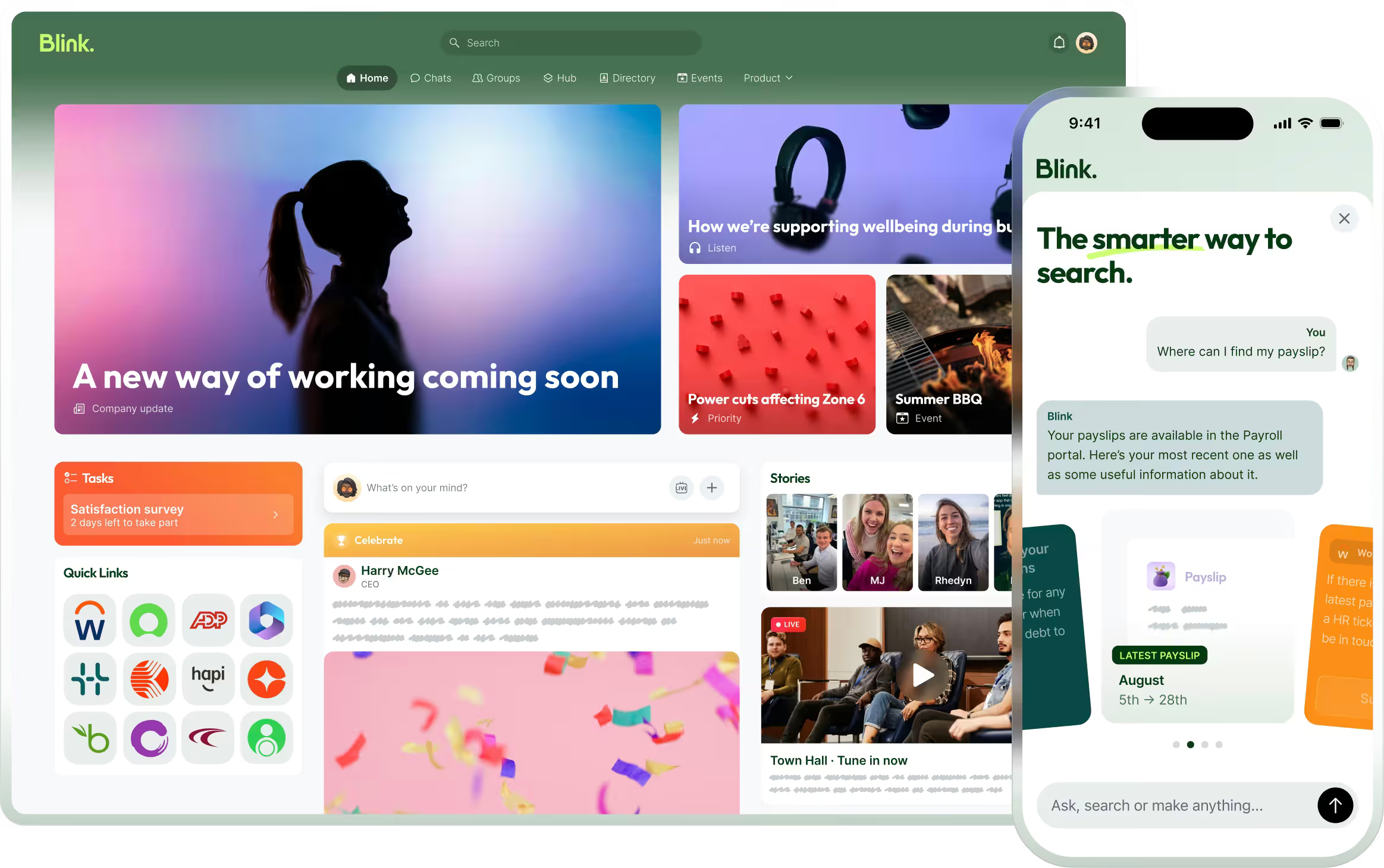
Blink is a mobile app that gives every employee, including anyone without a company email, one place for all seven types of internal communication. Our internal communication use case covers how this plays out for frontline and deskless teams specifically, where many of these types break down first.
What is internal communication?
Internal communication is how an organization shares information with its own employees, from leadership updates and safety alerts to everyday conversations between colleagues. It runs in both directions: messages that travel down from leadership, information that travels up from frontline teams, and conversation that happens sideways between peers. Good internal communication is targeted, timely, and built for the channel the audience actually uses, not the channel that's easiest to post in. For a desk-based team, that might be email or an intranet. For frontline and deskless teams, it usually means a channel on their own phone, since engagement gaps tend to run hardest for the employees who don't sit at a desk.
What are the main types of internal communication?
There are seven core types: leadership, operational, crisis and urgent, change, peer-to-peer, culture and recognition, and upward feedback. Each one serves a different job, moves at a different speed, and needs a different channel to land. Treating them all the same, usually by defaulting to email or one general chat group, is the single most common reason internal comms feels broken even when a team is working hard at it.
Leadership communication
Leadership communication is top-down messaging from executives and senior managers, covering company direction, results, and big decisions. It includes quarterly town halls, CEO updates, strategy briefings, and all-hands meetings. The job here is context: helping employees understand not just what's happening, but why.
Example: a CEO records a two-minute video after quarterly earnings, explaining what the numbers mean for day-to-day work, and it's pushed to every employee's phone rather than buried in an email only head office opens.
Operational communication
Operational communication is the day-to-day information people need to do their jobs: schedules, procedures, task updates, and routine announcements. It's high-frequency and practical. This is the type that fails quietest, because when it breaks, nobody escalates it, they just work around it with a text thread or a sticky note.
Example: a store manager posts the week's delivery schedule and stock count to the team channel every Monday morning, replacing a printed sheet taped to the stockroom door.
Crisis and urgent communication
Crisis and urgent communication covers safety alerts, incident updates, and anything that needs to reach every employee immediately, with proof that it was seen. This is the type where a missed message has real consequences: a safety recall, a severe weather closure, a security incident. Speed and confirmation both matter here, not just one or the other.
Example: a facility sends a severe weather closure alert that pushes to the top of every employee's feed and past notification settings, with read tracking so the site manager can see who hasn't opened it yet and follow up directly.
Change communication
Change communication supports employees through mergers, restructures, new systems, or policy shifts, where the goal is reducing uncertainty, not just announcing the decision. It usually runs over weeks, not a single post, and benefits from repetition across more than one channel.
Example: a company rolling out a new HR system runs a countdown campaign in the weeks before launch, announces go-live the day it happens, and follows up with short how-to videos for the first month, rather than one announcement and silence.
Peer-to-peer communication
Peer-to-peer communication is conversation between colleagues at the same level, whether that's a quick question in a team chat or a shared tip on how to handle a tricky customer. It's informal, horizontal, and often the communication type leaders have the least visibility into, even though it shapes how work actually gets done.
Example: JD Sports runs a "this or that" feature inside its app to collect frontline opinion on upcoming product lines, direct from the stores that will end up selling them, feeding that insight back into the business rather than letting it stay a between-shift conversation.
Culture and recognition communication
Culture and recognition communication celebrates wins, milestones, and the moments that build a sense of belonging, from work anniversaries to peer shoutouts. It's the type most likely to get cut when budgets tighten, and the type employees notice most when it's missing.
Example: UK transport operator Go North East sends milestone feed cards marking employees' length of service, turning a date that used to sit quietly in an HR system into something colleagues across every depot actually see and respond to.
Upward feedback communication
Upward feedback communication is information moving from employees back to leadership: surveys, suggestion channels, exit interviews, and direct replies to leadership posts. Most internal comms strategies are built almost entirely around broadcasting outward, which leaves leaders flying blind on what's actually landing.
Example: a comms team attaches a one-question pulse survey to a policy update and gets responses from frontline staff who've never had a channel to react to a company decision before.
Which channel fits which type of internal communication?
Match the channel to the type's speed and stakes, not to whatever tool is already open on your desktop. A channel that's great for culture content is often the wrong one for a safety alert, and vice versa. Here's how the seven types map to common channels:
{{blink-table:table-1}}
Newsletters deserve a specific mention here, because they're often misused. A weekly or monthly roundup works well for change updates and leadership context people can read on their own time. It's the wrong tool for anything urgent, since email sits unread for hours on a frontline shift, and it's no help at all to someone with no company email to receive it at. Blink's Newsletter Builder pulls directly from feed posts and events into a branded send, so the same content doing the job in-app also reaches an inbox, without a comms team rebuilding it twice. For anything in the crisis and urgent row, that's a different tool: Blink's Critical Communications feature pins urgent posts to the top of the feed and tracks exactly who has acknowledged them, which is the proof point a newsletter can't give you.
How do you build an internal communications calendar?
An internal communications calendar is a monthly plan mapping which type of message goes out, through which channel, and who owns it. Without one, comms defaults to reactive: whatever's urgent this week gets sent, and the quieter types, culture, recognition, upward feedback, quietly disappear. Pick one week of the month for each type, and don't move it just because something louder is competing for attention.
A simple monthly structure looks like this:
Week 1: Leadership and direction. A short update from leadership on priorities for the month, posted once and pinned for a few days.
Week 2: Operational check-in. Routine updates on schedules, procedures, or process changes, delivered through the channel your team already checks daily.
Week 3: Culture and recognition. Anniversaries, shoutouts, team wins. This is the week most likely to get skipped if it's not scheduled, so put it on the calendar deliberately.
Week 4: Feedback and listening. A short pulse survey or open comment thread, closing the loop on anything raised earlier in the month.
Running throughout: crisis and change, as needed. These don't wait for their calendar slot. Build the capability to send them immediately, and keep every other type of content clear of them when they happen, so urgent messages don't compete for attention with a recognition post.
A basic template outline for each entry: the message type, the channel, the owner, the date, and one line on the intended outcome (informed, acted on, replied to, felt recognized). That last column matters more than people expect. If you can't name the outcome, the message probably doesn't need to exist yet.
For a broader set of ideas to fill that calendar, 11 Ideas to Make Your Internal Communication Plan Work and 13 ways to quickly improve internal communications both have practical starting points.
How do these types work for frontline teams?
Frontline and deskless employees often have no company email and no regular desk, which rules out the channels desk-based comms teams default to. A leadership update that lives on an intranet homepage never gets seen by someone on a shop floor or driving a route. An urgent alert sent by email can sit unread for a full shift. The fix isn't a different strategy for frontline teams, it's the same seven types delivered through a channel built for a phone rather than a desktop.
A common starting point looks like this: a single group chat on a personal messaging app is carrying leadership updates, shift schedules, safety alerts, and birthday shoutouts all at once, across every site. Nobody can confirm who actually saw the safety notice. Nobody removes a leaver's access when they leave. That alone is the operational pain worth fixing first. It's also a genuine compliance risk, since a personal app run outside company control gives you no audit trail and no record of who saw what.
Moving off it works best in a specific order: start with crisis and operational communication, since those are the types where a gap causes real harm and where leadership will back the change fastest, running the old channel and the new one side by side rather than cutting over in one go. Once crisis and operational messages are landing consistently, layer in culture, recognition, and upward feedback.
Ready to put this into one place?
Start a 14-day free trial and see how a single app handles all seven types for a frontline team, from a leadership update to an urgent safety alert. If one chat group is still trying to do all seven jobs at once, that's the thing worth fixing first. Prefer to talk it through, or see the full picture first? Book a demo, or browse the Blink product overview.