
Gallup's State of the Global Workplace 2026 report puts global employee engagement at 20%, the lowest level since 2020. In that environment, the difference between a platform that gets adopted and one that doesn't rarely comes down to the technology. Instead it comes down to how the launch was run.
Most organizations announce new tools, but the smart ones build anticipation. I got to see that difference up close recently, working with AG Barr on the rollout of their Blink app, which their people named Fizz. Within 30 minutes of launch, 50% of their workforce had signed up. Two weeks later, they hit 92% adoption.
At Blink, we have a deep understanding of the drivers for adoption across the frontline and have incorporated this into our implementation approach. We call our approach the Five Levers, and this is what they look like in practice.
Lever 1: Get your comms team in the room from day one.
Having implemented technology across very different organizations, it’s clear to me that the comms team's proximity to the build is one of the strongest predictors of launch performance.
A common mistake in platform launches is treating comms as a final step. The platform gets configured, tested, signed off, and then someone hands the comms team a brief and asks them to do their thing.
The real value is unlocked when the comms team are active participants throughout the implementation journey. Involve them in design decisions, enable them to build deep knowledge of the product, and give them the opportunity to ask the questions that only someone who knows both their audience and the product deeply would think to ask.
Lever 2: Give people ownership before you ask for buy-in
Gallup defines engagement as the psychological attachment workers have to their work, their team, and their employer. That attachment can be built by users during an implementation through participation, consultation, and all the small, accumulating signals that say “this was made with you in mind”.
The most effective implementations I've been part of find ways to bring users into the process before launch. One customer shadowed frontline workers during the design phase to understand their ways of working and surface how the platform could genuinely remove friction from their day. Another customer ran an internal competition to name their custom Blink app. That might sound like a small gesture, but it got people curious and gave employees a sense of ownership that carried through to launch day.
None of these approaches were expensive, but all of them materially changed the reception at launch by treating co-ownership as an adoption strategy.
Lever 3: Build suspense, and make launch an event.
Most internal platform launches follow the same pattern: countdown comms, a PDF guide, and a go-live date. However, awareness isn’t the same as anticipation… and knowing something exists is not the same as wanting it.
The most effective comms teams run deliberate suspense campaign in the weeks before launch. By the time your platform goes live, you want people to be itching to finally get access to something they have been waiting for.
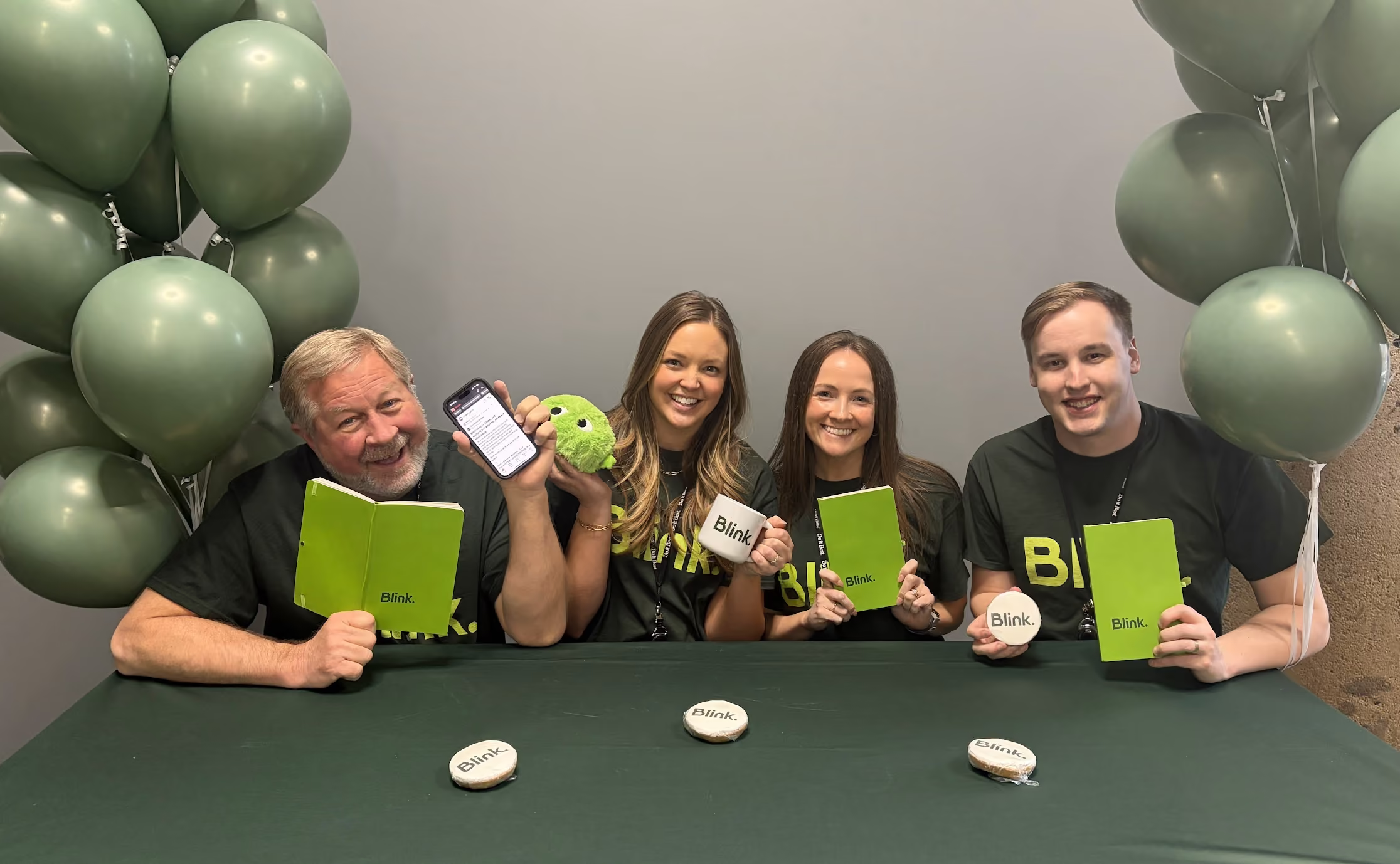
One of the best ways to do this is by treating launch as a moment worth celebrating. Set up stalls across locations, run competitions, visible leadership presence and lean on champions (more on that later).
The most memorable launches I've been part of have had a real sense of occasion. We've seen customers deploy drones to drop QR activation codes, bring in celebrity guests, and line up food trucks on launch day. Prizes have included iPads, flight vouchers, annual leave, and pizza parties for entire teams. These things create energy that employees are still talking about a year later.
Not every organization has that kind of launch budget though, and it doesn't matter as much as you might think. The underlying principle isn't spend, it's signal. A launch that feels like an event tells employees that the organization takes this seriously, that someone thought about them specifically, and that showing up on day one means something. You can do that with a well-placed stall, a visible leader handing out coffees, and a competition where the prize is a piece of inexpensive swag.
Frontline workers are harder to reach through traditional internal channels, so a physical presence on launch day says something an email can't. It signals that the organization considered them specifically, which is always noticed.
The lesson for comms professionals is that you have more control over the emotional temperature of a launch than most plans account for. Anticipation, energy, occasion are the difference between a launch that lands and one that quietly fades.
Lever 4: Create champions, not just comms
Even a well-designed email gets deleted, but a teammate who says "this is genuinely good, let me show you" gets results. That’s why every successful launch I've been part of has had a network of champions behind it.
Peer influence consistently outperforms top-down communication. This isn’t because the top-down communication is poor, but because people weight information differently depending on the source. A message from a familiar colleague carries credibility that a well-crafted comms email simply can't replicate.
Here’s a cheat sheet for building a great champion network:
- Identify the right people: credibility matters, so look for people who are trusted by their peers across all parts of the business - different locations, functions, and seniority levels.
- Give them early access: make sure they've had hands-on training and early access to the platform so they have time to explore it properly.
- Give them something to shout about: champions should understand the “why” behind the platform so they can have an authentic conversation rather than deliver a rehearsed message.
- Make them visible on launch day: a familiar face in the right place at the right time is worth more than any amount of pre-launch email communication.
- Keep them engaged beyond go-live: the best champion networks don't dissolve after launch day. Give champions a way to feed back what they're hearing, keep them updated on new features, and recognize their contribution. They're your longest-running adoption tool.
Lever 5: Plan the weeks after launch as carefully as the day itself
The common post-launch pattern to avoid is a spike on day one followed by a plateau. Early adopters come, they engage with the overwhelming amount of week one content on the platform, but then usage stalls. Organizations that plan the post-launch phase deliberately with real incentives, visible momentum, and continued champion activity consistently derive more value than those that treat launch day as the end of the project.
At Blink, we dedicate time to developing a post-launch engagement plan with our customers long before launch, aligning leaders, managers and core functions on what to share and when. We encourage leadership teams to regularly engage across the platform. easyJet's "3, 2, 1" method is one of the most effective approaches I've seen. Leaders are expected to like three posts, leave two comments, and post one thing each week. It's simple enough to stick to, and the visibility of leadership activity sets the tone for everyone else.
Another way to avoid a post-launch slump is to run campaigns within the platform, such as a competition for the post with the highest engagement (cue a ton of wonderful user generated content, with the prize likely going to a post containing a very cute pet photo) or a weekly prize draw eligible only to the people who have activated over the first 4-6 weeks. It should be meaningful enough to sustain motivation, and structured enough to keep the campaign alive long after launch day.
Rather than being the finish line, go-live is the start of a different comms challenge. The pre-launch campaign creates demand, and the post-launch campaign keeps people coming back.
What this actually takes
Gallup's 2026 data is clear that technology only lands when leaders and managers make it make sense for people. The Five Levers aren't complicated, but they do require treating the communication of change as a discipline with the same rigor as the technical implementation, starting early, going deep, and understanding that adoption has to be designed.
The organizations I've seen launch technology well involve comms from the start, build anticipation rather than just awareness, invest in champions who carry real credibility, and keep the campaign going after day one. The ones that don't, however good the platform, tend to end up with a flat launch and a difficult conversation about why nobody's using it.


.avif)





.avif)




.jpeg)





























-min.jpeg)








.jpeg)



.avif)



.avif)













-min.avif)






-min.jpeg)