
There are lots of ways you can up your internal communications game. You can attend courses and conferences. You can work with a mentor or an internal communications expert.
But don’t overlook the free resources you have at your fingertips. The blogs of professionals, companies, and consultancies working in the field of internal communications (IC) often contain a lot of wisdom.
They feature the latest IC trends along with tried and tested employee communication strategies. You can discover what other companies are doing with their comms. You can also find new ways to engage employees, influence leaders, and keep up-to-date with communication technology.
So how do you unearth this insight? Trawling through the internet to find the best content is tough. So we’ve done the hard work for you. Here, we’ve put together a list of the best internal communications blogs around right now.
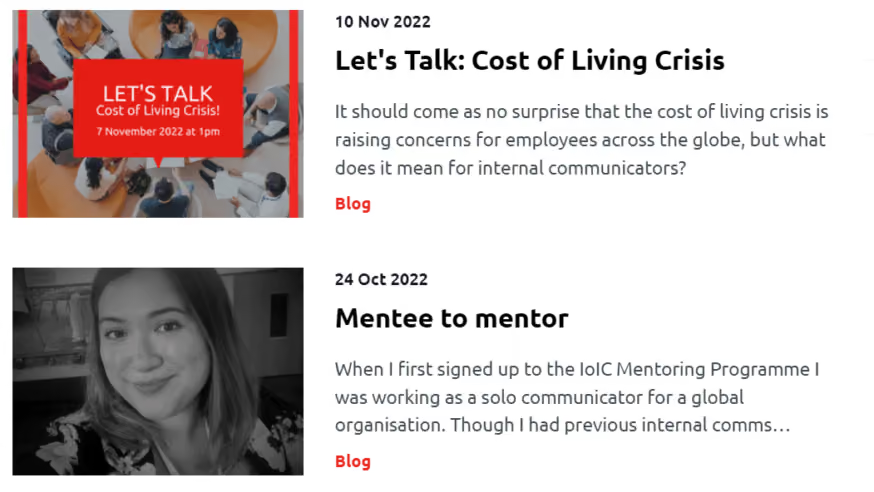
The Institute of Internal Communication has been a go-to for internal communication professionals for over 75 years. The Institute runs training, conferences, and awards. It also issues qualifications.
Its blog is an excellent resource. It covers topics such as visual communication, AI in the workplace, and the importance of developing trust in the workplace.
Some blog posts are only available to IoIC members. But there’s plenty on there to get you started. There’s also a podcast called The Future of Internal Communication, which is available on Apple Podcasts and Spotify.
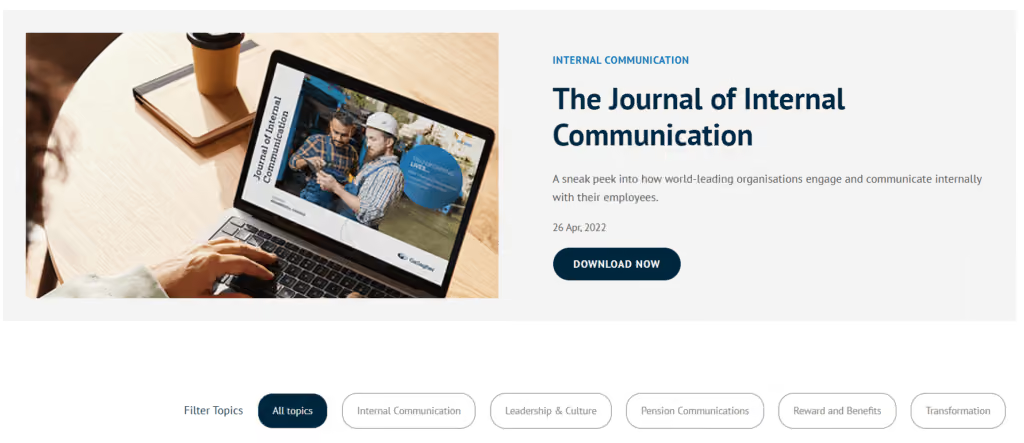
Gallagher is an internal communications agency that has worked on 100+ internal communication audits and strategic projects for large and small companies all over the world.
The company believes that real workplace communication isn’t about ticking a checklist. Instead, it’s about engaging workers through strong leadership and incentives. So Gallagher blogs on topics that include leadership, pension communications, rewards and benefits, and workplace culture.
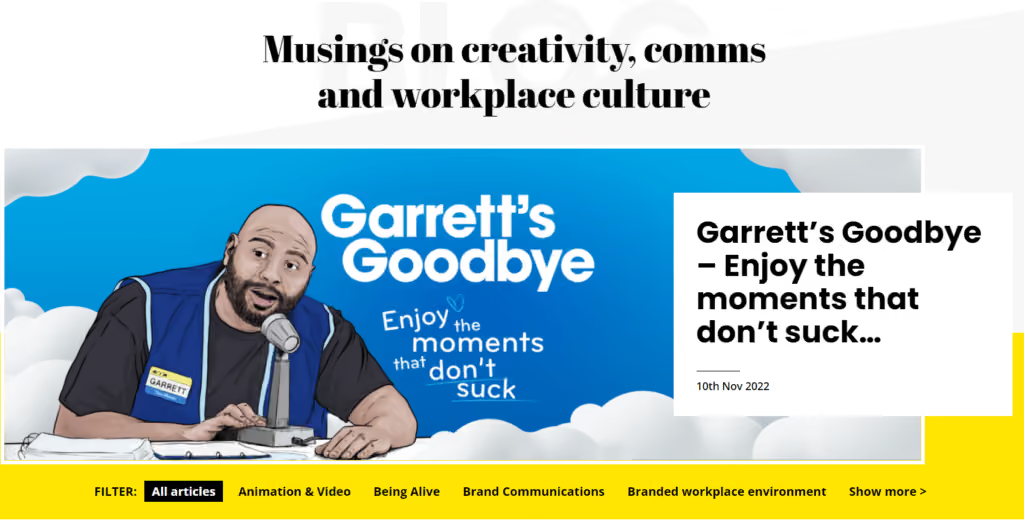
Alive with Ideas is a creative internal communications agency. They provide brands with strategy and engaging internal content.
The Alive with Ideas blog provides lots of creative comms inspiration. It covers topics like storytelling, the benefits of illustration, and tips for unleashing your creativity. There are lots of fun pop culture references and beautiful visuals, too.
If you’re looking for ways to liven up your employee communications and improve employee engagement, this is definitely the place to go.
McCann Synergy is an employee communications company focused on improving employee engagement across the entire employee lifecycle. It helps organizations develop a strong employer brand and a positive employee experience. It also offers support with employee engagement and workplace communications.
The McCann Synergy blog is filled with reports, whitepapers, and best practices on useful topics related to engagement and communication. These include crisis communications, employee experience, and behavioral science.
Redefining Communications is another internal communications consultancy. The team runs workshops and offers project support. They support global companies with comms, engagement, and organizational change.
Over on the Redefining Communications blog, you’ll find a ton of IC news and insight. The blog provides lots of great advice on the topic of employee communications, with some posts focused on improving comms in frontline organizations.
Dig a little deeper into their content and you’ll find some great podcasts, along with IC reports that you can download for a fee.
Rachel Miller is the ex-journalist and comms professional behind All Things IC. She’s been working in the IC industry for over two decades — and her company offers training and 1-2-1 support for internal communicators.
Over on the All Things IC blog, you’ll find lots of up-to-the-minute resources. There are summaries of newly released workplace communication research reports — and blogs on topics including AI and neurodiversity.
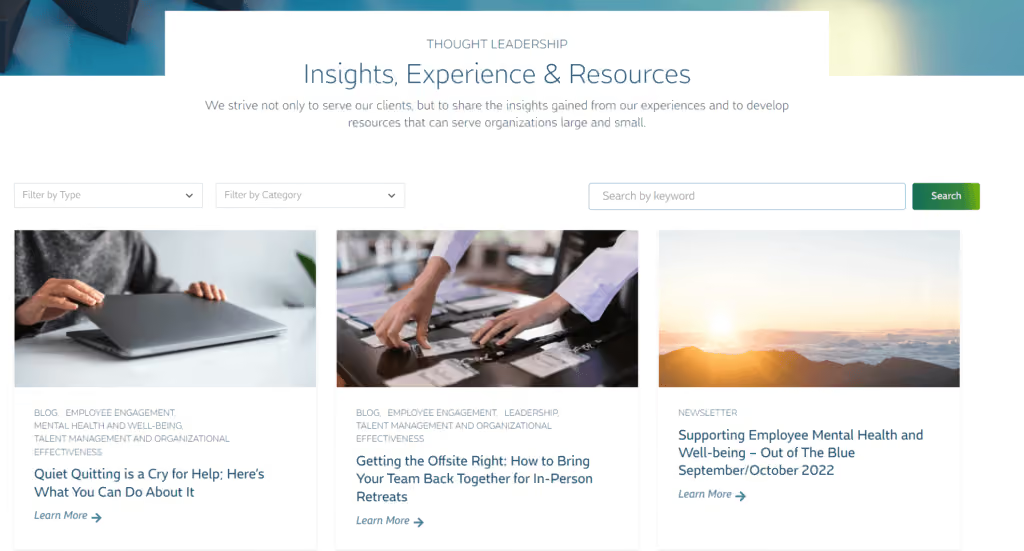
Blue Beyond is a consulting firm with expertise in the human side of business. Its impressive client list features many Fortune 500 brands.
With the Blue Beyond blog, the company shares internal communication trends and insights based on real IC experience. It also provides useful resources for both small and large companies. Recurring themes include change management, talent management, and workplace culture.
Brilliant Ink designs employee experiences that lead to positive business outcomes and high employee engagement.
Its blog spans a vast selection of topics — all related to employee engagement. So articles on employee communications are a regular feature. You will find insights on internal communication data, intranet platforms, and company values.
Comms Rebel is a communications consultancy founded by comms professional and confidence coach, Advita Patel. The Comms Rebel blog covers a wide range of topics surrounding workplace communication, with a particular focus on leadership, bias, and inclusion.
As you’d expect from the company name, Comms Rebel approaches workplace communications from a unique angle, highlighting overlooked issues and underrepresented employee groups.
Mike Klein is a consultant and strategist who helps organizations and communications leaders create sharper, more effective messages. He believes that people can say more by saying less.
Mike’s blog is packed with useful insight for comms professionals. He challenges conventional thinking and looks at internal communications measurement, technology, and strategies.
Inspiring Change is an internal comms agency that supports companies with organizational culture and employee engagement. The company’s founder, Scott McInnes, is on a mission to make internal comms clear, memorable, inspiring, and authentic.
Over on the Inspiring Change blog, you’ll find lots of useful articles. There’s advice for comms professionals wanting to connect employees with company values and culture. There are also tips on navigating organizational change.
Ragan Communications has been training professionals in internal communications, public relations, and social media for over 50 years. So, as you’d expect, the Ragan blog offers some great resources.
There are real-world internal communication case studies, round-ups of IC news, and interviews with IC professionals. You’ll also find lots of workplace communications advice, on topics ranging from manager comms, discussing social issues, and data analysis.
One for the leadership team. The brain behind this blog, David Grossman, is a leadership and communication expert and the founder of The Grossman Group. David is passionate about leadership communication and publishes articles on a bi-weekly basis.
Recent topics include empathetic leadership, change management, and building trust with employees.
The IC Citizen is penned by Martin Flegg, an IC expert with more than 20 years of industry experience. He specializes in internal comms, employee engagement, and change communication.
Martin has a knack for sharing strong opinions on debatable topics. You may not agree with everything he writes, but you’ll certainly get fresh perspectives.
Yes, this is us. Blink is a modern intranet software provider.
Our platform is built with frontline workers in mind. Traditionally, deskless employees have been left out of the company conversation. But we’re changing that with a user-friendly, mobile-first employee app.
Our blog reflects our passion for frontline communication. There’s in-depth guidance and actionable strategies you can use to improve workplace communication, employee engagement, and employee retention across your frontline and desk-based teams.
You can also read the latest internal communications news on The Shift, Blink’s bi-monthly newsletter — or get the lowdown on frontline communication tech by watching our live and on demand webinars.
Using internal communication blogs to improve comms at your organization
The way we collaborate and communicate is changing. So staying up-to-date with employee communication insights is a great way to boost the effectiveness of your comms.
Start by making the most of the IC information available online. The internal communication blogs on this list provide fresh ideas, practical strategies, and creative inspiration. They offer guidance on IC tech and communication trends.
So add these articles to your reading list. You’ll find new ways to share messages, engage employees, and improve the employee experience.
Want to delve deeper? For in-depth resources on frontline employee experience and engagement, take a look at Blink’s whitepapers and reports.
There are lots of ways you can up your internal communications game. You can attend courses and conferences. You can work with a mentor or an internal communications expert.
But don’t overlook the free resources you have at your fingertips. The blogs of professionals, companies, and consultancies working in the field of internal communications (IC) often contain a lot of wisdom.
They feature the latest IC trends along with tried and tested employee communication strategies. You can discover what other companies are doing with their comms. You can also find new ways to engage employees, influence leaders, and keep up-to-date with communication technology.
So how do you unearth this insight? Trawling through the internet to find the best content is tough. So we’ve done the hard work for you. Here, we’ve put together a list of the best internal communications blogs around right now.
The Institute of Internal Communication has been a go-to for internal communication professionals for over 75 years. The Institute runs training, conferences, and awards. It also issues qualifications.
Its blog is an excellent resource. It covers topics such as visual communication, AI in the workplace, and the importance of developing trust in the workplace.
Some blog posts are only available to IoIC members. But there’s plenty on there to get you started. There’s also a podcast called The Future of Internal Communication, which is available on Apple Podcasts and Spotify.
Gallagher is an internal communications agency that has worked on 100+ internal communication audits and strategic projects for large and small companies all over the world.
The company believes that real workplace communication isn’t about ticking a checklist. Instead, it’s about engaging workers through strong leadership and incentives. So Gallagher blogs on topics that include leadership, pension communications, rewards and benefits, and workplace culture.
Alive with Ideas is a creative internal communications agency. They provide brands with strategy and engaging internal content.
The Alive with Ideas blog provides lots of creative comms inspiration. It covers topics like storytelling, the benefits of illustration, and tips for unleashing your creativity. There are lots of fun pop culture references and beautiful visuals, too.
If you’re looking for ways to liven up your employee communications and improve employee engagement, this is definitely the place to go.
McCann Synergy is an employee communications company focused on improving employee engagement across the entire employee lifecycle. It helps organizations develop a strong employer brand and a positive employee experience. It also offers support with employee engagement and workplace communications.
The McCann Synergy blog is filled with reports, whitepapers, and best practices on useful topics related to engagement and communication. These include crisis communications, employee experience, and behavioral science.
Redefining Communications is another internal communications consultancy. The team runs workshops and offers project support. They support global companies with comms, engagement, and organizational change.
Over on the Redefining Communications blog, you’ll find a ton of IC news and insight. The blog provides lots of great advice on the topic of employee communications, with some posts focused on improving comms in frontline organizations.
Dig a little deeper into their content and you’ll find some great podcasts, along with IC reports that you can download for a fee.
Rachel Miller is the ex-journalist and comms professional behind All Things IC. She’s been working in the IC industry for over two decades — and her company offers training and 1-2-1 support for internal communicators.
Over on the All Things IC blog, you’ll find lots of up-to-the-minute resources. There are summaries of newly released workplace communication research reports — and blogs on topics including AI and neurodiversity.
Blue Beyond is a consulting firm with expertise in the human side of business. Its impressive client list features many Fortune 500 brands.
With the Blue Beyond blog, the company shares internal communication trends and insights based on real IC experience. It also provides useful resources for both small and large companies. Recurring themes include change management, talent management, and workplace culture.
Brilliant Ink designs employee experiences that lead to positive business outcomes and high employee engagement.
Its blog spans a vast selection of topics — all related to employee engagement. So articles on employee communications are a regular feature. You will find insights on internal communication data, intranet platforms, and company values.
Comms Rebel is a communications consultancy founded by comms professional and confidence coach, Advita Patel. The Comms Rebel blog covers a wide range of topics surrounding workplace communication, with a particular focus on leadership, bias, and inclusion.
As you’d expect from the company name, Comms Rebel approaches workplace communications from a unique angle, highlighting overlooked issues and underrepresented employee groups.
Mike Klein is a consultant and strategist who helps organizations and communications leaders create sharper, more effective messages. He believes that people can say more by saying less.
Mike’s blog is packed with useful insight for comms professionals. He challenges conventional thinking and looks at internal communications measurement, technology, and strategies.
Inspiring Change is an internal comms agency that supports companies with organizational culture and employee engagement. The company’s founder, Scott McInnes, is on a mission to make internal comms clear, memorable, inspiring, and authentic.
Over on the Inspiring Change blog, you’ll find lots of useful articles. There’s advice for comms professionals wanting to connect employees with company values and culture. There are also tips on navigating organizational change.
Ragan Communications has been training professionals in internal communications, public relations, and social media for over 50 years. So, as you’d expect, the Ragan blog offers some great resources.
There are real-world internal communication case studies, round-ups of IC news, and interviews with IC professionals. You’ll also find lots of workplace communications advice, on topics ranging from manager comms, discussing social issues, and data analysis.
One for the leadership team. The brain behind this blog, David Grossman, is a leadership and communication expert and the founder of The Grossman Group. David is passionate about leadership communication and publishes articles on a bi-weekly basis.
Recent topics include empathetic leadership, change management, and building trust with employees.
The IC Citizen is penned by Martin Flegg, an IC expert with more than 20 years of industry experience. He specializes in internal comms, employee engagement, and change communication.
Martin has a knack for sharing strong opinions on debatable topics. You may not agree with everything he writes, but you’ll certainly get fresh perspectives.
Yes, this is us. Blink is a modern intranet software provider.
Our platform is built with frontline workers in mind. Traditionally, deskless employees have been left out of the company conversation. But we’re changing that with a user-friendly, mobile-first employee app.
Our blog reflects our passion for frontline communication. There’s in-depth guidance and actionable strategies you can use to improve workplace communication, employee engagement, and employee retention across your frontline and desk-based teams.
You can also read the latest internal communications news on The Shift, Blink’s bi-monthly newsletter — or get the lowdown on frontline communication tech by watching our live and on demand webinars.
Using internal communication blogs to improve comms at your organization
The way we collaborate and communicate is changing. So staying up-to-date with employee communication insights is a great way to boost the effectiveness of your comms.
Start by making the most of the IC information available online. The internal communication blogs on this list provide fresh ideas, practical strategies, and creative inspiration. They offer guidance on IC tech and communication trends.
So add these articles to your reading list. You’ll find new ways to share messages, engage employees, and improve the employee experience.
Want to delve deeper? For in-depth resources on frontline employee experience and engagement, take a look at Blink’s whitepapers and reports.
Once upon a time, a company intranet that worked off a server in your office was enough to keep internal communication on track. But today, company needs have changed. And so have employee expectations.
We’ve entered the era of the digital workplace. Employees use a variety of different devices. Teams work remotely, across multiple locations. And beyond the world of work, everyone is now accustomed to intuitive, convenient, and personalized digital experiences.
Digital change has come quickly. And workplace software — like the intranet — hasn’t always kept pace. Traditional intranets feel old and clunky today. They’re affecting employee experience (EX) - and they could be doing more harm than good.
Thankfully, a new breed of intranet is now emerging. It’s fresher and more relevant to today’s workforce. It’s also built with digital workplace challenges front of mind.
A modern intranet holds the key to two-way communication and collaboration, better employee engagement, and an enhanced digital employee experience (DEX). And it could be a game changer for your organization.
Here, we’re going to take a look at the changing face of the company intranet and examine the features and benefits of a new and improved modern intranet.
Contents
Intranets: then and now
Why you need a modern intranet
Features of a modern intranet
How modern intranets impact the digital employee experience
Choosing the right modern intranet
Conclusion
Intranets: then and now
The company intranet has come a long way since it was first introduced back in the 1990s. Adapting to advances in technology and changing workplace trends, it’s taken on a variety of different forms over the years.
When talking about the modern intranet, it’s useful to compare the most cutting-edge intranet software to what has come before. So let’s step back in time and revisit each stage of intranet evolution.
Early intranets
Closed private networks were the first intranets to hit the office. They used local servers to host static web pages, meaning only computers based within the same geographical location could access them.
These early intranets provided limited interactivity and functionality. They were a place to share company directories, policies, and other documents. But because the setup and maintenance of early intranets required a lot of technical expertise, information was often outdated and badly organized.
Web-based intranets
As the internet went mainstream, web-based intranets made their way onto the market. These intranets were accessible via standard web browsers and had basic search functions, which helped users find what they were looking for. But these new intranets still had their drawbacks.
Internal communication remained one-way, with information traveling from the top of an organization down. Content was often poorly maintained because updates were complex. And there was very little opportunity for companies to provide personalized employee experiences.
{{callout}}
Social intranets
Social intranets were the first intranets to go mobile. Remote servers meant geography mattered less — and everyone within an organization, regardless of their location, could access the same information.
Inspired by social media platforms, social intranets prioritized communication, with features like user profiles and user-generated content. They were also designed to support team collaboration and productivity, with personnel services and project management tools built in.
Modern intranets
Modern intranets take the social intranet concept to the next level. They are a mobile-first solution with a focus on user experience (UX), designed to meet the expectations of today’s digital workforce.
Content creation is democratized in modern intranets. All members of an organization can access information and tools easily. And team leaders get the analytics and data-driven insights they need to improve employee engagement.
Interested in seeing a modern intranet in action? Preview Blink today with a short 2-minute video.
Why your frontline organization needs a modern intranet
So why should your frontline organization ditch its traditional intranet and adopt a modern software solution instead? There are several very good reasons.
Older intranet software can cause friction and frustration. Perhaps your intranet has become a dumping ground for outdated information. Or it simply fails to provide the intuitive, user-friendly, productivity-boosting features we’ve all come to expect.
We know that traditional intranets fail to live up to employee expectations. 67% of workers say that digital experiences in their personal lives are better than the digital experiences they get at work.
Many traditional intranets are built around the needs of desk-based teams, so they do your frontline workers a disservice. Frontline workers miss out on the communication and resources available to their desk-based peers.
A modern intranet, in contrast, helps you meet all of the following challenges head-on.
1. Employee engagement
According to Gallup’s State of the Workplace Report for 2023, just 23% of employees are engaged at work. But organizations should try to do better. That’s because high levels of employee engagement lead to happier employees, improved productivity, and lower rates of attrition.
Employee engagement is always a challenge. But engaging employees in a frontline organization can be particularly tricky. When your workers are deskless, how do you give them the connection, coaching, and support they need to thrive within your organization?
A modern intranet gives you all of the tools you need to engage your employees, regardless of where they work. You can count on a social feed, a content hub, employee recognition tools, surveys, and more.
With analytics too, you can see what is engaging your employees — and what isn’t — so you can improve your efforts going forward.
2. Communication
Open communication within a workplace is vital. It helps you inform, motivate, and engage your employees, while fostering an inclusive and supportive work environment. It involves top-down, bottom-up, and peer-to-peer communication, so everyone has a voice.
For frontline teams, maintaining open channels of communication within teams who don’t work face-to-face requires tailored solutions.
A modern intranet helps you build internal communication links between every member of your workforce — whether they’re based in the office, on the shop floor, or out in the field.
You don’t need to rely on emails or a company noticeboard. Instead, all types of internal communication are supported via your intranet app.
With better communication, you bring your teams together and you may find it easier to grow your company too. A Forbes study found that companies who involve 75% of their frontline in internal comms, achieved more than 20% growth over a year.
3. Digital access
Older intranet software is built around an outdated version of the workplace. It doesn’t prioritize the mobile experience and instead works best for employees who sit at a desk on a computer for the majority of each working day.
Newer intranets understand that the world of work has changed. Digital tools are a workplace essential. And frontline, hybrid, and remote teams should have equal access to the information and interaction that these tools provide.
That’s why the best modern intranets have a mobile-first design. Employees can access them as easily on a small smartphone screen as on a desktop computer. All workers across an organization are engaged and empowered, so no one misses out.
4. Collaboration
Traditional intranets are known for being slow and difficult to use, with low rates of user adoption. In fact, 57% of employees say they see no purpose in their company intranet.
This impacts collaboration. When employees avoid your intranet — because it isn’t intuitive to use or data is hard to find — knowledge sharing suffers and you risk creating organizational silos.
For frontline teams, this exacerbates an existing risk. Frontline workers spend time away from HQ, working different shift patterns, and managing a high workload. These factors already get in the way of team collaboration.
Luckily, this is another frontline challenge that a modern intranet can solve. The intranet allows people across your organization to share ideas and objectives via an easy-to-use interface.
Everyone can contribute, even those who work remotely, making your organization more productive, more innovative, and better able to solve problems.
Features of a modern intranet
We’ve touched on what makes a modern intranet different from the other intranet software available. But now we’re going to delve into the details. Here are features you can expect from the newest intranets and how they stand to benefit your business.
A central hub
A modern intranet acts as the gateway to your business. It’s the go-to location for company communication and knowledge sharing.
With a single, searchable hub, it’s easy for employees to find what they’re looking for, whether that’s essential documents, a directory of co-workers, or a list of the latest company events.
Importantly, information is stored logically and consistently. And the advanced search functionality of a modern intranet — thanks to keyword suggestions and content tagging — means it’s always clear what information is and isn’t available.
User friendly interfaces
Modern intranets are familiar to their users. That’s partly because they can be customized with employer branding. But it’s also because they have an intuitive, user friendly interface that mirrors many of the digital tools employees already feel comfortable using.
Employees don’t need a company email address to sign in. They can get notifications whenever important information is posted. And it’s easy to download intranet apps from the App Store. This means very little training is required.
Personalized experiences
Personalization makes the modern intranet even more engaging for users. Employees can personalize their dashboard and see content tailored to their role and department.
You can also program your intranet so it presents different information depending on where an employee is at in their career and how much time they’ve spent with the company. Someone who started working for you last week will get different intranet content to someone who has been working for you for years.
Communication tools
Managers can share important news and announcements. Teams can share ideas. An employee can wish a coworker a happy birthday. With a variety of communication tools based within the same intranet software, meaningful communication becomes second nature.
Employees don’t have to switch between different platforms for informal co-worker chat, essential C-suite comms, and knowledge sharing resources. They can easily find communications, and contribute to them too, all within the same interface.
It’s also easy for managers to highlight need-to-know information.Push notifications and mandatory reads ensure essential information never goes unread.
Real-time communication
Asynchronous communication is important for teams who work across different time zones or shift patterns. But real-time communication is also crucial for your organization. It allows employees to communicate as if they were in the same physical location — even when they’re not.
This allows for faster decision-making, improved problem-solving, and better collaboration. It also helps employees to feel more connected to one another — because real-time communication mirrors face-to-face communication in a way that an email thread just can’t.
Employee recognition
Employee recognition isn’t always easy when employees work disparately. Managers have to be intentional about praise and recognition because they get few informal opportunities to show their appreciation.
With built-in employee recognition features, a modern intranet makes it easy for you to motivate and incentivize your team.
Managers are prompted to recognize employee anniversaries and milestones. Peers can celebrate coworker wins. And some intranet software even provides recognition leaderboards and real-life rewards as further incentive for hard work.
Collaboration tools
The modern intranet makes collaboration a priority. It provides features that support collaboration for teams who don’t necessarily work in the same office.
From shared calendars to real-time chat, document sharing to task allocation, a modern intranet helps teams work together, even when they’re physically apart.
Mobile compatibility
Workers no longer have to be chained to their desktop computers in order to get the most from the intranet experience. Modern intranets are mobile responsive. They offer the same user experience and the same great features whichever device employees have access to during their workday.
This means frontline, remote, and hybrid workers enjoy the same intranet experience as their desk-based peers. And you create a joined-up organization in which all workers are treated equally.
Integration capabilities
Modern intranet software integrates with the digital tools and data sources you already use within your organization. It creates a seamless experience for employees.
They don’t need to log in to multiple platforms and deal with repetitive or conflicting information. Everything is available via the same intranet hub.
For your management team, integration makes everything more efficient. You don’t need to duplicate work over different tools, which means you improve data accuracy too.
Feedback functions
Good internal communication goes both ways. And with modern intranet feedback functions, it’s easy to find out what your employees are thinking and feeling at any given moment.
Surveys and forms are delivered in a user friendly format so a higher proportion of your employees is likely to respond. And with accurate insight into employee sentiment, you can create better employee experiences, making informed decisions based on what your workforce really wants and needs.
Security
When you opt for a modern intranet, security comes as standard. The best providers work by recognized cybersecurity guidelines.
They provide data encryption and data backup. Regular penetration testing ensures the system always provides a strong defense against cyber-attack. And access controls mean admin teams can choose with members of your organization can see sensitive information.
Analytics to optimize and measure
The best modern intranets offer analytics too, meaning you get real-time data on employee engagement and the employee experience.
You can track a variety of metrics — things like user activity, co-worker interactions, likes, searches, and downloads. And then you can view these results in a visual, easy-to-digest format.
Along with surveys and feedback forms, intranet analytics gives insight into how employees use the software and how it impacts their overall experience of the workplace. This empowers you to make data-driven improvements.
How modern intranets impact the digital employee experience
The digital employee experience (DEX) is how employees feel about the digital tools they use within the workplace. For optimal DEX, you need digital tools that support and streamline every employee workflow, without creating points of friction.
DEX comes under the umbrella of employee experience (EX). But we’d argue that, in a digital workplace, DEX isn’t just part of the EX picture. It’s integral to it. In fact, we can relate DEX to nearly all of the nine EX elements identified by McKinsey.
an employee’s sense of growth, purpose, and motivation
how employees feel about their productivity and efficiency
The company intranet is inevitably a big part of employees’ digital experience. And when you replace a traditional intranet with modern software, designed to meet the expectations and needs of today’s employees, you impact DEX in all of the following ways.
Enhanced communication
These days, we rely on digital communication tools to connect frontline, hybrid, and remote working teams. It’s important to EX that teams get the same level of connection and knowledge sharing, and the same sense of belonging, that they’d get working face-to-face.
Modern intranet software is built with team communication at its core. It understands that, in a digital workplace, informal water cooler chats aren’t always possible.
So it provides teams with communication tools that create a sense of physical togetherness, even when teams work disparately.
With Blink Chat, for example, employees can message each other in real-time. They can chat one-on-one or set up Group Chats for multiple team members. Within chats, employees can send messages, send documents, and even start online voice or video meetings, straight from the app.
But the modern intranet doesn’t just facilitate peer-to-peer communication. It also gives managers the communication tools they need to enhance the employee experience.
This is where the Blink Feed comes in. Via a familiar, social media-style feed, leadership can post company-wide communications. They can guide company culture and broadcast important news, motivating and informing employees in the process.
Employee techquity
Employee techquity is achieved when frontline workers have equal access to the digital tools, resources, and people they need to succeed. Older intranet systems tend to leave frontline and remote workers behind. They fail to address many of the key challenges faced by frontline teams.
This means frontline and remote employees miss out on the opportunities afforded to desk-based staff. They find it harder to advance in their careers, they don’t always have access to the same tools, tech, and training, and they can end up feeling disconnected from company HQ.
A modern, mobile-first intranet helps to create a fairer working environment. All employees get to use exactly the same functions and features, whether they access the platform via a desktop computer or a smartphone device.
A modern intranet is easy to use, so frontline workers can dip into internal comms during a busy work day. It also acknowledges the fact that many frontline workers don’t have a company email address, so provides alternative login methods.
By providing an equal digital experience for all workers within your organization, everyone gets the tools they need to do their job — and everyone enjoys a sense of connection and belonging.
Employees enjoy a better workplace experience when they feel they’re working to the best of their ability.
In a digital workplace, this means having the right information, along with the right collaboration and productivity tools. And this is another area of DEX that a modern intranet can help with.
A modern intranet acts as a content hub for your organization. But unlike old intranet software, this new style of content management system is well-organized and user friendly. It’s easy to find and read policy documents and to collaborate on files with co-workers.
Just take a look at the Blink Hub. It’s a content management system that puts policies, training materials, and manuals in one convenient, easy-to-access location.
A drag-and-drop interface makes it easy to add content. And because the Blink Hub is available via desktop and mobile apps, every member of your organization can access it.
A modern intranet can also provide self-service functions, another big plus for the digital employee experience.
When employees can book shifts, request annual leave, register for a training course, and access pay stubs all from the same platform, work admin becomes much less of a headache.
Employee engagement
Engaged workers feel emotionally connected to their work and co-workers. They feel aligned with company values and empowered to work productively.
A poor digital employee experience gets in the way of engagement. But there are lots of ways that a positive DEX — supported by a modern intranet — can enhance it.
The social features of a cutting-edge intranet — like social feeds, discussion forums, and employee profiles — help employees build meaningful connections with people at all levels of your organization.
Employee recognition and reward functions within the intranet also boost engagement. Employees understand their goals and how these goals relate to the overarching company mission. A culture of recognition and rewards — made easy with intranet tools — then incentivizes them to meet their objectives.
Another way that your intranet can improve employee engagement is with employee personalization.
Workers get to personalize the platform dashboard to make it more relevant and engaging. Admins can adapt content too, tailoring it to the needs of workers at each stage in the employee lifecycle.
Analytics and feedback
Modern intranets make it easy for you to gather information on the digital employee experience. You can launch surveys, send out forms, and dive into the analytics provided by your platform.
This is a huge bonus to your DEX strategy. Because you don’t need to stab in the dark. You have all the data you need to make targeted EX improvements.
View data on employee engagement, satisfaction, and retention. See what content performs best to improve your content management strategy. Understand how your teams interact, identifying co-worker relationships that need a little TLC.
A tool like Blink Analytics allows you to really drill down into the data. You can segment it based on team or location. So you understand exactly how your digital workplace is working for each member of your organization.
Simplicity
Some organizations have approached the challenge of digital transformation by acquiring tech tools for every business function. But this isn’t an effective way of doing things.
Gartner research shows that application sprawl (when workers are expected to use multiple digital tools) turns up the volume without improving communication.
Simplifying and streamlining the technology you use can therefore have a huge impact on the digital employee experience.
When workers have a single, go-to platform, there’s less friction. Employees aren’t constantly pinged with notifications from multiple apps. They don’t have to familiarize themselves with different interfaces. And it’s easy to find the information and tools they need.
Choosing the right modern intranet
We’ve covered all of the reasons that a modern intranet might benefit your organization. But with numerous intranet options out there, how do you choose the right one for your business?
Let’s take a look at a couple of questions you can ask when looking for intranet software that meets the needs of your organization and employees.
Is the software built to scale?
An intranet is a big investment of time and money. It also quickly becomes a central part of your company operations. So you don’t want to be changing it in a hurry.
When choosing an intranet, look for a solution that can grow with your business. Consider whether an intranet contender will continue to meet your needs if you experience a period of rapid growth and need to take on lots more staff.
Scalable intranets offer bespoke pricing for enterprise clients (per-user pricing can become unaffordable as your team grows). They’re also cloud-based, so you don’t have to rely on on-premise infrastructure when you need to expand capability.
Some other considerations to bear in mind? You need access controls suited to large teams, the option to create communication channels for each team or department, and the right level of security and support for a bigger organization.
Is mobile access a priority?
If you have any workers who don’t spend their workday sitting behind a desk, then a mobile-first intranet is the only logical choice.
On-premise solutions aren’t always accessible via mobile devices. You may even find that remote desk workers, using a laptop or desktop computer, have to jump through VPN hoops to access intranet content.
A mobile-first intranet is designed to work well — and provide the same features — over any device and from any location. So it’s particularly useful for frontline teams who need to access internal info on the go, using their smartphone.
Does the solution provide analytics?
The best intranet solutions give you the analytics and reporting features you need to measure the success of your new platform.
They provide data on employee engagement, content performance, user behavior, employee retention, and employee satisfaction. With real insight, you can identify areas for improvement and make targeted changes.
Only shortlist solutions that offer robust analytics functions. They should be able to provide data on a wide range of metrics, allow you to segment data by a variety of user groups, and provide real-time data. They should also present all data in a visual, easy to understand way.
Does the intranet integrate with your existing technology?
One of the key benefits of a modern intranet is its simplicity. It brings all of the communication and collaboration tools your digital workplace needs into the same platform.
The ideal intranet will meet your business needs in terms of two-way communication, content management, and collaboration. But it should also integrate with any of the tech tools you already use.
You need to know that any payroll, project management, or customer service software can integrate seamlessly with your intranet. And that these tools will continue to work just as well as before.
A new intranet shouldn’t negatively impact the adoption of your current tools. Instead, streamlining your digital tools should actually improve uptake.
Is the intranet user friendly?
An intranet only benefits your company (in all of the ways listed above) if your employees actually use it. So you need a solution that is intuitive and easy to learn, even if your team isn’t super tech-savvy.
Look for an intranet with a user friendly interface. It should feel familiar even if you’ve never used it before. Also, ensure it includes all of the self-service and search functions that make life easy for your teams.
User friendliness is particularly important for frontline teams. Working away from a desk, often with limited time for company comms, your intranet needs to be so easy and engaging that these remote, time-poor workers choose to open the app and check in.
When conducting your software search, it can be helpful to look at adoption and intranet usage stats. If other organizations, with a similar structure to yours, have managed to persuade their workers to use a particular intranet solution, then the platform will probably work well for you too.
Ever since its introduction in the 1990s, the intranet has been an integral part of company operations. But today, organizations are moving away from older intranet versions to embrace a newer, slicker, more effective modern intranet.
A modern intranet supports the creation of a truly digital workplace. It gives frontline, remote, and office-based teams everything they need to work happily and productively. Because it provides a beautiful interface, designed to meet the needs of digital workers, employees actually enjoy using it too.
Choose the right modern intranet and you’ll improve the way your teams communicate and collaborate. You’ll improve DEX and employee engagement, so employee retention gets easier.
You’ll also avoid some of the pitfalls of digital transformation, preventing application sprawl by making all tech tools available via the same user friendly dashboard.
For frontline organizations, the modern intranet really comes into its own. Mobile-first, intuitive design with a real-time communication focus, ensures everyone – whether they work on the frontline or in an office – has access to the tools and information they need.
If you’re ready to benefit your employees and your organization by adopting a cutting-edge intranet solution, take a look at Blink —– a platform designed specifically for frontline teams. Blink does everything a modern intranet does, and more.
Employees get a social feed and a content hub. They can access self-service functions, make their voice heard via company-wide surveys, and receive recognition for a job well done.
As an organization, you can count on analytics and top-notch security. Blink also integrates with many of the most popular workplace apps out there, so it fits seamlessly into your workflow.
Blink has all the tools you need to make your frontline organization more connected, collaborative, and successful. So why not book a demo to see Blink in action?
Employee engagement in retail requires more than a staff discount
Sure, that discount code is a great perk. But on its own, it’s not enough to keep your retail team engaged long-term.
Retail work is fast-paced, seasonal, and demanding — and staff don’t tend to stick around for long. Currently, the retail staff turnover rate is hovering around 60%.
These realities make retail employee engagement tricky — but also crucial. When teams are engaged, they’re more productive, more efficient, and more likely to stay working for your store.
They also provide a better service to customers. Companies with the best employee experience (EX) are more than twice as likely to achieve a top customer experience (CX).
So how do you engage retail staff — from team stalwarts to seasonal staff? Here, we look at what retail managers can do to inspire the loyalty and motivation of their teams.
Why is retail engagement so hard? Understanding retail team dynamics
First, what are retail managers up against? Retail teams don’t operate like office teams. They face a set of unique engagement challenges:
Part-time and seasonal staff. Store staff come and go. Managers spend a lot of time getting new hires up to speed — and retail employees don’t always know their coworkers well.
Changing shift schedules. Employees can go weeks without seeing some team members, simply because their shifts never line up. So building a sense of teamwork and community isn’t easy.
Varying digital access. Many stores still use outdated word-of-mouth and paper processes. Staff don’t always have access to the digital platforms and communication channels they need.
The head-office gap. In many retail chains, there’s a disconnect between those making the decisions and those on the shop floor. Messages get lost or delayed. Employee insights are overlooked. Initiatives feel irrelevant because the context isn’t always clear.
In short, retail engagement — like most frontline employee engagement — is tough. But crack it, and you keep staff motivated, connected, and delivering their best.
{{mobile-main="/image"}}
The core pillars of employee engagement in retail
So what moves the needle for employee engagement in the retail industry? Here’s what your team is looking for.
Accessible tools
If internal communications only live on a traditional company intranet platform, retail employees aren’t being kept in the loop — especially if that intranet is only accessible via desktop. Retail staff need mobile-first internal communication tools with a fast, frictionless user experience.
Look for internal communication software where employees can access workplace resources, instant messaging with coworkers, and company policies — all from the same user-friendly custom dashboard.
Relevant and bite-sized updates
Retail employees don’t have time to wade through a wordy email or a multi-page PDF. They’re serving customers, restocking shelves, and juggling a dozen different priorities. So employee communications need to be short, visual, and easy to digest. Think quick videos, infographics, and bullet-point news feed posts. The faster someone can read and act on a message, the better.
Recognition and celebration
From hitting sales goals to nailing a tricky customer request to earning glowing customer feedback — employees deserve recognition for their wins. Employee recognition doesn’t have to be big or expensive. It just has to be genuine. A public thank you in the team chat, a mention in the morning huddle, or a Story celebrating a shift’s success can lift morale and encourage other employees to bring their A-game.
Well-being support
Retail work is demanding — physically, mentally, and emotionally. Employees spend long hours on their feet. They have to cope with huge spikes in demand during busy seasons. They’re also — sadly — subjected to high levels of customer abuse. To ensure employee engagement in the retail sector, staff need well-being support, stress-busting resources, and a corporate culture that respects work-life balance.
Meaningful work
Frontline retail employees who feel connected to their company’s mission are 76% more likely to stay and more likely to put in discretionary effort, too. When they see how their work shapes customer experiences, store success, and company goals — and get a say in decisions that affect their day-to-day — effort and commitment increase.
Retail managers matter. In fact, research shows that managers account for 70% of the variance in team engagement. That’s huge.
You set the pace, tone, and culture of your store — and your actions have a direct impact on how connected and valued your team feels.
While you may have to get head office approval for some engagement initiatives, there’s plenty you can do right now to engage your retail workforce. Let’s take a look.
If you want your team to show up on your digital tools, you have to do the same. So comment on employee posts. Respond to that company-wide poll. Be active in the team chat. When your team sees you using digital channels, they’re much more likely to join in.
#2. Keep your team up-to-date
Improve internal communication and you improve employee engagement. So commit to a regular schedule of team-specific comms. Whether it’s a new promotion, a new hire, or the latest sales stats, keep employees in the loop through push notifications, using channels that everyone can access. That way, no one has to rely on the grapevine for essential updates.
#3. Encourage peer-to-peer communication
Coworker connection helps to create a sense of belonging. But some retail staff might never work the same shifts. You can build stronger team relationships by encouraging group chat on digital channels. Pose questions. Ask for input. Get conversations started. In doing so, you facilitate the sharing of knowledge and workplace hacks — and help employees feel part of your store community.
#4. Say thank you
Engagement thrives when you show appreciation for employees. And recognition doesn’t have to be extravagant — a public thank-you in your team feed, a quick shout-out in the morning huddle, or a Story celebrating a team win can make a big impact. If you want to boost employee morale, the key is to be specific, so recognition feels genuine.
#5. Act on feedback promptly
Whether it’s a broken fitting room light, a problem with the cash register, or an employee’s ideas for your new store promo, showing you listen and act on employee feedback quickly builds trust. Make sure every employee has a way to share their ideas, concerns, and frustrations — via employee surveys, polls, or a regular 1-to-1 meeting. Then, close the feedback loop by letting them know what’s being done.
{{mobile-survey="/image"}}
#6. Provide training and development opportunities
Your best employees are the ones who want to grow and learn. And if they don’t get training and development opportunities with your company, they’re likely to hit the job boards. So offer shadowing opportunities, targeted training, and stretch assignments — and make sure they know about career paths available within your retail organization.
#7. Connect the dots
Help your team see how their work impacts the business, the customer, and even the local community. Connect daily goals to larger company objectives — with the help of customer stories, business updates, and store performance stats — so employees feel part of something bigger.
#8. Facilitate shift swaps
Making shift swaps simple and fair helps employees take control over their schedules. If your company offers a self-service shift swap app, lean into it. This is the easiest way to reduce your workload and help employees manage their work-life balance. No fancy system? You can still make swaps straightforward by posting the weekly schedule, in advance, in the break room — and by establishing a clear system for swap requests.
#9. Run well-being check-ins
Do you know how your team’s doing? This is where instant messaging and video conferencing for mobile access makes a difference. Take 60 seconds to ask how they’re feeling before diving into KPIs or tasks for the day. A genuine check-in can make an employee feel seen and valued. Plus, their responses can give you valuable insight into how to improve employee engagement in your retail store.
#10. Set mini challenges
Create a spot of friendly competition to drive team collaboration and inject energy into slow shifts. You can set targets for speedy restocking, positive customer feedback, or product knowledge. Then offer rewards. These can be as simple as picking the music for the next shift or a favorite snack from the local café. Done right, challenges can boost workplace engagement and help your team hit business goals.
#11. Keep track of engagement metrics
It’s hard to improve what you can’t measure. Whether it’s mandated from HQ or not, it pays to understand and track employee engagement KPIs with a dedicated analytics tool. Look at metrics like absenteeism, staff turnover, and employee net promoter score (eNPS) — if possible, broken down by employee segmentation — to understand how your actions are impacting team engagement over time and to find new ways to boost morale.
{{mobile-shifts="/image"}}
From stockroom to shop floor, retail engagement that drives results
An engaged store is a productive store — and it all starts with the manager. When managers understand the importance of employee engagement in retail — and how to inspire it — teams are happier, more loyal, and deliver better customer experiences.
There are plenty of employee engagement activities you can put into practice in your store. From wellbeing checks to shift swap tools to regular company updates. But the right retail employee engagement and retention tools makes connecting and motivating your team a lot easier.
An employee app like Blink — designed for frontline employees — puts recognition, real-time feedback, scheduling, and comms in one central hub. Retail employees can access the Blink dashboard from their smartphones. So it’s easy to connect workers across shifts, bring seasonal workers into the fold, and make everyone feel part of company culture.
Our retail partners, including McDonald’s and Domino’s, are already seeing the difference that digital-first comms strategy can make. Will you be next?
A 2022 Gallup report on the work environment found that businesses with engaged employees have 23% higher profits than companies with “miserable workers”. Such businesses also see lower absenteeism and higher customer loyalty.
Unfortunately, Gallup’s 2023 report goes on to tell us that only 23% of employees are actually engaged.
The solution? Effective employee engagement strategies designed to help you create a better company culture, reduce staff turnover, and eventually boost your company’s profits.
But before you can do any of that, you need to know how to measure employee engagement, and what measurement methods really work.
Once you have the tools to measure engagement, you’ll have a solid foundation for improving your engagement levels and reaping the benefits that highly engaged employees bring.
What to do before you start measuring employee engagement
Understand your workforce
Each employee is different with their own unique preferences, needs, and motivations. As such, it's important to get to know your teams well — their needs, challenges, and everything in between — so that you can tailor your employee engagement strategy to work best for them.
Start by getting to know your workforce better: who they are, how they work, and what currently gets in the way of them engaging.
For example, there is often a huge digital inclusion gap between frontline staff and their desk-based coworkers. This gap makes it very hard for frontline workers to engage with their organizations and roles – and even harder for business leaders to get to know them in the first place.
This is where engaging your first-line managers becomes crucial. By enabling first-line managers with the skills and tools to get to know their teams, you have a hotline directly to your frontline – and their engagement preferences.
It’s also important to consider the types of metrics you use for your specific workforce. Desk-based engagement metrics may not accurately reflect the engagement levels of people working in frontline roles. Transit, healthcare, logistics, or manufacturing workers (to name a few) will often have different requirements, channel preferences, and motivations for engagement than other employees.
Therefore, it's essential to understand the specific engagement requirements of your staff, track tailored engagement metrics, and create strategies to address them.
Agree on engagement goals and outcomes
Once you know your workers’ needs, it is important to agree on engagement goals and outcomes with other stakeholders in your organization. This could involve gaining the buy-in of senior management, employee representatives, or other key stakeholders.
Clearly defining your goals and desired outcomes will help ensure that efforts and metrics used to improve engagement are focused and aligned with your overall business strategy. Goal and outcome KPI could include:
Goal: Increase employee retention by 10%
Outcome KPI: Employee retention rate
Goal: Reduce employee turnover by 25%
Outcome KPI: Voluntary resignation rate
Goal: Drive employee satisfaction by 15%
Outcome KPI: Employee satisfaction survey or ENPS scores
By taking these steps before measuring employee engagement, you can ensure that you have a solid understanding of your workforce, metrics that reflect your business objectives, and clear engagement goals to achieve.
There are a number of metrics and methods that can help you gauge a holistic view of employee satisfaction, productivity, and overall engagement in your company, 10 of which we’ll dive into in more detail below.
10 ways to measure employee engagement
Both survey and non-survey methods are available methods to measure employee engagement. Typically, it’s best to use a mix of both to get a holistic overview of employee engagement.
How to measure engagement with survey methods
Surveys help you reach a considerable number of employees at once.
Running employee surveys can be a time-consuming, paper-filled process, but it’s still a great starting point for building the foundation of your employee engagement efforts. And with modern Employee Survey tools now available to streamline the whole process, it needn’t be such a laborious task.
Here are three survey measurement methods you can implement:
1. Annual employee engagement surveys
An annual employee engagement survey measures employees’ experience, motivation, and passion for their job and organization. It reveals how your employees go about their daily jobs and what you can do to improve their engagement on a large, long-term scale.
You can use these surveys to get ideas on areas for improvement and a basis for new recommendations and goals.
Similarly, you can use employee surveys to evaluate your company’s culture and see whether the desired cultural values are practiced among desk-based and deskless employees.
However, employee engagement surveys are only effective if you conduct them correctly.
Here are four best practices for conducting employee surveys:
Use a mix of survey questions: Ask both multiple-choice and open-ended questions. This helps your company collect the most insights into employee engagement without overwhelming respondents.
Leverage mobile apps:Paper surveys don’t cut it. They’re time-consuming since you wait for employees to return the survey papers before you can analyze them, and they’re often disregarded by employees completely or inaccessible by teams that are not in the corporate office, such as frontline teams. Digital surveys take far less time to create and share, and the response is almost instant. So, create surveys that employees can complete from their personal or corporate devices from any location.
Share employee survey results: Share the survey findings with your office and your frontline workers and let them know what actions you’ll take. Managers and leadership need to assure employees that they’re listening and taking into consideration the feedback received.
Identify the best time(s) to survey employees: It might be smart to run your survey during slower periods of work, so that employees have enough time to devote to the survey. Similarly, there’s solid advice to avoid conducting surveys during high-stress periods or bonus season. Such periods skew the survey results and give an unrealistic picture of everyday employee engagement and satisfaction.
2. Pulse engagement surveys
Employee pulse surveys allow you to send more frequent survey requests to your teams. Instead of the annual snapshot of data you gain from once-a-year surveys, pulse surveys let you measure employee engagement levels in real time.
This short survey format allows your teams to provide quick feedback on any aspect of the job or organization, from team dynamics and workflows to company policies and leadership. It’s a great way to learn more about what’s working for your employees on a daily basis and identify what could be improved.
Pulse surveys are much shorter, providing less data than annual surveys but offering real-time insights into employees’ current feelings about the workplace and their job satisfaction.
As such, pulse surveys can be incredibly effective at identifying any sudden decreases or increases in employee morale and engagement, helping you spot them and take action quickly.
You can also tailor pulse surveys to navigate different occasions and identify trends in employee engagement year-round, instead of just once a year. For example, you could send a survey after an important organizational announcement or when there’s been a period of major change.
However you choose to use them, regular pulse surveys are a great way to measure employee engagement and ensure your workforce feels heard.
3. Employee net promoter score (eNPS)
Chances are your organization is already using the net promoter score (NPS) to measure customer satisfaction and loyalty. The same metric can also be used internally to measure employee engagement.
The employee net promoter score (eNPS) provides a solid basis for understanding employee engagement and loyalty in a cost-effective way. By tracking the eNPS scores over time, you can identify trends in employee engagement — which can help you understand how the changes you implement affect staff engagement.
Expert tip: On its own, eNPS is not the most effective way to measure engagement.eNPS it tells you the ‘what’ but not the ‘why’ of an employee engagement score. Only measure employee engagement via eNPS if you can follow it up with more detailed methods, such as employee engagement surveys.
Further methods for measuring employee engagement
4. Implement an employee app with analytics features
Many leaders aren’t aware of the reasons behind the lack of engagement and increasing turnover rates in their business — especially frontline managers. Due to the nature of frontline organizations — varied work environments, conflicting shift patterns, and a historical reliance on paper — it is more difficult to engage with frontline workers and even harder to measure their engagement levels.
As such, employee feedback and surveys don’t always provide the response rates you want, and employees don’t always provide insights you can act on.
To address this, you can implement an employee engagement super-applike Blink to create a digital space that invites a multidirectional, real-time conversation where frontline workers (and their desked counterparts) can speak directly to management — and to each other.
You can also use this technology to measure the outcome of their work environment and assess how your workers engage with your content, interact with other teammates, and participate in company-wide conversations.
For instance, Blink offers Frontline Intelligence — anintegrated analytics tool that measures employee engagement by tracking:
Content metrics: See how your workers interact with posts, files, or pages you share. You can track important metrics such as reach, impressions, likes, comments, and link clicks.
Communication flows: View how many team members communicate with others using the employee app. Visualize the growth in communication and changes in relationships over time to keep a tab on your organization’s employee engagement.
Internal trends: Get an overview of trending posts and topics in the employee feed to understand which content performs best and when.
This allows you to uncover who your promoters of engagement are, and who’s in line with your company’s mission and values. You can capture the insights that aren’t explicitly communicated to you – and integrate that into your next steps.
This data can help you detect feelings of disengagement early on and do a root cause analysis before they become a serious problem, affect productivity and quality of work, and increase your turnover rate.
Ensure that you also measure the adoption rate for your employee app. A high adoption rate can be indicative that your employees are engaged in their roles and understand the value that a new tool is bringing to the business. You may see differences in app usage trends between the office and frontline workers. If that is the case, add questions surrounding employee app usage in the next employee survey.
If you’re looking for an employee app that’s designed for frontline organizations, check out Blink. This all-in-one platform gives:
Frontline workers access to the people, processes, communications, and applications they need to do their jobs — all through their corporate or personal devices.
Leaders access to the data they need to improve the employee experience in meaningful ways.
5. 1-1s
1-1s are one of the most effective ways to measure employee engagement.
These meetings allow you to have meaningful conversations with each of your team members about their performance, goals, and satisfaction levels. They also give employees an opportunity to provide honest and constructive feedback about their work environment, so that they can help influence real, positive change within the organization.
1-1s can be used as a more informal and frequent performance review, and they can give you detailed insights into the current state of employee engagement. By keeping track of these meetings over time, you can identify any sudden drops or increases in engagement, and take action accordingly.
6. Performance reviews and feedback meetings
As a more formal 1-1 process, performance reviews and regular feedback meetings can be used to make critical decisions on employee compensation, necessary training, and proposed career development. But you can also use them to gauge and measure employee engagement.
Highly-engaged workers are more likely to perform well in their jobs. Gallup found that engaged workers are 18% more likely to have above-average employee productivity.
To effectively gauge your employees’ performance and improve engagement, develop a continuous feedback process so that employees know how they’re doing and what’s expected.
Here’s how you can implement a reliable feedback process:
Create a list of opportunities when employee feedback can give you critical insights into how your company operates, such as at the close of onboarding and recruitment or during quarterly and annual performance reviews.
Use various methods and strategies to collect feedback to keep employees engaged and get the most relevant answers for the situation.
Implement engaging and constructive conversations between managers and employees at least once every two months. Ensure managers are practicing active listening and that they are actually implementing change based on the feedback.
Exit interviews are an important component of any employee engagement strategy. They provide invaluable insight into the reasons why employees choose to leave your company, and can help you identify areas that need improvement in order to keep your best talent.
What was the motivation behind your decision to search for a new job?
Can you identify the factors that had a positive or negative impact on your ability to succeed in your role?
Based on your experience, do you have any recommendations for onboarding new employees?
How did you feel about the management of your role?
Did you feel appreciated by your team, supervisors and/or managers?
What were the most enjoyable aspects of this job?
What was the most challenging aspect of this job for you?
Not all employees are willing to offer honest feedback during an exit interview, so consider implementing a post-exit survey where you can ask more detailed questions about employee satisfaction and engagement while the person is still employed at your organization.
This allows you to better understand the motivations behind each employee’s decision to leave and take action to prevent similar situations from occurring in the future.
If you want to stay two steps ahead of the exit interview, however, stay interviews can be a potentially transformative addition to your employee engagement strategy. Currently deployed by only 27% of US HR decision-makers, stay interviews help you understand how well your current employees’ expectations are being met when it comes to meaningful connections.
How to measure employee engagement through key metrics
8. Internal communication receptiveness
Effective internal communication can be used to bridge the gap between managers and employees, build trust in the workplace, and boost employee engagement. But it’s not enough just to communicate – you need to measure how your employees actually react and respond to the content you share.
That’s where key metrics come in. From employee app usage data, to the amount of content employees interact with or create, there are a number of metrics that can give you valuable insights about employee engagement.
You can measure receptiveness to your internal communication by tracking how much of your content is consumed, whether it’s posts or newsletters.
Specific metrics like post likes and response rates, message opens, and even file analytics can tell you how receptive your teams are to internal communication efforts. If you’re using a super-app like Blink, you can track these metrics over time to monitor how well your internal messages are being received.
The data from these analytics can give you the confidence you need to leave certain channels of communication behind. If frontline workers are not engaging with email — or don't even have access to it! — then waste no more time sending email comms, for example. An accessible mobile tool like Blink can pave the way for greater internal communication receptiveness by giving everyone equal access to messages, wherever they log in from.
9. Voluntary turnover rate
If an employee voluntarily resigns from an organization, it’s voluntary turnover.
Voluntary turnover is on the rise. According to the Institute of Corporate Productivity (i4cp) and Fortune’s global survey of 1,195 respondents in Q1 of 2022, 77% of large organizations experienced high voluntary turnover in 2021.
To calculate the voluntary turnover rate, divide the number of employees that voluntarily left your company by the average number of workers you had during that period.
These are the top reasons of voluntary turnover outlined in Microsoft’s 2022 Work Index report:
Personal well-being or mental health (24%)
Work-life balance (24%)
Lack of confidence in senior management or leadership (21%)
Lack of flexible work hours or location (21%)
In other words, a high voluntary turnover rate means your workers struggle to stay engaged with the company due to a lack of support and direction.
If you notice high voluntary turnover, conduct a voluntary turnover analysis to know the exact cause:
Check for trends: Compare your voluntary turnover rate to the previous period and look for possible trends and early warnings. For instance, if you see many employees leaving after two years, it may be due to a lack of career advancement opportunities. And if you see new hires leaving within the first year, onboarding might be the issue.
Gather employee feedback: Collect qualitative data from surveys and exit interviews to determine why employees leave your organization.
Prepare an employee turnover report: Translate the voluntary turnover data into monetary value. That’ll help you follow up with different departments and levels of hierarchy and develop an actionable plan to increase retention rates.
Analyzing the voluntary turnover rates for the first year is especially important since new employees represent a lot of pure cost. A time-to-productivity analysis can tell you when an employee’s productivity has risen to a point where their contribution outweighs their cost.
For example, if the average threshold productivity occurs at the six-month mark, any employee who leaves before that incurs a financial loss to the company.
10. Employee absenteeism rate
Absenteeism is the habitual failure to come to work or stay there during working hours, and it is often unplanned and unannounced.
It’s important to differentiate unexcused absences from legitimate ones, and to be aware of the disruption that absenteeism can cause to your organization. That’s because it will negatively affect anyone working with this individual and undermine trust between employees and management and the employees themselves.
A high employee turnover rate is a strong indicator that your company needs to make adjustments before this behavior impacts your workforce’s productivity and relationships. Absenteeism is often also a reflection of poor management, so your managers must be aligned on the appropriate policies and be upskilled to develop their leadership abilities.
To measure the absenteeism rate, divide the number of unexcused absences in a given period by the total workdays. Multiply the result by 100 to get the absenteeism rate for that period.
As a rule of thumb, an absenteeism rate of 1.5% is considered healthy. Employees do fall ill and request time off for various reasons, so you shouldn’t expect a rate below 1.5%.
However, an absenteeism rate above 2% indicates issues. Your workers may be burnt out, feeling disengaged, or in conflict with their peers or supervisors.
The best way to prevent employee absenteeism is to intervene early.
Develop an action plan by:
Asking your managers to arrange regular check-in meetings, especially with underperforming employees.
Implementing flexible work policies for employees struggling with personal issues.
Getting your managers to address the problems between workers who are having conflicts.
Ensuring management forms meaningful connections with employees and their leadership style receives positive feedback.
Comparing employee engagement measurement methods
How not to measure employee engagement
Measuring employee engagement incorrectly often leads to unreliable results and an inaccurate view of how well your team is doing. Common mistakes when it comes to measuring engagement include:
Not setting KPIs (Key Performance Indicators) which can provide you with measurable goals to strive for. Without these, it can be difficult to determine whether the changes you've implemented have had a positive or negative impact on your employee engagement levels.
Relying on just one method to measure engagement, such as employee surveys. This can not only be a problem that stops you from capturing the full image of engagement for your employees but can also lead to the overuse and over-reliance on surveys to measure engagement.
Ineffective methods of communication. If you rely on a communication channel that employees aren’t engaging with today —like an intranet — then you're highly unlikely to capture the richness of data that you need. That’s why we would always recommend an employee super-app over a back-end intranet.
What to do after you have measured employee engagement
Whatever your employee engagement metrics and methods show, it’s important to note that engagement is not an activity, project, or initiative. It's an outcome you earn from consistently offering value to your business.
Remember: as trends continue to change, so will employee expectations. Keep your finger on the pulse of employee engagement levels within your organization and take swift action where necessary.
There are many digital tools to keep a tab on employee engagement. However, the best solution is one that’s designed specifically for your employees, and can provide all of these solutions in one place.
If you have a frontline-focused workforce, check out Blink. Blink offers interactive employee surveys, cutting-edge content analytics, and intuitive communication tools to measure and actively improve employee engagement.
Blink provides a solution to fixing the broken feedback loop and filling the knowledge gap between leadership and frontline workers.
The line that launched a thousand eye rolls — and how to counter it.
“Can you just send this out?”
Six words that send a chill up any internal communicator’s spine.
And a phrase that indicates how many organizations still view the internal communications team. As glorified messengers, not strategic partners.
This mindset is harming the effectiveness of internal communications and the business outcomes that are linked to it. Think employee experience, retention, and productivity.
Because today’s workplace is noisy. And sending out messages without strategy only adds to that noise. Messages get lost. People switch off. It gets even harder for comms to cut through.
This was a hot topic in Blink’s recent webinar — Human internal comms: Fueling engagement with authenticity. And here, we’re going to dig a little deeper into why the comms function is so routinely misunderstood — and what we can do to fix that.
Internal communications: The most undervalued strategic function
Internal communication (IC) has long been overlooked and undervalued. And too many communicators are still kept on the sidelines.
According to recent Gallagher research, 27% of internal communicators say they lack leadership buy-in and are left out of decision-making. They’re relegated to a supporting role rather than a strategic one.
But internal communication sits at the heart of company culture, change, and connection. It’s a direct line to employee experience — especially for frontline employees with limited digital or face-to-face contact.
And let’s be clear: It’s about more than churning out information. Internal communicators shape meaning and build trust. They develop effective ways to really reach and resonate with your workforce.
And this is important. Because your people receive a staggering number of employee communications. Over on the webinar, the panel shared the fact that people receive 121 business emails every day and switch between tools and tabs nearly 1,200 times.
“Internal comms […] are fighting against this noise. People don’t want more information, necessarily. They want more meaningful information and meaningful connections.”
— Blink
Simply “sending this out” does a disservice to employees, organizational goals, and the morale of your IC team.
{{mobile-main="/image"}}
How we got here: What’s holding comms back?
So why have some IC teams ended up simply distributing messages rather than crafting a narrative? Here’s what’s standing in the way.
A misunderstanding of the role
In too many organizations, internal communicators are seen as wordsmiths — a team who’ll polish a piece of text before sending it out to employees. This perception can be hard to shake and leaves IC wading through admin tasks rather than forging strategy.
Lack of leadership buy-in
Without the backing of the C-suite, the comms team is brought in late — often after decisions are made. This leaves little room for IC to shape the company story or influence outcomes. The impact IC has on business objectives is also underestimated so it’s hard for teams to secure the budget and support they need.
Lack of tools to measure strategic value
It’s a catch-22. Comms teams struggle to get investment for modern tech tools. But without these tools — and their data analytics — it’s hard to prove the worth of IC and justify investment. You need data to show how IC supports big business goals.
Too reactive, not proactive
Many IC teams get stuck in a reactive cycle — publishing company news and chasing approvals. They don’t get the breathing room or support they need to step back, align with business objectives, and plan a comprehensive internal communication strategy.
Siloed working
If internal communications is isolated from HR, IT, operations, and line managers, they miss opportunities to align and embed strategy and share employee feedback. Cross-functional collaboration is impossible and teams miss out on the insights others within the organization can provide.
The cost of staying in your lane
Fail to break free from the messenger role and there are a bunch of risks to contend with. These include:
Information overload. When messages are delivered without strategy — or a sense of the wider narrative — employees become overwhelmed and switch off from internal communications.
Poor employee engagement. Messages don’t feel consistent, relevant, or interesting. Employee engagement suffers, along with employee retention, productivity, and satisfaction.
IC burnout. Communicators struggle to sustain their morale. Those who enjoy collaborative relationships with the C-suite have 2x better well-being than those with transactional relationships.
Misalignment. Poor internal communications lead to measurable losses for your organization. These include project delays, compliance issues, and lost productivity.
Frontline connection gap. Without a clear strategy, deskless workers get stuck with paper notices or word-of-mouth comms.
Missed impact. If you’re treated like a service desk, your influence is capped. So you find it hard to support business objectives in the way you know internal communications can.
{{mobile-chat="/image"}}
Redefining the role: What internal communications should look like
A tactical internal communicator wears many different hats. Here’s what a new and improved strategic role should look like.
A strategic partner
Comms teams deserve a seat at the table. When you get a say in company strategy, you can better manage company changes and crisis communication. You get greater control over tech tool selection and have the intel you need to drive company-wide alignment.
A trusted advisor
You act as a comms guru for your organization, training leaders and managers to show up in the right way, on the right communication channels, at the right time. You guide them in open communication and empathy, giving them an effective blueprint to follow.
An EX designer
When comms gets tactical, you can craft the employee experience journey, rather than simply delivering touchpoints. You can connect messages to meaning more effectively, ensuring that EX talking points are backed by policy and action.
A community builder
You don’t just send out top-down messages. You develop interactive, two-way comms that spark conversations and fuel employee engagement. Think polls, Q&As, employee-generated content, and content that inspires comments, likes, and shares.
A creative powerhouse
The best internal communicators aren’t satisfied with sending out text-heavy emails and documents. They keep their finger on the pulse of internal comms trends and create attention-grabbing, short-form, social media-inspired content. We’re talking images, photos, videos, graphics, and short snippets of text.
{{mobile-stories="/image"}}
So what now? How to shift from executor to strategist
Ready to level up? Here’s how you can move beyond messaging to deliver an internal communication plan with real impact.
Say no to being the messenger
Crafting effective internal communications means knowing when to say no. As Tiffin Jernstedt — former chief communications officer and internal communications expert — puts it:
“You have to say: We know everything that’s going on in the organization and your message doesn’t fit today.”
You can’t send everything. Your job is to prioritize. To help people within your business understand what matters most right now — and how messages fit within a broader narrative, that day, that week, and that month.
Need help pushing back? Try one of these approaches:
Ask: What outcome are you trying to achieve with this message?
Suggest: I think that message is most suited to this channel.
Offer: We can help shape this message to make it land — but we’ll need to rework it slightly.
Explain: We track comms engagement closely. Here’s why timing matters.
Bring data to the table
Authentic internal communication doesn’t just inform. It inspires, connects, and builds trust. To prove that, track internal communication metrics, like these ones:
Content read rates
Employee response time
Behavior change
Platform adoption rate
Employee satisfaction
Employee engagement
Then, link these metrics to overarching business objectives. If you can prove the ROI and impact of your employee communications, you can make the case for a more strategic role.
Build cross-functional allies
Team work makes the dream work.
Foster positive working relationships with your HR, ops, and IT teams. You can work together toward shared goals and get well-rounded insight into what employees need.
Not sure where to begin? Start small:
Start a recurring cross-functional meeting to think through EX gaps and opportunities
Ask key stakeholders what they wish more employees knew
Help a frontline leader share a success story
Share data between departments to build a detailed picture of EX
Push for better tools
The best internal communication tools support you to deliver rich, multimedia messages. They provide the channels and functionality you need to win employee attention, craft compelling journeys, and encourage interaction.
These digital tools also give you reporting and analytics tools that help you make meaningful internal communication improvements, while also proving your impact and justifying a more strategic role.
{{mobile-survey="/image"}}
Raise the bar — and your voice
Internal communications deserves better — and whether you’re a team of one or a team of many, so do the professionals behind it.
It’s time to shift perceptions, get strategic, and fight for a seat at the table. Move beyond simply sending out messages and you can make a real difference to internal communication and the business results that rely on it.
Employee experience (EX) is how your organization makes workers feel at every stage of the employee journey. EX impacts employee engagement, employee productivity, and retention — which means that building a consistently positive employee experience makes a big difference to your business.
Positive EX is particularly important for frontline employees. These people are the face of your organization. The frontline experience directly affects product quality and customer satisfaction.
But the frontline employee experience is falling short:
A recent Quinyx report found that 1 in 2 frontline workers have thought about quitting their jobs in the past year due to low pay, stress, and irregular working hours.
O.C. Tanner research reveals that 2 in 5 frontline employees say they’re viewed as inferior by employees in the office, and more than a third say their work is not valued as highly as office work.
Frontline employees are hard to reach. Working in isolation, away from HQ, they often feel disconnected from company culture and comms — and don’t get access to the same tech tools as their desk-based peers.
The demands of shift work. A sense of inequality. A feeling of disconnection. There are lots of barriers getting in the way of a positive frontline employee experience. To overcome these barriers, you need a targeted approach that keeps frontline needs front of mind.
The good news is that there are actionable steps you can begin taking today to create a positive employee experience across your frontline — ultimately helping your organization boost employee engagement, productivity, and retention.
8 steps to building a positive employee experience for your frontline workforce
To create a positive employee experience for frontline workers, consider these eight areas of opportunity:
Develop an employee experience strategy
Create a positive company culture
Give employees development and growth opportunities
Establish effective communication channels
Recognize employee achievements
Improve the physical and digital work environment
Hone onboarding and offboarding
Ask for employee feedback
Let’s take a closer look at each of these actions.
In the most successful organizations, employee experience and employee engagement sit at the center of company strategy, informing how they hire, onboard, and develop talent. It also informs how they motivate their teams, set goals, and communicate to their employees.
Achieving this holistic approach is easier when you have a thoughtfully crafted employee experience strategy — one that tackles all five stages of the employee lifecycle:
Attraction
Recruitment
Onboarding
Development
Separation
To create a strategy suited to each of these employee journey stages, use employee feedback to help you uncover weaknesses at each stage. You can then set EX goals that align with organizational goals — and develop initiatives that will help you achieve them.
Step 2: Create a more positive company culture
A positive company culture supports a positive employee experience. So what can you do to improve the culture within your organization?
Define core values and incorporate them into the workplace
When you get clear on your company’s core values, you unite employees behind one definitive version of company culture and establish how people should work together and the goals you’re all working towards.
Once you’ve defined your values, think about how you’ll express them across every stage of your employee journey. Also, weave them into your internal communications regularly to reinforce their importance.
Foster a supportive and inclusive environment
Employees who feel that they belong at an organization are 5.3 times more likely to feel empowered to perform their best work. So to build a positive and productive workplace culture, you need to ensure that everyone feels supported and included.
That might mean taking an in-depth look at your diversity, equity, and inclusion policies and how they are lived across the employee journey. It might mean working to create a culture of psychological safety and open communication, where everyone feels able to share their ideas and concerns.
For frontline teams, it could mean ensuring employees get opportunities to build relationships with co-workers — and that they get access to the same tools and resources as their desk-based peers.
Promote wellbeing and work-life balance
Another characteristic of strong and resilient workplace cultures is an emphasis on wellbeing in work and in life. Companies that show concern for the holistic wellbeing of employees — caring about them as people, not just workers — are more likely to create a more engaging employee experience.
Gym memberships, mental health support, financial planning, and volunteer days can all improve the physical and mental wellbeing of employees. For many employees, work-life balance is another key factor — and there are various strategies you can use to bring flexibility to frontline work.
You can share frontline worker shifts at least two weeks in advance, giving them more time to plan their out-of-work lives. You can give them access to shift-swapping tools so they can exchange shifts with co-workers without manager involvement.
Or follow the example of the Principality Building Society, which made the decision to shut their branches half an hour before the end of retail employee shifts. This allows employees to finish tasks and leave on time, without having to serve customers for those last minutes of the day.
Step 3: Give employees development and growth opportunities
Frontline workers are often overlooked when it comes to training and career progression. McKinsey research shows that 65% of frontline workers are unaware or unsure of how to achieve advancement. Only 32% say that they receive education or training in the workplace.
But training and development can have a big impact on the employee experience. McKinsey also revealed that frontline employees rank job growth or promotion above pay and benefits. In fact, it’s their top priority in the workplace.
Make it easy for frontline employees to access development resources by choosing training programs that can be accessed via mobile devices. Micro-learning features are also a good idea, allowing employees to complete short lessons, fitting learning around their busy schedules.
Communication is key, too. The connection between a frontline role and opportunities elsewhere in the organization isn’t always clear. Managers need to make employees aware — very early in the employee journey — of the career progression options available to them.
Step 4: Establish effective communication channels
Good internal communication is the foundation of employee engagement and any successful employee experience strategy. But frontline employees are more likely to miss out on vital and culture-building communications if they’re put on a noticeboard or sent via email.
Frontline workers need communication channels that they can access on the go, on their smartphones. They need streamlined channels, so they know exactly where to find the information they’re looking for. To ensure engagement, they should also only receive content that is relevant to them.
Communication channels should allow frontline workers to connect with co-workers, too. The 32,000 frontline care workers at Elara Caring, working alone in clients’ homes, often felt isolated and lonely. This harmed employee satisfaction.
Now, with the help of Blink, the team can communicate easily over a dedicated company app. This means more knowledge sharing, stronger co-worker relationships, and a more positive employee experience.
Step 5: Recognize employee achievements
Employees experience more job satisfaction when they receive recognition from managers and peers. The act of giving recognition is also good for staff morale.
You can recognize an employee on their birthday or a work anniversary. You can highlight project success or how an employee has demonstrated company values.
But giving rewards and recognition to frontline workers requires more intention: Because frontline employees don’t work in the office, there’s less opportunity for informal thanks.
This is where digital recognition tools can help. By sharing praise and rewards on your digital communication channels, you make recognition a more visible part of company culture — even for your frontline. So you get to boost employee productivity, motivation, and satisfaction across the board.
Step 6: Improve the physical and digital work environment
Design a safe and comfortable workplace
The physical work environment has a big impact on employee wellbeing and productivity. You need to ensure the workplace is safe and comfortable and doesn’t put undue physical strain on your workers.
To improve frontline workplace safety and comfort, you should:
Provide the necessary personal protective equipment
Conduct regular mandatory training so everyone knows safety protocols
Provide channels where employees can communicate safety concerns quickly
Run regular safety audits
A well-designed work environment prevents accidents and injuries, reduces stress, and improves job satisfaction.
Use tools to streamline processes and improve efficiency
Only 10% of frontline workers say they have high access to the tools, tech, and opportunities they need to connect and advance in their workplace. But the digital employee experience is crucial to your overall EX.
Give employees too many tools — or tools that add friction to their workday — and you risk creating frustration and disengagement. Avoid using any tech tools and you’re left with inefficient paper processes. Either way, you end up harming employee satisfaction.
When choosing tools for a frontline workforce, look for:
Mobile-first tools, that don’t require a company email address and are available on employee smartphones
A tool that brings all company software into one hub, so employees don’t have to remember lots of logins and passwords
The best employee apps are built with the frontline in mind. They’re intuitive to use and offer a host of useful features. They allow workers to chat with co-workers, get company updates, select their benefits, view pay slips, complete the onboarding process, and sign up for shifts — all via their mobile device.
Step 7: Hone onboarding and offboarding
To build a better employee experience for your frontline, you need to consider every stage of the employee journey:
Craft an effective onboarding process for new employees
Onboarding is a process that should start before an employee’s first day at your organization and last for at least three months. It should incorporate regular recognition and two-way feedback, along with goal setting, team building, and skills development.
For frontline employees, it makes sense to make onboarding resources available via smartphone. That way, they can read FAQs, complete mandatory training, and learn about company policies at a time and place that suits them.
Conduct exit interviews
Exit interviews are another integral part of any employee experience strategy.
First, because when you treat employees fairly and positively even as they leave your organization, you show other employees that you value the person, not just the worker.
Second, because exit interviews can reveal areas for employee experience improvement. Whether it’s progression opportunities, pay and benefits, company culture, or internal communication, finding out what prompted an employee to leave can give you lots of food for thought.
Step 8: Ask for employee feedback
Offboarding feedback is important. But don’t wait until employees are leaving your organization to ask what they think of their employee experience. Schedule regular employee surveys to get feedback and learn t how they think and feel about your organization.
Use employee surveys
You can use quarterly employee experience surveys to assess employee sentiment. By asking the same employee survey questions every quarter, you can benchmark your performance and see which of your employee experience initiatives are making the most difference. You can then update goals in your employee experience strategy.
You can also use pulse surveys to get a snapshot of your employee experience at any given moment. This helps to ensure any employee experience issues are identified and dealt with promptly.
For either type of survey, be sure to ask demographic questions. These allow you to segment survey responses by employee journey stage, department, or team — revealing more detailed insights without compromising employee anonymity.
Follow survey best practices
To get the most from your employee surveys, follow survey best practices by:
Allowing employees to respond to surveys anonymously. That way, you get honest and valuable answers.
Sending employee surveys in a format that’s accessible to everyone. Mobile-first survey software ensures every member of staff — whether they’re working in the office, at home, or on the frontline of your organization — gets to give their opinion.
Developing a survey communication strategy. Keep employees in the loop, thanking them for their feedback and clearly communicating how you plan to act upon it. This ensures ongoing engagement with the feedback process.
The role of technology in the frontline employee experience
The digital employee experience is a big part of the employee experience. But it’s particularly important for frontline workers who don’t spend their days at a desk.
With the right technology, you connect everyone — including hard-to-reach frontline employees — to internal communication, co-workers, and vital workplace resources. This helps improve EX, boosting employee productivity and retention in the process.
Many workplace tech tools are designed for office staff. They work beautifully for your team at HQ. But don’t provide the same features and level of functionality for your frontline workers.
To prevent tech from widening the gap between the frontline and desk-based worker experience, you need tech tools and employee experience software with the following features:
An easy-to-use, intuitive interface with a minimal learning curve
A mobile-first design, so all features are accessible via an employee’s smartphone
Single sign-on security, so employees can log into all workplace software with one set of login details
No email required — some frontline workers don’t have a company email address so it’s important that workplace tech works without them
Blink’s employee app ticks all these boxes and more.
It provides a news feed, group chat, and 1:1 messaging for easy communication. It gives managers EX-boosting tools, like recognition and employee surveys. Blink also integrates with other workplace tech, creating a one-stop shop for your frontline team.
“Using Blink, Abellio bus drivers can access a system of simple pathways that makes it easy for them to report issues, start a conversation with management or colleagues, or go about their day-to-day tasks such as checking shifts and accessing payslips, reconnecting them back to the organization they work for via one simple, easy-to-use app.”
If you're exploring alternatives to Happeo, you're likely looking for a modern intranet or employee experience platform that better fits your communication, collaboration, or content needs. While Happeo offers a sleek, Google Workspace-friendly intranet solution, it may fall short for organizations that need deeper employee engagement, more robust integrations, or greater frontline accessibility.
Before diving into the best alternatives, here’s what to look for.
What to look for in a Happeo alternative
When evaluating Happeo alternatives, keep these key criteria in mind:
Employee-first UX – Choose a tool that’s intuitive across devices and roles, not just built for office workers.
True mobile parity – Ensure the mobile experience offers full functionality, not just read-only access.
Instant communication features – Look for platforms with video, voice, push alerts, and Q&A—not just static posts.
Plug-and-play integrations – Prioritize tools that connect easily to your existing HRIS, payroll, scheduling, and productivity software.
Dynamic targeting and personalization – Employees should only see content that’s relevant to them, based on role or location.
Built-in governance tools – Features like post approvals, audit trails, and localization ensure compliance at scale.
Insight-driven decisions – Make sure the platform offers analytics that go beyond vanity metrics to show real impact.
The top 10 alternatives to Happeo
#1. Blink (Best all-in-one Happeo alternative)
Gartner Rating: 4.8/5 G2 Rating: 4.7/5 Pricing: Free trial available; custom pricing based on company size and feature needs
Blink is the #1 Happeo alternative for organizations seeking a more dynamic and inclusive employee experience platform. While Happeo is well suited for desk-based teams using Google Workspace, Blink stands out by meeting the needs of every employee — whether they’re on the front line, hybrid, or remote.
{{mobile-desktop-main="/image"}}
Unlike traditional intranets, Blink is mobile-first, meaning employees can access personalized news, resources, and tools wherever they are. Its unified News Feed centralizes top-down comms, peer-to-peer messages, surveys, forms, and file sharing in one place. Features like voice notes, live video streaming, ghostwriting for leaders, and built-in translations make communications faster, more authentic, and accessible across diverse teams.
Blink also includes content governance, user-level targeting, analytics, and native integrations with HRIS, payroll, scheduling, and messaging tools. And while Happeo focuses on static content hubs, Blink offers a real-time digital HQ that drives usage and engagement.
If you’re looking for an intranet alternative that’s secure, flexible, and designed to drive meaningful impact across all teams, Blink is your best bet.
#2. Jostle
G2 Rating: 4.4/5 Gartner Rating: Not listed Pricing: Starts at $4/user/month
Jostle is an intranet alternative focused on clarity and usability. It’s ideal for mid-sized companies looking to simplify internal communications without overwhelming users with complex features. Jostle offers a visually organized structure with dedicated spaces for announcements, discussions, and documents.
Unlike Happeo, which leans into integration with Google Workspace, Jostle is platform-agnostic and easier to implement for Microsoft-based teams. However, it may lack the customization and extensibility needed by enterprise-scale orgs. It's a strong contender for companies prioritizing simplicity over design flexibility.
Simpplr is a sleek and highly customizable intranet solution that focuses on employee engagement and personalized experiences. It includes features such as smart feeds, event planning, video content, and policy management—all wrapped in a modern interface.
For companies looking for more than just a content hub, Simpplr’s AI-based recommendations and analytics offer a smarter way to keep employees informed. While it rivals Happeo in terms of UI and UX, it does require more onboarding and configuration time. It's best suited for enterprises with dedicated internal comms and IT support.
Staffbase caters to internal communications teams at large enterprises, particularly those managing distributed or non-desk employees. Its core strengths include branded employee apps, segmented messaging, newsletters, and editorial planning tools.
Compared to Happeo, Staffbase leans more heavily into comms and content workflows rather than being a digital workplace or document hub. This makes it an excellent alternative if you want to elevate your comms strategy but don’t need native integrations with Google or Microsoft ecosystems.
#5. Unily
G2 Rating: 4.5/5 Gartner Rating: 4.3/5 Pricing: Typically starts at $30,000/year
Unily is an enterprise-grade employee experience platform that delivers polished design, multilingual support, and deep integrations with Microsoft 365. It includes customizable content pages, advanced analytics, and personalization features.
Unlike Happeo, Unily is better equipped for global organizations with complex structures and compliance needs. However, its enterprise pricing and implementation time may be a barrier for smaller teams or those needing a fast rollout.
#6. LumApps
G2 Rating: 4.3/5 Gartner Rating: 4.2/5 Pricing: Starts at $12/user/month
LumApps is a robust intranet platform with strong support for both Microsoft and Google environments. It offers a central hub for personalized news, documents, and collaboration with social features like commenting and reactions.
Compared to Happeo, LumApps goes further in enabling internal branding and knowledge management at scale. Its onboarding can be intensive, but for organizations that want a visually impressive and highly segmented experience, it’s a solid choice.
#7. Firstup
G2 Rating: 4.4/5 Gartner Rating: 4.1/5 Pricing: Custom pricing based on company size
Firstup is built for employee communications at scale, with automation and personalization features that help you deliver the right message at the right time. It excels at campaign planning, content scheduling, and measurement.
While Firstup isn’t a direct replacement for a traditional intranet like Happeo, it’s a powerful alternative for companies focused on messaging, employee activation, and comms ROI. The platform is highly data-driven and ideal for comms teams seeking a more strategic approach.
#8. Haiilo
G2 Rating: 4.5/5 Gartner Rating: Not listed Pricing: Contact sales
Formerly known as Smarp, Haiilo combines employee communications, advocacy, and intranet tools into a single platform. It’s known for its intuitive UX and ability to empower employees to share content externally.
Compared to Happeo, Haiilo emphasizes social amplification and mobile-first communications more than intranet-style documentation. It’s a strong pick for organizations looking to boost brand reach and engagement from within.
#9. Noodle
G2 Rating: 4.2/5 Gartner Rating: Not listed Pricing: Starts at $3/user/month
Noodle is a no-frills intranet platform designed for affordability and simplicity. It covers the basics—document management, employee directories, calendars, and chat—in a clean and easy-to-use interface.
While Happeo has more polish and integrations, Noodle wins on cost and ease of deployment. It’s a practical option for smaller teams or budget-conscious orgs that don’t need advanced features or automation.
#10. Igloo
G2 Rating: 4.2/5 Gartner Rating: 4.1/5 Pricing: Starts at $8/user/month
Igloo offers a modular intranet solution for businesses that want to build a digital workplace tailored to their needs. With features like forums, wikis, task management, and dashboards, it’s more of a knowledge-sharing and collaboration platform than just a content hub.
Unlike Happeo, which is visually streamlined but limited in scope, Igloo supports cross-functional use cases such as project collaboration and onboarding. It requires more setup time but pays off in flexibility.
Final thoughts
Happeo offers a solid intranet experience, particularly for organizations tightly integrated with Google Workspace. But for many teams—especially those with a mix of deskless, remote, and office-based employees—it may not go far enough in enabling real-time communication, personalization, or frontline access.
Whether you need better mobile capabilities, deeper integrations, or more authentic engagement, there are several strong alternatives to consider. Blink rises to the top for its all-in-one approach, modern UX, and inclusive design. Explore your options carefully—and choose a platform that scales with your people, not just your tech stack.