How Domino's transformed their internal communication strategy
Domino's Pizza Group is the UK’s leading pizza brand; their first UK store opened in 1985. They have over 1,000 stores across the country and more than 35,000
Domino's Pizza Group is the UK’s leading pizza brand; their first UK store opened in 1985. They have over 1,000 stores across the country and more than 35,000 team members. Their vision is simple: to be the number one pizza company in the world. But their internal communication strategy was holding them back.
So, what happens when communication becomes critical in the wake of a global pandemic? And how do you reach frontline workers who are digitally and physically disconnected (see the winning types of internal communication)?
The challenge
Domino’s have a distributed workforce operating out of various sites. These include Head Office and Supply Chain Centers in Milton Keynes, Warrington, West Ashland & Naas.
Frontline processes were paper-based and manual with no practical way to reach everyone. Dominoes struggles to get key messages across, because communication relied on word of mouth, posters and consumer channels like WhatsApp.

Domino’s had no reliable channel for frontline communication. And employees needed consistent information – but paperwork posed a Covid-19 transference risk.
The internal communications strategy
The situation demanded an immediate flow of two-way communication. As a result, Domino’s launched Blink in April 2020 as a critical part of their Covid-19 response plan. The goal? Empower, equip and protect all frontline employees.
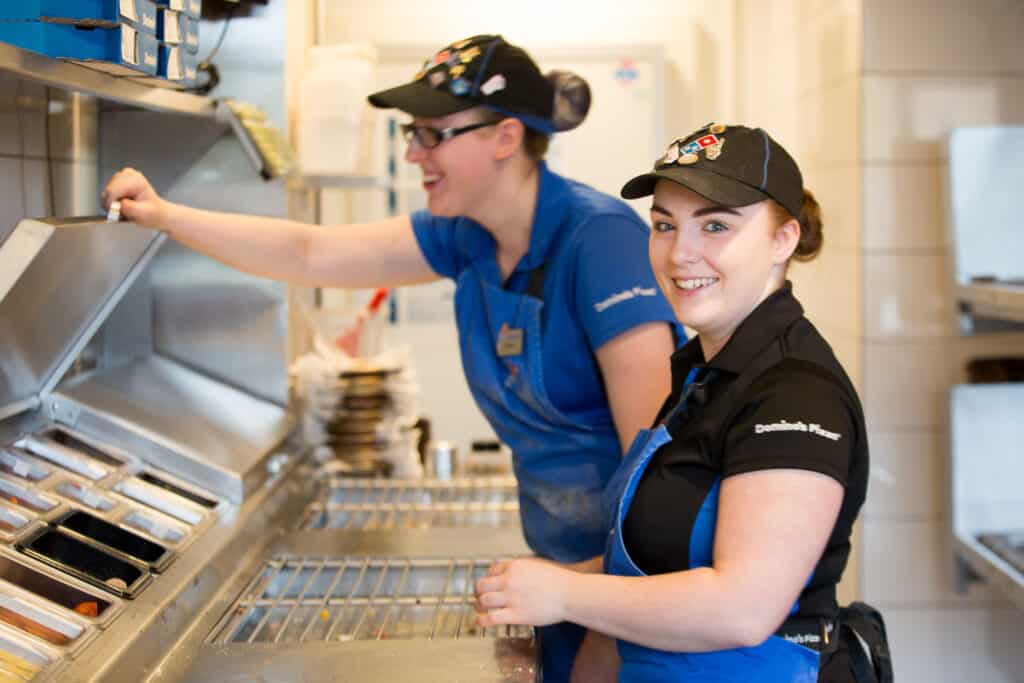
Before long, Blink integrated with benefits, payslips and holiday bookings. Domino's also began using digital forms for shift swaps and holiday bookings. The result? 85% adoption rate in less than a fortnight, and a strong long-term, communication strategy.

Background
Domino's Pizza Group is the UK’s leading pizza brand; their first UK store opened in 1985. They have over 1,000 stores across the country and more than 35,000 team members. Their vision is simple: to be the number one pizza company in the world. But their internal communication strategy was holding them back.
So, what happens when communication becomes critical in the wake of a global pandemic? And how do you reach frontline workers who are digitally and physically disconnected (see the winning types of internal communication)?
The challenge
Domino’s have a distributed workforce operating out of various sites. These include Head Office and Supply Chain Centers in Milton Keynes, Warrington, West Ashland & Naas.
Frontline processes were paper-based and manual with no practical way to reach everyone. Dominoes struggles to get key messages across, because communication relied on word of mouth, posters and consumer channels like WhatsApp.
Domino’s had no reliable channel for frontline communication. And employees needed consistent information – but paperwork posed a Covid-19 transference risk.
The internal communications strategy
The situation demanded an immediate flow of two-way communication. As a result, Domino’s launched Blink in April 2020 as a critical part of their Covid-19 response plan. The goal? Empower, equip and protect all frontline employees.
Before long, Blink integrated with benefits, payslips and holiday bookings. Domino's also began using digital forms for shift swaps and holiday bookings. The result? 85% adoption rate in less than a fortnight, and a strong long-term, communication strategy.

A 2022 Gallup report on the work environment found that businesses with engaged employees have 23% higher profits than companies with “miserable workers”. Such businesses also see lower absenteeism and higher customer loyalty.
Unfortunately, Gallup’s 2023 report goes on to tell us that only 23% of employees are actually engaged.
The solution? Effective employee engagement strategies designed to help you create a better company culture, reduce staff turnover, and eventually boost your company’s profits.
But before you can do any of that, you need to know how to measure employee engagement, and what measurement methods really work.
Once you have the tools to measure engagement, you’ll have a solid foundation for improving your engagement levels and reaping the benefits that highly engaged employees bring.
What to do before you start measuring employee engagement
Understand your workforce
Each employee is different with their own unique preferences, needs, and motivations. As such, it's important to get to know your teams well — their needs, challenges, and everything in between — so that you can tailor your employee engagement strategy to work best for them.
Start by getting to know your workforce better: who they are, how they work, and what currently gets in the way of them engaging.
For example, there is often a huge digital inclusion gap between frontline staff and their desk-based coworkers. This gap makes it very hard for frontline workers to engage with their organizations and roles – and even harder for business leaders to get to know them in the first place.
This is where engaging your first-line managers becomes crucial. By enabling first-line managers with the skills and tools to get to know their teams, you have a hotline directly to your frontline – and their engagement preferences.
It’s also important to consider the types of metrics you use for your specific workforce. Desk-based engagement metrics may not accurately reflect the engagement levels of people working in frontline roles. Transit, healthcare, logistics, or manufacturing workers (to name a few) will often have different requirements, channel preferences, and motivations for engagement than other employees.
Therefore, it's essential to understand the specific engagement requirements of your staff, track tailored engagement metrics, and create strategies to address them.
Agree on engagement goals and outcomes
Once you know your workers’ needs, it is important to agree on engagement goals and outcomes with other stakeholders in your organization. This could involve gaining the buy-in of senior management, employee representatives, or other key stakeholders.
Clearly defining your goals and desired outcomes will help ensure that efforts and metrics used to improve engagement are focused and aligned with your overall business strategy. Goal and outcome KPI could include:
Goal: Increase employee retention by 10%
Outcome KPI: Employee retention rate
Goal: Reduce employee turnover by 25%
Outcome KPI: Voluntary resignation rate
Goal: Drive employee satisfaction by 15%
Outcome KPI: Employee satisfaction survey or ENPS scores
By taking these steps before measuring employee engagement, you can ensure that you have a solid understanding of your workforce, metrics that reflect your business objectives, and clear engagement goals to achieve.
There are a number of metrics and methods that can help you gauge a holistic view of employee satisfaction, productivity, and overall engagement in your company, 10 of which we’ll dive into in more detail below.
10 ways to measure employee engagement
Both survey and non-survey methods are available methods to measure employee engagement. Typically, it’s best to use a mix of both to get a holistic overview of employee engagement.
How to measure engagement with survey methods
Surveys help you reach a considerable number of employees at once.
Running employee surveys can be a time-consuming, paper-filled process, but it’s still a great starting point for building the foundation of your employee engagement efforts. And with modern Employee Survey tools now available to streamline the whole process, it needn’t be such a laborious task.
Here are three survey measurement methods you can implement:
1. Annual employee engagement surveys
An annual employee engagement survey measures employees’ experience, motivation, and passion for their job and organization. It reveals how your employees go about their daily jobs and what you can do to improve their engagement on a large, long-term scale.
You can use these surveys to get ideas on areas for improvement and a basis for new recommendations and goals.
Similarly, you can use employee surveys to evaluate your company’s culture and see whether the desired cultural values are practiced among desk-based and deskless employees.
However, employee engagement surveys are only effective if you conduct them correctly.
Here are four best practices for conducting employee surveys:
Use a mix of survey questions: Ask both multiple-choice and open-ended questions. This helps your company collect the most insights into employee engagement without overwhelming respondents.
Leverage mobile apps:Paper surveys don’t cut it. They’re time-consuming since you wait for employees to return the survey papers before you can analyze them, and they’re often disregarded by employees completely or inaccessible by teams that are not in the corporate office, such as frontline teams. Digital surveys take far less time to create and share, and the response is almost instant. So, create surveys that employees can complete from their personal or corporate devices from any location.
Share employee survey results: Share the survey findings with your office and your frontline workers and let them know what actions you’ll take. Managers and leadership need to assure employees that they’re listening and taking into consideration the feedback received.
Identify the best time(s) to survey employees: It might be smart to run your survey during slower periods of work, so that employees have enough time to devote to the survey. Similarly, there’s solid advice to avoid conducting surveys during high-stress periods or bonus season. Such periods skew the survey results and give an unrealistic picture of everyday employee engagement and satisfaction.
2. Pulse engagement surveys
Employee pulse surveys allow you to send more frequent survey requests to your teams. Instead of the annual snapshot of data you gain from once-a-year surveys, pulse surveys let you measure employee engagement levels in real time.
This short survey format allows your teams to provide quick feedback on any aspect of the job or organization, from team dynamics and workflows to company policies and leadership. It’s a great way to learn more about what’s working for your employees on a daily basis and identify what could be improved.
Pulse surveys are much shorter, providing less data than annual surveys but offering real-time insights into employees’ current feelings about the workplace and their job satisfaction.
As such, pulse surveys can be incredibly effective at identifying any sudden decreases or increases in employee morale and engagement, helping you spot them and take action quickly.
You can also tailor pulse surveys to navigate different occasions and identify trends in employee engagement year-round, instead of just once a year. For example, you could send a survey after an important organizational announcement or when there’s been a period of major change.
However you choose to use them, regular pulse surveys are a great way to measure employee engagement and ensure your workforce feels heard.
3. Employee net promoter score (eNPS)
Chances are your organization is already using the net promoter score (NPS) to measure customer satisfaction and loyalty. The same metric can also be used internally to measure employee engagement.
The employee net promoter score (eNPS) provides a solid basis for understanding employee engagement and loyalty in a cost-effective way. By tracking the eNPS scores over time, you can identify trends in employee engagement — which can help you understand how the changes you implement affect staff engagement.
Expert tip: On its own, eNPS is not the most effective way to measure engagement.eNPS it tells you the ‘what’ but not the ‘why’ of an employee engagement score. Only measure employee engagement via eNPS if you can follow it up with more detailed methods, such as employee engagement surveys.
Further methods for measuring employee engagement
4. Implement an employee app with analytics features
Many leaders aren’t aware of the reasons behind the lack of engagement and increasing turnover rates in their business — especially frontline managers. Due to the nature of frontline organizations — varied work environments, conflicting shift patterns, and a historical reliance on paper — it is more difficult to engage with frontline workers and even harder to measure their engagement levels.
As such, employee feedback and surveys don’t always provide the response rates you want, and employees don’t always provide insights you can act on.
To address this, you can implement an employee engagement super-applike Blink to create a digital space that invites a multidirectional, real-time conversation where frontline workers (and their desked counterparts) can speak directly to management — and to each other.
You can also use this technology to measure the outcome of their work environment and assess how your workers engage with your content, interact with other teammates, and participate in company-wide conversations.
For instance, Blink offers Frontline Intelligence — anintegrated analytics tool that measures employee engagement by tracking:
Content metrics: See how your workers interact with posts, files, or pages you share. You can track important metrics such as reach, impressions, likes, comments, and link clicks.
Communication flows: View how many team members communicate with others using the employee app. Visualize the growth in communication and changes in relationships over time to keep a tab on your organization’s employee engagement.
Internal trends: Get an overview of trending posts and topics in the employee feed to understand which content performs best and when.
This allows you to uncover who your promoters of engagement are, and who’s in line with your company’s mission and values. You can capture the insights that aren’t explicitly communicated to you – and integrate that into your next steps.
This data can help you detect feelings of disengagement early on and do a root cause analysis before they become a serious problem, affect productivity and quality of work, and increase your turnover rate.
Ensure that you also measure the adoption rate for your employee app. A high adoption rate can be indicative that your employees are engaged in their roles and understand the value that a new tool is bringing to the business. You may see differences in app usage trends between the office and frontline workers. If that is the case, add questions surrounding employee app usage in the next employee survey.
If you’re looking for an employee app that’s designed for frontline organizations, check out Blink. This all-in-one platform gives:
Frontline workers access to the people, processes, communications, and applications they need to do their jobs — all through their corporate or personal devices.
Leaders access to the data they need to improve the employee experience in meaningful ways.
5. 1-1s
1-1s are one of the most effective ways to measure employee engagement.
These meetings allow you to have meaningful conversations with each of your team members about their performance, goals, and satisfaction levels. They also give employees an opportunity to provide honest and constructive feedback about their work environment, so that they can help influence real, positive change within the organization.
1-1s can be used as a more informal and frequent performance review, and they can give you detailed insights into the current state of employee engagement. By keeping track of these meetings over time, you can identify any sudden drops or increases in engagement, and take action accordingly.
6. Performance reviews and feedback meetings
As a more formal 1-1 process, performance reviews and regular feedback meetings can be used to make critical decisions on employee compensation, necessary training, and proposed career development. But you can also use them to gauge and measure employee engagement.
Highly-engaged workers are more likely to perform well in their jobs. Gallup found that engaged workers are 18% more likely to have above-average employee productivity.
To effectively gauge your employees’ performance and improve engagement, develop a continuous feedback process so that employees know how they’re doing and what’s expected.
Here’s how you can implement a reliable feedback process:
Create a list of opportunities when employee feedback can give you critical insights into how your company operates, such as at the close of onboarding and recruitment or during quarterly and annual performance reviews.
Use various methods and strategies to collect feedback to keep employees engaged and get the most relevant answers for the situation.
Implement engaging and constructive conversations between managers and employees at least once every two months. Ensure managers are practicing active listening and that they are actually implementing change based on the feedback.
Exit interviews are an important component of any employee engagement strategy. They provide invaluable insight into the reasons why employees choose to leave your company, and can help you identify areas that need improvement in order to keep your best talent.
What was the motivation behind your decision to search for a new job?
Can you identify the factors that had a positive or negative impact on your ability to succeed in your role?
Based on your experience, do you have any recommendations for onboarding new employees?
How did you feel about the management of your role?
Did you feel appreciated by your team, supervisors and/or managers?
What were the most enjoyable aspects of this job?
What was the most challenging aspect of this job for you?
Not all employees are willing to offer honest feedback during an exit interview, so consider implementing a post-exit survey where you can ask more detailed questions about employee satisfaction and engagement while the person is still employed at your organization.
This allows you to better understand the motivations behind each employee’s decision to leave and take action to prevent similar situations from occurring in the future.
If you want to stay two steps ahead of the exit interview, however, stay interviews can be a potentially transformative addition to your employee engagement strategy. Currently deployed by only 27% of US HR decision-makers, stay interviews help you understand how well your current employees’ expectations are being met when it comes to meaningful connections.
How to measure employee engagement through key metrics
8. Internal communication receptiveness
Effective internal communication can be used to bridge the gap between managers and employees, build trust in the workplace, and boost employee engagement. But it’s not enough just to communicate – you need to measure how your employees actually react and respond to the content you share.
That’s where key metrics come in. From employee app usage data, to the amount of content employees interact with or create, there are a number of metrics that can give you valuable insights about employee engagement.
You can measure receptiveness to your internal communication by tracking how much of your content is consumed, whether it’s posts or newsletters.
Specific metrics like post likes and response rates, message opens, and even file analytics can tell you how receptive your teams are to internal communication efforts. If you’re using a super-app like Blink, you can track these metrics over time to monitor how well your internal messages are being received.
The data from these analytics can give you the confidence you need to leave certain channels of communication behind. If frontline workers are not engaging with email — or don't even have access to it! — then waste no more time sending email comms, for example. An accessible mobile tool like Blink can pave the way for greater internal communication receptiveness by giving everyone equal access to messages, wherever they log in from.
9. Voluntary turnover rate
If an employee voluntarily resigns from an organization, it’s voluntary turnover.
Voluntary turnover is on the rise. According to the Institute of Corporate Productivity (i4cp) and Fortune’s global survey of 1,195 respondents in Q1 of 2022, 77% of large organizations experienced high voluntary turnover in 2021.
To calculate the voluntary turnover rate, divide the number of employees that voluntarily left your company by the average number of workers you had during that period.
These are the top reasons of voluntary turnover outlined in Microsoft’s 2022 Work Index report:
Personal well-being or mental health (24%)
Work-life balance (24%)
Lack of confidence in senior management or leadership (21%)
Lack of flexible work hours or location (21%)
In other words, a high voluntary turnover rate means your workers struggle to stay engaged with the company due to a lack of support and direction.
If you notice high voluntary turnover, conduct a voluntary turnover analysis to know the exact cause:
Check for trends: Compare your voluntary turnover rate to the previous period and look for possible trends and early warnings. For instance, if you see many employees leaving after two years, it may be due to a lack of career advancement opportunities. And if you see new hires leaving within the first year, onboarding might be the issue.
Gather employee feedback: Collect qualitative data from surveys and exit interviews to determine why employees leave your organization.
Prepare an employee turnover report: Translate the voluntary turnover data into monetary value. That’ll help you follow up with different departments and levels of hierarchy and develop an actionable plan to increase retention rates.
Analyzing the voluntary turnover rates for the first year is especially important since new employees represent a lot of pure cost. A time-to-productivity analysis can tell you when an employee’s productivity has risen to a point where their contribution outweighs their cost.
For example, if the average threshold productivity occurs at the six-month mark, any employee who leaves before that incurs a financial loss to the company.
10. Employee absenteeism rate
Absenteeism is the habitual failure to come to work or stay there during working hours, and it is often unplanned and unannounced.
It’s important to differentiate unexcused absences from legitimate ones, and to be aware of the disruption that absenteeism can cause to your organization. That’s because it will negatively affect anyone working with this individual and undermine trust between employees and management and the employees themselves.
A high employee turnover rate is a strong indicator that your company needs to make adjustments before this behavior impacts your workforce’s productivity and relationships. Absenteeism is often also a reflection of poor management, so your managers must be aligned on the appropriate policies and be upskilled to develop their leadership abilities.
To measure the absenteeism rate, divide the number of unexcused absences in a given period by the total workdays. Multiply the result by 100 to get the absenteeism rate for that period.
As a rule of thumb, an absenteeism rate of 1.5% is considered healthy. Employees do fall ill and request time off for various reasons, so you shouldn’t expect a rate below 1.5%.
However, an absenteeism rate above 2% indicates issues. Your workers may be burnt out, feeling disengaged, or in conflict with their peers or supervisors.
The best way to prevent employee absenteeism is to intervene early.
Develop an action plan by:
Asking your managers to arrange regular check-in meetings, especially with underperforming employees.
Implementing flexible work policies for employees struggling with personal issues.
Getting your managers to address the problems between workers who are having conflicts.
Ensuring management forms meaningful connections with employees and their leadership style receives positive feedback.
Comparing employee engagement measurement methods
How not to measure employee engagement
Measuring employee engagement incorrectly often leads to unreliable results and an inaccurate view of how well your team is doing. Common mistakes when it comes to measuring engagement include:
Not setting KPIs (Key Performance Indicators) which can provide you with measurable goals to strive for. Without these, it can be difficult to determine whether the changes you've implemented have had a positive or negative impact on your employee engagement levels.
Relying on just one method to measure engagement, such as employee surveys. This can not only be a problem that stops you from capturing the full image of engagement for your employees but can also lead to the overuse and over-reliance on surveys to measure engagement.
Ineffective methods of communication. If you rely on a communication channel that employees aren’t engaging with today —like an intranet — then you're highly unlikely to capture the richness of data that you need. That’s why we would always recommend an employee super-app over a back-end intranet.
What to do after you have measured employee engagement
Whatever your employee engagement metrics and methods show, it’s important to note that engagement is not an activity, project, or initiative. It's an outcome you earn from consistently offering value to your business.
Remember: as trends continue to change, so will employee expectations. Keep your finger on the pulse of employee engagement levels within your organization and take swift action where necessary.
There are many digital tools to keep a tab on employee engagement. However, the best solution is one that’s designed specifically for your employees, and can provide all of these solutions in one place.
If you have a frontline-focused workforce, check out Blink. Blink offers interactive employee surveys, cutting-edge content analytics, and intuitive communication tools to measure and actively improve employee engagement.
Blink provides a solution to fixing the broken feedback loop and filling the knowledge gap between leadership and frontline workers.
For business leaders, having a strong team is essential for the success of their organization, especially if your teams are dispersed, deskless or remote. But how can you ensure that your team is performing at their best, wherever and however they work? How can you truly improve teamwork in the modern workplace?
The truth is, there’s no one-size-fits-all approach when it comes to how to improve teamwork in the workplace. The best thing you can do is experiment with many different methods until you figure out what works for your workers’ needs. That’s why we created a list of strategies for you to choose from.
So, how can you improve workplace teamwork?
This post covers 22 creative ideas to consider, plus discusses the differences in improving teamwork for frontline teams.
Improving teamwork in frontline teams vs desk-based teams
It's important to acknowledge that there are key differences in ways of improving teamwork depending on whether your team is desk-based or on the frontline.
With desk-based teams, developing better teamwork skills might involve setting clear goals, implementing agile project management techniques, and creating an inclusive work culture. You’re likely going to be able to have regular and easy face-to-face meetings to keep team members engaged and up to date on team projects. Your tactics for improving teamwork, therefore, become a little more straightforward and almost naturally occur.
Frontline employees, on the other hand, require a bit more attention and thought. Frontline workers aren’t going to be sitting at their screens all day, and they may not meet in a central location like an office. This is why you may need to implement specific teamwork tactics for this group of employees.
For example, you might focus on workflow optimization and really driving efficient two-way communication between teams and leaders in order to compensate for the lack of a central location and “office chit-chat.” Tightening your comms between the frontline and desk-based teams ensures everyone is on the same page and working towards a common goal.
Whether you’re managing a frontline or desk-based team, what really matters is that you listen to the direct needs of your workers. What does their day-to-day life at work look like? How can you provide your teams with the right tools to succeed as a team, wherever they may be working from? The creative ideas outlined in this guide should help you brainstorm some out-of-the-box solutions for improving teamwork in your workplace.
How to improve teamwork: First steps for leaders
Using the innovative tips we've outlined for you below, you can inform your regional managers, team leaders, and line managers, so they can start implementing these ideas with their respective teams. But before jumping straight into the fun, get-your-hands-dirty type of team building, it's important for leadership to lay down some groundwork.
Here are our first steps for business leaders looking to improve teamwork in their workplace:
Clearly define team goals, roles, and responsibilities
Communicate openly and frequently
Foster a culture of accountability and support
Find the right employee app to support your workforce.
21 innovative ideas to improve team performance
1. Involve team leaders in corporate communication
Leadership is a crucial driver of teamwork. For teams to work effectively, objectives need to be clearly defined. Competing projects and responsibilities pull most team members in different directions (see the corporate communications strategy tool).
For example, leaders in the manufacturing industry can often be stationed on the factory floor, where they may not have easy access to company-wide communications. This can lead to a disconnect between their team and overarching company goals.
It’s up to leaders to set the bigger picture so they can set priorities. Ensure leadership is involved in internal comms planning so employees at all levels across multiple teams can understand the overarching company goal towards which they’re working. If all team members understand their place in the bigger picture, it will help motivate and align their efforts towards a common goal.
2. Create teamwork recognition programs
Rewarding successful collaboration creates an incentive for people to do so more frequently. Collaboration is significant for deskless and frontline employees who might not feel like part of the team.
Find ways to publicly acknowledge the hard work of effective teams, whether by giving them an award in front of their peers or by sharing their wins in a writeup. Teams who win together will continue to work well together.
Teamwork recognition programs will be especially important for frontline or remote teams, as they may not receive that natural praise that occurs in an in-person or office setting unless it is directly communicated with them.
In fact, employee engagement statistics show that nearly 4 in 10 (37%) frontline workers don’t feel as valued as their desk-based colleagues. One solution to this is to provide an employee app with a recognition feature, such as Blink’s Recognition.
By providing direct tools that enhance recognition or Kudos between team members, leaders can increase collaboration, job satisfaction and more natural engagement.
3. Clarify ownership early on
Teamwork is challenging when people aren’t sure what their roles are. Ambiguity can lead to resentment, arguments, or even delayed projects. So, clearly document the scope of each role from the get-go. And make sure that documentation is accessible to everyone, so that when questions arise, they’re easy to answer.
For example, Blink users can store this information in the Hub. This allows workers that are frequently on the go to have easy access to job responsibilities and sets the tone for role ownership.
4. Make communication a two-way street
Teamwork only works when team members feel like they can speak openly, share ideas without getting shot down (and build on those of others), make suggestions, and voice their opinions.
Make sure communication isn’t just flowing downward, but also upward and between team members. Multi-way communication is the goal. A communication tool that allows employees to engage in two way conversations with each other and with management is a great way to facilitate this.
Outlining clear roles isn’t enough to keep teams operating smoothly. The next step is figuring out who is responsible for what work (on what timelines). Get the team together to outline skill-sets and create project workflows and deadline charts. Oh, and make sure everyone's present when the discussion happens. That way, team members can call out unrealistic expectations of them.
6. Have a clear organizational purpose
Every member of a team should be clear on what the long-term goals of the company are. This ensures the team projects are purpose-driven and valuable, have clearly defined and measurable objectives, and that everyone on the team moves in the same direction.
Having a purpose-driven team impacts engagement levels, productivity, and innovation. When team members have a clear understanding of why they’re doing what they do, they are more likely to feel motivated and inspired to work towards that purpose.
If your company doesn’t have a clearly defined purpose or mission statement, now is the time to create one. This initiative can be guided through brainstorming sessions or employee surveys, and can be stored in an easy-to-access, mobile Hub for on-the-go guidance.
7. Set clear team goals
When you're talking about improving teamwork in the workplace, the importance of clearly defined objectives can't be overstated. Teamwork is basically impossible in an environment where no one is sure what the team is working toward. You need to be sure that everyone on every team is on the same page.
To help with this, you can establish team processes that guide behavior and decision making towards meeting your goals. Whether that means letting other project members know the status of your work, or always speaking up if you see a problem that could affect the team’s success, setting clear expectations helps team members work better together.
An employee app like Blink can keep each team member on the same page and working towards the same goal with secure direct chats, the Blink feed for key updates and a central hub for storing policies, procedures, and guides in one convenient place.
8. Identify communication problems
Doing an internal comms assessment may seem like a strange way to bolster teamwork, but remember that effective collaboration can’t happen without effective communication. Addressing communications pain points and sources of strife (e.g., failure to meet deadlines, unresponsiveness, and interpersonal issues) in your organization proactively will make it easier for all of your employees to collaborate in the future.
To better identify and understand communication problems arising in your teams, particularly on the frontline, you need a way to measure them.
With Blink's Frontline Intelligence feature, you can track powerful engagement analytics to offer insight into the people and relationships that make your organization tick. By understanding who engages with what, and what your teams aren't engaging with, you have the opportunity to spot any potential communication pain points and address them before they become a larger issue
9. Stop micro-managing
Teams should feel like standalone units even as they contribute to your larger organizational goals. If you don't give your teams some degree of autonomy, they won't work as a collective because they'll always be waiting for management to issue orders from on high. As much as possible, let teams set their deadlines, develop their workflows, and work out their issues.
10. Talk less, listen more
There will always be give and take on teams, but the giving and the taking eventually has to balance out, or resentment will build up, and work will slow down. Ensure your company culture rewards listeners as much as speakers and sets a good example by being a listener yourself.
You can also give those whose ideas and opinions would ordinarily be drowned out a voice by encouraging people to share outside of team meetings (on an employee engagement app like Blink, during open-door hours, etc.).
Encouraging a culture of listening will not only have a positive impact on teamwork but on the workplace in general as it will make employees feel valued and increase engagement between team members.
When team members feel heard and their opinions valued, they’re more likely to contribute and collaborate effectively. So next time you’re in a meeting or brainstorming session, remember the age-old adage: it’s better to listen than to speak. Your team will thank you for it.
11. Let teams use multiple methods of communication
Different employees communicate in different ways. Some, as noted above, will dominate a meeting. Others prefer to speak one-on-one while others feel most comfortable in a chat room or texts.
Deskless and frontline employees may be most efficient when using an employee app or similar communication tool. In any case, letting teams use whatever forms of communication and communication tools they prefer is another way to ensure that everyone can have their say.
One way to facilitate this is to provide your workforce with a mobile and desktop employee communication app, like Blink, that allows for various forms of communication and feedback within one easy-to-access, flexible platform.
12. Mediate disputes
Some companies approach conflict resolution with a wait-and-see approach, but that doesn't work very well for team members' disputes. Because these disputes can quickly grow into serious issues that interfere with projects, it's necessary for team members to address them proactively. Ensure interpersonal conflicts are written and bring in mediators as required to work through issues between colleagues.
13. Allow flex work
Introverts, early risers, night owls, and caregivers can all be valuable team members, so don’t ignore them when you’re considering how to improve teamwork in the workplace.
Offering employees flex work options like telecommuting and quiet workspaces ensures that your entire workforce can be as productive as possible and take advantage of opportunities to work collaboratively.
Flex work can also have a positive impact on overall employee satisfaction and mental health by improving work life balance and decreasing stress levels.
So consider offering flex work options, along with the right employee engagement tools to keep your team engaged, and see how it improves teamwork in your organization.
14. Use better collaboration tools
Integrated tools like Blink encourage effective teamwork because they put all of the resources employees need to collaborate in one place. There are information management tools, agile project management tools, sharing tools, scheduling tools, team project and task management tools, and admin tools in one place, so teams don’t have to waste a lot of time switching between platforms.
If you are working with a remote team, you may also want to consider adopting a cloud-based desktop virtualization solution such as V2 Cloud, which provides complete access to a full Windows desktop from anywhere, with any device. It’s crucial to have the right infrastructure when working with a hybrid policy to boost better collaboration and productivity.
This enables distributed teams to accordingly give members access to a multi-user Windows operating system with Microsoft Office, Quickbooks cloud hosting and all business applications that employees and consultants require.
15. Ask team members for feedback
Knowledge is power, so if you want to know where your workforce is when it comes to teamwork, why not just ask them? Soliciting feedback doesn’t have to be complicated or time-consuming.
Open and honest feedback is a vital cog in the teamwork wheel, especially for frontline workers. If team members feel they have a safe space to share their thoughts and concerns, even when they're out of the office loop, they’ll likely be more engaged and willing to contribute their ideas in future. This can help to guide future team-building processes and be part of your employee engagement strategy.
Blink offers surveys within the employee app so that all employees have the opportunity to provide feedback - or do short interviews with team members to see how projects are coming along.
16. Hire wisely
It’s so tempting to fill positions with candidates who have the top qualifications but don’t discount the importance of an applicant’s personality. When you know that a new hire will be working as a part of a team, consider involving that team in the hiring process.
You may know what kind of skills and experience a hire should have, but they will have more insight into how well potential hires will or won’t fit in with existing team members.
17. Start a culture committee
Did your company’s culture develop intentionally? Probably not. Suppose your company culture grew more or less organically and isn’t really supporting teamwork initiatives. In that case, you can create a culture committee to retool your company culture so that it supports collaboration, openness, and other values you deem necessary.
18. Create a mentor program
Team members will work together more effectively when they feel connected. Creating a mentor program that pairs new team members with company veterans promotes cohesiveness and smoother collaboration.And for deskless workers, the benefits of a mentor program reach wider than just your employees.
Studies show that providing coaching and mentoring for frontline practitioners can have a positive mediating impact on outcomes for the children, young people, families and communities who use these services.
19. Meet in different locations
You can cut down on the number of meetings teams have to attend by doing more of your communication in an employee app like Blink, but that doesn't mean you'll never need to have another meeting. When you have to meet, hold meetings in new locations in the office or local cafes or other public spaces. Talking outside of the office can increase productivity, inspire communication, and make team members more creative. Just make sure you’re aware of the risks associated with using public wifi and take appropriate measures to protect yourself from cyberattacks.
20. Create team traditions
When teams have their traditions, and inside jokes, they'll naturally feel a sense of unity. That solidarity will positively impact the work they do, whether in the office or out. Encourage teams to eat lunch or take a coffee break together, or hold a team vs. team board game or video game competition.
This can help to build teamwork skills in a lighthearted and relaxed environment, promoting team collaboration.
21. Mix it up
Teams that have been working together for a long time work better together and may be more productive because of the trust and familiarity that has built up over time. Newly-formed teams, on the other hand, are typically better at coming up with new ideas and making big leaps. Don’t be afraid to shift people around or to form new teams.
You can’t force teamwork. Collaboration is something that happens naturally when conditions are right. Implementing some or all of the ideas above can set the stage for smoother teamwork at your company—resulting in higher productivity (and more profit).
How can the right employee engagement app improve teamwork in the workplace?
As mentioned above, using an employee engagement app can cut down on the number of meetings teams have to attend, allowing them to spend more time actually collaborating and working on projects.
Additionally, having a central place for all company announcements and updates can improve communication between desk-based teams and frontline workers—who make up a whopping 80% of the global workforce.
By facilitating and driving engagement, the best app for business teamwork will enable teams to work together effectively, improve the employee digital experience and help them stay on top of their day-to-day tasks, goals, and communications. By making teamwork easier and more efficient, an employee engagement app can ultimately result in improved productivity and stronger team collaboration, particularly for frontline teams.
Plus with key employee engagement data, analytics and insights available through the Blink platform, your leadership team can always stay on top of who's engaging with what to streamline the employee experience and encourage teamwork.
Why workplace teamwork matters so much
Collaboration is the backbone of business success. In fact, the strengths and dynamics of your team directly affect your business outcomes.
In the modern knowledge economy, productivity often involves working with people from different backgrounds, skill sets, and industries. One mind alone cannot generate solutions to the kinds of large-scale problems companies have to overcome to succeed.
The most successful companies think regularly about how to improve teamwork in the workplace because they know they’ll see a return on their investment. They actively work to create the kinds of conditions that promote collaboration.
Here’s the ROI these organizations see:
Boosted employee engagement
Worker engagement distinctly increases when employees can regularly work together in teams and collaborate. The ADP Research Institute surveyed over 19,000 workers and found that feeling part of a team is a massive factor in employee engagement: those employees who felt like members of a team were more than twice as likely to be fully engaged.
In addition, research by McKinsey shows us that the most engaged workers are those who work in teams. They are twice as likely to be fully engaged as people who work on their own.
Collaboration breeds innovation
When teams work together smoothly, they harness the power of diversity and can come up with ideas an individual might struggle to come up with alone. Alexia Cambon, Director of Research at Gartner, says:
“Our research shows that teams of knowledge workers who collaborate intentionally are nearly three times more likely to achieve high team innovation than teams that do not use an intentional approach.”
As such, it’s important to make sure teams have the right tools and processes in place to collaborate effectively. This might include a live, collaborative Feed for easy access to live updates project materials, a team chat tool for quick communication, and regular check-ins to ensure everyone is on the same page.
Teamwork is faster
Teams that work together also tend to work faster because they can draw upon a wider range of opinions, skills, and experiences, whether they’re making decisions or putting together plans.
Divide difficult tasks into simpler ones, then collaborate to complete them faster
Develop specialized skills, so that the best person for each task can do it better and faster.
So encourage teamwork in your organization and watch productivity soar. Not only will speed increase, but it will maximize your efficiency and give your team the opportunity to learn and grow.
Simply put, more brains = more productivity
When an entire team is working on a project, that project will move from the design phase into the implementation phase more quickly, and more efficiently –– even with fewer resources.
Teamwork leads to learning opportunities
Working collaboratively gives all team members an opportunity to learn others’ experiences. They gain insight from fresh perspectives and learn new ways of doing things. This can lead to greater job satisfaction, as well as improved morale and productivity over time.
In addition, team projects can serve as valuable development opportunities for individuals’ skills and experience, helping them grow in their careers, and even develop higher levels of loyalty to your business.
“By sharing information and essentially cross training each other, each individual member of the team can flourish,” reports Atlassian.
Collaboration builds confidence
People who work on effective, supportive teams feel valued and appreciated because they know they have something special to offer the team. And as we’ve discussed many times in the past, employees — especially introverted employees — who feel valued are more engaged.
Of course, it’s important to clarify that questions about how to improve teamwork in the workplace aren’t just being asked by employers. Surveys show that most employees consider teamwork very important, even if they’re not sure how to improve collaboration in their workplaces.
In addition, a person who feels valued as part of a team will feel more confident and willing to share their ideas and take calculated risks. Should they stumble, they know they have a team there to lift them back up.
Final Thoughts
Ultimately, fostering a culture of teamwork takes effort, but it’s worth it for improved productivity and satisfaction in the workplace.
By implementing some of these ideas and using an employee engagement app like Blink, your employees will feel more connected, communication will improve, and your team’s collaboration will thrive. Happy teamwork!
Blink’s employee app makes working in teams a breeze.
Scrolling through Blink, I see so many stories about people going the extra mile and that is fantastic — we do that every day in Heathrow as part of our own expectations of ourselves. We work together to make sure that whatever needs to get done, gets done.
Jamie is the backbone of Heathrow and without him it would not be the same. Jamie was the first employee to go into a COVID household — and he isn’t even a tech! He just gets involved in all aspects of the operation. Jamie lives Medequip values and that’s why I had to nominate him.
What does he want to do next?
To continue being a valued member of the Medequip team. He’s a selfless person!
On 14th May 2024, Workplace from Meta announced that it would be closing, leaving its rumored 10 million users looking for a new digital home for communication and engagement.
Blink and Workplace share many features, but ultimately Workplace by Meta is a communication tool, and Blink’s platform is designed to be used as an all-in-one communications app and intranet replacement.
How they’re similar
Employee newsfeed
Workplace is explicitly designed to feel like a natural extension to Facebook, so the user experience is streamlined and simple to use. But the emphasis on socialization may not be suitable for every work culture, and some reviewers mention, “The easy access to the Facebook newsfeed keep distracting me from my works for hours.”
Blink’s real-time Feed is easy to understand and engage with because of streamlined, familiar options like reactions and comments. But Blink blends the social engagement features users naturally gravitate towards with business-minded additions. The newsfeed is also personalized based on each employee’s team, interests and role, and content categories are segmented, reducing social ‘noise’ in the feed. Employees can also filter their newsfeed, so they never miss what they need to see.
Finally, Blink Assist uses AI to aid and empower employees at all levels of a business to create and share content.
This makes Blink a strong Workplace alternative for companies that want to encourage engagement without distraction.
Chats
Both platforms have similar chat features useful for teamwork and project management, supporting file sharing, GIFs, images and videos.
Both platforms enable users to create custom chatrooms based on teams, workgroups, or topics. When work is done, users can turn off notifications or set their status as away.
When the task requires extensive communication over video, both platforms enable remote teams to start a video call right from the chat group. The only difference is that Workplace does this through its proprietary video app, while Blink integrates with Zoom, Google Meet, and Teams to fulfill the same role with more flexibility.
Employee engagement
Both platforms facilitate employee engagement by providing tools for feedback collection such as surveys and polls, colleague recognition posts, milestone celebrations, and new starter introduction videos.
Blink provides richer survey functionality, including milestone surveys for example during the onboarding process, and sentiment analysis to understand where and why employees are disengaged.
How they’re different
Knowledge Library / Digital Hub
Workplace’s intranet replacement is its knowledge library, organized by an unlimited number of group pages. The library is static, and some reviewers say, “It is not always the easiest to locate what you are looking for.”
Blink improves upon the outdated intranet concept with its Hub. It aggregates essential documents, pulls relevant documents from third parties like Sharepoint provides seamless access to HRIS, roster system, benefits, learning tools etc. through single sign-on.
Blinks forms and custom microapps can fully digitize manual processes and workflows, offering significant operational improvements.
If you’re looking for a powerful all-in-one communications app and intranet replacement, Blink is a good Workplace alternative.
Analytics
Workplace’s insights panel can tell you how active your members are, the top contributors, sentiment analysis etc.
Blinks enhanced workforce analytics go far beyond usage data. Our analytics collate and correlate multiple data points to provide a breadth of insight on your workforce. These can be drilled down to department, manager, location level to provide deeper, actionable insight. Your dedicated CSM can help you to turn actionable insights into action plans which can be distributed via automated notifications through the feed to ensure that action happens and track the impact of actions
Dedicated customer support manager
With Blink, your organization receives a personal implementation manager and the support of our broader team of experts to design a solution to meet your objectives and see you through onboarding to ensure successful implementation with 90%+ activation.
Then, a customer success manager helps you optimize the app for your needs and to improve key metrics like reach, engagement, retention and efficiency.
You get regular check-ins and personalized support 24/7, forever, no matter your subscription tier.
Support from Workplace by Meta is much less personalized. When you need something, you have to fill out a form and wait for a customer service agent to get to your ticket with a turnaround time of 24 hours.
For advanced support (with turnaround time below four hours), Workplace charges $2 more per month, per user.
That’s why Blink is a great Workplace alternative for organizations that place a high priority on customer service.
One app vs. two
Workplace by Meta requires each employee to download two apps on their phone: one standard app for groups and the newsfeed and a second app dedicated to the chat function.
Blink’s features are less intrusive and come streamlined with everything ready to use from a single app, making it an excellent Workplace alternative.
Security
Blink holds itself to banking-grade security standards, which means that it uses GDPR security measures like encryption, ISO 27001 compliant data centers, and HTTPS encryption during transmission.
Given Meta’s reputation with data, users are less confident about Workplace’s security, saying, “Security, especially of recent, is always a big question mark and concern.”
Integrations
Blink’s extensive in-app integrations enable the platform to work as a digital front-door for every technology your workspace needs to operate.
It seamlessly integrates with most apps in your workflow, from big-name apps like Google Docs and Microsoft 365 to all major HRIS to niche industry tools.
In contrast, most Workplace integrations involve automation bots or shortcuts that take the user out of the app. This can foster a disjointed employee experience.
So for organizations that already know they will be using several internal communication tools together, Blink is a better Workplace alternative.
Blink vs. Workplace by Meta — final thoughts
The right employee communication app for you depends on whether you’re looking for a familiar one-size-fits-all solution to increase communication or a highly customizable platform to boost employee engagement.
Organizations that appreciate personalization, deeper integrations, actionable insights, quality customer support, and security will find Blink an excellent Workplace alternative.
If you’re in doubt, book your free demo with Blink today and see for yourself.
“Blink for Everyone" allows nonprofits to maintain connectivity and engagement
Boston – May 28, 2024 – Blink, the leading employee engagement super-app, today announced the formal launch of "Blink for Everyone," a program offering non-profit organizations access to its platform free of charge. This initiative builds on Blink’s commitment to support nonprofits with the essential tools they need to stay connected and engaged, especially during transitional times.
Meta’s decision to pivot away from Workplace has left many non-profits facing increased costs or a loss of critical connectivity. Blink for Everyone addresses this gap by offering a mobile-first, unified platform that enhances communication and collaboration among team members.
“Nonprofits are essential to society and our communities and we want to enhance their impact by offering access to an all-one-one people engagement platform,” said Sean Nolan, CEO and founder of Blink. “With the closure of Meta’s Workplace for Good, many organizations are searching for alternatives. Blink for Everyone is our commitment to help non-profits continue their vital work without the burden of additional costs. We believe in equality of access, where every worker, whether desk-based or deskless, has the tools they need to thrive.”
Nonprofit organizations using Blink have already reported significant improvements in their operations and employee engagement.
"Blink has significantly enhanced our organizational communication with its intuitive interface, leading to a positive shift within our workforce," said a representative from St. Amant. "Since adopting Blink, our dispersed teams have become more informed and connected, fostering a sense of unity and collaboration."
Chris Lawley, board member, Destiny Rescue remarked, “Blink has revolutionized how we connect, communicate and collaborate as an organization. As a globally dispersed team, we were struggling with keeping our teams connected in real-time. Blink's support for non-profit organizations allowed us to adopt their world-class technology without a license fee. Important information is now being shared seamlessly across continents, making our operations safer and more efficient."
Blink features and benefits
Two-way communications: augmented with an integrated activity feed and a centralized resource Hub.
Mobile-first approach: a single application for all company-focused interactions, ensuring accessibility for all employees.
Seamless experience: Facilitates smooth communication and engagement across the entire workplace.
Scalability and Configurability: Easily scales and supports organizations of all sizes, ensuring flexibility and adaptability.
Blink’s mission is "connect everyone, so everyone thrives." This initiative reflects Blink’s commitment to ensuring that all organizations, regardless of their size or budget, have access to the best tools for communication and engagement.
Nonprofits interested in Blink for Everyone can register their interest on Blink's website.
About Blink
Blink is a provider of a leading super-app designed for frontline organizations. The company aims to revolutionize employee work life by bridging the digital divide between deskless and desk-based employees, enabling effective communication and engagement in distributed organizations. Blink is used by industry-leading companies, including RATPDev, Elara Caring, and Domino’s. Each user opens the app an average of seven times a day, helping lower frontline attrition by up to 25%. Founded in 2015 and with offices in London, Boston, and Sydney, Blink is a Leader in the G2 Grid® for Best Employee Engagement Software. Visit Joinblink.com for more information.
Every week is EMS Week at Blink — because we care, too
EMS Week may be over, but at Blink, our appreciation for emergency medical professionals doesn’t end with the calendar. For us, recognizing the lifesaving work of EMTs, paramedics, and staff isn’t a once-a-year gesture — it’s a year-round commitment grounded in care.
This year’s EMS Week theme, “We care for everyone,” says it best. EMS teams are there for all of us — and it’s our job to be there for them.
Behind every siren is a team that deserves support
The reality of working in emergency medical services is demanding on every level. Long hours, unpredictable situations, and high-stakes decisions are just part of the job. And for EMS professionals, that job never really stops — holidays, weekends, middle-of-the-night calls.
It’s a role that requires not just skill and courage, but constant coordination, communication, and clarity. And that’s where Blink comes in.
Caring for others starts with caring for your team. That’s why Blink is designed to meet the needs of EMS professionals — not just as employees, but as people.
At Blink, we’re proud to serve thousands of paramedics, EMTs, and staff across some of the country’s largest EMS organizations.
Assisting EMS behind the scenes
We’re proud to work with EMS organizations across the country — from city ambulance services to rural responder units — to help their teams stay connected, informed, and empowered, no matter where the job takes them.
Whether they’re responding to an emergency or prepping for the next shift, EMS workers need tools that work as hard as they do.
With Blink, EMS organizations can:
Send real-time updates about protocols, routes, or equipment changes
Deliver training resources straight to mobile devices
Coordinate shifts and crews with better visibility and fewer delays
Recognize outstanding work with peer-to-peer shoutouts and leadership messages
Give employees a voice with surveys, feedback tools, and two-way communication
Foster connection between teams that rarely see each other face-to-face
Poor communication is the #1 most common stressor for EMS workers (BMC Emergency Medicine)
Built for the field — not just the office
EMS professionals don’t spend their days behind a desk. So why rely on systems that expect them to?
Blink is a mobile-first employee experience platform, built for people whose work happens on the move. We make it easier for EMS leaders to reach every team member — from the newest trainee to the most experienced paramedic — and equip them with the information they need, when they need it.
EMS professionals care for everyone with every call they answer. At Blink, we believe the same care should be extended to them — through tools that reduce friction, strengthen connection, and show that their work and well-being truly matter.
We believe EMS teams deserve more than recognition during one week of the year. They deserve better tools, better communication, and better connection — every week.
To all the EMS professionals working tirelessly behind the scenes and on the frontlines: thank you. We see you, we support you, and we’re committed to building technology that helps you do what you do best — saving lives.
Blink. And keep your EMS teams stay connected — every hour, every shift, every week.