Most intranet comparisons are written by people who've never had to get a nurse, a warehouse picker, or a hotel housekeeper to download an app. Blink. has. We've onboarded 87% of a 10,000-person workforce in 10 days, and we've watched the platforms that look great in a demo fall apart the moment they meet someone without a corporate email address. That's the lens this guide is written through.
Most intranet software was built for people who sit at desks all day. That's a problem when roughly 80% of the global workforce doesn't have a desk, a laptop, or a corporate email address (Emergence Capital, The Rise of the Deskless Workforce). This guide compares 15 intranet software providers for 2026, covering features, pricing, strengths, and where each platform falls short. Whether you're replacing SharePoint, consolidating tools, or reaching workers who've never had an intranet before, you'll find your shortlist here.
Last updated: May 2026.
The short answer
For organizations with significant frontline or deskless populations, the realistic shortlist is Blink., Staffbase, or Firstup, with Simpplr a strong choice if your workforce is mostly desk-based and you want AI-native search. SharePoint and Microsoft Viva remain the default if you're deeply standardized on Microsoft 365 and have IT capacity to configure them. Everything else fits a more specific use case.
Quick comparison: top intranet software at a glance
What is intranet software?
Intranet software is a private digital platform that connects employees within an organization to company news, documents, tools, and each other. Unlike the public internet, an intranet is accessible only to authorized workers and serves as a central hub for internal communication, knowledge sharing, and day-to-day workflows.
Modern intranet platforms have moved far beyond the static page repositories of the early 2000s. Today's best intranet software includes AI-powered search, personalized content feeds, mobile apps, employee recognition, surveys, and integrations with tools like Microsoft 365, Google Workspace, and HR systems. For a deeper look at what these platforms should do for distributed teams, see our guide to internal communication tools.
For organizations with frontline and deskless workers, mobile-first intranet software has become essential. See our complete guide to team communication tools for deskless teams for the wider category.
Which intranet platforms actually work for your team?
Not all intranet software serves the same audience. The biggest split in this market is between desk-first platforms (built for knowledge workers with laptops and corporate email) and whole-workforce platforms (built to reach every employee, including those on the shop floor, behind the wheel, or on a ward).
If your organization has a significant frontline or deskless population, this distinction matters more than any feature checklist. A platform that scores perfectly on Gartner's criteria but requires a corporate email to log in will fail for the workers who don't have one. For more on closing that gap, see frontline digital inclusion.
Here's how each platform stacks up.
1. Blink.
Best for: Organizations with frontline and deskless workers who need a mobile-first intranet. Works across SMB and enterprise.
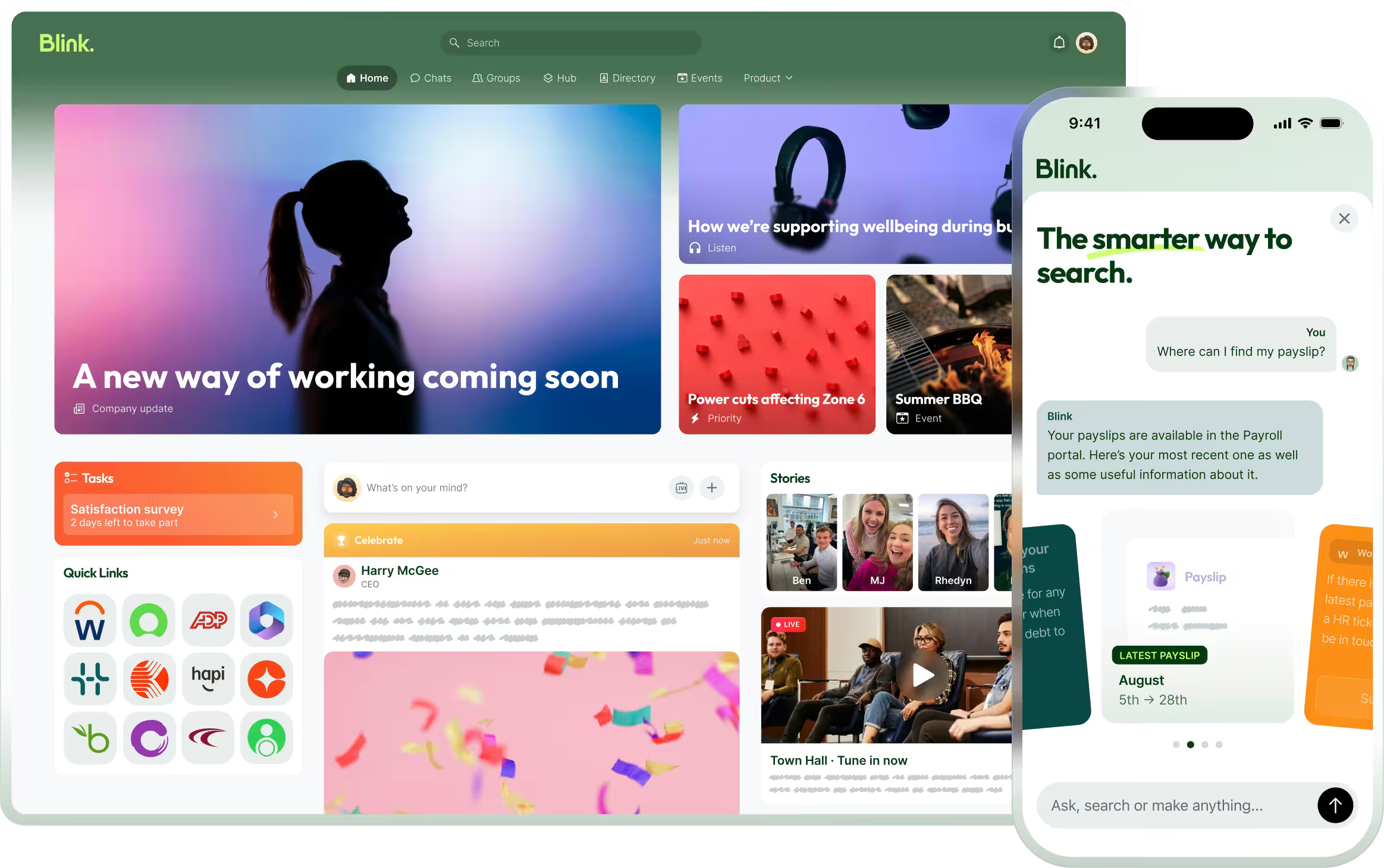
Blink. was built from the ground up for workers who don't sit at desks. The mobile app is the primary experience, not an afterthought, and employees can join via phone number or QR code with no corporate email required. The platform combines a news feed, team chat, a searchable Hub, surveys, recognition, and digital forms in a single app.
Key strengths:
- Mobile-first architecture with offline access
- No email or IT setup needed for workers to join
- 87% adoption at JD Sports in 10 days, 20,000+ active employees at easyJet (Blink. customer stories)
- Native integrations with Microsoft 365, Salesforce, and major scheduling and HR systems (Blink. integrations)
- AI assistant on the Pro tier
- Recognized in Gartner's Market Guide for Employee Communications Applications
Where it's limited:
- Less suited for organizations that want a traditional document-heavy desktop intranet
- Pure knowledge management is not the lead use case
Pricing: Core at $3.75 per user per month (annual), Pro at $5.00 per user per month, Enterprise custom. Free trial across all tiers (Blink. pricing).
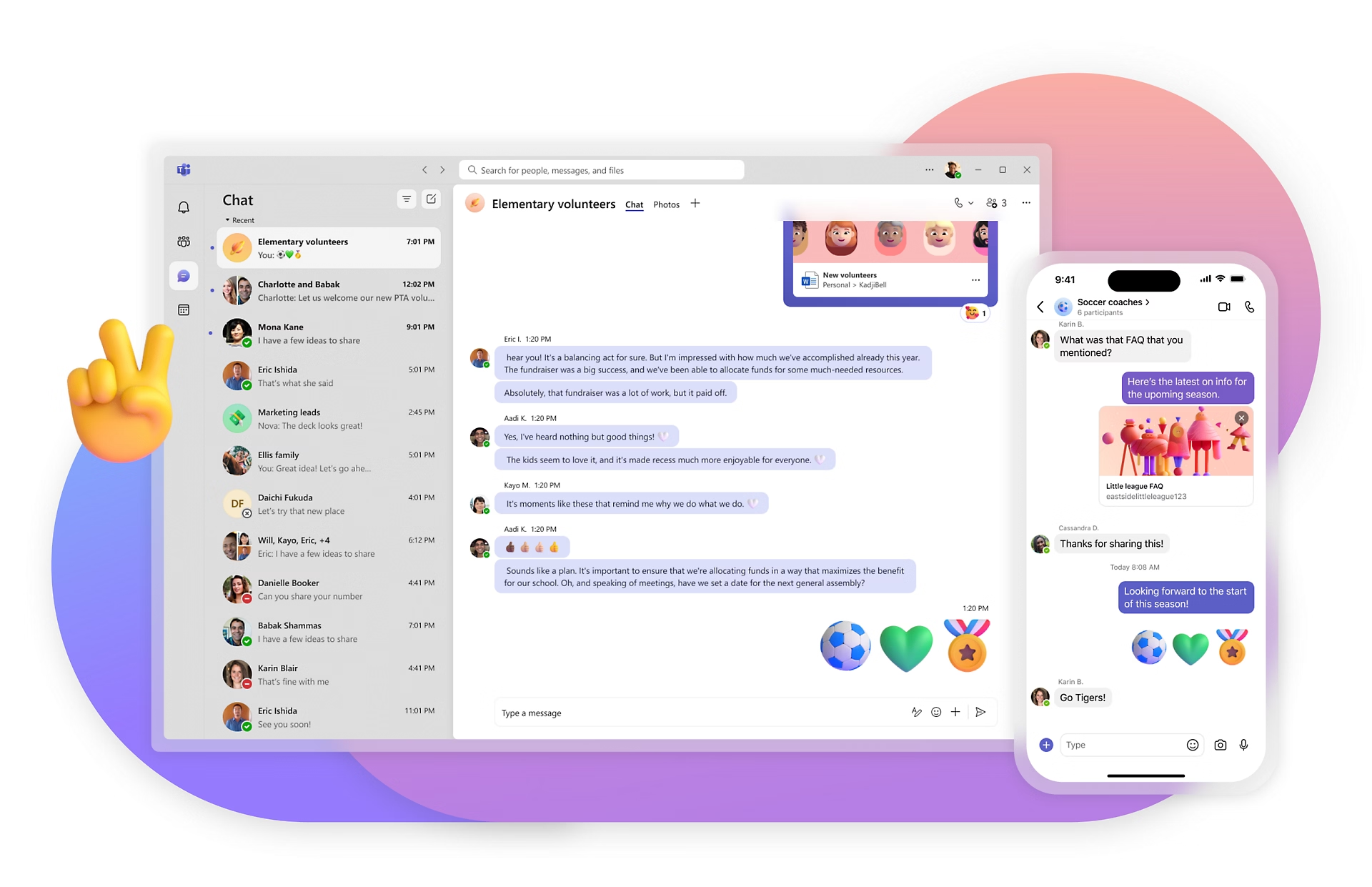
For head-to-head comparisons, see Blink. vs Microsoft Teams and Beekeeper vs Blink..
2. Simpplr
Best for: Desk-based organizations wanting an AI-powered intranet.
Simpplr has positioned itself as the AI-native intranet, earning Leader status across Gartner, Forrester, G2, and IDC reports. The platform focuses on personalized content delivery and automated governance for knowledge workers. Strong search capabilities and clean design make it popular with IT and comms teams at mid-to-large enterprises.
Key strengths:
- Leader across all four major analyst reports
- AI-powered search and content recommendations
- Clean, consumer-grade interface
- Strong governance and content lifecycle management
Where it's limited:
- Primarily designed for desk-based workers with corporate email
- Limited frontline-specific features (no QR-code sign-up, no offline mode)
- Rising fast in AI search visibility, which is making them more visible in buyer research
Pricing: Custom.
See Simpplr alternatives for competitive context.
3. Staffbase
Best for: Enterprise internal communications teams.
Staffbase is built for internal comms professionals who need to create, publish, and measure content across channels. The platform includes a branded mobile app, email newsletters, digital signage integration, and detailed analytics. Strong adoption in large European enterprises.
Key strengths:
- Purpose-built for IC teams with editorial workflows
- Branded mobile app with push notifications
- Email newsletter builder (no separate ESP needed)
- Detailed content performance analytics
Where it's limited:
- High complexity for smaller organizations
- Frontline features require additional configuration
- Pricing can be steep for mid-market
Pricing: Custom.
4. Workvivo (by Zoom)
Best for: Building company culture and social engagement.
Acquired by Zoom in 2023, Workvivo uses a social-media-style feed to drive engagement. The platform is strong on peer recognition, social features, and community building. Popular with organizations that prioritize culture and employee voice.
Key strengths:
- Social feed that feels familiar
- Strong recognition and shout-out features
- Zoom integration for video
- Mobile experience available for desk and frontline workers
Where it's limited:
- Mobile reviews on Google Play have flagged frontline usability issues
- Less focused on operational comms (shift scheduling, forms, workflows)
- Post-acquisition integration with Zoom's broader suite is still evolving
Pricing: Custom.
See top Workvivo alternatives.
5. Unily
Best for: Complex global enterprises with sophisticated requirements.
Unily serves some of the world's largest organizations. The platform offers deep customization, multi-language support, and enterprise-grade security. Strong on governance and compliance for regulated industries.
Key strengths:
- Handles complex, multi-region deployments
- Deep Microsoft 365 integration
- Advanced personalization and targeting
- Strong governance and compliance features
Where it's limited:
- Expensive and complex to implement
- Primarily desktop-oriented, mobile is a secondary experience
- Overkill for mid-market organizations
Pricing: Custom.
See Unily alternatives.
6. LumApps (with Beekeeper)
Best for: Organizations deeply embedded in Google Workspace or Microsoft 365 that also want frontline reach.
LumApps integrates natively with both Google Workspace and Microsoft 365. In July 2025, LumApps acquired Beekeeper in a deal valuing the combined company at more than $1 billion, backed by Bridgepoint, with a 12 to 24 month integration roadmap to deliver a combined "AI Employee Hub" (LumApps press release).
Key strengths:
- Deep Google Workspace and Microsoft 365 integration
- AI-powered content targeting
- Added Beekeeper's frontline features post-acquisition
- Strong in knowledge management and document search
Where it's limited:
- Beekeeper integration is still maturing, two-product complexity remains
- Less intuitive for non-technical users
- Frontline features are inherited, not native
Pricing: Custom.
See LumApps alternatives and Beekeeper vs Blink. for the post-acquisition buyer view.
7. Microsoft SharePoint and Viva
Best for: Organizations already committed to the Microsoft 365 ecosystem.
SharePoint remains the most widely deployed intranet platform globally, largely because it's bundled with Microsoft 365 licenses. Viva adds employee experience features (engagement surveys, learning, insights) on top. The combination is powerful for desk-based teams but requires significant IT investment to configure and maintain.
Key strengths:
- Included with existing Microsoft 365 licenses (no additional cost for basic functionality)
- Deep integration with Teams, Outlook, and the Microsoft ecosystem
- Massive partner ecosystem for customization
- Viva adds engagement, learning, and analytics layers
Where it's limited:
- Not designed for frontline workers, requires corporate email and Microsoft 365 license
- Heavy IT administration and governance overhead
- Mobile experience is functional but not mobile-first
- Configuration complexity means most deployments take 6 to 12 months
Pricing: Included with Microsoft 365 Business plans (from $6 per user per month). Viva suite is additional (Microsoft 365 pricing).
8. Interact
Best for: Mid-market organizations wanting an enterprise-grade intranet.
Interact offers a well-rounded intranet platform with strong content management, people directories, and analytics. Popular with mid-market organizations that want enterprise features without enterprise complexity.
Key strengths:
- Good balance of features and usability
- Strong people directory and org chart
- Content targeting and personalization
- Integrates with Microsoft 365 and Google Workspace
Where it's limited:
- Mobile app is secondary to the desktop experience
- Less suited for large frontline populations
- Fewer AI features than newer competitors
Pricing: Custom.
9. Igloo
Best for: Knowledge management and document collaboration.
Igloo focuses on bringing together knowledge, documents, and conversations in a single platform. Strong for organizations where information findability is the primary challenge.
Key strengths:
- Document management and search
- Customizable digital workplace channels
- Good integration with existing file storage (SharePoint, Google Drive)
Where it's limited:
- UI feels dated compared to newer platforms
- Limited frontline and mobile capabilities
- Smaller market presence means fewer third-party integrations
Pricing: Custom.
10. Haiilo
Best for: Employee advocacy and social amplification.
Haiilo (formerly Smarp) combines an internal intranet with employee advocacy tools, enabling workers to share approved content on their personal social media channels. Strong with marketing and employer branding teams.
Key strengths:
- Built-in employee advocacy platform
- Content creation and curation tools
- Analytics for both internal engagement and social reach
- Multi-language support
Where it's limited:
- Advocacy features may be unnecessary for organizations focused purely on internal comms
- Less robust for operational workflows and frontline use cases
Pricing: Custom.
See Haiilo alternatives.
11. Firstup
Best for: Intelligent, personalized content delivery at scale across desk and frontline.
Firstup (formerly SocialChorus + Dynamic Signal) uses AI to deliver the right content to the right employee at the right time. The platform supports email, mobile app, SMS, and digital signage channels, making it viable for reaching workers across multiple touchpoints.
Key strengths:
- AI-powered content delivery and personalization
- Multi-channel reach (app, email, SMS, signage)
- Analytics and engagement measurement
- Designed to reach both desk and frontline workers
Where it's limited:
- More of a content delivery platform than a full intranet
- Less strong on two-way communication and collaboration
Pricing: Custom.
See Firstup alternatives.
12. Happeo
Best for: Google Workspace users wanting a social intranet.
Happeo is built specifically for organizations using Google Workspace. It adds an intranet, social feed, and knowledge base on top of Google's productivity tools.
Key strengths:
- Native Google Workspace integration
- Social channels for team and topic-based communication
- Clean, modern interface
- Pages and knowledge base features
Where it's limited:
- Google Workspace only (no Microsoft support)
- Desktop-first experience
- Smaller feature set than enterprise alternatives
Pricing: Public pricing typically starts in the $5 per user per month range. See Happeo alternatives.
13. Jostle
Best for: Simple, clean internal communications.
Jostle focuses on simplicity, offering a clean intranet experience for organizations that want to communicate without complexity. Refreshingly straightforward in a market full of feature bloat.
Key strengths:
- Very easy to set up and use
- Clean interface with low learning curve
- Good for organizations under 1,000 employees
- Transparent published pricing
Where it's limited:
- Limited customization and advanced features
- Not suited for complex enterprise requirements
- Basic mobile experience
Pricing: Public pricing typically starts in the $5 per user per month range. See Jostle alternatives.
14. MangoApps
Best for: Mid-market organizations wanting an all-in-one digital workplace.
MangoApps combines intranet, messaging, training, and workflow features in a single platform. Good value for organizations that want multiple capabilities without buying separate tools.
Key strengths:
- All-in-one platform (intranet + chat + training + workflows)
- Competitive pricing for mid-market
- Customizable modules
- Basic frontline features included
Where it's limited:
- Jack-of-all-trades means no single feature is best-in-class
- UI can feel cluttered with all modules activated
- Less polished than specialist platforms
Pricing: Public pricing typically starts in the $4 per user per month range. See MangoApps alternatives.
15. Axero
Best for: Knowledge sharing and community-driven organizations.
Axero focuses on creating internal communities and knowledge-sharing spaces. Good for organizations where peer-to-peer knowledge transfer is the primary goal.
Key strengths:
- Community and forum features
- Knowledge base and wiki capabilities
- Customizable spaces for teams and projects
- Competitive pricing
Where it's limited:
- Primarily desktop-oriented
- Less focused on news delivery and top-down communications
- Limited frontline and mobile capabilities
Pricing: Custom.
Why intranet software matters for frontline workers
Roughly 80% of the global workforce is deskless (Emergence Capital), yet most enterprise communication technology still targets the desk-based minority. That gap is why most intranet deployments fail to reach the people who need them most: the warehouse workers, nurses, retail associates, drivers, and hotel staff who keep organizations running but rarely touch a laptop.
Frontline disengagement has a measurable cost. Gallup's State of the Global Workplace consistently finds that disengaged workers leave at materially higher rates than engaged ones (Gallup State of the Global Workplace).
Modern mobile-first intranet platforms are closing this gap. At JD Sports, 87% of frontline workers adopted Blink. within 10 days. At easyJet, 20,000+ employees are active users. Stagecoach reported a 26% reduction in driver turnover after giving frontline staff access to a mobile intranet (Blink. customer stories). For more on the engagement levers, see our guide to deskless worker communication.
How to evaluate intranet software for your organization
Start with your workforce profile. What percentage of your employees are desk-based vs. frontline? If more than 30% of your workforce doesn't have a corporate email address, eliminate any platform that requires one.
Define your primary use case. Are you solving for internal communications, knowledge management, employee engagement, or all three? Platforms like Staffbase excel at comms, Igloo at knowledge, Workvivo at engagement. Blink. combines comms, engagement, and operational tools for frontline-heavy teams.
Test the mobile experience yourself. Download the app. Try to complete common tasks (read a news post, find a document, submit a form) on your phone. If it feels clunky, your frontline workers won't use it. Look for platforms where mobile is the primary experience, not a scaled-down desktop version.
Ask about time-to-value. Enterprise intranet deployments can take 6 to 12 months. Some mobile-first platforms can onboard teams in days.
Calculate total cost of ownership. The license fee is just the start. Factor in implementation costs, IT administration time, training, and the opportunity cost of low adoption. A cheaper platform with 20% adoption costs more per engaged user than an expensive one with 90%.

.avif)

.avif)





.avif)




.jpeg)































-min.jpeg)








.jpeg)




.avif)



.avif)


.avif)








.avif)


-min.avif)