
Preboarding hourly employees: a faster first week
Preboarding is everything that happens between an hourly employee accepting a job and showing up for their first shift, and it's the single biggest lever for stopping no-shows before they happen. Get it wrong and you'll find out on day one, when a scheduled new hire simply doesn't walk through the door. For hourly teams, that's not a rare edge case. It's a recurring line item in every hiring manager's week.
Most onboarding advice is written for salaried hires with a company laptop, a company email, and two weeks of notice before they start. Hourly hiring doesn't work that way. You're filling roles in days, not weeks. The person you hired on Tuesday might start Thursday, and the "onboarding portal" your HRIS is so proud of assumes they already have a company login. That gap between offer and day one is where hourly hires quietly disappear, and it's also the easiest part of the process to fix.
This guide covers what preboarding actually looks like for hourly and frontline teams, a practical plan from day minus seven through day 90, and how to automate the whole sequence so it doesn't depend on a manager remembering to send a text. For the broader picture of what makes frontline teams function day to day, see Blink's guide to managing frontline employees.
What is preboarding?
Preboarding is the structured communication and preparation that happens between an hourly employee accepting an offer and arriving for their first scheduled shift. It covers a welcome message, what to bring and wear, where to park and who to ask for, any paperwork that can be completed in advance, and a reminder close enough to the shift that it's still top of mind. The goal is simple: by the time the shift starts, nothing about showing up is a mystery.
This is distinct from onboarding, which starts once someone is officially employed and covers training, system access, and the first weeks on the job. Preboarding is also where most first-day no-shows actually get prevented, because a candidate who's heard nothing since their offer call has every reason to assume the job isn't real, or to take the next offer that does call them back. A short, well-timed sequence of messages closes that gap.
Why hourly onboarding is different
Hourly onboarding runs on volume and speed, not process and paperwork. A corporate onboarding program might handle a few hundred hires a year, spread out, with HR business partners assigned to each one. A retail chain, a care provider, or a logistics operator might hire that many people in a single month, across dozens of locations, each one running the process slightly differently because there's no HR person on-site to standardize it.
Three things make hourly onboarding structurally harder than salaried onboarding. First, most hourly hires don't have a company email until they're actually on payroll, so the "automated onboarding email" sequence most HR tech is built around simply doesn't fire before day one. Second, there's no desk and often no laptop, so anything that assumes a browser session and a quiet hour to fill in forms is asking for a no-show. Third, the gap between "yes, I'll take the job" and "first shift" is often two or three days, not two or three weeks, so there's very little time to build commitment before the person has a chance to take a different, better-communicated offer instead.
The result shows up as two separate problems that get treated as one. The first is the no-show: people who accepted the job and never appear for shift one. The second is early attrition: people who do show up but leave in the first weeks because nothing after day one matched what day one promised. Preboarding solves the first problem. A deliberate first 90 days solves the second. Treat them as different problems and you'll actually fix both.
Preboarding: before day one is where no-shows get prevented
The no-show problem isn't usually about the candidate changing their mind. It's about silence. Someone accepts a job on a Monday, hears nothing for three days, and by Thursday morning a different, more responsive employer has already texted them twice. Preboarding is the fix, and it doesn't need to be complicated. It needs to be reliable.
A working preboarding sequence for hourly hires covers four things:
- A welcome message within hours of acceptance, confirming the role, the start date, and the shift time, sent somewhere the person will actually see it. The first message has to land on a personal phone rather than wait on a system the new hire can't access yet.
- What to bring and what to wear, including ID requirements, dress code, and anything site-specific like steel-toe boots or a hairnet. Vague instructions create a reason to delay showing up.
- Who to ask for and where to go, by name if possible. "Report to the loading dock, ask for Maria" removes the single most common reason a new hire hovers in a parking lot and leaves.
- Any paperwork that can be done on a phone before day one, tax forms, direct deposit, ID verification, so day one is spent working rather than filling in fields. The less admin stacked onto shift one, the more it feels like a real job and less like a trial.
A reminder 24 to 48 hours before the shift, sent the same way as the welcome message, catches the people who meant to show up and simply forgot. It's the cheapest no-show prevention available, and it's the step teams skip most often because nobody owns it.
Day one: a short checklist
Day one should take minutes to plan and feel effortless to the new hire. Keep it to what actually matters on shift:
- Someone greets them by name at the door. Nobody should be left to work out where to go on their own.
- ID and paperwork are already done from preboarding, so the shift starts with work, not forms.
- They meet their buddy or shift lead in the first ten minutes.
- They're shown exactly where the essentials are: break room, bathroom, time clock, supplies.
- One task they can complete and feel good about before the shift ends.
That last point matters more than it looks. A new hire who leaves day one having actually done something useful is far more likely to come back for day two than one who spent eight hours shadowing.
Week one: buddy, first tasks, and a quick check-in
Week one is where a new hire decides whether the job matches what they were promised. Pair every new hire with a buddy, someone doing the same role, not their manager, who can answer the small questions that feel too minor to escalate. Give them real tasks from day one rather than a week of pure observation, since extended shadowing reads as a lack of trust rather than training.
A short check-in by day three or four, five minutes, nothing formal, surfaces issues early enough to act on them. Ask what's confusing, what they need, and whether the shifts they were told about match what's actually on the schedule. Scheduling mismatches are a quiet but common reason hourly hires disappear in week two: told one number of hours at hiring and scheduled for fewer once they start.
Days 30, 60, and 90: feedback and recognition
The first 90 days are where most hourly attrition actually happens, and most of it is preventable with a few scheduled touchpoints. At day 30, a short survey or conversation about how the role compares to what was described catches mismatches before they turn into a resignation. At day 60, recognition matters more than most managers assume: a public acknowledgment of a small win costs nothing and does real work on whether someone feels seen. At day 90, a proper check-in on role fit, hours, and career path signals the job is more than a stopgap, which is exactly the signal that keeps people around past the point where most hourly attrition hits.
Too many frontline teams treat these milestones as a formality instead of a structured checkpoint. A deliberate day 30, 60, and 90 plan beats leaving it to a manager to notice something's wrong, because it doesn't rely on any one person remembering to ask. For more on what keeps people past the 90-day mark, see Blink's guide to why frontline workers quit around day 90.
How to automate preboarding and onboarding in Blink
None of this works if it depends on a manager remembering to send a text between shifts. Blink's employee journeys let you build the entire preboarding-through-90-day sequence once and have it trigger automatically, off registration or a start date, rather than off a manager's memory. That matters more for hourly teams than for salaried ones, where onboarding tech already assumes an email address and a desk to open it from.
Setting one up follows a similar pattern regardless of role or location:
- Load start dates for new hires so the journey has a trigger to work from, rather than waiting on a manager to kick it off manually.
- Build the welcome-message trigger on registration, so the welcome message, start date, and shift time fire the moment someone registers rather than whenever someone remembers.
- Set a pre-shift reminder 24 to 48 hours before the first shift, sent the same way as the welcome message.
- Set day-30, 60, and 90 survey triggers so feedback and recognition touchpoints go out on their own, rather than depending on a manager's calendar.
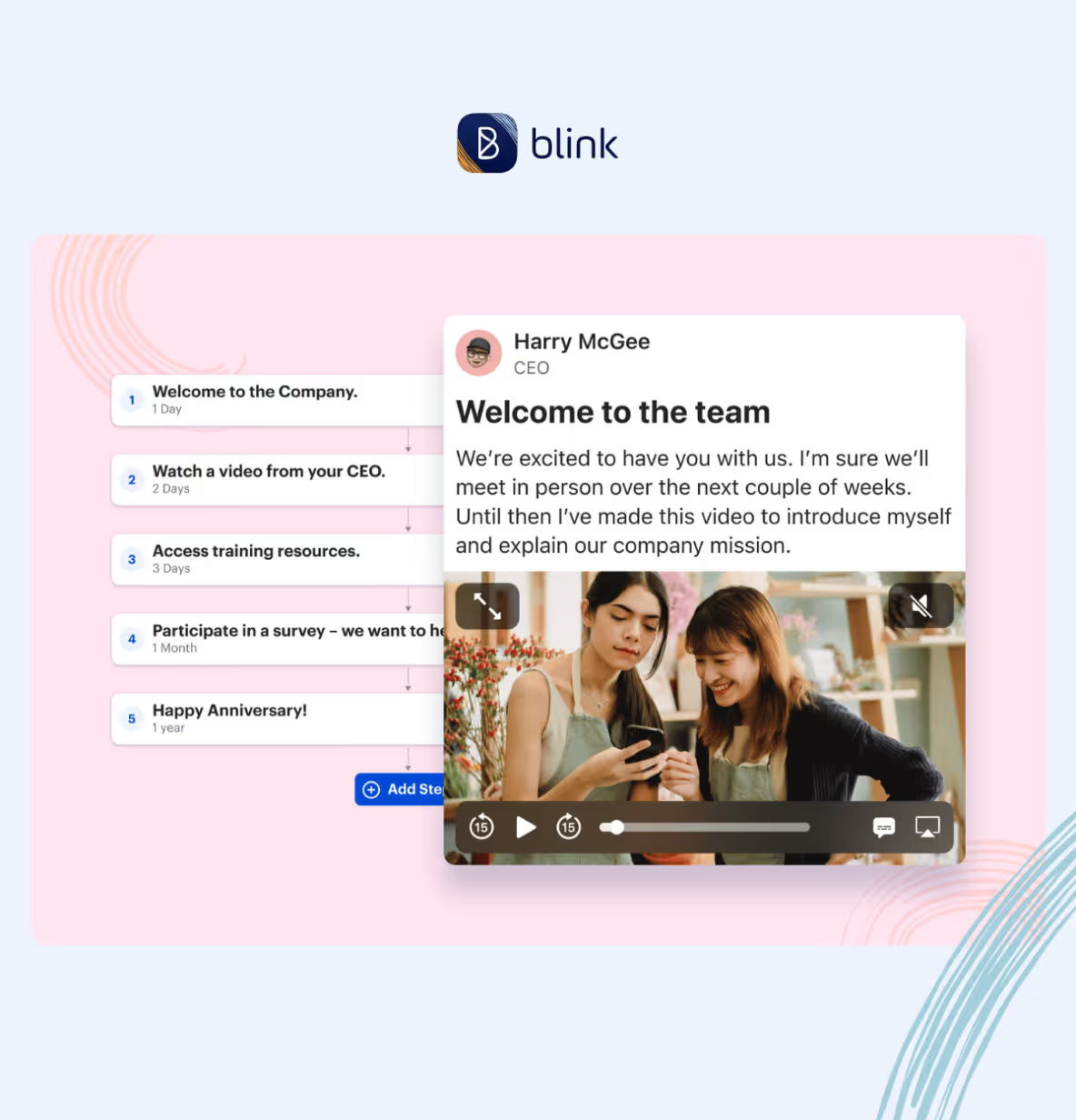
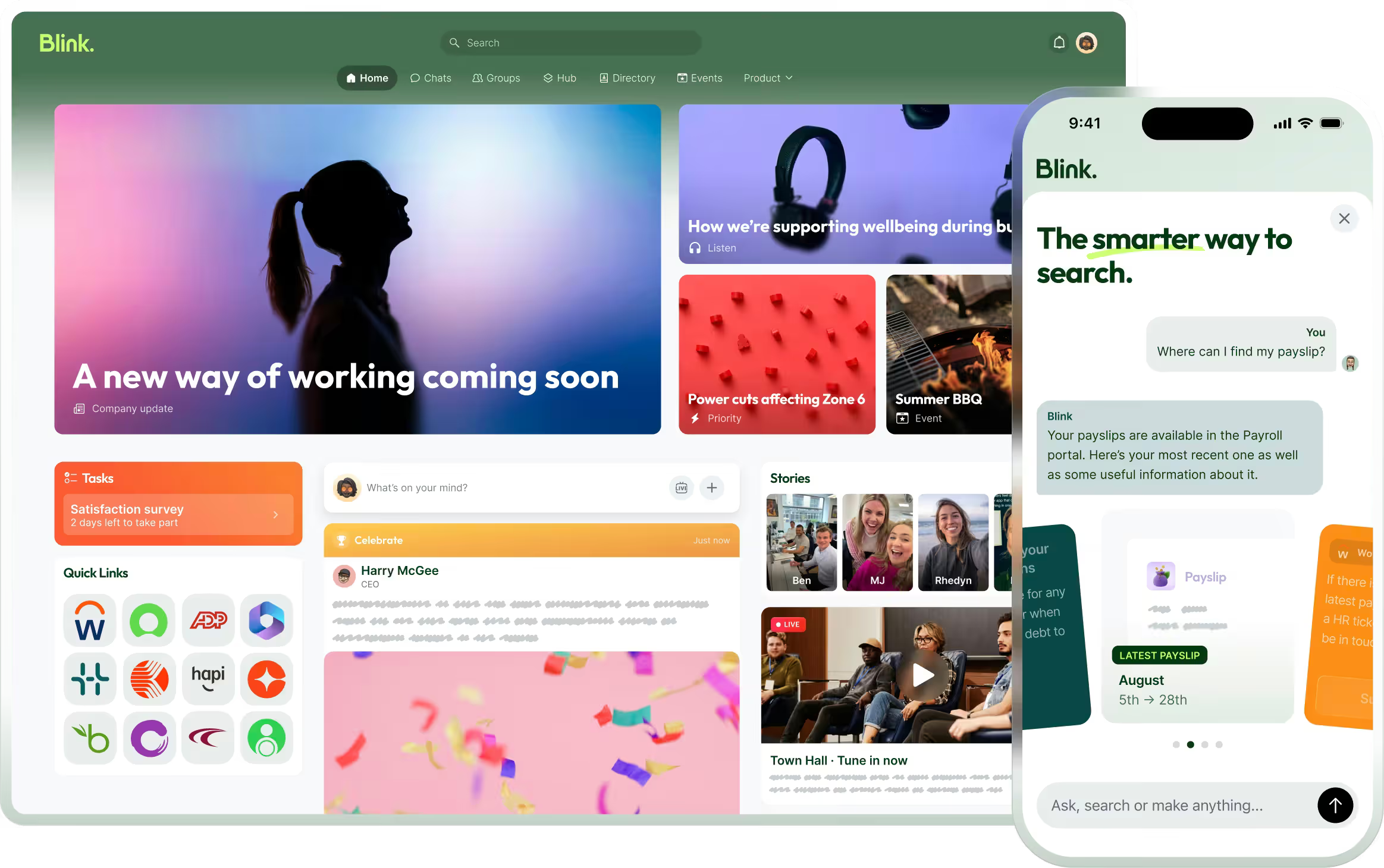
A typical journey looks like this: the welcome message and what-to-bring details fire the moment someone registers, a reminder goes out automatically 24 to 48 hours before their first shift, a day-one checklist and buddy introduction post to the Feed the morning they start, and feedback surveys trigger on their own at day 30, 60, and 90. Feed posts can carry short videos, a short "here's what to expect" clip can do more than a page of text, along with direct links into the Hub for anything the new hire needs to look up themselves: dress code, parking, a map of the site. Milestone check-ins run through Blink surveys, so you get a consistent, trackable signal on how new hires are actually doing instead of relying on whichever manager happens to ask.
The advantage for hourly teams specifically is that none of this needs a company email or a laptop. The journey reaches a personal phone the moment someone registers, a major reason the gap between offer and shift one closes instead of filling with silence. For the wider case on what a consistent employee experience does for retention, see Blink's guide to employee retention.
Automate your preboarding sequence with Blink
Preboarding only works if it's automated rather than remembered. Start a 14-day free trial to build your first preboarding journey, built for the people going through it to reach it without a company login. If you'd rather see it running first, book a demo to walk through how journeys, surveys, and the Feed work together for hourly and frontline hiring at scale.