
Read 5 expert tips to create better employee journey maps. We’ll go over how to use this tool to improve employee engagement and learn from your workers.
New employee journey maps can take time to develop. But when adding more smiley faces isn’t enough, how do you get an employee journey map to work better for your organization?
The concept of employee experience maps has been gaining traction as a way to boost employee engagement and improve your onboarding process.
The template follows a pretty straightforward path from hiring, through training, and eventually exiting, but it’s the way you use these maps that makes them valuable.
You know your workers will have training at a particular stage, but how helpful is it? Do you see an increase in turnover at any stage? These are the types of questions your employee journey maps should help you answer.
Why use an employee journey map?
An employee journey map can be a helpful tool for improving the employee lifecycle. This concept visualizes the entire employee experience through your organization, from onboarding until their last day.
There are a few different ways to name each stage of the journey, but every employee experience map follows the same basic flow:
Recruitment and hiring
Onboarding
Engaging and training
Development
Progress and performance
Exit or offboarding
These employee journey touchpoints describe the main stages a worker might be at within the company.
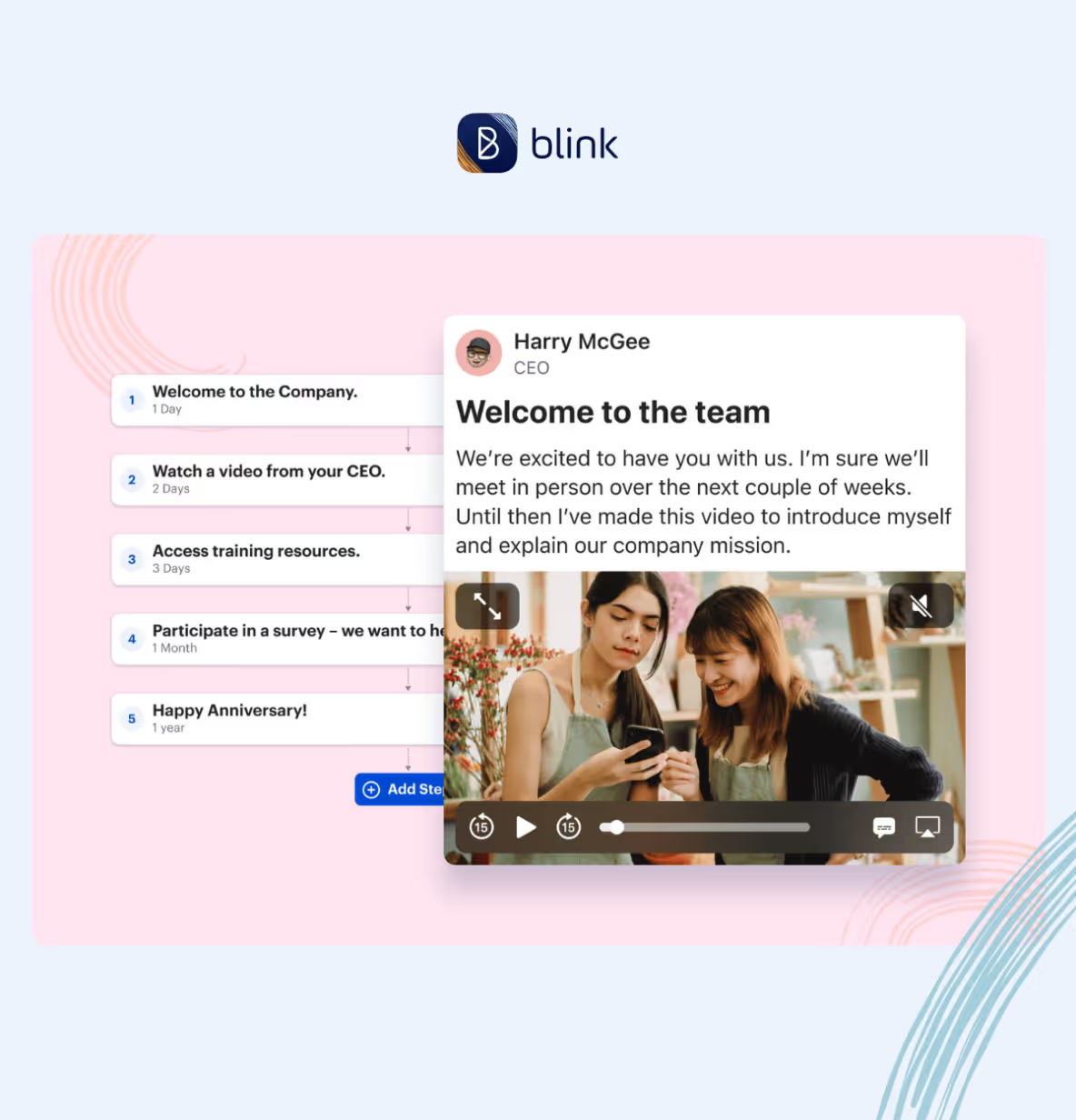
You can track the average time it takes to complete each step, assign different training and feedback for different stages, and look for patterns within your journey maps.
An employee journey map can help with engagement as you can better address the needs and concerns a worker will have by knowing where they stand in the organization.
Making the most of this tool will help you actually get some use from it.
How to make a better employee experience journey map
Don’t worry. Not all good employee experience journey maps lead to Manchester. They just have to lead to happier workers.
Whether you already use an employee journey map template or are just starting to look into the idea, there are some steps you can take to make your maps work better.
They are the following:
Create different maps for different roles. The map for a frontline manager will look different from a warehouse worker, with different training and onboarding for each position. Depending on your organization, you may need a few maps or a few dozen.
Analyze your employee journey maps and look for patterns. Do many employees have trouble at the same part of the training? That may become more obvious when you compare maps and visualize the issue at hand.
The latest report from the Bureau of Labor Statistics shows an average tenure of 4.1 years, and 22% of workers had been with their current employer for a year or less.
Looking up industry-specific numbers can help you further pinpoint areas to focus on when planning out your journey maps.
Time feedback to the stage in the journey your employee is at. Look for onboarding feedback while the process is still fresh in their mind.
Provide appropriate feedback to your employees as well. Let them know how they’ve improved after training, or likewise what they could concentrate a bit more on.
Remember, journey maps are a tool that can help predict how an employee’s experience will look, but it’s not set in stone. There can be unexpected events that change their journey map.
Like a global pandemic that reduced working hours by 17.3% in 2020. Most of us are still trying to get back on track after that one.
Make sure your organization learns from the tool. These aren’t coloring book pages for employees to fill in while HR processes their paperwork. Learn from them.
Did you know only 12% of employees strongly agree their company did a good job at onboarding?
Using an employee journey map, you can analyze your new hires at this stage and see why they might feel that way.
Wrapping up — Making employee journey maps better for your workers
Employee journey mapping is one of those tools with lots of potential. It can help you improve different processes in your organization, increase employee engagement, and create an easy-to-follow workflow for various roles.
Or you can spend an entire quarter making everyone fill these in and then promptly lose them in a subfolder that was last opened three years ago.
Just keep in mind that creating an employee journey map is the first step. You also need to make it easy to access for employees and have them provide feedback.

New employee journey maps can take time to develop. But when adding more smiley faces isn’t enough, how do you get an employee journey map to work better for your organization?
The concept of employee experience maps has been gaining traction as a way to boost employee engagement and improve your onboarding process.
The template follows a pretty straightforward path from hiring, through training, and eventually exiting, but it’s the way you use these maps that makes them valuable.
You know your workers will have training at a particular stage, but how helpful is it? Do you see an increase in turnover at any stage? These are the types of questions your employee journey maps should help you answer.
Why use an employee journey map?
An employee journey map can be a helpful tool for improving the employee lifecycle. This concept visualizes the entire employee experience through your organization, from onboarding until their last day.
There are a few different ways to name each stage of the journey, but every employee experience map follows the same basic flow:
Recruitment and hiring
Onboarding
Engaging and training
Development
Progress and performance
Exit or offboarding
These employee journey touchpoints describe the main stages a worker might be at within the company.
You can track the average time it takes to complete each step, assign different training and feedback for different stages, and look for patterns within your journey maps.
An employee journey map can help with engagement as you can better address the needs and concerns a worker will have by knowing where they stand in the organization.
Making the most of this tool will help you actually get some use from it.
How to make a better employee experience journey map
Don’t worry. Not all good employee experience journey maps lead to Manchester. They just have to lead to happier workers.
Whether you already use an employee journey map template or are just starting to look into the idea, there are some steps you can take to make your maps work better.
They are the following:
Create different maps for different roles. The map for a frontline manager will look different from a warehouse worker, with different training and onboarding for each position. Depending on your organization, you may need a few maps or a few dozen.
Analyze your employee journey maps and look for patterns. Do many employees have trouble at the same part of the training? That may become more obvious when you compare maps and visualize the issue at hand.
The latest report from the Bureau of Labor Statistics shows an average tenure of 4.1 years, and 22% of workers had been with their current employer for a year or less.
Looking up industry-specific numbers can help you further pinpoint areas to focus on when planning out your journey maps.
Time feedback to the stage in the journey your employee is at. Look for onboarding feedback while the process is still fresh in their mind.
Provide appropriate feedback to your employees as well. Let them know how they’ve improved after training, or likewise what they could concentrate a bit more on.
Remember, journey maps are a tool that can help predict how an employee’s experience will look, but it’s not set in stone. There can be unexpected events that change their journey map.
Like a global pandemic that reduced working hours by 17.3% in 2020. Most of us are still trying to get back on track after that one.
Make sure your organization learns from the tool. These aren’t coloring book pages for employees to fill in while HR processes their paperwork. Learn from them.
Did you know only 12% of employees strongly agree their company did a good job at onboarding?
Using an employee journey map, you can analyze your new hires at this stage and see why they might feel that way.
Wrapping up — Making employee journey maps better for your workers
Employee journey mapping is one of those tools with lots of potential. It can help you improve different processes in your organization, increase employee engagement, and create an easy-to-follow workflow for various roles.
Or you can spend an entire quarter making everyone fill these in and then promptly lose them in a subfolder that was last opened three years ago.
Just keep in mind that creating an employee journey map is the first step. You also need to make it easy to access for employees and have them provide feedback.

Internal communication isn’t just about messages — it’s about impact
Too often, internal comms teams focus on sending the right messages through the right channels. But what if that’s not enough?
With workplace expectations evolving — especially among Gen Z and Millennial employees — internal communications leaders need to do more than inform. They need to engage. Influence. Inspire action.
That’s where the 3 C’s of internal communication come in: Curiosity, courage, and catalyst.
“We know that with younger generations, it’s so much more important for them to feel that they are a part of things. Old fogies like myself, you just get your head down, do the work, hope that you get a paycheck… It’s so different these days.”
This framework, developed by author and keynote speaker Shola Kaye, transforms internal comms teams from messengers into strategic influencers. In a recent podcast, the Blink team sat down with Shola to explore the 3 C’s — why they matter and how comms leaders can put them into action.
Let’s break it down.
Curiosity: Don’t make assumptions right off the bat
The first C you need in your internal communications toolkit is curiosity.
Curiosity prevents us from making assumptions, which get in the way of empathy. By being curious, we get to know and understand the people around us.
“If you want to engage people, you’ve got to really know who you’re speaking to. What is on their minds? Where are they coming from? Because otherwise, how will you know how to pitch your content?”
That means listening before you speak. And creating a company culture of psychological safety where employees feel confident that their thoughts and opinions will be taken on board.
Why it matters:
Too often, comms teams assume they know what employees want or need — but a strong company culture of employee engagement starts with listening.
It’s also worth remembering that internal comms trends and employee expectations are always evolving. What worked last year might not work today. So it pays to stay curious, listening to the voices of your target audience on a continuous basis.
How to apply it:
Use pulse surveys and real-time employee feedback loops. Uncover what’s resonating and implement two-way communication practices. Be sure to acknowledge and act upon employee input or employees will start to doubt the process.
Let employees shape your internal communication strategy. Ask them: What’s missing? What do they need? How do they like to receive company communications? You can then craft more effective and engaging messages.
Create conversational hooks. Ask informal questions. For example: What did you do on the weekend? What’s a great movie you watched recently? This creates conversational hooks, which lead to connection, trust, and collaboration within the workplace.
Go beyond small talk. Ask “big talk” questions. Instead of simply asking “How are you?” try asking, “How are you feeling about these changes?” These deeper-level questions encourage meaningful dialogue and bottom-up communication.
{{mobile-survey="/image"}}
Courage: Own your voice so people can’t help but listen
Internal communications teams are the unsung heroes of the workplace. It takes real courage to be the voice of a company — sharing tough news, listening to hard feedback, and taking bold risks to build a better employee experience.
“To be empathetic, you’ve got to open yourself up to what is going on for someone else. That can press buttons. It can be triggering. It can be exhausting. So it takes some courage to develop empathy and this level of communication in the workplace.”
Courage means having difficult conversations in the knowledge that you’ll come out the other side “stronger, better, more confident at communication.” It means taking your comms beyond the internal communication tools, styles, and channels you’ve used traditionally to deliver something more engaging and authentic.
Why it matters:
Internal comms teams often walk a tightrope between corporate messaging and employee advocacy.
But great communicators don’t just share what’s safe — they push for transparency, honesty, and authenticity. They speak in an open, human way that sets the tone for the whole organization.
How to apply it:
Advocate for direct, no-BS communication. Employees respect transparency over corporate jargon so don’t be afraid to speak honestly, as long as you approach tricky subjects with tact and sensitivity.
Take a stand on employee well-being and inclusion. Don’t sit on the fence. If it matters to your workforce, it should matter to senior management. Clearly communicate your business goals and what your company stands for.
Encourage business leaders to be real and visible. Align your internal communication plan to where senior leaders are on the “audacity scale.” For one C-suite member, that might mean recording a video message or running a listening tour, while the more gregarious may be happy to run a Q&A session with employees.
Be open to new channels and formats. For comms leaders, courage can mean experimenting with new internal communication channels and formats. Video updates. Mobile-first and social tools. Insta-grade storytelling. You don’t always know how these changes will go down with employees. But the reward may be worth the risk.
Catalyst: Make change happen
Being a catalyst for change is easier than you might think. Asking the right questions at the right time — and directing employees toward the collaboration tools and resources they need — can be all it takes.
However, to be an effective catalyst, inspiring others to do and be more, you need to put the other C’s — curiosity and courage — into action first.
“If we’re being empathetic and truly listening to others, we start to learn what they need to grow, to move forward… So then we can step into this role of catalyst to help facilitate that growth.”
Why it matters:
Internal comms isn’t just about informing employees. Done right, your internal communication strategy can inspire action. It can cultivate a motivated and engaged workforce. It can drive cultural change.
Effective communications help employees feel more connected and valued — and engaged in the company’s mission. And when employees understand how they contribute to organizational goals, they become more invested in their own growth and development, too.
{{mobile-main="/image"}}
How to apply it:
Turn communication into action. Don’t just inform. Invite employees to share ideas in town hall meetings or employee surveys. Provide clear steps and resources that make it easy for them to shape company culture.
Set an inspiring example. Leverage storytelling to highlight employee success stories, frontline employee contributions, and company impact. Show, don’t tell — using formats like short videos, photos, and quotes — how individuals are driving change.
Amplify unheard voices. Actively seek out perspectives from underrepresented teams, then amplify their contributions and elevate them as internal influencers so they reach a wider audience.
Champion new digital tools. Be the change you want to see. Advocate for technology that makes internal communication more accessible and inclusive. Think mobile-first apps, AI-powered chat tools, and one-stop digital hubs.
{{future-of-internal-comms-2025="/callouts"}}
Put the three C’s into action for next-level internal comms
Curiosity, courage, catalyst — three simple words that provide a blueprint for next-level internal communications. The 3 C’s can help you take your internal communications strategy from a function to a force for connection and change.
By staying curious, you uncover what truly matters to your workforce, across all generations. By leading with courage, you create space for honest, impactful conversations. And by stepping up as a catalyst, you empower employees to shape their futures — and that of the organization.
Employee retention is the art of holding onto your staff once you’ve hired them.
And, in 202w, it’s more important than ever.
Why?
Because companies are finally waking up to the competitive advantages of being a "people" company. A "churn and burn" approach to hiring results in poor customer service.
This is an issue, because customers are placing increasing value on good service. With smartphones, it’s easier than ever to find a competitor company to buy from. Or in the case of consumer goods, to avoid the shop altogether and order online.
Before we start.
You can hold onto employees (more or less) by treating them well. Listening to their concerns, and providing them with a few incentives to stay put.
If you’re an HR professional or a CEO, you don’t need us to tell you that. What you might find useful is an in-depth guide to employee retention in the modern workforce.
How to maximize your employee engagement efforts. And make sure there were no stones left unturned in creating the most comprehensive guide... we asked some industry-leading experts to contribute. We’ll cover:
Detail on the importance of employee retention today.
How to build effective employee retention strategies.
The exit interview, and how to turn it into your secret employee retention weapon.
Let’s begin...
Why is employee retention important?
Employee retention means "treating your employees right"; it’s an end in itself, not just the means.
From an ethical standpoint, no company should mistreat their employees. Meeting your colleagues’ basic needs and providing them with a safe and stimulating workplace? It's the right thing to do for its own sake.
But it’s more than that.
Attracting talent to your company—and keeping it once you’ve found it—has so many advantages. According to Herzberg's famous Two-Factory Theory, employee retention and employee motivation are interdependent. You can find out more about this in the Vantage Circle HR blog. A strong employee retention strategy will:
Reduce operating costs.
Improve customer service levels.
Allow you to out-compete your competitors for the best people.
The cost of high employee turnover
Hiring and firing is expensive.
Eye-wateringly expensive, to be precise. Think six to nine months salary as a conservative estimate.
Then you need to consider the impact of not having someone there to do that person’s work. That could slow down a massive project. Cause higher overtime costs as existing staff pick up their work. Or just lead to a reduction in staff morale as they struggle with increased workloads.
Companies tend to get the importance of this for salaried positions and execs. but there’s often a bit of a blind spot when it comes to their non-desk workforce and the real cost of losing an employee.
Sure, replacing a senior-level manager is more expensive than replacing a bus driver. But what happens if your bus drivers’ morale becomes so low that two or three quit per month?
It all adds up.
"Losing talented staff can also have emotional consequences on those who stay. Effectively reducing productivity by decreasing morality and motivation," says Rochelle van Rensburg of the Ezzely Blog.
"Maintaining essential talent is therefore mission-critical to organizational effectiveness for all these reasons. Staff retention puts companies ahead of their competitors, by reducing recruiting and re-skilling costs. But more importantly, by keeping the top performers, which results in all of their specialized knowledge and expertise remaining in-house."
Your mobile workforce interacts most with customers. They are the public face of your company. So, their happiness will reflect in the level of service they give your customers.
Happier, more engaged employees deliver better customer service. They also build up a bank of operational knowledge over time. This helps them respond to queries quicker and more effectively than a steady stream of new hires ever could.
The importance of employee retention in 2020
An active employee retention strategy is more important than ever. There are two key reasons for this:
Firstly, it's never been easier for customers to look elsewhere if they feel that your levels of service don’t match their expectations. We live in an age where any information you want is available via a few taps of a smartphone screen.
Dissatisfied with a hotel stay? Booking.com can recommend thousands of others.
Bad experience in a taxi? A quick Google gets you all the phone numbers of other local firms.
Poor customer experience at a theme park? TripAdvisor lists other attractions.
You get the idea.
Despite this, customers still want to be loyal. Millennials want to stick around if your brand fits in with their personal values. Don’t throw away this loyal market.
Secondly, it's never been easier to browse jobs via online jobs boards. If your workforce isn’t happy they will move. Don’t assume that they will sit in their job miserable because there aren’t any other options.
Reasons why employees leave and reasons why managers leave aren't always the same.
Your competitors may be waking up to the benefits of being a "people company." They'll more than happily snap up the staff you can't keep.
The best employee retention strategies
A strong employee retention rate is crucial to remain competitive. How you go about doing this is worth examining in some depth.
Remember - you are an employee too! As you create your employee retention strategies, keep asking yourself, "would I be happy with this?" or, "does this seem reasonable to me?"
Here are a few points you’ll need to cover when creating an employee engagement plan. Remember, the employee experience starts before the first day at the interviewing stage. To set each new starter up for success, getting the onboarding right is crucial. Want to learn more? Check out the Definitive Guide to Onboarding.
Let's quickly touch on the foundation of any working relationship: trust. As Kayla Lopez from the recruitment firm Viqtory.com reminds us. "If your employees trust you and the organization they tend to embrace the workplace; this begins before the employee is even hired. Transparency is something that we need to willingly support to gain trust. A workforce that trusts you will be engaged, a workforce that is engaged will retain. Trust is the foundation of all strong partnerships."
Now for the details...
Pay well
We’ll start with the basics.
If your pay rates don’t match with your competitors’, you’re going to have a bad time keeping hold of your high achievers.
Take a quick look at what your competitors pay for equal positions. Try and build a league table of what similar companies to you pay, and where you rank. Glassdoor is a good starting point.
Aiming for the absolute top is ideal if you can afford it, but you don’t have to offer the best salary offer out there. There are plenty of other ways to encourage your staff to stay put (more on that below), as long as you can land in the middle of the table. For someone working in a frontline job, it is difficult to give your best at work knowing you could get $5.00 per hour more for the same job elsewhere. (Even if there’s free pizza every Friday).
It’s also worth noting that even a generous wage packet won’t persuade your employees to stay if you’re otherwise a nightmare to work for. Consider this step the cornerstone of all your employee engagement efforts. Not enough by itself, but essential in building something lasting and meaningful.
Give competitive benefits
You might not be able to take it to Silicon Valley levels. (Free three-course meals for breakfast, lunch and dinner, unlimited holidays, and puppy creches).
You can offer a benefits package or a performance bonus scheme tailored to the size of your business, your budget, and your business objectives. The key is to prioritize benefits that would have a tangible difference to the lives of your employees. Add the fancy stuff on if you have money to spare.
Think about:
Childcare vouchers: we’re all aware of the struggle to find affordable childcare. Help your workforce with their work-life balance (and keep it diverse—most of the people who end up quitting jobs for childcare reasons tend to be women) by offering vouchers to help with the cost.
Health coverfor employees and dependents: an absolute must if you're US-based, although even if you live in a country which has some form of universal health care, giving employees the opportunity to go private is very appealing.
Flexible working: if the type of work you do accommodates it, flexible working is like gold dust to your staff. A "work your hours however you want" policy helps people manage childcare commitments, fit in dentist appointments, and reduce the stress of trying to juggle work and life commitments.
Lunch program: Most of the lunch break is spent buying, prepping or reheating food. Offering a tasty and healthy in-house solution, such as the online canteen Smunch, allows your employees to capitalize on their break time and share a meal together. Ultimately, this will improve your company culture and cross-departmental communication as well.
Once you’ve got the basics sorted, some nice-to-have options include:
Above average PTO allowances
Free gym memberships and cycle to work programs
Personal development funds
Develop a feedback culture to empower employees
Your employees know their workplace better than anyone else. Make the most of it.
If your employees feel involved in shaping their workplace and consulted on major decisions then they will be reluctant to leave it.
The key to this is to carry regular, easy-to-complete employee engagement surveys so you know exactly what the mood on the ground is and how to improve it.
Employees will hold an enormous amount of goodwill towards a workplace that listens to their concerns and acts on them. Equally, they will reserve a special sort of resentment for those that send out survey after survey, only to ignore the results.
It’s essential to have a solid plan in place for your employee engagement surveys, or they will backfire spectacularly.
Key pointers
Small, regular surveys are better than long, annual ones. Only giving your employees one chance per year to raise issues will result in bottled up frustrations spewing out come survey time. Not only does this result in surveys that skew unhelpfully negative, but it also means that your HR team will face an uphill struggle
Another point about designing surveys that you can respond to effectively: keep it targeted. Focus each of your quick-answer surveys on a specific area—facilities onsite, for example, or about relationships with line managers.
Use short answer questions: "yes/no" or "on a scale of 1-5" formats make it easier for people to respond immediately. Long-form feedback can be helpful, but having lots of long-answer text boxes on your survey will put people off completing it. A good compromise is to have an optional "any specific comments" box at the end of the survey.
When you’ve processed the surveys, share the results and shout about what you’re doing to act on feedback. Employees will appreciate the transparency, and it’s important to signpost what you’re doing to address the concerns they raise—or they won’t bother to participate in future surveys.
Try and create a "feedback culture" in your company by encouraging people to come forward with suggestions for improvements any time they want. Surveys highlight pain points as they are reactive; an anonymous suggestions box (either digital or real-life), on the other hand, will bring out the more innovative side of your workforce.
These suggestions might be small—a new way of organizing the break room fridge, or the introduction of free coffee Mondays—but the opportunity to improve the workplace in this way will work wonders for your wider staff’s sense of allegiance to it.
Make your workplace a fun place to work
If your coworkers are your friends, spending time at work doesn’t seem so taxing.
This is where the fun stuff comes in—the away days, lunchtime yoga, the free breakfast bar, the Christmas party...
If you have a mobile workforce, don’t forget to include them, too! They might not be in the office that often, so having regular get-togethers or breakfast clubs when shifts change is a great way to build a sense of belonging.
Obviously, base these activities on what your own workforce would like, but some ideas include:
Regular lunchtime sports clubs (running, yoga, five-a-side, badminton are good starting points)
Away days and team-building weekends.
Semi-regular opportunities for free food. Depending on the size of your team, you could offer lunch on the company each Friday, pizza parties when teams hit their targets or just because
Big events like Christmas parties and family fun days. If you run awareness weeks for things like diversity, mental health and stress, why not run some exciting events for these too?
Recognition of key milestones. If there are particularly busy periods throughout the year (like the Christmas rush for anyone working in retail or hospitality), put on an event to recognize the hard work your employees put in. This could be a full-on party, or simply just giving your staff the nod to take off after lunch on a quiet day.
This step does, however, come with a big flashing warning sign that says: don’t bother doing any of these without doing the steps listed above first.
Because these are fun and exciting, and sound super trendy when you put them on your Careers page, people often use them in place of paying a decent wage, or offering flexible working hours, or acting on employee feedback.
The exit interview - your employee retention secret weapon
One of the best ways of figuring out what’s going wrong with your employee retention efforts is asking your colleagues when they leave.
Seems counter-intuitive, and rather frustrating, doesn’t it?
And in some ways, it is. No amount of collecting and aggregating exit interview data, tweaking your employee engagement plan and making changes in your company to reduce employee turnover will change the fact that, for that particular employee, your efforts weren’t enough. For HR people and line managers, that stings sometimes.
Still, if you can take your losses on the chin, this is a real opportunity to do better for your colleagues, and identify and fix any major issues that push people to leave.
There are three main reasons why exit interviews are so effective at flagging up things that need to change:
The employee is leaving so won't hold back
Regardless of how many times you reassure your colleagues that your pulse surveys are anonymous and that helpful suggestions are encouraged, they will still be a little suspicious.
The worry that surveys aren’t really anonymous, or that speaking out about a key workplace bugbear will get them labelled as a troublemaker, will be a constant thorn in the side of your employee retention efforts.
(As a side note, if this attitude is pervasive then it might be time to take a look at your workplace culture. A little reticence is natural. An all-encompassing dread of speaking up might indicate something a little more sinister).
The exit interview is a different kettle of fish. They’re leaving. There are no raises or opportunities for promotion in the pipeline. This is their opportunity to "tell it like it really is."
Listen, even if you think they’re being unfair and bitter.
Problems brought up during exit interviews tend to have weighed heavily on an employee’s decision to leave. In other words, they’re big issues you need to address urgently.
Get the whole picture
Multiple exit interviews help build up a better picture of life on the ground.
Of course, there’s always the chance that one particular employee just, for whatever reason, didn’t have a good time.
That’s where keeping data from previous exit interviews comes in.
For example, if an employee complains about their line manager being unbearable, it might just be a clash of personalities. Equally it could be because that line manager is difficult to work for and too demanding. It’s difficult to say without further info.
So. Run some analytics.
How many other employees from that line manager’s team have left over the past year?
Did they say anything in their exit interviews?
Have they been flagged to HR for anything previously?
If so, you might want to investigate further.
This is why it’s important to conduct an exit interview for every single person that leaves the business. If you restrict it to management positions, people based in HQ, or full-time workers, you’re missing key sets of data that could be useful in improving your employee retention strategy.
Find out what went wrong
An exit interview, conducted well, helps you identify wrong turns in your employee journey map.
You’ll probably have some sort of employee journey map already.
You might call it something different. We’re referring to the plan you make that starts at the hire phase and ends with the offboarding phase when the employee leaves. This normally includes guidelines for each stage they go through with your company. For example:
Hiring:
Offer letter and contract sent
Start date agreed two weeks in advance
Onboarding:
First day: tour of premises, fire safety, welcome coffee or lunch
First six weeks: all e-learning to be completed
You get the idea. Here's a basic template you could expand on:
The exit interview provides an excellent opportunity to ask your employees about various stages in this plan, to see whether they’ve been carried out to your expectations.
Ask specifically, and don’t be afraid to go right back to the start of their employment. Whether they felt welcomed in their first weeks, for example. If they were given clear and regular feedback on their performance, and compare that to your notes on how your employee journey should pan out.
It could be that, despite your meticulous efforts in planning it, your employee journey map isn’t being adhered to by managers in the wider organisation. This could be why your employees are leaving - this map provides guidelines on how to make sure people feel safe, supported and included at work. If people don’t follow it you’re going to have problems.
Your employee journey map is important. If it isn’t being followed, you need to correct that as soon as you can. Exit interviews are the best way to do this.
How to conduct an employee retention interview
Be flexible around your employees needs
If a lot of your workforce are remote or mobile, don’t insist on a face-to-face interview at HQ.
There are several free video calling apps available, so why not make use of them? An employee is more likely to feel comfortable talking to you if you’ve made accommodations for their situation.
If they’re more comfortable talking to you, they’re more likely to be honest with you, and that’s exactly what you want.
Don’t make it overly formal
Go for a relaxed vibe. Making things too formal will only stifle conversation.
If you’re conducting a face-to-face interview, it’s a nice touch to provide some sort of refreshments; hot drinks and a pastry, maybe. The employee will appreciate the gesture, and it will encourage a more conversational feel, which is exactly what will get them to open up.
Identify the specifics to touch on
You will know, from previous exit interviews if there are any particular pain points in your employee experience.
Ask about them. You’ll then be able to establish:
Whether these are still issues
What progress you’ve made on them, and how effective your efforts to tackle them have been.
...But allow them to express their opinion too
If the structure of the interview is entirely created by you, you could miss something important.
By allowing employees space to expand on their own concerns, you give yourself the opportunity to pick up on potential issues that aren’t on your radar. Sure, a lot of this could be specific to that particular individual, but you should investigate nonetheless—otherwise you’ll never know whether it’s the iceberg tip of something bigger.
Remember: your relationship with the employee isn't over
People leave for all sorts of reasons—not all of them negative.
You might want to leave the door open for talented employees, in case they want to return at some point. Also consider that talented former employees can be great source of referrals.
These can be your company’s cheerleaders, even after they’ve left. A good exit interview can make this relationship. A poor one can ruin it.
Of course, there’s also the possibility that the employee leaving has been less than stellar. In this case you should see the exit interview as a chance to smooth things over, and divert potentially negative Glassdoor reviews or social media mentions.
Final thoughts
To summarize:
An employee retention strategy is important because it makes your employees happier. Happier, more engaged employees perform better in general, and deliver better customer service.
The cost of employee turnover is measured in increased operational costs and decreased institutional knowledge.
Bearing this in mind, the question you should be asking yourself isn’t "can we afford to expand our employee retention efforts?"
It’s "can we afford not to?"
An engaged, happy workforce with a low churn rate isn’t just a nice thing to have.
It’s not just something you can boast about on your Careers page.
It’s a competitive advantage—and people are only just waking up to this fact. Because now more than ever, people value good customer service. If you can provide that, you’ll have a serious head start on your competitors.
Blink is an internal communications tool that’s does everything your intranet does, but better. Try it out today! Request a free demo to get started.
Domino's Pizza Group is the UK’s leading pizza brand; their first UK store opened in 1985. They have over 1,000 stores across the country and more than 35,000 team members. Their vision is simple: to be the number one pizza company in the world. But their internal communication strategy was holding them back.
So, what happens when communication becomes critical in the wake of a global pandemic? And how do you reach frontline workers who are digitally and physically disconnected (see the winning types of internal communication)?
The challenge
Domino’s have a distributed workforce operating out of various sites. These include Head Office and Supply Chain Centers in Milton Keynes, Warrington, West Ashland & Naas.
Frontline processes were paper-based and manual with no practical way to reach everyone. Dominoes struggles to get key messages across, because communication relied on word of mouth, posters and consumer channels like WhatsApp.
Domino’s had no reliable channel for frontline communication. And employees needed consistent information – but paperwork posed a Covid-19 transference risk.
The internal communications strategy
The situation demanded an immediate flow of two-way communication. As a result, Domino’s launched Blink in April 2020 as a critical part of their Covid-19 response plan. The goal? Empower, equip and protect all frontline employees.
Before long, Blink integrated with benefits, payslips and holiday bookings. Domino's also began using digital forms for shift swaps and holiday bookings. The result? 85% adoption rate in less than a fortnight, and a strong long-term, communication strategy.
Ben epitomizes the value of “genuine.” He consistently demonstrates good character and looks out for the safety and wellbeing of everyone around him. His easygoing nature and technical ability make him a great leader and a core member of the operational team.
How does Blink help in his role?
Blink helps in delivering safety-critical documentation to the RSW workgroup.
What does he want to do next?
Continue driving excellence in training and ORAs standards.
Nominated by: Joel Farrell, Rail Operations Manager
“Dear Employee, your GTK forms are now Available in the YTG portal, Please fill them by Thu so they can be processed by MONDAY. Thank you!!!!”
Internal messages like these are liable to confuse your audience.
Grammar mistakes, inconsistent capitalization, and workplace jargon make internal communications confusing. A lack of personalization and an ill-defined tone of voice make it unengaging.
The result? Your audience doesn’t understand your message — or chooses to ignore it because it holds no interest.
We know that ineffective communication costs businesses up to $15,000 per employee per year. So consistent, effective, and engaging communication has to be the standard.
An internal communication style guide helps your communicators post content that ticks all these boxes. Let’s look at what a style guide is — and how to create one — so you can ensure clear employee communication and a positive employer brand image.
What is a business communication style guide?
A business communication style guide is a document that details the content and writing standards you want internal communicators to stick to.
It includes rules on things like grammar, formatting, writing style, word choice, and tone of voice. It offers guidance on how to make content more interesting, relevant, and easy to digest. It may also provide information on how to create and format multimedia content.
Your internal communicators can refer to these standards whenever they create content, ensuring that everything is kept consistent, no matter who is writing or posting.
This makes your internal messages easier for employees to understand. It also supports your internal communication strategy. Because when employees are used to receiving clear and relevant messages, they’re much less likely to switch off from employee communications.
A style guide keeps everyone on the same page at all times. And it embeds a shared understanding of internal content creation throughout your company.
How to write your internal communication style guide: a template
Internal messages should be as concise as possible. The same goes for your internal communication style guide.
Nobody in your company wants to spend hours reading through a list of rules before they publish an internal communication message. So don’t be tempted to write reams.
It may help to look at style guide examples and templates — like the one we’ve included here — as inspiration. There’s broad consensus on what good internal messaging looks like. So most style guides contain a lot of the same information.
However, you will need to add company-specific guidance relating to your brand personality, tone of voice, and any particular language you want to use or avoid.
With all that in mind, here are the basic components you’ll need to include in your workplace communication style guide, along with some tips.
Introduction
The first section of a style guide is the introduction. It explains the basics of the guide, like how to use it, why it’s important, and what it includes.
The VA.gov style guide hits on all these points. It provides a straightforward experience for everyone, regardless of whether they’re viewing the guide for the first or tenth time.
To ensure people can use your guide as a reference, create a list of contents and use linked subheadings. That way, users can jump straight to the information they need.
A few internal communication principles
A good business communication style guide doesn’t just cover specific rules for workers to follow. It also shares the underlying internal communication principles behind those rules.
With knowledge of these principles, content creators can make the right editorial call, even in situations the guidelines don’t cover.
Here are some of the golden rules to include for content creators in your internal communication style guide.
Stick to the four Cs: Internal communication should be correct, clear, concise, and conversational. So fact check each piece of content. Ensure your primary message shines through. Say what you want to say in as few words as possible. And write in a way that reflects how real people talk to one another — using everyday words and phrases.
Understand your audience: Plan your content before you start writing. As you form an outline, ask yourself:
What are the key things you want to convey?
Who is this message for?
What will the target audience want to know?
What is their likely state of mind when consuming the content?
This will help you write cohesive content that gets to the point and answers employee questions.
Be clear and helpful: Break down complex messages into simple, bite-size chunks. Put the most important piece of information at the start of your content. Also, break up paragraphs and sentences to make them more digestible for readers.
Make it human: It’s much easier to connect with individual people than with an inanimate organization. So use words like “we” instead of your company name. And use the word “you” to talk to employees directly.
X Blink is looking for employees who want to volunteer with a local charity.
✓ We’re looking for employees who want to volunteer with a local charity.
X Employees can get involved by clicking this link.
✓ You can get involved by clicking this link.
Write inclusively: Only refer to a person’s disability, age, race, religion, gender, or sexual orientation if it’s relevant to the context of your content.
Grammar and punctuation
The third part of your internal communication style guide is all about the mechanics of writing.
Of course, you can’t cover every single grammar rule here. But you can give guidance regarding the most common grammatical errors and inconsistencies. Here are some ideas.
Ampersands: Don’t use ampersands (&), whether in titles, subtitles or the body of a message. Use the full word “and”.
Commas: Don’t forget to add the serial comma (also known as the Oxford comma), in lists of three or more items.
X In his award speech, Tom Cruise mentioned his parents, Steven Spielberg, and Martin Scorsese.
✓ In his award speech, Tom Cruise mentioned his parents, Steven Spielberg and Martin Scorsese.
Contractions: Contractions make your writing feel less formal. So use them in all your internal communications.
X We will have more news for you soon.
✓ We’ll have more news for you soon.
Be careful with common contraction errors. Writers often confuse “its” with “it’s”.
“Its” is used to show possession:
The HR team has its away day on Monday.
“It’s” represents the phrase “it is”:
It’s the HR team away day on Monday.
Also, avoid non-standard contractions like “should’ve” and “would’ve”.
Exclamation marks: Some writers are prone to using lots of exclamation marks. This can come across as overly informal or a little aggressive. However, the occasional exclamation mark can make a message seem more friendly. Be clear on whether and where you want communicators to use them.
Accuracy and spelling: Ensure that your content is free from errors. Use a spell-checker to catch mistakes you might have overlooked. And proofread everything before submitting it for publication or distribution.
Style and formatting
Style and formatting are all about how you want communicators to use language — and how you want them to present their message on the page.
Acronyms and abbreviations: These can cause confusion, particularly for new employees. So try to avoid them. When absolutely necessary, write the full version of the acronym or abbreviation the first time it appears in a piece of text.
For example:
The customer experience (CX) team achieved their target this quarter.
Then use the acronym or abbreviation throughout the rest of the text.
In some cases, when an acronym or abbreviation is commonly used in the English language, you don’t need to spell the full word out.
Some examples: Mr, Ms, Ph.D
Capitalization: Use sentence case capitalization for page titles, subheadings, text links, and buttons.
X The Ultimate Internal Communication Style Guide
✓ The ultimate internal communication style guide
Remember that proper nouns (names of specific people, places, or organizations) are always capitalized, wherever they appear. And ALL CAPS should be avoided at all costs. They make a reader feel like you’re shouting at them.
Dates and times: Dates are displayed differently in different countries. To avoid any confusion, write dates in their full format.
X 11/12/2026
✓ November 12, 2026
Don’t abbreviate days of the week or months of the year. For example, write “Monday” not “Mon” and “January” not “Jan”. Also, write noon and midnight, rather than 12:00 p.m. and 12:00 a.m.
Bullet lists: Bullet lists make content easier to scan and understand. If there are three or more concepts in a sentence, try putting them in a bullet list instead.
When writing bullet lists:
Capitalize the first letter of each bullet point
Keep each list item short (no more than one or two lines)
Use a parallel structure (start each point in the same way —for example, with a verb or a noun)
Links: The links you include in your content should feel natural and intuitive. They should show readers where to click and where the link will take them.
When creating links:
Use descriptive language
Hyperlink the most relevant text
Avoid making the hyperlinked text too long
Headings and subheadings: Use headers and subheads to organize your content. This breaks text up and makes it easier to read.
Paragraphs and sentences: Keep the majority of your sentences and paragraphs short. Long blocks of text can be overwhelming for a reader, particularly if they’re reading content on a small mobile device screen.
Here’s a quick rule of thumb:
No more than 25 words in a sentence
No more than three sentences in a paragraph
Numbers, weights, and measures: Write numbers one to nine as words. Write numbers 10, 11, 12, and so on as numerals. Write out fractions as words, using hyphens. For example, two-thirds or three-quarters.
Decide whether to write out or abbreviate weights, measures, and currencies. For example, decide between:
% and percent
kg and kilograms
€ and euros
Vocabulary: Highlight the correct form of commonly misspelled or incorrectly formatted words — particularly those your organization uses regularly. Ensure that your company name, company locations, and hyphenated words are written the same way across all content.
Context-specific formatting: Perhaps news feed posts shouldn’t exceed a specified word count. Or you don’t want communicators to use emojis in emails. Explain any style and formatting rules related to the internal communication channels you use.
Writing voice and tone
This is where your business communication style guide is likely to feature lots of unique content. It’s all about the brand personality you convey — and how you make employees feel.
Start by thinking about your brand personality and values. Then, imagine your brand as a person.
Ask yourself how that person would speak and the kind of words they’d use. Perhaps their speech is polished and motivational. Or maybe they prefer to talk informally, throwing in the odd joke.
In this part of your internal communication style guide, describe what your brand personality is and isn’t. Also, give written examples that show communicators how to convey this personality across internal communications.
But remember that — while brand voice is a fixed thing — your tone can vary.
You may like to adapt your tone according to each communication channel and message format — or for different audience segments. If this is the case, give examples of how to adjust the tone for different scenarios.
Beyond the specifics of your brand voice and tone, there are a few foundations of good internal communication to keep in mind.
Use active voice: Using active voice instead of passive voice makes your employee communication more engaging and energetic.
X The training day was delivered by Amy.
✓ Amy delivered the training day.
Be open and transparent: Transparent communication builds trust. This contributes to a positive company culture. So when creating internal communications, use a tone that is approachable and honest. Be as open as possible, particularly where mistakes have been made.
Also, invite employee feedback to respond to your communications. In doing so, you establish two-way communication, giving employees a voice and discovering useful perspectives.
Be respectful: As we mentioned earlier, inclusive language is essential for internal comms. Ensure you speak to all employees as equals. Don’t patronize and don’t highlight company hierarchy unnecessarily.
Be direct and to the point: Your employees want to learn the most important details of your message as quickly as possible. Keep your copy short without missing key information. Also, include a clear call to action so employees know what to do next.
Keep it positive: We’re not saying you should gloss over bad news. But where possible, use a positive tone when writing internal messages. Avoid cynicism and sarcasm.
Write with a conversational tone: Make text easy to understand by writing in Plain English. Pick short, simple words over long, complicated ones.
It can help to read your writing out loud. If you wouldn’t use particular words or sentence structures when talking to someone face-to-face, try editing your copy to make it more conversational.
For example:
X Blink is a software solution for frontline-centric organizations.
✓ Blink is an employee app for companies with a big frontline workforce.
Multimedia content
Text may be the foundation of internal communications. But multimedia content is incredibly engaging for employees.
If you regularly create content like videos, images, infographics, or audio, tell your team how this media should be presented. Here are some of the things you might like to cover.
Branding: If graphics and videos need to feature the company logo, company colors, or specific fonts, tell creators how you want them to incorporate your branding. Also, give guidance on whether stock photography is acceptable.
Quality and formats: Detail the minimum resolution of images, the maximum file size of multimedia content, the required quality of audio, and preferred file formats.
Accessibility: Give instructions on alt tags, contrasting color palettes, and any video caption requirements to ensure your multimedia content is accessible to all employees.
A final note on creating your internal communication style guide
An internal communication style guide acts as a reference. Your communicators can use it to improve your internal communication, making it more consistent, engaging, and effective.
Many of the guidelines in an internal communication style guide cover best practices. These can be applied to almost any organization. But you need to adapt your guide so it reflects your branding, your tone of voice, and the needs of your employees.
It can help to treat your guide as a work in progress. Once you have a guide in place, you can add to it. Any time you see an error or an inconsistency in your internal communications, update your style guide to prevent similar mistakes in the future.
We hope this template speeds up the creation of your internal communication guide. Good luck with your first draft!
Let’s create digital experiences your people will actually enjoy
It takes seven clicks to find your schedule. The training video won’t load on mobile. Your last question to HR? Still sitting in an unread inbox. Welcome to your Monday.
Now flip that:
You open one app. Your schedule’s there. So is your manager’s announcement. You give quick feedback on your shift — and get a response before lunch.
That’s the difference good digital design makes.
In 2025, the user experience employees have with workplace tech is the employee experience.
We use communication tools to message teammates, take training, request time off, and recognize each other. When those tools work well, they reduce friction and boost morale. When they don’t, it shows — in employee engagement, retention, and productivity.
Employee experience (EX) design means applying a thoughtful, human-first design approach to every moment that shapes someone’s experience at work — physical, digital, and cultural.
That includes onboarding and learning, the work environment, feedback loops, employee recognition, collaboration tools and technologies, and even how values show up day to day.
Think of it like UX — but for your people.
At each moment in the employee journey, ask:
Who’s the end user here? A new hire? A frontline shift worker? An overwhelmed manager?
Where does this moment fit in the bigger picture? Is it part of onboarding, communication, or recognition?
What are they feeling — and what do they need right now? Confidence? Clarity? Connection?
How can we make this interaction seamless and satisfying? Whether it’s tech, a conversation, or a checklist.
And how will we know it’s working? What data or feedback loops will tell us?
The goal isn’t just to “optimize” moments — it’s to make them feel intuitive, personal, and friction-free.
By carefully crafting experiences, both big and small, you help your people feel valued and give employee satisfaction a boost.
And because tech tools are a huge part of today’s workplace experience, digital employee experience (DEX) design forms a big part of the picture.
{{mobile-onboarding="/image"}}
What good EX feels like: 5 signs you’re doing it right
When we’re talking about tech tools, good EX looks something like this.
Effortless
People find what they need fast. There’s no need to dig through resources or ping the IT team for help. Systems are designed to be intuitive and free from points of friction.
Example:A restaurant worker views their upcoming shift schedule via a dashboard on the employee app. They don’t have to message their line managers or co-workers to get the latest info.
Personal
Content and tools are personalized to each employee. Employees enjoy experiences that are tailored to their roles, locations, and interests.
Example:Your HR department lead sees a dashboard built for their role, with shortcuts to key tools, relevant company news, and the latest workforce insights.
Connected
Everyone feels part of the same conversation and nobody feels left out. All employees have equitable access to company tech tools.
Example:A warehouse employee doesn’t need to use a communal computer in the break room. Thanks to a mobile-first platform, they can access resources and catch up on company news using their smartphone.
Dependable
Resources are always relevant and up-to-date. Messages are consistent. Tech tools have all the functionality employees need.
Example:Employees use a streamlined selection of tech tools — so messages and experiences are consistent across every touchpoint.
Empowering
Employees can take action, voice opinions through easy feedback channels, or get support in just a couple of clicks.
Example:A retail worker submits feedback via their smartphone, then views updates on workplace improvements over on the company news feed.
{{mobile-community="/image"}}
Barriers to good EX — where it breaks down
So now we know what good EX looks like, time to find out why many organizations struggle to turn their EX ambitions into a reality as part of their digital transformation. Here’s a roundup of the usual suspects.
A fragmented tech stack
“Which tool do we use for that, again?”
A cluttered and disconnected tech stack is overwhelming for employees. They spend their time switching between tabs. They struggle to remember which app performs which task. And that’s before we even get started on all those login details.
If your tech tools aren’t working together, smoothly and efficiently, you’re creating a scattered (and suboptimal) experience for employees.
Over-reliance on email or manager cascade
Email isn’t the best communication channel for every employee. Frontline workers, for example, are unlikely to check their inbox during the work day.
Putting managers in charge of relaying key messages is no better. It’s a sure fire route to an overstretched management team — and inconsistent messaging.
These methods of workplace communication don’t fit the world of fast-paced, modern work we now operate in. And they do nothing for EX.
Top-down comms that don’t invite feedback or interaction
If employees can’t respond, react, chat, or ask questions, you’re not communicating — you’re broadcasting. And this kills employee engagement.
The company intranet is still the backbone of digital employee experience in many organizations. But legacy intranets are often clunky and outdated — and a real drain on EX.
Unless your intranet platform meets the needs of a tech-savvy and highly connected workforce, it’s falling short. You need a modern social intranet that provides an engaging, consumer-grade experience for employees.
Frontline employees excluded at key moments
Are your frontline workers always the last to know company news? And the least likely to use workplace tech?
You can’t make big improvements to EX unless you take the whole organization with you. That includes those hard-to-reach employees working on the frontline of your business.
For that, you need mobile-first tools that provide the same features and functionality across both mobile and desktop versions.
{{mobile-stories="/image"}}
Designing digital experiences your workforce will love
Digital employee experience in need of a reboot? Then here are a couple of guiding principles to bear in mind.
Build with empathy
Of course, the best tech tools support operational efficiency and productivity. But to achieve good EX, you need to move beyond business goals to really empathize with your end users.
That starts with an EX audit. Learn how employees are feeling at each digital and in-person interaction and find out how you can make their journey as smooth and stress-free as possible.
To get reliable data, speak to employees — run focus groups, conduct interviews, and embark on listening tours. Seek employee feedback on touchpoints throughout the working day and the employee life cycle.
Design together
When it comes to employee experience management, a cross-functional team works best. To create a joined up employee experience — and an integrated selection of tech tools — you need stakeholders working together.
The C-suite, HR, internal communications, IT, operations, frontline, and office-based employees should all get a say in what the digital employee experience will look like.
Map user journeys
Frontline employees vs. office-based staff. Hourly vs. salaried workers. New hires vs. long-time leaders.
Each employee persona has different needs — and your tools should reflect that. Aim to provide personalized experiences for employees in different roles, departments, and locations.
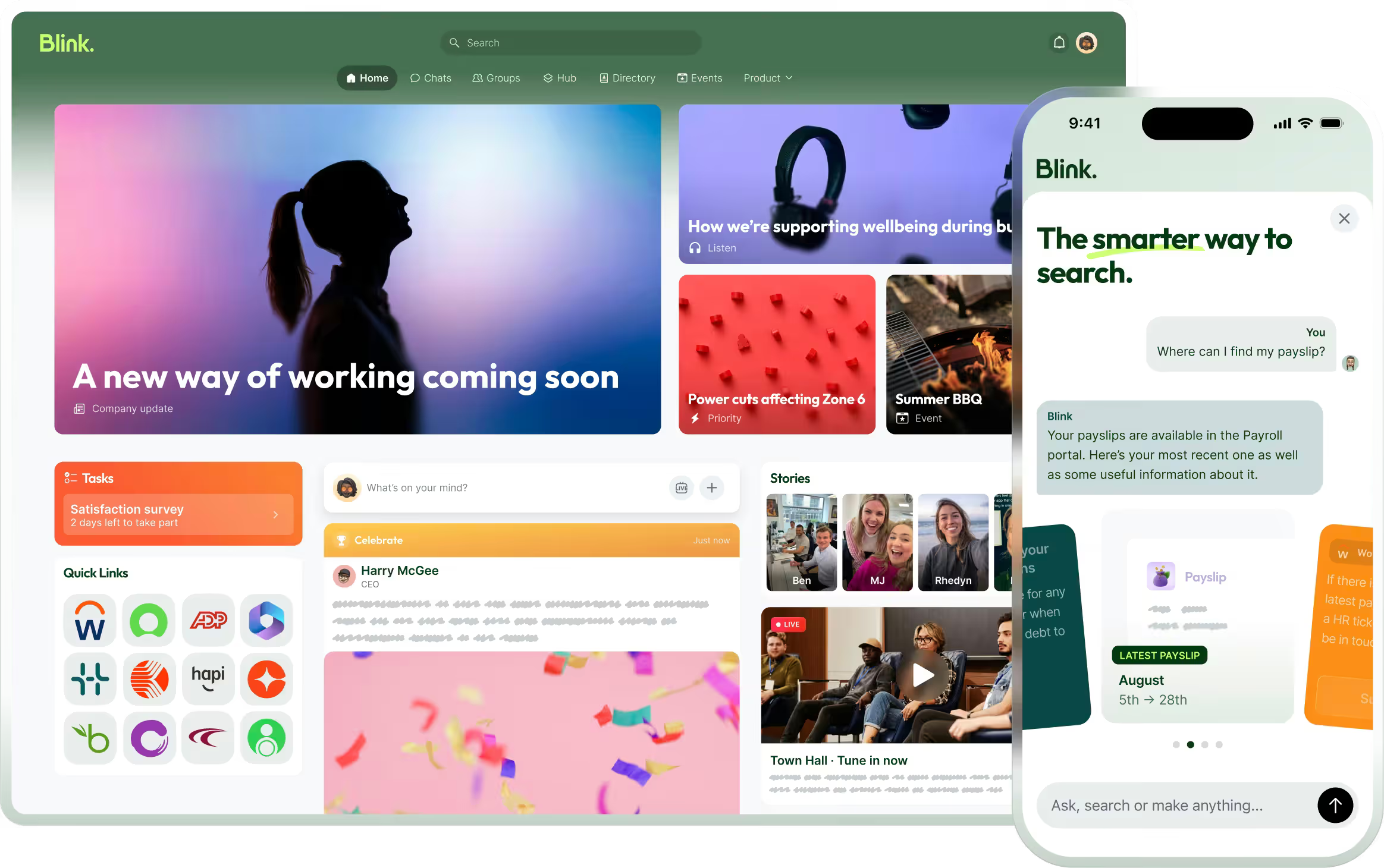
With an employee experience tool like Blink, you can create personalized user journeys, segmenting your workforce so they get a tailored experience across the whole platform. This can lead to a massive uptick in employee engagement — as well as employee retention.
Prioritize mobile-first design
Don’t shrink a desktop tool to fit a smartphone screen. Instead, opt for software that’s been designed with the mobile experience front of mind.
An employee app like Blink makes it easy for you to reach your workforce — who, let’s be honest, already live on their phones. It’s also an excellent way to reach frontline employees.
By taking your tech tools mobile, you create an equitable experience for all employees, no matter where or how they access your software.
Make feedback loops part of the design, not an afterthought
The best experiences evolve with employees. So treat EX as an ongoing exercise in empathy.
Use data and employee feedback to iterate and improve systems. Continually reassess how employees use your tech tools — and how you can make experiences even better.
To make this process as easy as possible, embed feedback loops into your tech tools. Ask for employee feedback, right within your software. And ensure leaders have access to the data and analytics they need to make meaningful EX improvements.
{{mobile-live-stream-poll="/image"}}
Upgrade EX to get more from your digital tools — and your workforce
The right tech tools don’t just support EX — they help shape it.
They determine whether employees spend their days in a state of friction-free flow. Or whether frustration and stress color the workplace experience.
A modern intranet. An employee app. An internal comms platform. A dedicated employee experience tool. Whichever platforms you’re using, look at them from the employee perspective.
Tailor tools to their needs. Personalize experiences for each employee. Prioritize interaction, feedback, and mobile-first design to elevate and streamline EX.
In doing so, you’ll delight employees, earning their trust and driving engagement, so you get the very best from your workforce.