Reducing frontline turnover: the real cost and fix
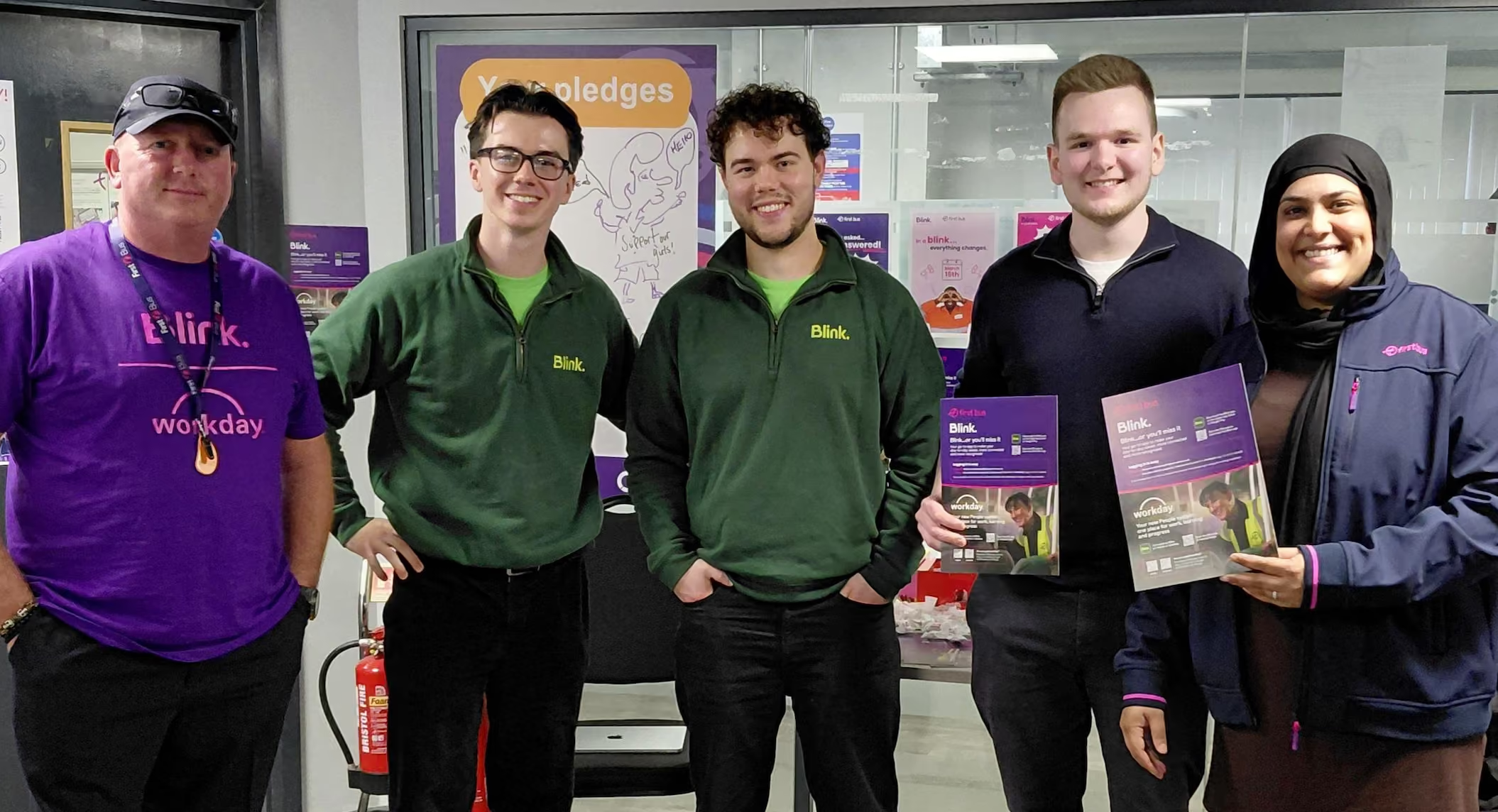
Reducing frontline turnover starts with knowing what actually drives it, and the data says it's rarely pay. Stagecoach, a UK bus operator, saw up to a 26% reduction in frontline turnover after replacing fragmented, paper-based processes with Blink, a single employee app. That's the kind of number that changes an entire year's recruitment math for a transport operator already short on qualified drivers.
Most frontline turnover isn't about the salary line. It's about whether someone felt seen, informed, and set up to succeed in their first 90 days. Fix that, and the recruitment bill shrinks on its own. This guide breaks down what actually drives frontline turnover and frontline employee retention, the levers that move it, and what it looks like when organizations get this right, backed by real outcomes from Blink customers. For a broader view of the pillar this sits inside, see Blink's guide to employee retention strategy.
What is frontline turnover?
Frontline turnover is the rate at which deskless employees, people in retail, hospitality, transport, healthcare, and manufacturing roles, leave their jobs and need to be replaced. It's typically measured as an annual percentage: the number of frontline employees who left divided by the average number employed, multiplied by 100. Frontline turnover tends to run higher than turnover among desk-based staff, because frontline roles combine lower pay, less flexibility, and historically worse access to company information and support. It matters because every frontline departure carries a direct cost (recruitment, onboarding, lost productivity during ramp-up) and an indirect one (remaining staff picking up slack, service quality dipping, customers noticing the churn in the staff they see every day).
Why is frontline turnover so expensive?
Every frontline departure carries a direct cost in recruitment, onboarding, and lost productivity, plus an indirect cost in service quality while the role sits open. For a business running 50 locations, even modest turnover adds up to a six-figure problem hiding in plain sight, once you count manager hours spent interviewing and training, the dip in team performance while a role is vacant, and the customers who notice when their regular server, driver, or care worker keeps changing.
Turnover doesn't just cost money the moment someone leaves. The disengagement that precedes a resignation and the ramp-up time that follows a replacement both carry a cost of their own, often larger than the recruitment line item itself. The pattern Blink sees across its customer base is that the organizations with the lowest turnover aren't always the highest payers. They're the ones where frontline employees feel like they know what's going on and that someone would notice if they left.
Does better communication actually reduce frontline employee retention?
Yes. Communication is one of the few retention levers an employer controls directly. It's the pattern Blink sees most consistently across its customer base: organizations that close the information gap for frontline teams see the disengagement that precedes resignation start to lift, often with a measurable dent in turnover within a couple of quarters, because employees who are kept in the loop stop quietly checking out.
Frontline employees who don't have a company email or a desk have historically been the last to hear anything, shift changes, policy updates, even basic praise for a job well done. That gap breeds a specific kind of disengagement: not loud, not a formal complaint, just a slow drift toward "nobody would notice if I left." Closing the information gap closes that drift. When every driver, every store associate, every care worker gets the same message at the same time, on a device they already carry, the gap between "informed employee" and "frontline employee" disappears.
Key takeaway: communication isn't a nice-to-have alongside retention strategy. For frontline teams specifically, it's one of the retention strategies, because the absence of it is what creates the disengagement that turnover tracks.
How much does a bad first 90 days cost you in frontline turnover?
New hires who leave in their first 90 days cost an employer the full price of recruitment without ever returning the investment in training, which makes onboarding the single highest-leverage window you have. New hires who don't feel equipped, informed, or welcomed in their first three months are far more likely to leave before they ever become productive.
A faster, smoother onboarding experience signals to a new hire that this employer has its act together, and that signal shapes whether they stick around past the first rocky shift. Every day a new hire spends confused about where to find their schedule, their training material, or who to ask for help is a day closer to them deciding this job isn't worth the hassle. Blink customers running onboarding through QR-code sign-up and a mobile-first first day consistently see new hires productive faster than a paper-based process allows, because the information a new hire needs is in their pocket from day one instead of locked in a system they can't yet access.
Onboarding doesn't need more content. It needs to reach people where they already are, on their phone, from day one, without requiring a company email address they don't have yet.
Does recognition actually reduce frontline turnover?
Recognition reduces frontline turnover because it directly counters the feeling of being invisible to the organization, which is what drives quiet disengagement and eventual exits. That invisibility is corrosive over time, even in roles with reasonable pay.
A functioning recognition loop doesn't need to be complicated. It needs to be visible, specific, and frequent enough that it's a normal part of how the business runs, not an annual awards ceremony. Peer-to-peer recognition and public shoutouts on a shared company feed, visible with Blink's recognition features, tend to become self-sustaining once employees trust that a comment or a shoutout actually gets seen, so people start recognizing each other without being prompted.
Key takeaway: recognition that only happens through a manager doesn't scale past a handful of direct reports. Recognition that happens on a shared, visible channel scales with the organization.
What's the feedback loop that's missing from most frontline retention strategies?
A real feedback loop tells you why someone is about to leave while there's still time to fix it, rather than why they already left. Exit interviews only answer the second question. Most frontline retention strategies stop at the exit interview, which means the first real signal an employer gets is the resignation itself.
The problem for most frontline organizations isn't a lack of care. It's a lack of infrastructure. Email surveys sent to a company address nobody checks get a low response rate, if they reach the right person at all. A pulse survey sent through the same app employees already use for their schedule and their pay information gets answered because it costs the employee ten seconds, not ten minutes of hunting for a login they don't remember.
The pattern Blink sees across customers is that frontline employees given a real, fast way to flag a problem use it, often about things like broken equipment, unclear scheduling, or a manager who never explains the reasoning behind a decision. Those are fixable, if you hear about them in week three instead of at the exit interview.
Why does frontline turnover matter more than office turnover?
Frontline turnover is visible to your customers in real time, while office turnover usually isn't. A new hire in a back-office finance role can ramp up quietly over a few weeks. A new hire on a retail floor, behind a hotel front desk, or driving a regular bus route is customer-facing from day one, and the gap between an experienced employee and a brand-new one is obvious to the people being served.
Frontline employees are also the group least likely to have a company email address, a company laptop, or regular face time with HR or leadership, which means the standard retention playbook built for desk-based staff, intranet articles, all-hands meetings, email surveys, simply doesn't reach them. That's the core reason frontline turnover has stayed stubbornly higher than office turnover for years: not because frontline workers care less about their jobs, but because the tools built to retain employees were built for people who already had a desk. For a frontline-heavy business, closing that gap starts with giving every employee, regardless of role or device, the same access to information, recognition, and a voice that desk-based employees have had for years.
How do you actually start reducing frontline turnover?
Fixing frontline turnover takes a stack of small changes that compound:
- Audit your first 90 days. Map exactly what a new hire experiences in their first week. If it involves paper forms, a company email they don't have, or a three-day wait to get system access, that's your biggest single leverage point. If you run multiple sites, check that this experience is consistent everywhere, not just at the location that happens to run it well.
- Put communication on the device they already have. A frontline retention strategy that depends on a company email address or a break-room noticeboard will always underperform one built for the phone in their pocket.
- Make recognition visible, not just verbal. A manager saying "nice work" in passing doesn't compound. A public shoutout that colleagues can see and react to does.
- Build a real feedback loop, and close it. Ask a question, then visibly act on the answer. Employees stop responding to surveys the moment they conclude nothing changes.
- Measure the cost, not just the rate. A 20% turnover rate sounds abstract. Twenty departures at a few thousand dollars each adds up fast, and a concrete figure gets budget approved where a percentage doesn't.
None of this requires a long rollout. Blink customers are typically up and running in a day, and Blink's own activation data across its customer base runs 95-99%, including for frontline workers who don't have a company email, so the rollout itself isn't the obstacle it looks like from the outside.
See what turnover is actually costing you
Blink's employee app gives every frontline worker, with or without a company email, one place for schedules, recognition, onboarding, and feedback. Stagecoach cut frontline turnover after making that switch, and it's the pattern Blink sees across its customer base more broadly. Start a 14-day free trial, no credit card required, and get your team up and running today. Want to see the number first? Calculate what turnover is actually costing you.