Beyond scheduling: what enterprise frontline workforce management actually requires
Your frontline workers are clocked in. Their shifts are covered. The rota went out on time. By every operational metric your workforce management software tracks, this week looks fine.
And yet turnover is climbing. A site manager is fielding the same question from six different shifts because there's no other way to answer it once. Nobody read the policy update from last month, and nobody can prove it either way. Somewhere on your sites right now, someone is running a compliance check with a paper clipboard because the system that was supposed to replace it never reached the floor.
Call it the scheduling gap: the work your WFM tool was never built to do. For enterprise organizations managing hundreds or thousands of frontline workers across multiple sites, it's one of the most expensive blind spots in the business, and it's usually invisible until a safety incident, an audit, or a resignation letter makes it visible.
Frontline workforce management covers every system, process, and tool an organization uses to plan, coordinate, communicate with, and develop its frontline teams. That includes scheduling and time-tracking, but it also includes communications, compliance, knowledge sharing, and the cultural infrastructure that determines whether your workers stay, perform, and care.
This guide makes the case for what complete frontline workforce management looks like, why operational tools alone can't deliver it, and how enterprise HR and operations leaders are closing the gap. If you want the fuller picture of what a connected frontline experience looks like end to end, Blink's guide to building a better frontline employee experience covers the broader framework this article sits inside.
What is frontline workforce management?
Frontline workforce management is the set of practices and platforms an organization uses to plan, coordinate, and support employees who work on-site, in the field, or in direct contact with customers and operations. It spans scheduling and shift management, time and attendance tracking, compliance and policy administration, internal communications, training and knowledge sharing, and employee engagement.
The discipline exists because frontline workers have fundamentally different needs from desk-based employees. They often don't have company email addresses. They work across locations, shifts, and sometimes contractors or agency staff. They're harder to reach, harder to train at scale, and more likely to leave when they feel disconnected from the organization. In Blink's work across retail, care, transport, and logistics, this pattern holds consistently: the engagement gap shows up hardest among deskless and frontline employees specifically. Complete frontline workforce management treats that gap as a strategic problem, not an administrative inconvenience.
Why scheduling tools only solve half the problem
Scheduling tools solve a real and important problem. Getting the right person in the right place at the right time is genuinely complex at enterprise scale, and platforms built for that specific task do it well.
The limitation is what scheduling tools measure, and what they can't. A time-and-attendance system can tell you that 94% of shifts were covered last quarter. It cannot tell you whether the people who covered those shifts understood the new safety protocol, felt confident escalating a concern, or had any idea the company was launching a new service next month.
Connecteam, for instance, has built a strong reputation in the SMB market for combining scheduling, time-tracking, and basic team communication in one interface. For teams of 20 to 100 employees, it's a genuine contender. But enterprise organizations with thousands of frontline workers, multi-site complexity, and deep compliance requirements consistently hit a ceiling with point solutions like it: no structured channel for workers to surface concerns, no compliance audit trail, and reach that falls well short of what a 2,000-person operation needs.
The ceiling looks like this on the ground, not just on a vendor comparison chart:
- Operational visibility without engagement visibility. The dashboard shows who's clocked in. It doesn't show who's about to quit, or who's confused about a procedure they're too embarrassed to ask about twice.
- Broadcast-only communication. Managers push messages out. A warehouse picker or a care worker on a home visit has no structured channel to flag a problem back up before it becomes an incident.
- Compliance tracked on paper. Policy acknowledgments, training completions, and certification records live in spreadsheets or a binder in the site office, found only when someone goes looking for it during an audit.
- No organizational identity. Frontline workers, especially in retail, logistics, and care, don't feel connected to the broader organization because nothing connects them beyond a shift pattern.
That last point matters more than it looks. The quality of the employee experience on the frontline is a direct predictor of the quality of the customer experience. Operational efficiency gets you in the game. Engagement is where the margin lives.
The enterprise gap: what operational tools miss
For enterprise operations directors, the question isn't whether frontline workforce management tools are useful. It's whether the tools in place are doing enough. Most aren't.
Three categories of need consistently fall outside what scheduling-first platforms can address.
1. Communication at scale, without email
Most frontline workers don't have company email addresses. That's not a technology failure, it's simply a workforce design reality in retail, hospitality, construction, logistics, and care. But it means that every internal communication system built around email instantly excludes the people on the floor, in the van, or on the ward.
Picture the manager who's already juggling a packed shift and still has to relay the same safety update to twelve people individually, because there's no other channel that reaches them. Organizations working around this with WhatsApp groups or personal messaging apps aren't solving that problem. They're creating a new one: no structured record of who read what, no employer-owned channel, and a GDPR and compliance exposure most legal teams haven't yet gotten a handle on.
2. Compliance and knowledge management at the point of need
Frontline teams need access to the right information at the right moment, not in a training session three months ago, not in a PDF buried in a SharePoint folder they've never been shown. They need it on the floor, on their phone, in the thirty seconds before a difficult conversation with a customer or a safety check with a contractor.
That kind of just-in-time knowledge infrastructure isn't scheduling. It's content management, search, and communications design. Most operational WFM platforms don't build for it because it sits outside their core use case.
3. The cultural layer: belonging, recognition, and voice
This is the category most operations directors are least comfortable talking about, and it's the one with the biggest measurable impact on retention. Engaged frontline workers are less likely to leave, more likely to advocate for the business, and more likely to go beyond their job description when a customer or situation requires it.
When frontline workers have a single, mobile-first place to receive information, ask questions, access resources, and feel seen as part of a wider community, the business sees it in the numbers that matter: fewer leavers, lower agency spend, steadier teams. Customers using Blink can see up to a 26% reduction in frontline turnover, measured at Stagecoach. At enterprise scale, that's not an engagement metric. That's a cost-of-operations metric measured in millions.
What complete frontline workforce management looks like
The organizations getting this right aren't replacing their scheduling tools. They're adding an engagement and communication layer that operational systems can't provide.
Think of it as a stack, not a single platform:
The most common failure mode for enterprise organizations is treating the top row as the whole stack. Scheduling gets funded and optimized. Everything below it gets improvised with email, WhatsApp, and the occasional town hall.
The cost of that improvisation shows up in exit interviews, in the compliance folder nobody wants to open before an audit, and in how many times a shift supervisor repeats the same instruction in a single day. It's less visible in the engagement data, because most frontline organizations aren't measuring it yet.
Why frontline workers are different, and why that changes everything
You can't apply desk-worker logic to frontline workforce management. The tools, the cadence, and the content design all have to be built for people who:
- Don't sit at a computer
- Consume information in short bursts, often between tasks or on a break
- Work across multiple sites, shifts, or with third-party staff
- Are more likely to trust their direct manager than the corporate center
- Are skeptical of technology that feels like surveillance rather than support
That last point matters for adoption. Enterprise organizations regularly deploy frontline tools, watch usage settle at a fraction of the workforce, and call the rollout a success anyway because nobody set a bar beforehand. A communications platform that half your workforce doesn't use isn't a communications platform. It's a content archive that some people visit.
Across Blink's enterprise customer base, overall adoption is over 90%, including for workers without a company email address. JD Sports reached 87% adoption within 10 days of launch. These figures hold at the scale that matters to an operations director managing thousands of workers across dozens of sites, not in a small pilot that never has to survive contact with a real shift pattern.
The reason activation rates matter so much is that communication is only as effective as its reach. A policy update read by 60% of the frontline is a compliance risk. A training video watched by 55% of a care team is a clinical governance concern. Frontline workforce management only works when it actually reaches the workers on the frontline, not just the workers who happen to check a desktop portal.
Why this matters for enterprise HR and internal comms teams
Operations directors see the scheduling gap through a cost and execution lens. HR and internal comms leaders see it through a different frame: the internal case for investment.
The argument that resonates in the boardroom isn't about engagement. It's about what disengagement costs. Turnover, compliance failures, incident rates, manager time spent repeating information across sites, these are things a finance team can put a number against once someone bothers to measure them. When HR leaders can show that a frontline communications platform drives policy read rates into the mid-90s, and that customers using Blink see up to a 26% reduction in frontline turnover, the conversation shifts from "nice to have" to "why haven't we done this already?"
Building that internal case means connecting daily frontline experience to business operations: the manager who repeats the same safety briefing six times a shift, the compliance record that lives in a drawer, the leaver exit interview that says "I didn't feel like part of the team." The problem isn't that frontline workers are hard to reach. It's that most enterprise organizations have never built the infrastructure to reach them. Blink's guide on internal communications for frontline teams that email alone can't reach goes deeper on why email-first strategies fail this specific audience.
That infrastructure is also what's missing before workforce data and AI-assisted scheduling can become standard tools. None of that works without a reliable way to reach every worker first.
How to evaluate what your frontline operation actually needs
Before adding tools, audit the gap. Ask these questions across your frontline operation, site by site, not just at head office:
On communication:
- How do frontline workers currently receive company news, policy updates, and operational changes? If the honest answer is "their manager tells them at the start of a shift," what happens on the shift that manager isn't working?
- What percentage of your frontline workforce has a company email address?
- How do you verify that a message has been read and understood, not just sent?
On compliance:
- How are policy acknowledgments currently recorded, and could you produce that record for a single site within an hour if an auditor asked?
- Where does an employee go to find the current version of an SOP or procedure guide, on their phone, mid-shift?
- What is your audit trail if a compliance question is raised about a specific site or shift?
On engagement:
- Do you have a mechanism for frontline workers to ask questions or raise concerns without going through their immediate line manager?
- When did you last survey your frontline workforce? Did they respond?
- What does your frontline turnover rate look like, and what proportion of leavers cite feeling disconnected as a factor?
If the answers to any of these questions involve WhatsApp, paper, or "I'm not sure," your frontline workforce management stack has a gap. The question is how significant the cost of that gap is, and whether the business is ready to quantify it.
Closing the gap: where to start
The most effective enterprise implementations don't start by replacing the scheduling system. They start by solving the communication and compliance layer first, where the gap is most visible and the ROI is fastest to measure.
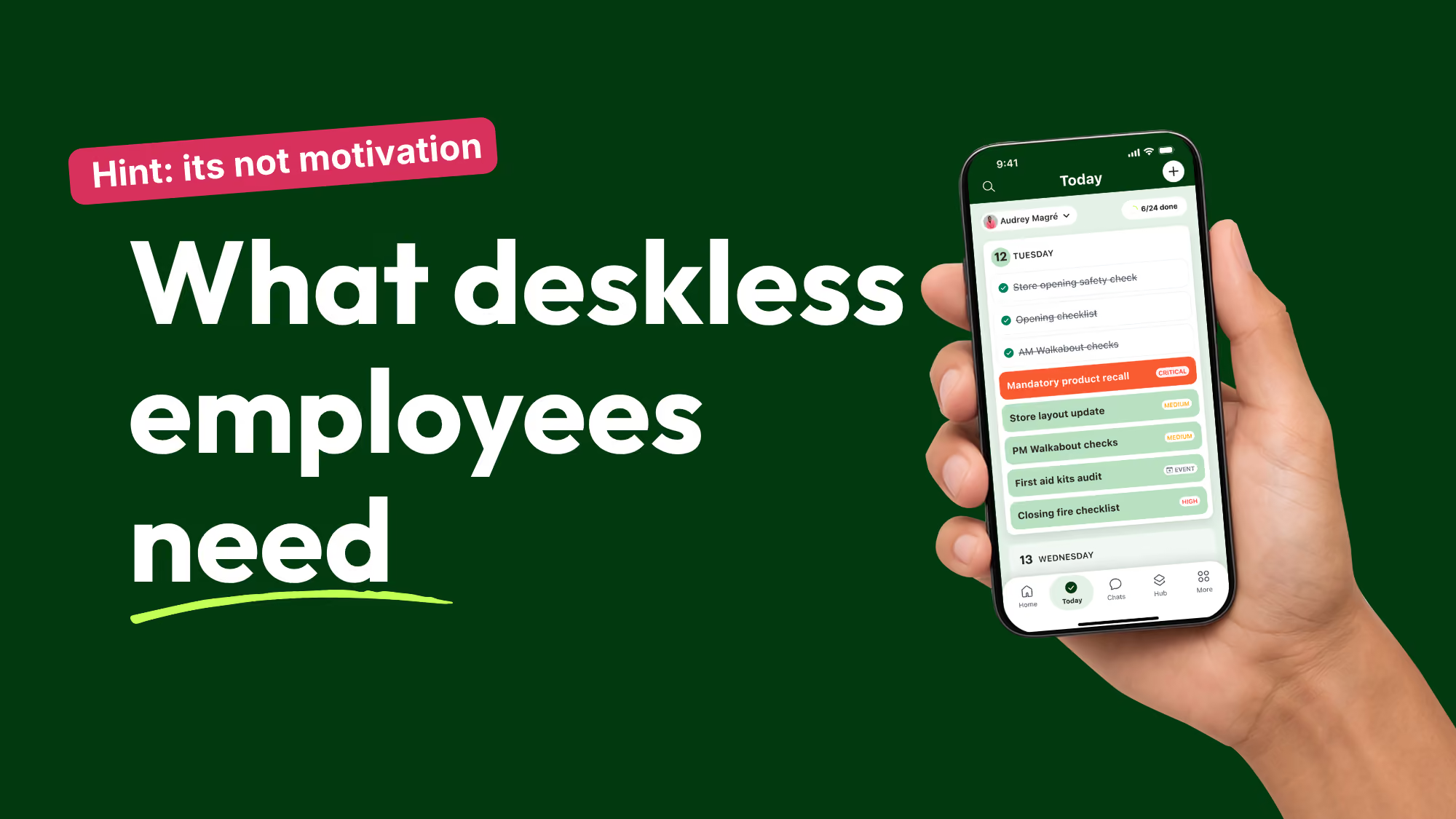
A mobile-first employee experience platform gives every frontline worker a single place to receive information, access resources, and connect with the organization, without requiring a company email address, a desktop computer, or a manager to relay the message. That's the foundation.
Once communication reaches the whole workforce, everything else becomes possible: targeted training, compliance verification, manager feedback loops, and eventually the kind of workforce data that makes AI-assisted scheduling and operations genuinely useful. You can't analyze engagement you can't measure. And you can't measure it if you can't reach the people.
Blink works as that foundation layer across enterprise frontline organizations in retail, logistics, care, and transport, sitting alongside scheduling and HR platforms including Workday and ServiceNow rather than replacing them.
See it in action
Scheduling software tells you the shift is covered. It can't tell you whether the person on it understood the safety briefing or is about to hand in their notice. Explore how Blink's platform works for enterprise frontline teams, or see results from enterprise deployments at easyJet, JD Sports, and Stagecoach. Overall adoption across Blink's customer base runs over 90%. Start a 14-day free trial, no credit card required, and get set up in a day.