What the LumApps and Beekeeper acquisition means for your frontline strategy
If you're a Beekeeper customer, you've had a few months to sit with the news. LumApps, an intranet platform built mainly for desk-based workers, has brought Beekeeper, a mobile-first frontline communication platform, under one roof. LumApps now says the combined company is "trusted by more than seven million employees", and its site confirms Beekeeper is "now part of LumApps."
That's the headline. But if your frontline operations run on Beekeeper today, the question you actually care about is simpler: what does this mean for my team, my contract, and my roadmap?
This piece gives you a clear-eyed read on the acquisition, what's changing, what's still unconfirmed, and what questions you should be asking before your next renewal. For broader context on evaluating a frontline communication platform, that guide is a useful companion to this one.
What is the LumApps and Beekeeper acquisition?
LumApps is an enterprise intranet platform built primarily for desk-based workers. Its strength is corporate communications: news feeds, document hubs, integrations with Microsoft 365 and Google Workspace, and an AI-powered content layer for internal comms teams.
Beekeeper is a mobile-first frontline communication platform. Its core customers are in hospitality, manufacturing, retail, and transport, where large parts of the workforce don't sit at desks, don't have company email addresses, and need comms that work on a personal smartphone on the floor, on the road, or in a facility.
LumApps has now absorbed Beekeeper, positioning the combined business as a single "AI Employee Hub" intended to serve desk and frontline workers from one platform. LumApps' own frontline product page frames this as replacing "paper, scattered group texts, and intranets built for desk workers" with one mobile hub, which is effectively the Beekeeper pitch now running under the LumApps brand.
What does this actually change for Beekeeper customers day to day?
The most immediate risk isn't the deal itself, it's what happens to the people and features you rely on. A support ticket might take longer to resolve. A feature request you'd been promised might quietly drop off the roadmap. Your account contact might change.
None of that has been confirmed publicly for every customer. But two things are already visible. First, the Beekeeper brand is being folded into LumApps: the standalone identity is already diminishing on LumApps' own site, where Beekeeper is referenced as absorbed rather than as a separate product line. Second, LumApps is now selling one frontline pitch under its own name, which means the roadmap decisions that used to be made by a company focused only on frontline customers are now being made by a company that also has to serve desk-based intranet customers.
That's the shift worth watching. It's not a verdict on product quality today. It's a reason to ask sharper questions at your next renewal than "is everything still working."
Why ownership and integration timing matter here
Mergers in workforce software typically take time to settle, and the settling period is where customers feel the most friction. Combining two platforms means reconciling two codebases, two support structures, and two product philosophies. LumApps has introduced a unified mobile app pulling in features from both platforms, but a full technical integration of two separate products is not a fast process, and your team is running on a platform in active transition during that window.
That matters for a simple reason: priorities during an integration period tend to go toward work that makes the combined pitch easier to sell, not necessarily toward the frontline-specific features a Beekeeper customer signed up for in the first place. That doesn't mean the product gets worse. It means the incentives have shifted, and a multi-year frontline strategy should treat that shift as part of your vendor risk picture, not just a line in a roadmap deck.
The two-product problem every merger faces
Combining a desk-first platform and a frontline-first platform is harder than the press release makes it sound.
Intranet platforms are built for people who have company email, a desk, and a laptop. The UX assumptions are different. The content architecture is different. The admin workflows are different. The security and provisioning models are different.
Frontline platforms are built for people who have none of those things. Setup via QR code. No email required. Lightweight, fast-loading apps designed for shared devices or personal phones in high-turnover environments. Push notifications that actually get opened because there's no inbox competing for attention.
Building a genuine "AI Employee Hub" for both groups means either building separate experiences within one platform, which is complex and expensive, or building a hybrid that serves both groups adequately but neither optimally. A long integration timeline is a long time for your frontline to wait on the answer.
Five questions Beekeeper customers should ask right now
If you're on Beekeeper, these are the questions that matter at your next vendor conversation.
1. What happens to your contract and pricing? Post-acquisition pricing reviews are common after any merger. If you're mid-contract, you have some protection. If renewal is in the next 12 months, ask specifically whether pricing tiers are changing and whether your existing feature set is guaranteed at the same price point.
2. What is the product roadmap for frontline-specific features? Get specifics. Ask which Beekeeper features are being maintained, which are being folded into the LumApps platform, and which are being deprecated or merged. "Continued investment in frontline" is not a roadmap. A list of features, dates, and owners is.
3. Who is your customer success contact, and are they staying? Post-acquisition CSM changes are one of the most disruptive things for enterprise customers. If the person who understood your deployment is being reallocated or departing, that matters for your day-to-day support quality.
4. What does data portability look like if you decide to migrate? Your frontline data, comms history, forms, and workflow outputs: ask about data export options now, before you need them. It's easier to ask before you sign something new than after.
5. What's the timeline for features your operations depend on? Beekeeper's form builder, shift communication tools, and compliance workflows were built for deskless use cases. Understand whether these are being maintained, rebuilt inside LumApps, or at risk of deprioritization as the combined product serves a broader desk-worker market.
What switching actually looks like
Asking the five questions above is step one. If the answers don't reassure you, it helps to know what moving off Beekeeper actually involves, rather than treating migration as an abstract risk.
A typical switch runs in three stages. First, data export: your comms history, forms, shift records, and workflow outputs come out of Beekeeper in a structured format, which is why asking about export options now, before a renewal forces the question, matters. Second, a parallel run: the new platform is set up and tested alongside Beekeeper, usually over one to two weeks, so nothing goes dark mid-transition. Third, cutover: the new platform goes live, training is pushed through the new app itself rather than a separate LMS, and Beekeeper is switched off once adoption is confirmed.
With Blink, setup is designed to run in a day rather than months, and the trial period is 14 days with no credit card, so you can test the parallel-run step before committing to anything.
Why frontline-first design matters more than one platform for everyone
The appeal of a single platform for desk and frontline workers is real. One vendor, one contract, one data layer. It's a compelling argument in an enterprise procurement meeting.
But the frontline deserves more than an add-on to a desk-worker platform. We've seen deskless and frontline employees show up hardest in engagement gaps, across every sector Blink works in. Their comms tools have historically been afterthoughts. Their intranet access was via a shared kiosk, if at all.
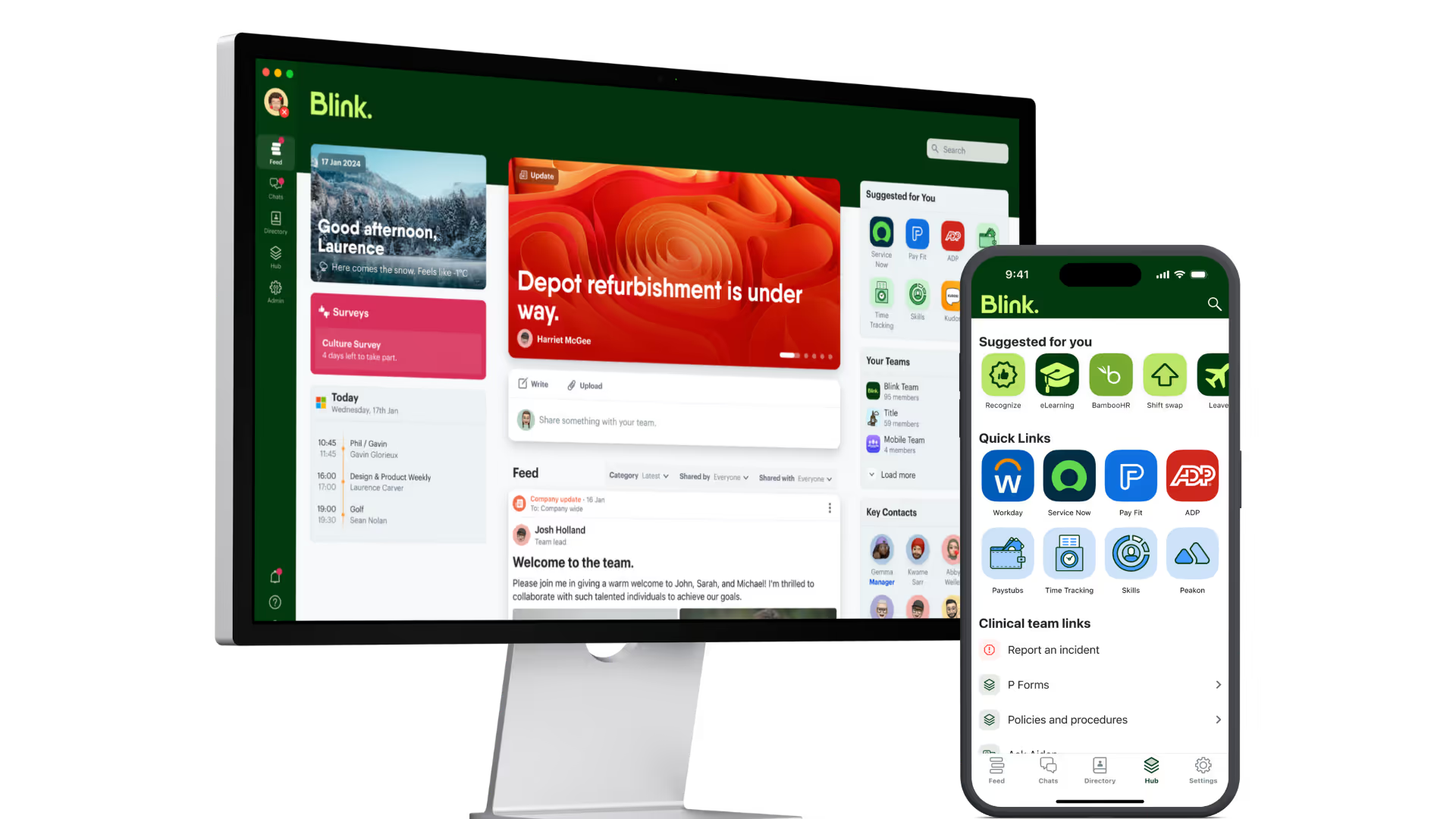
A platform designed specifically for how frontline teams work produces different outcomes than one built around a shared login with desk-based staff. That means mobile-first as a design principle, not a feature checkbox. It means onboarding via QR code because not everyone has a company email. It means read receipts and push delivery because compliance isn't optional in regulated industries. It means activation that holds up in practice, not just on a slide: overall adoption across Blink's customer base is over 90%.
At easyJet, 88% of more than 20,000 employees are active users on Blink. That's a frontline-scale number, delivered by a product built for frontline adoption from day one.
The case for evaluating your options now
Acquisitions create natural evaluation windows. If you're a Beekeeper customer, you're in one right now. Your existing contract terms still apply, your team knows the current product, and the switching cost is lower now than it will be once integration is deeper and the product has changed more substantially.
Evaluating your options doesn't commit you to switching. It gives you a basis for comparison when you do need to decide. The five questions above are worth asking of any vendor, including LumApps/Beekeeper. Asking them of Blink, Workvivo, or Staffbase as well means you're making an informed choice rather than a default one.
Staying with a platform because switching feels complicated isn't a frontline strategy. It's a procurement habit.
How to think about the alternatives
If you're actively evaluating, the right alternatives depend on what Beekeeper was solving for you.
If Beekeeper was your frontline communication platform, the most direct comparisons are Blink, Connecteam, and Sona, particularly for care and retail environments. Each takes a different approach to frontline-first design, compliance, and workflow integration.
If Beekeeper was your attempt to unify desk and frontline communications, Workvivo (now part of Zoom) and Staffbase serve that space, as does the combined LumApps/Beekeeper entity. The question is whether unifying the two means the result works well for both groups, or just adequately for both.
If your primary concern is IT governance, Blink supports SSO, GDPR compliance, and audit trails, and integrates with common enterprise systems. The question isn't just whether a platform will work, it's who owns the data, where it lives, and what the exit path looks like if you need one.
For a full feature-by-feature breakdown, see the Beekeeper vs. Blink comparison guide, which covers how the LumApps acquisition affects the competitive picture in detail. If you're a Beekeeper customer reassessing your frontline platform, it's worth adding Blink to your evaluation. See how Blink works or talk to a specialist: setup runs in a day, no credit card required, with up to a 26% reduction in frontline turnover reported at Stagecoach after moving to Blink.