What I learned trying to reach the TikTok generation at JD Sports
Engaging the TikTok generation: How JD Sports is building culture for the Gen Z workforce
Published:
June 30, 2026
Last updated:
June 30, 2026
Here's the question I come back to constantly: how do you get 16-to-19-year-olds on the shop floor to care about a message from the CEO?
It's not a rhetorical question. It's one my team has been working on for the last 18 months, and we've made a real impact.
Five generations, one workforce
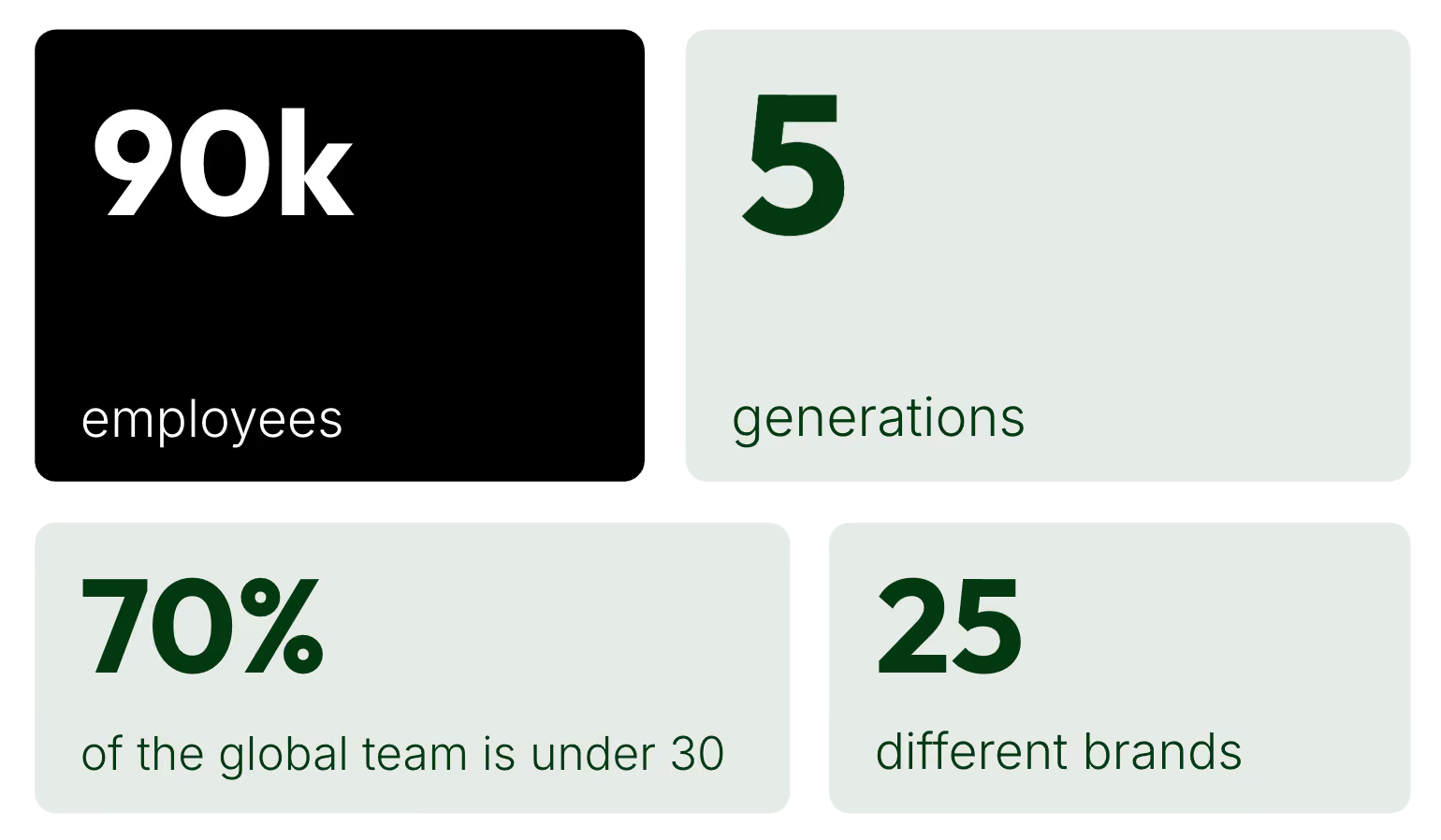
JD Sports isn't a small operation. We have 90,000 colleagues across 20+ countries with25 brands under the JD Group banner. And five generations working side by side, with 70% of our workforce being under the age of 30.
That last number is the one that keeps me up at night (in a good way). The majority of our people are on shop floors, not in front of laptops. They're not opening an intranet. They're not watching the hour-long town hall recording.
There's never a day where we don't walk into the office and think: what can we do for the stores today, and how are we going to get this message to land? Everyone has a different love language. There is no one-size-fits-all anymore, there just can't be.
The red flag: one-way, overly corporate communication
As a FTSE 100 company, we have real obligations. Results to share, legal updates to communicate, leadership directives to cascade. None of that goes away.
But the way we were delivering it? It wasn't landing.
Long messages. Lengthy calls. Content that felt designed for a boardroom, not a stockroom.
The fix wasn't to dumb things down. It was to meet people where they actually are.
JD Now: going where our people are
We launched JD Now - our internal comms platform - in the UK 15 months ago. The brief was simple: mobile-first, bite-sized and human.
Instead of polished corporate videos, we started producing 30–45 second clips on iPhones. Quick editing, often with a same-day turnaround. A CEO update became five key points, delivered straight to camera, in under a minute.
For some of our shop floor colleagues, it might be the first time they've ever seen anything from our CEO. Because it's on their phone and it's done in a style of content they’re already used to seeing from their other favorite apps.
But the bigger unlock wasn't the content my team was making. It was the content our colleagues started creating themselves.
When you give people a platform, they run with it
Employee-generated content has taken over JD Now — and honestly, we didn't plan it that way.
One store team created a popular movie franchise-themed video to promote an Air Max release. A group in London started recording a podcast about career progression, using an Amazon mic and an iPhone. These all became smash hits with great engagement of likes and comments from their peers and leaders. We didn't ask them to do any of this. They just did it, because they'd found a space that felt theirs.
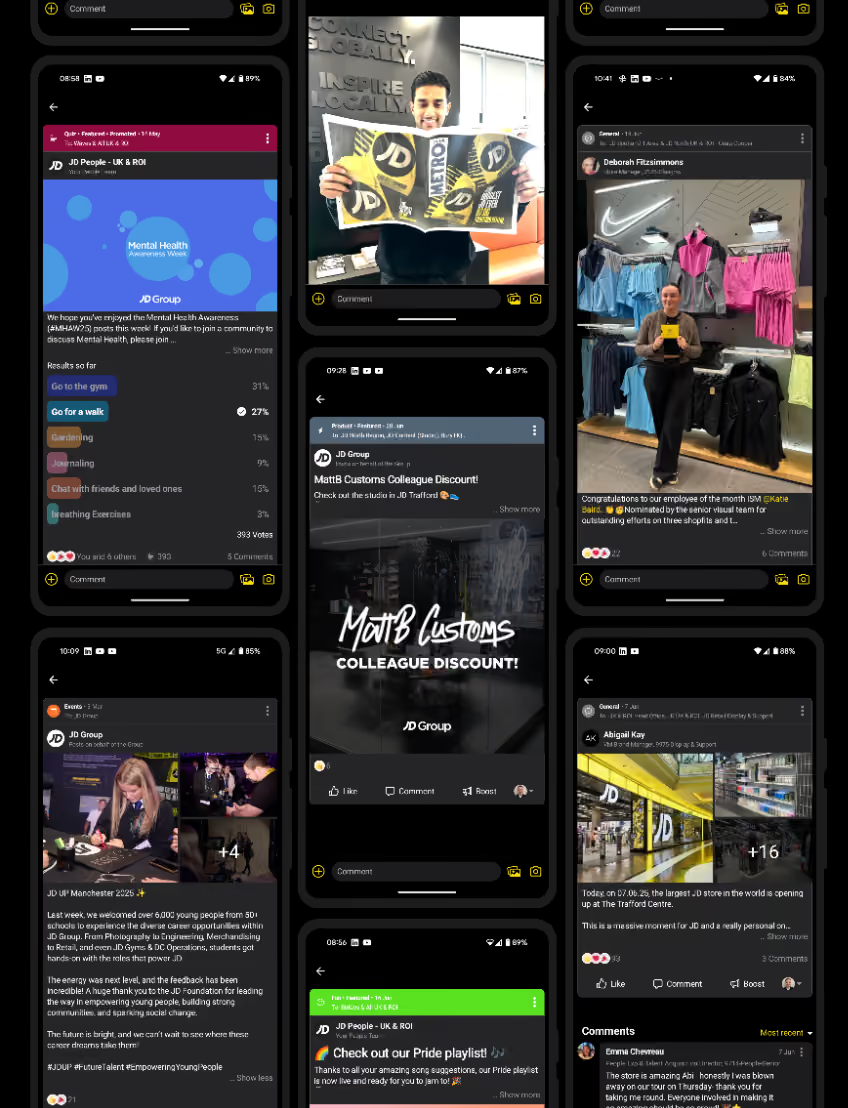
That podcast host? We spotted him, brought him up to Manchester to host a major youth event, and then took him to a King's Trust event where he met Prince William. Because he posted on our internal comms platform.
Making leaders human
One of the most consistent things we heard in surveys was simple: there’s a big opportunity to know and understand the people who are leading us better.
We tackled this head-on with JD Now — starting with our senior leaders in retail. Many of them are known as the important people who come in, provide feedback and expect excellence (we always make sure we’re the best, of course).. However, during our launch week, and the weeks leading up to it, we empowered these leaders to use JD Now as a platform to connect with their people - not just talk about sales, but use it as a way to connect and engage in a way they might not have been able to before. They’ve leaned into it…now commenting on various posts and showcasing their personalities a bit more.
The response from colleagues? Oh, they’re normal people!
I know it sounds corny. But we were blown away by how many colleagues said: yeah, actually, employee communications can be engaging. One comment, a post, a like on a photo from a store and the ability to have more visibility did so much more for the perception and connection to that team than a dozen town hall appearances.
The numbers back it up
When we first launched JD Now, we saw an incredible 74% adoption across our initial 20,000 colleagues, and it has grown from there. Right away, we knew that our teams had a genuine desire to experience a new way of communicating.
This was validated with a 3% increase in our overall Communication score in our first global survey following the launch of JD Now. We absolutely credit that to changing how we communicate and how we get retail leaders genuinely involved.
But the metric I care about most isn't a survey score. It's when a store manager says to me, unprompted: "We should put that on JD Now."
We didn't prompt them. They came to us. That's what matters.
What I'd tell every comms team
The future of communications isn't rooted in communication. It's about culture.
What makes your organization you?
What are your values, and how do they connect with your colleagues?
Everything else falls into place when you feel really good about what you have to offer — and when your people feel it too.
Gen Z is taking over the workforce whether we're ready or not. I'm a millennial, so I'm somewhere in the middle, but I see it every day, and understand the importance of connecting to people in a way that resonates with them, and knowing one-way isn’t the best way.
The organizations that'll win aren't the ones with the slickest content strategy. They're the ones that make young people feel like they actually belong there.
That's what we're building at JD. And we're only just getting started!

Here's the question I come back to constantly: how do you get 16-to-19-year-olds on the shop floor to care about a message from the CEO?
It's not a rhetorical question. It's one my team has been working on for the last 18 months, and we've made a real impact.
Five generations, one workforce
JD Sports isn't a small operation. We have 90,000 colleagues across 20+ countries with25 brands under the JD Group banner. And five generations working side by side, with 70% of our workforce being under the age of 30.
That last number is the one that keeps me up at night (in a good way). The majority of our people are on shop floors, not in front of laptops. They're not opening an intranet. They're not watching the hour-long town hall recording.
There's never a day where we don't walk into the office and think: what can we do for the stores today, and how are we going to get this message to land? Everyone has a different love language. There is no one-size-fits-all anymore, there just can't be.
The red flag: one-way, overly corporate communication
As a FTSE 100 company, we have real obligations. Results to share, legal updates to communicate, leadership directives to cascade. None of that goes away.
But the way we were delivering it? It wasn't landing.
Long messages. Lengthy calls. Content that felt designed for a boardroom, not a stockroom.
The fix wasn't to dumb things down. It was to meet people where they actually are.
JD Now: going where our people are
We launched JD Now - our internal comms platform - in the UK 15 months ago. The brief was simple: mobile-first, bite-sized and human.
Instead of polished corporate videos, we started producing 30–45 second clips on iPhones. Quick editing, often with a same-day turnaround. A CEO update became five key points, delivered straight to camera, in under a minute.
For some of our shop floor colleagues, it might be the first time they've ever seen anything from our CEO. Because it's on their phone and it's done in a style of content they’re already used to seeing from their other favorite apps.
But the bigger unlock wasn't the content my team was making. It was the content our colleagues started creating themselves.
When you give people a platform, they run with it
Employee-generated content has taken over JD Now — and honestly, we didn't plan it that way.
One store team created a popular movie franchise-themed video to promote an Air Max release. A group in London started recording a podcast about career progression, using an Amazon mic and an iPhone. These all became smash hits with great engagement of likes and comments from their peers and leaders. We didn't ask them to do any of this. They just did it, because they'd found a space that felt theirs.
That podcast host? We spotted him, brought him up to Manchester to host a major youth event, and then took him to a King's Trust event where he met Prince William. Because he posted on our internal comms platform.
Making leaders human
One of the most consistent things we heard in surveys was simple: there’s a big opportunity to know and understand the people who are leading us better.
We tackled this head-on with JD Now — starting with our senior leaders in retail. Many of them are known as the important people who come in, provide feedback and expect excellence (we always make sure we’re the best, of course).. However, during our launch week, and the weeks leading up to it, we empowered these leaders to use JD Now as a platform to connect with their people - not just talk about sales, but use it as a way to connect and engage in a way they might not have been able to before. They’ve leaned into it…now commenting on various posts and showcasing their personalities a bit more.
The response from colleagues? Oh, they’re normal people!
I know it sounds corny. But we were blown away by how many colleagues said: yeah, actually, employee communications can be engaging. One comment, a post, a like on a photo from a store and the ability to have more visibility did so much more for the perception and connection to that team than a dozen town hall appearances.
The numbers back it up
When we first launched JD Now, we saw an incredible 74% adoption across our initial 20,000 colleagues, and it has grown from there. Right away, we knew that our teams had a genuine desire to experience a new way of communicating.
This was validated with a 3% increase in our overall Communication score in our first global survey following the launch of JD Now. We absolutely credit that to changing how we communicate and how we get retail leaders genuinely involved.
But the metric I care about most isn't a survey score. It's when a store manager says to me, unprompted: "We should put that on JD Now."
We didn't prompt them. They came to us. That's what matters.
What I'd tell every comms team
The future of communications isn't rooted in communication. It's about culture.
What makes your organization you?
What are your values, and how do they connect with your colleagues?
Everything else falls into place when you feel really good about what you have to offer — and when your people feel it too.
Gen Z is taking over the workforce whether we're ready or not. I'm a millennial, so I'm somewhere in the middle, but I see it every day, and understand the importance of connecting to people in a way that resonates with them, and knowing one-way isn’t the best way.
The organizations that'll win aren't the ones with the slickest content strategy. They're the ones that make young people feel like they actually belong there.
That's what we're building at JD. And we're only just getting started!

Start your free trial today
See how Blink helps frontline teams stay connected, informed, and engaged.
Boston, MA — May 18th, 2026 — Blink, the leading employee experience platform for frontline workforces, today announced it has raised $17 million in funding from Enlightened Hospitality Investments (EHI), the growth equity fund affiliated with Danny Meyer’s Union Square Hospitality Group (USHG). Blink also announced a new global partnership with Shake Shack following a successful integration of its workforce management solutions.
As restaurants – and frontline-driven industries more broadly – continue to navigate high employee turnover, margin pressure, and an increasingly complex operating environment, Blink is helping organizations address some of their most persistent workforce challenges. By improving employee communication and engagement, Blink enables teams to stay connected, informed, and aligned – driving higher staff satisfaction, reducing turnover, and increasing overall productivity. Blink’s frontline workforce solutions empower employees to access critical company information, tools and communicate seamlessly across teams, from corporate to frontline staff, all in one unified platform. In 2025, adoption of Blink’s self-service employee tools, which enable team members to swap shifts, access pay stubs, and have more agency over their work, grew 300% year over year, and employees opened the Blink app seven times a day on average to stay informed, efficient, and connected.
“We are excited to partner with Danny and the EHI team and believe that their commitment to delivering Enlightened Hospitality is more relevant now than ever,” said Sean Nolan, Founder & CEO of Blink. “We also are thrilled to launch with Shake Shack, an industry leader who shares our commitment to a strong corporate culture that begins on the restaurant floor. As we embark on this next chapter of growth, we look forward to partnering with forward thinking brands who are empowering their people to win in this competitive market”
Blink will use the funds to invest in its product and engineering teams and drive continued innovation across its AI-first platform, while also accelerating its go-to-market strategy to reach more customers across the hospitality industry and beyond.
“I have always believed that Enlightened Hospitality – the ethos that when you take care of your people, your people take care of your customers – is how to create sustaining success in any business" said Danny Meyer, Co-Founder and Managing Partner of Enlightened Hospitality Investments and Founder of Union Square Hospitality Group. "Blink’s technology puts people first by making sure team members are equipped and supported so they can, in turn, deliver their very best. Blink’s smart technology will help shape the future of restaurants."
Blink IQ, the company’s AI workforce insights platform, gives management real-time insight into trends such as workforce feedback, productivity, sentiment, and turnover to help companies identify issues early, take action fast, and improve both engagement and operational performance.
“At Shake Shack, everything starts with our people. The energy in our Shacks and the Enlightened Hospitality our teams bring to life each day are what make us special,” said Luke DeRouen, Chief Communications Officer at Shake Shack. “As we continue to grow, we are focused on giving our teams simple tools that keep them informed, connected, and engaged. Blink will help us do exactly that, enabling a more connected and consistent experience across our Support Center and Shack teams.”
Blink works with some of the world’s most recognized hospitality brands across the restaurant and hotel industry and continues to expand across verticals, including retail, transportation, healthcare, manufacturing, and logistics. In 2025 alone, the company added over 700,000 users in the hospitality sector.
By centering the platform on the employee experience, Blink helps restaurants streamline operations, strengthen culture, boost retention, and elevate every guest experience. To learn more about Blink, visit www.joinblink.com.
To learn more about this partnership, read the announcement on Business Wire and Kristen Hawley’s exclusive coverage in Expedite here.
About Blink
Blink is the mobile-first employee experience platform that connects your people, systems, and culture in one super-app. It bridges the digital divide between deskless and desk-based workers, supercharging employee communication and engagement at industry-leading companies like Shake Shack, McDonald’s, Domino’s, Booking.com, Dollar Tree, Nokia, easyJet, JD Sports, Carrefour, and Stagecoach. Blink is the top-rated Employee Communications Application on Gartner Peer Insights and a Leader in the G2 Grid for Best Employee Engagement Software. Learn more at joinblink.com.
About Enlightened Hospitality Investments (EHI)
Enlightened Hospitality Investments (EHI) is a value-added strategic growth equity firm affiliated with Danny Meyer’s Union Square Hospitality Group (USHG). The firm was formed to leverage the brands, businesses and team at USHG to identify and invest in scalable businesses with proven category leadership and a commitment to building an employee, customer and community-focused culture. EHI partners with portfolio companies to provide strategic direction, operational experience, increased visibility and access to relationships to drive growth with our portfolio partners. EHI manages over $550M of committed capital and primarily focuses on hospitality and related technology businesses, but will also invest in other hospitality-related companies that share an employee, customer and community-focused culture.
The most common communication challenges in organizations from big enterprise businesses to small startups are so widespread that dealing with them can start to feel normal.
It’s easy to forget that internal communications issues can have a big impact. Don’t make the mistake of thinking you can safely back burner internal comms because communication challenges and barriers are so widespread.
The fact is that poor internal communications can seriously harm your business. It’s a domino effect of frustrating communication, poor morale, lower productivity, higher absenteeism leading to higher employee turnover, and finally, higher costs and smaller profits.
Of course, when you’re in the thick of things, the relationship between poor internal comms and your bottom line might not be very clear. After all, it wasn’t that long ago that communication was thought of as a nice but not necessary soft skill.
We put together this article to lay out some of the ways communication challenges and barriers can sap a company’s resources along with strategies for making your internal comms more effective (also see the best way to improve internal communications).
The deep impact of communications challenges in organizations
The idea that internal communications problems can make a business less profitable can seem overblown.
The statistics, however, show that having a weak internal comms strategy (or having no strategy at all) can have a detrimental impact on everything from employee engagement to your business's bottom line.
Here’s how communications challenges in organizations affect success.
Communication challenges and barriers lead to increased employee turnover
Studies looking into the real cost of employee turnover often show different results.
Some studies show it costs employers 33% of a worker's annual salary to hire a replacement while other research suggests that it costs three times that salary.
What all of the data has in common is that employee turnover definitely costs companies big bucks.
Relationships suffer when communication is a problem
Two heads are better than one, but whole teams of heads are necessary for long-term success.
When people can’t communicate with one another effectively because of technical barriers or, worse, can communicate but feel uncomfortable doing so because there’s not a culture of openness at a company, collaboration may slow or even stop.
That means innovation can’t happen and problems languish with no solutions. Your employees just can’t be as productive when relationships with colleagues are strained and everyone feels like they’re working in isolation.
Less productivity means less profit.
Customer service suffers when there are communication challenges
Internal communications and external communications are inexorably linked.
Employees need access to information to answer customer queries, respond to sales inquiries, or help customers get what they need.
When they can’t get that information easily, they’re apt to feel a strong sense of disengagement that can actually lead to everyone—workers and customers alike—feeling frustrated and dissatisfied during encounters.
Dissatisfied employees leave, and as we’ve shown above, that costs money. And dissatisfied customers take their business elsewhere, costing you even more.
Poor communication = stress = higher healthcare costs
This might seem like a stretch, but stress costs the United States $300 billion every year—a figure that includes costs shouldered by businesses that provide insurance to their employees.
While there’s no way to show a hard and fast causal link between frustrations caused by comms issues and increased healthcare costs, it’s worth mulling over the idea that the communications challenges in organizations that stress workers out may also be contributing to expensive physical and mental health issues in those same employees.
Healthcare is expensive, after all, and effective internal comms is cheap in comparison.
Internal communication problems can be a motivation killer
Workers who don’t feel like they have an important role to play, who don’t understand what is expected of them, and who feel like they don’t have a voice literally can’t give their all.
Time that would otherwise go toward productive (and profitable) work is instead spent trying to navigate a confusing company culture or to figure out what that company’s priorities are. There’s no passion among employees because they feel totally disengaged from their tasks and their teams.
The Gallup State of the American Workplace report put it succinctly: “Actively disengaged employees aren’t just unhappy at work—they are resentful that their needs aren’t being met and are acting out their unhappiness. Every day, these workers potentially undermine what their engaged coworkers accomplish.”
Communications challenges in organizations lead to mistakes
Workers who have access to the information they need to really contribute to a company make fewer mistakes because they feel comfortable concentrating on the work in front of them.
Employees who are focused on trying to figure out what their priorities should be or simple emotional management are more prone to error.
In a retail environment, the result of this kind of disengagement may be fewer sales. In industries like healthcare, however, mistakes can lead to hugely expensive regulatory issues or even injury and death.
Poor internal communication makes boosting employee satisfaction impossible
You can’t boost your workers’ overall satisfaction if you don’t have a clear idea of what employees like and don’t like about their day to day.
At companies with strong internal communications strategies, managers regularly touch base with employees to get a sense of what’s working and what isn’t. When comms just isn’t a priority, chances are slim to none that workers will open up about what changes could make your business better.
Absenteeism rates are higher when communications is an issue
Employees who can’t jump ship at the moment may show their communications-related dissatisfaction by simply not showing up.
A Gallup study conducted in the UK showed that disengaged workers miss 10 more working days each year compared to peers who feel a strong connection to the company vision and are clear on what’s expected of them.
The biggest challenges facing internal communications teams
The factors that have contributed to the biggest communications challenges in organizations are well documented at this point. Lack of clarity, platform. and targeted messaging.
The main problem that companies have faced has always been how to address those factors effectively and economically. Email and Dropbox alone are outdated.
Just having a clear vision doesn’t necessarily mean it is easy to share and then reinforce that vision. A company intranet portal that provides a platform for internal comms may not actually facilitate good communication. And getting the right information into the hands of the right people has always been tough.
Luckily, solving the big communications challenges in organizations has become easier with tech tools like an internal communications tool. Intranets have evolved over time from simple information repositories to a kind of mobile base of operations where business happens from anywhere.
Blink, for instance, can help you communicate administrative and benefits information, but is also a platform for collaboration, a place to store and search for data, a way to solicit feedback (including anonymous feedback), and a social hub for employees to share with one another.
It lets internal comms teams curate messaging so employees stay on the same page without getting overwhelmed by emails, meetings, memos, and Slack chatter.
Up-to-date internal comms tools like Blink’s employee app are even more important for businesses with a lot of frontline workers—especially now that nontraditional employees like remote workers and long-term contract workers make up such a large percentage of the workforce.
By automating paper-based processes, microapps like this help increase productivity overall.
How effective internal communications will change your business for the better
Curious about what effective internal communication can really do for your bottom line? Here are some statistics that might surprise you:
Companies that communicate effectively are 50% more likely to report below average turnover levels.
69% of employees say they’d work harder if their contributions were recognized and praised.
Knowing what you know now, we also want to offer you a quick list of steps you can take right away to gauge how your internal comms is currently working and to enhance your internal comms strategy.
Assess your current strategy — Assuming you have one, that is. If not, you’ll want to make one. But if you do, take the time to consider your internal communications objectives, who has ownership of comms, if the tools you are using are effective, and whether your current strategies are really getting the job done.
Poll your employees — Do they feel like they have a voice in your company? If they have an idea, can they easily share it? When they have questions, can they find answers quickly and easily? Does dealing with administrative tasks take up way too much time? Do they like your communications tech? Let workers answer anonymously and adjust your comms strategy accordingly.
Put everything in one place — Make this the year you finally commit to storing your company data in one place so tracking down a file is never again a half-day affair. When you use Blink to store the information your employees need—from HR docs to project guidelines—they can easily find it all.
Stop sending so many emails — Lengthy, reply-all type email threads are frustrating and, frankly, easy to ignore. Worse, they interrupt the flow of work and often contain irrelevant information leaving workers feeling resentful instead of informed.
Send information to the right people — Use a comms platform like Blink that lets you send information to specific employees and teams instead of the entire company. You can even label posts priority and check to make sure that your messages were received and read by recipients.
The bottom line is that employees at every level of your company will be happier, more productive, and more passionate about their work if they feel informed.
The internal communications strategy you put into place now will not only make it easier for your employees to do their jobs, but will also make your company more profitable in the long run.
Blink makes it easier to overcome the most common organizational communication tool challenges in organizations. Are you ready to tackle the challenges facing internal communications at your company?
Employee experience (EX) has been a trending topic across workplaces for a few years now. Originating as what seemed like a corporate buzzword quickly became a large-scale strategy for major employers across the globe.
And according to Forrester, the EX outlook for 2024 remains gloomy:
“Two key metrics dropped between 2022 and 2023 globally: Employee engagement fell from 41% to 37%, while culture energy fell from 63% to 59%[...]We predict that 2024 will see continued decline, with employee engagement dipping to 34%.”
These percentages are likely lower for frontline employees.
That’s because frontline workers often miss out on the employee engagement boosts available to their office-based counterparts. We’re talking connection and development opportunities, tech tools, and regular recognition.
The key issue now is what employers plan to do about it. Employee experience remains an important focus for any forward-thinking business. That’s because when employees are happy and engaged, your business benefits from:
So how are companies planning to engage and retain employees in 2024? And what EX patterns are already emerging? Here are the employee trends set to impact the future of employee experience over the coming year and beyond.
Top 5 EX trends to look out for in 2025
The growth of AI in the workplace
First on our list of employee experience trends is artificial intelligence (AI).
AI was a hot topic in 2023. As generative AI – like ChatGPT and Bard – marched onto the scene, lots of people got their first, hands-on experience with the technology.
Many businesses are already on board. 55% of respondents to a McKinsey survey said that their organizations were using AI in 2023. And more than two-thirds expect their organizations to increase AI investment over the next three years.
AI isn’t going anywhere. So in 2024, we predict that more companies will harness its potential for both business and employee experience transformation. Here’s how.
Streamlining workflows
AI is helping to streamline workflows. Which is good news for organizations – and for frontline employees.
Tech takes care of repetitive and monotonous tasks. It reduces frontline friction, so employees can perform tasks more easily. Workers get to spend more time on customer care and on activities that demand a higher level of expertise.
For instance, in retail, AI is predicting increased footfall. This gives shop floor staff time to prepare the store and provide a better service.
In healthcare, AI can help to reduce waiting times, which means happier patients and frontline healthcare staff.
And in manufacturing, real-time AI insight into equipment status allows workers to make repairs before machines break down entirely, making their job easier.
In 2024, more businesses will use AI to improve processes and streamline the work of their frontline teams.
Internal communications
AI is also playing an important role in internal communications. Leaders are using AI to perform tasks like these:
supporting DEI by highlighting bias in real-time, as employees type a message
identifying employees who haven’t received recognition in a while
helping employees find relevant resources on the company portal
Some organizations are also using AI chatbots to support the employee experience. Bots provide 24/7 assistance to employees, guiding them through company systems and helping them complete HR self-service tasks.
This spells satisfying experiences for employees where their queries are answered quickly – and a lighter workload for your People Team.
HR
HR teams are using AI to hone recruiting, onboarding, and training processes. They’re making these EX touchstones more effective and streamlined.
AI is helping to:
remove bias from the recruitment process
predict the needs of new hires
highlight training resources relevant to a chosen career pathway
This means People Teams get more time to focus on value-add employee experience activities. And employees feel more engaged with your organization, right from the very beginning of their journey.
But a word of warning. Getting the right AI balance will be key. Employees are happy to deal with AI for some HR functions. But AI in its current form lacks emotional intelligence. A real, human touch is still needed if you want to achieve the very best EX.
Education
As a whole, organizations are more optimistic and curious about AI than they were five years ago. But there’s a disconnect between leaders and frontline employees. According to a BCG survey:
Leaders are more optimistic than frontline employees about AI (62% vs 42%)
Leaders are more likely than frontline workers to say they’ve received training to improve skills and stay relevant (44% vs 14%)
Leaders use generative AI more regularly than frontline workers (80% vs 20%)
Regular generative AI users are more optimistic than non-users about the technology (62% vs 36%)
Frontline workers are worried about AI eroding or stealing their jobs, so we anticipate AI education being an important part of the puzzle in 2024. Leaders will have to explain the value of this tech to employees and how they plan to use it going forward.
Every digital interaction a worker has at your company forms part of their digital employee experience (DEX). But workplace tech often falls short.
It fails to mirror the seamless digital experiences people get in their lives away from work. It’s also often inaccessible to any worker who doesn’t sit behind a desk.
However, in 2024, it feels like things are changing.
Updating technology
52% of employees believe that software related to their employee experience is dated and difficult to use. And 52% of frontline employees say they would leave their jobs over poor tech tools.
Employers are taking note. In response to employee tech frustrations, companies are upgrading from old company intranets to modern, mobile-first solutions.
They’re using employee apps, like Blink, that help organizations create connected company ecosystems that include every member of the workforce.
Available via a smartphone app, Blink doesn’t rely on email addresses or a complicated login process. It’s a secure, streamlined platform that puts company comms, tools, and resources in the same accessible place.
And because mobile-first apps like Blink are similar to the digital tools employees already use at home, they’re intuitive. Any team member can pick up an app and use it instantly.
Streamlining technology
We now know that too many tools hamper the employee experience. Rather than switching between different platforms, employees prefer to use the fewest number of programs to achieve their goals.
So this year, companies are battling tech bloat and looking for tools that perform multiple functions. They’re also implementing tools that meet the needs of various departments – like HR, IT, and comms teams – bringing all EX essentials under the same roof.
This streamlined approach will reduce the need for multiple employee logins. Instead, tools will be increasingly integrated and easy to use.
Personalizing the experience
Employees are getting personalized experiences away from work. Movie recommendations on Netflix. The annual listening roundup from Spotify. A shopping list from their supermarket app.
We know that a personalized approach drives customer loyalty. So could this be the year employers apply the same logic to their employee experience?
Personalized internal comms
Good internal communication is essential to EX. It fosters trust between employees and leadership. It also makes your workforce more engaged, connected, and aligned.
The best internal comms are reliable and consistent. They’re also personalized to each employee, based on their location, department, role, or tenure.
Comms leaders are increasingly using personalization as a way to get their message heard. They’re doing this with the help of tech that allows them to segment employees more effectively.
This means employees no longer receive irrelevant memos. They don’t get distracted or overwhelmed by internal communications that don’t apply to them.
Instead, they receive tailored messages that resonate – and that encourage sustained engagement with comms going forward.
Personalized tech
As you’ve probably gathered, tech and AI are a common thread throughout these employee experience trends. They’re integral to the progress being made in the sector.
As well as using AI to segment your workforce and target internal communications more effectively, you can use tech to create personalized digital experiences.
For example, employees can reconfigure their company dashboard, prioritizing the features most relevant to their work. Some companies are using tools that go a step further, using AI to personalize portals automatically.
Personalized learning and career pathways
L&D and career advancement are still top priorities for frontline employees in 2024. But one size never fits all. So we expect more organizations to develop personalized learning and career pathways for their employees.
It’s about making learning accessible and engaging for each individual. Leaders will make micro-learning, mentorship, coaching, on-the-job learning, and online courses available to all employees.
It’s also about making learning relevant to each individual career path. Tech tools – once again – stand at the forefront of this shift. L&D leaders are using them to identify and benchmark skills related to each role. And then recommend relevant learning materials and assessments.
Employees want to be heard
Companies that only engage in top-down communication will stick out like a sore thumb in 2024. Listening and open communication are now cornerstones of good employee experience management.
Employees want to feel heard because it helps them to feel valued. And employers stand to benefit, too.
When you give employees a voice – and listen to what they have to say – you gain valuable insight into what your workforce wants. You then make better EX decisions. But this is only possible when you allow information to travel in all directions – top-down, bottom-up and peer-to-peer.
Manager training
Good company-wide communication relies on an open company culture. But it seems there’s disagreement over how well organizations are doing.
According to Leapsome’s Workforce Trends Report, 97% of HR leaders say that they have a good feedback culture. But only 13% of remote employees agree. What’s more, a third of all employees don’t feel they can talk to HR.
This is perhaps why organizations are putting greater focus on manager development. Managers help set the culture. But listening and open communication don’t always come naturally.
With training, managers can gain the active listening and empathy skills they need to encourage collaborative communication. They also learn to embrace rather than shy away from employee feedback.
Surveys & feedback
In a bid to make EX strategies more effective, we expect organizations to spend more time in 2024 gathering the opinions of employees.
They’ll be finding out what matters to their workers. And what workers think of EX as it currently stands.
Companies will develop a regular schedule of feedback requests and surveys. Annual surveys to track progress over time – and pulse surveys to get an up-to-the-minute snapshot of their organization.
Personalization comes into play here too. By personalizing surveys to different departments, teams, and employee journeys, organizations get better feedback engagement and more accurate results.
But simply filling out a survey isn’t enough to make employees feel heard. Currently, it’s a hollow exercise for a worrying proportion of organizations.
According to O.C. Tanner’s Global Culture Report, only 58% of organizations take action to improve after receiving employee feedback.
So to get the most employee satisfaction and retention benefits from your surveys, always incorporate the following actions:
Acknowledging and thanking employees for feedback
Sharing survey results
Communicating how you plan to use employee feedback to improve EX
Giving everyone a voice
When it comes to being heard, some employees seem to have a louder voice than others. Usually, it’s those closer to the heart of operations – employees based at HQ who get regular contact with managers and leaders.
However, as organizations strive to improve EX for all employees, they’re looking to include everyone in the conversation. This means frontline as well as desk-based teams.
Leaders increasingly understand the importance of spending time with frontline workers – either digitally or in person. It’s a way to grasp the realities, successes, and challenges of their roles.
We predict more of this in 2024, as well as a push for more inclusive decision-making.
With the right communication tools, accessible to everyone, head office can pose questions and present problems to all employees. They can get input from all members of the workforce and craft better, more effective solutions.
Data-driven decision-making
As we’ve seen, companies are using tech solutions to supercharge their EX. In the process, they’re gathering a ton of valuable data that they can use to inform their future efforts.
Data-driven decision-making is the last of our employee experience trends. And it seems it’s becoming par for the course. Organizations are routinely asking their employees:
Are you engaged with your team?
Are you happy with management? Leadership?
Are you satisfied with your experience at work?
Companies are using data from staff surveys to better identify employee experience issues. But they’re also getting a sense of the bigger picture by setting employee sentiment data alongside statistics on staff retention and productivity.
With the help of segmentation, they’re able to understand these figures at a granular level – by location, by department, by manager. This is allowing leaders to make more targeted and effective EX interventions.
But to harness the potential of data-driven decisions, you need the right tech tools. You need readily available, real-time data. You also need data that is well-presented and easy to digest so management can pivot EX strategies effectively.
Blink analytics lets you see positive and negative team relationships at a glance. It shows you the data associated with each individual post on the company newsfeed. And it has all of the features you need to filter and benchmark data with ease.
What’s your EX plan for 2025?
2023 was a tough year. But the future of employee experience remains bright and exciting.
In 2024, we expect to see a real internal comms culture shift. Organizations are finding ways to amplify unheard frontline voices. They’re also making real efforts to act upon what they hear – and to involve everyone in the conversation.
AI and tech are a powerful force that we can use to improve EX. They make work easier and more enjoyable for employees while helping leaders create personalized and engaging experiences at every point in the employee journey.
And finally, thanks to both employee listening initiatives and great AI and tech tools, employers are getting better access to perspective-changing data. This is allowing them to drive informed and effective EX transformation.
So what are your EX plans for 2024?
Incorporate these employee trends into your EX strategy and you’ll get ahead of the competition. You’ll develop an employee-centric approach that drives better retention, productivity, and profits.
Check out a preview of Blink here to see how our frontline employee super-app can help transform employee experience.
A telltale sign of whether an organization will survive and thrive into the future is its adaptability.
That’s because sooner or later, every organization will go through a big change that impacts its employees.
It may be a merger, a growth slump, an acquisition, a leadership replacement, or a company-wide policy update. To make it work – to adapt and thrive – employees need to be aligned with a company’s change efforts. This is especially true for frontline organisations.
Sadly, when it comes to communicating change, many organizational change initiatives fail miserably. A recent study by Gartner shows that only 34% of all change efforts are successful.
We’re not big on fancy jargon. So let’s keep it simple. Change communication is the process of keeping your workers updated on your change initiatives throughout a period of change.
How you go about communicating change can help employees and other stakeholders understand:
What is being changed
Why the change is necessary at this time
What’s the scope of your change efforts
How the change will affect them
What steps are required from their side
Whether you’re adopting new technology, updating a part of a business operation, or shuffling leadership, communicating change helps workers shift from where they are to where they need to be in the future.
Understanding the change communication model
If you want your change initiative to bear fruit, your workers should go through the following phases.
Awareness: informing employees about the coming change. This should be done through clear and relevant messages distributed through internal communication channels.
Understanding: helping employees what, why, and how of the change.
Acceptance: supporting employees in accepting the upcoming change effort and act in accordance with it. This will almost certainly require two-way communication.
Commitment: making sure that communication keeps flowing until the new activities become the norm, to reach full commitment.
Each of these phases is important for a smooth transition. If you rush the process and skip a phase you will encounter resistance. There are no shortcuts.
So the big question is: how can you best meet the needs of workers during each phase? We’re glad you asked. Here are some tips to help you streamline your change initiatives.
Communicating change in the workplace: how to do it right
Use visual communication
Visual communication relies on visual aids to convey information – graphs, maps, charts, infographics…
Images and videos are visual forms of content too. TechSmith’s research shows that using them saves time and leads to faster understanding than text on its own.
Visuals can help you communicate key data in a way that it’s easily digestible, comprehensible, and memorable.
Chances are your company is already using visualization in many areas. From the emoji that a coworker shares with you to the poster in the hall depicting Covid precautions, you probably come across a variety of visuals every day. So it’s only a matter of extending the same creativity to your change communications.
On top of that, tools like Canva, Piktochart, and Visme that have recently flooded the market allow even non-designers to create stunning visuals in no time.
Once you have created the visual content for communicating change, use a platform like Blink (which has a newsfeed and content hub) ensure smooth distribution and ready accessibility.
Bring in video communication
Videos are among the most engaging communication formats. Viewers retain 95% of a message when the message is conveyed with a video, as compared to just 10% from plain text.
If the thought of creating a video is conjuring images of complex video editing software in your head, worry not.
Just like with graphics, you don’t need to be a video-mixing pro to create engaging clips. What matters is that your videos are genuine and authentic – they don’t need to be slick and polished.
Tools such as Snagit, Piktostory, and Loom make it really easy to record, edit and share videos with employees in your organization.
Communicating change in the workplace: 6 best practices 1
Don’t forget face-to-face channels
It’s no secret that people are increasingly working remotely and relying on digital communication platforms to meet and keep in touch. In many ways, that’s a good thing.
But change, no matter how small, is a sensitive topic. When communicating change, it’s not just about what you’re saying, but also about how you’re saying it – the non-verbal signals you, and your employees, send out contain important information.
Take the example of a global manufacturer who held a meeting of about 200 workers right after a reorganization. There was an unease in the crowd, and when the VP got up to deliver his speech, he spotted this and took it into account: instead of embarking on his presentation, he started by addressing the elephant in the room.
He told the workers that he understood how they were feeling. Uncertain. Sad. Scared. He expressed honest, heartfelt sorrow over the senior management’s distress about letting good people go. He validated what the employees were feeling.
Had this been a virtual meeting, the VP probably wouldn’t have caught the non-verbal signals of workers’ mental and emotional condition.
Communicating change in the workplace: 6 best practices 2
So whenever possible, include in-person communication in your change management communication process. Tune in to what preoccupies your employees so you can respond genuinely. This is especially important if they are frontline workers; make sure they feel seen, heard and taken into account.
Incorporate the principles of storytelling
In the early 1980s, the airline industry went through a tough time. Scandinavian Airlines was hit particularly hard: it was facing a loss of $20 million.
To turn itself around, the business decided to make a big change in its strategy, the core of which was to focus more on business travelers. But changing the mindset of its 20,000 workers was not going to be easy.
So what did they do? The management sent a short handbook to all the employees with a visual story communicating the change. The booklet covered what the company was going through, its future goal, and how workers could help the organization get through its struggles.
Along with other change communication efforts, this approach helped the company increase its earnings by $25 million in the first year, and $80 million overall.
Stories can go a long way in reducing the fear and uncertainty associated with your change initiative, and rally your workers around shared objectives.
Change is stressful. 73% of employees affected by change report experiencing moderate to high stress levels.
When going through a transition, employees want to feel heard and validated. They should be able to share their concerns, feelings, and experiences, and raise questions.
In-person chats go a long way in giving workers a sense of being included. If that’s not possible, or in larger companies, two-way digital communication channels can make a big difference. Either way, the unspoken message you want to convey is that the management and the employees are in this together.
Create a change communication strategy
Your employees will feel reassured and get on board much faster if they have a clear view of exactly what’s happening when, and if they feel that they have a voice.
The best way to embark on a change process is to start with a change communication strategy that helps workers see what lies ahead. Not knowing generates anxiety; being in the loop alleviates it.
A proper change communication strategy will help you distribute timely, consistent, and relevant information, along with mechanisms for workers to share feedback and raise questions.
Communicating change in the workplace: final thoughts
Communicating change takes time and effort but it is often worth it. When communicated skilfully, a change effort can shift gears and successfully move your company into a desired future state.
Many organizations fail at change management because they treat it as a set-and-forget process. Don’t make that mistake. When communicating change, make sure to hammer home your key messages not just once, but again and again. Keep communicating until the change becomes second nature.
If you make your workers the protagonists in the story of your change, you’ll see a real willingness on their part to adapt and contribute.
If you are looking to implement effective change communication, schedule a demo to learn about how Blink can help you drive successful organizational change with efficient internal communications.
Intranet (n): dusty, desktop-only internal website your company set up years ago. Hard to navigate. Rarely updated. Mostly ignored.
Sound familiar? Then your business is missing a huge opportunity.
Modern intranets — especially mobile-first ones like Blink — are intuitive, engaging, and built for the frontline and the desk-based workforce.
They’re not just document libraries — they’re a vibrant digital hub, where employees can access information, connect with each other, and feel part of company culture.
So what exactly can an intranet do for your organization? Here are 15 powerful ways to put yours to work in 2025.
What are the applications of an intranet?
There are lots of business-boosting ways to use your intranet. These include:
Sharing company news and updates
Connecting co-workers
Amplifying company culture
Providing access to docs and resources
Easy employee reporting
Shift scheduling
Automating routine tasks
Unifying workplace tools
Viewing pay stubs
Enabling HR self-service
Tracking training and employee performance
Recognizing employee efforts
Inviting employees to company events
Conducting employee surveys
Keeping tabs on business metrics
Ready to take a closer look at each of these intranet uses? Let’s dive right in.
Uses of an intranet for internal communication
A modern intranet provides all the functionality you need to run a successful internal communications strategy. From a news feed to instant messaging to scroll-stopping, social-style posts, here are some great ways to use an intranet for internal comms.
{{mobile-desktop-main="/image"}}
#1. Sharing company news and updates
Forget the company noticeboard. Share updates that actually get seen.
Putting company news on your intranet keeps everyone on the same page. So it’s easier to align on tasks, projects, and overarching business goals.
On a modern intranet, company updates are best suited to the news feed. Here, you can serve up snippets of scrollable content. You can also segment employees by location, role, team, and tenure to ensure that news feed content always feels relevant.
To get your most important messages to cut through, put sticky messages at the top of every employee’s news feed or intranet dashboard. You can even request a read receipt so you can be confident that vital safety announcements and policy updates have been seen.
Want to reach the whole workforce? A mobile-first intranet makes company news available to every employee's smartphone, while push notifications draw their attention to the updates that matter most.
#2. Connecting co-workers with instant messaging
Does your internal comms strategy start and end with email? In 2025, there are smarter, more inclusive ways to connect and engage your workforce.
Email-only communication causes inbox fatigue and poor employee engagement. It provides limited analytics and insights. And it excludes those without a company email address — typically all frontline employees.
{{mobile-chat="/image"}}
Instant messaging via your intranet platform is an excellent alternative. In fact, more than 40% of employees in the US already communicate via instant messaging at work.
The best solutions mirror the messaging experience employees enjoy on tools like WhatsApp. They provide a fast, secure, and intuitive way to conduct real-time conversations with managers and co-workers, over 1-to-1 or group threads.
They also support a streamlined experience, where employees can share links and documents — and even launch a video meeting — right within the app.
A mobile-first intranet makes this functionality available to frontline employees, as well as desk-based staff. It connects co-workers, supporting knowledge-sharing and peer support, even when employees work in different locations.
#3. Amplifying company culture
If you want to reinforce company culture and values across your organization, a modern social intranet is just the right tool.
It comes with interactive, social-media-style features that support the sharing of informal, authentic, and engaging content. Think behind-the-scenes videos, snaps of the latest team lunch, or a post to celebrate a co-worker’s birthday.
Some top social intranet tips? Use your intranet to publish Stories (short-form videos that are great at grabbing attention). Create hashtags to highlight company values. And encourage employees to contribute their own relatable content.
{{mobile-stories="/image"}}
You can also create dedicated Communities based on job function, hobbies, or DEI interests. These virtual spaces foster a sense of belonging and connection, particularly among dispersed and hybrid teams.
#4. Providing access to docs and resources
Document sharing has long been a standard intranet feature. But, with a new-and-improved modern intranet, you can take that functionality to the next level, offering easy access to documents and resources via a user-friendly content hub.
Here, employees can use intuitive search functions to find exactly what they’re looking for. Whether they’re onboarding or just refreshing their knowledge, they can access company policies, read FAQs, and learn about processes.
You can also surface useful content on every dashboard, personalizing the experience so employees see content that’s relevant to them and their roles.
And content management? That’s easy too. Admins can see at a glance which resources need to be updated, so it’s easy to plan revisions into the content schedule.
Uses of an intranet for productivity
The best intranets support employee productivity. They digitize paper processes and automate manual tasks, saving time in every employee work day. Take a look at these intranet uses for inspiration.
#5. Easy employee reporting
Rather than filling in paper forms — or waiting till they see their manager in person — employees can use digital forms on your intranet to streamline the reporting process. They can use your intranet to:
Request replacement IT equipment
Report vehicle or machinery faults
Report a workplace accident
These messages reach relevant teams and managers quickly and securely, no matter where an employee happens to be at the time of filling out the form. So it’s a great way to improve reporting and compliance.
#6. Shift scheduling
If your intranet doesn’t work for frontline employees, your frontline managers are probably feeling pretty overstretched. They’ll be spending a lot of time keeping deskless workers up to speed — and organizing shift schedules.
But set your intranet up for shift scheduling and you save hours of manager time. Employees can log into the intranet via their smartphones to view and swap upcoming shifts, without supervisors having to micromanage the process.
The end result? More filled shifts. A happier, more empowered workforce (who enjoy better work-life balance). And lower stress levels for your frontline managers.
#7. Automating routine tasks
A modern intranet often comes with built-in automation and AI tools that free your people to focus on value-add activities.
Need help drafting a post for the news feed or replying to a tricky comment? Let AI offer inspiration. Want content tailored to every employee? A personalization engine can deliver it, straight to their dashboard.
You can also supercharge search with AI-powered results, recommend resources, and provide instant support with the help of AI chatbots.
Automation is another key feature. You can automate employee journeys. From onboarding nudges to compliance reminders, PTO requests to training alerts — workers receive the right communications at the right time.
#8. Unifying workplace tools
Tired of juggling logins? Sick of toggling between tabs?
When an intranet has deep integrations with the other workplace software you use, it acts as a digital front door for your organization. It’s a user-friendly entry point for everything your people need.
Add in single sign-on technology and employees only have to remember one set of login details to access HRIS, CMS, project management, and payroll software.
This reduces pressure on your IT team — who no longer spend their days dealing with password reset requests. It also creates a joined up digital employee experience, where everything your teams need is just a couple of clicks away.
Uses of an intranet for HR
When your intranet is built just right, HR gets so much easier. With automation, self-serve tools, and seamless alignment with internal comms, you free your HR team from repetitive tasks and allow them to focus their attention on more complex tasks.
#9. Viewing pay stubs
A modern intranet makes it easy for employees to view and download their pay stubs whenever they need them, without submitting a request or chasing payroll.
Whether integrated with your existing timesheet or HR system — or available via built-in intranet functionality — this feature saves time on both sides and gives employees the financial visibility they need.
#10. Enabling HR self-service
A well-designed intranet empowers employees to take care of common HR tasks without sending an email or getting on the phone with your HR team.
They can:
Make time-off requests
Activate benefits and access benefit information
Claim business expenses
Book approved travel and accommodation
By digitizing these processes you make them more convenient. You reduce the need for complex and error-prone paper processes. And you lighten the workload of both employees and HR teams.
Make these features mobile-friendly and they’re then equally accessible to both desk-based and frontline staff, ensuring no one’s left behind.
#11. Tracking training and employee performance
Learning and development is easier to manage when your intranet does some of the heavy lifting.
With the right integrations, employees can access training programs directly from their intranet dashboard. From onboarding materials to ongoing professional development, it’s all in one place.
Key modules can be surfaced automatically, while news feed posts and push notifications can help highlight upcoming training sessions. Compliance training on the horizon? Use priority posts with required acknowledgment to ensure nothing gets missed.
Intranets can also support performance management. Progression plans, KPIs, and development conversations can be logged and tracked in a central location, making it easier for employees to understand expectations and for managers to support growth.
Uses of an intranet for employee engagement
A modern intranet can actively support employee experience — and measure your impact too. Here’s how to use your intranet for employee engagement.
#12. Recognizing employee efforts
Recognition is a powerful motivator. In fact, 82% of employees think recognition plays a significant role in their satisfaction at work.
Chances are, your organization already has some form of employee recognition scheme in place — an awards program or a performance-related bonus.
But — with the help of your intranet — you can weave recognition into the daily interactions of your organization, embedding it in company culture.
You can use your intranet comms channels to celebrate employee birthdays and anniversaries. You can encourage both managers and co-workers to spotlight the hard work of employees.
Link recognition to a rewards program — where employees can exchange recognition points for gift cards, charitable donations, or company merchandise — and you give them even more incentive to bring their A-game.
#13. Inviting employees to company events
Whether it’s a town hall, a team-building session, or a virtual Q&A, intranets make it easy to spread the word and manage attendance for workplace events.
You can:
Target event invitations by location, department, or role
Add RSVP functionality and calendar integration
Remind employees of upcoming events via the intranet news feed
Create dedicated event pages to keep attendees informed
Send push notifications if event details change
By using these intranet functions you simplify the process for both employees and organizers — and avoid events slipping under the radar of their target audience.
#14. Conducting employee surveys
Another modern intranet feature you should be making use of? Employee surveys.
Surveys are one of the simplest but most effective ways to listen to your workforce — and a modern intranet can help you launch them regularly and at scale.
When your intranet has an in-built or integrated survey function, use it to take the pulse of your organization, gathering insights on engagement, satisfaction, or specific initiatives.
And, whether it’s a quarterly deep-dive or a quick-fire poll, make surveys easy to complete from any device — including mobile — so participation stays high.
Once the results are in, you can use intranet analytics and reports to make sense of employee responses in super-fast time. So it’s easy to spot emerging issues and make meaningful changes to the employee experience.
#15. Keeping tabs on business metrics
Intranet analytics reveal a lot about your organization. They tell you how employees are interacting with your intranet — and each other.
Are some tools underused? Which channels are most effective? Where are the drop-off points? Analytics shine a light on it all.
With this data — in tandem with employee feedback — you can improve less popular intranet features, add new functionality, and create an even better user experience.
The best intranets also help you keep tabs on important business metrics like:
User engagement
Employee satisfaction
Employee retention
Productivity
These insights don’t just help you optimize your intranet — they support smarter decision-making across your organization.
By tracking trends over time, you can spot shifts in engagement, identify potential issues early, and measure the impact of new initiatives. You can view data holistically, getting to know the levers that make the most difference to the employee experience and business goals.
What will you do with your intranet in 2025?
The best modern intranets do all the above and more. They’re the digital and social hub of your organization, providing employees with the tools, comms, and connections they need to thrive in the workplace.
But not every intranet makes the cut. Legacy intranets are struggling to keep up with the latest intranet trends.
Typically, they have clunky mobile apps. The user experience lags behind that of consumer-grade tools. And you need additional software to fulfill all the needs of your organization.
Look for modern, mobile-first tools that support every employee — whether they’re behind a desk or on the frontline. Aim for an exceptional user experience and all the functionality listed above.
One platform. All the tools. And an intranet your employees will love.
The intranet we think of when we hear the word “intranet” has a bad reputation. For too long, intranets have been static, disorganized, and irrelevant. Clunky design, poor navigation, and buried links have long frustrated employees, turning these platforms into digital wastelands that are more of a hindrance than a help.
But modern intranets are changing the game. Today’s employee experience platforms are dynamic, user-friendly hubs that streamline internal comms, fuel collaboration, and boost engagement. They stand out in three key ways:
Mobile first: Always accessible from a smartphone, no matter where or how your employees work (with an equally great desktop experience)
Insta-grade: As seamlessly intuitive and visually engaging as the social apps (like Instagramnand TikTok) that we use every day in our personal lives
Real-time insights: Built-in analytics, like engagement and sentiment, that empower leaders to optimize employee adoption and productivity
Ready to leave outdated intranets behind? Let’s explore seven steps to designing an intranet experience your employees will love.
How do you modernize your employee intranet?
Follow these seven steps to upgrade your company intranet as quickly and smoothly as possible.
Step 1: Take stock of what’s working (and what’s not)
The first step to improving your employee intranet is auditing the system you’re currently working with. Identify elements that you’d like to keep, as well as those that make sense to get rid of.
Intranet areas to audit include:
Content quality: Assess your intranet content based on its quality, usefulness, and the level of engagement it receives from employees. This helps you determine which content should be kept or deleted. It may also give insight into the content formats you want to prioritize on your refreshed platform.
Usability: To assess the usability of your employee intranet, you can create and trial a series of scenarios. Base these scenarios around tasks your employees typically try to complete on the intranet — like creating a user account on a business tool, enrolling in annual benefits, or referring someone for a job opening. You can also look at help desk requests and search logs to find out what employees are struggling with.
Mobile access: Don’t forget to audit your intranet across all devices. Ask yourself how user-friendly the mobile version of your intranet is. Assess how easy it is to log in via mobile and whether you can access the same features and functionality across both mobile and desktop.
{{mobile-main="/image"}}
Step 2: Find out what your team really needs
An audit gives insight into how your current intranet is working. Next, it’s time to dig deeper.
Seek feedback from employees across the whole of your organization. Include employees from different departments and levels of the company for a holistic view — and be sure to include frontline workers, who are often left behind when it comes to workplace tech.
Using employee surveys and focus groups, ask employees which elements of the current intranet they find useful. Find out where they experience friction. Also, get their opinion on the new intranet features and functionalities they’d like to see.
With a clear idea of user needs, you can build a comprehensive picture of what your modern employee intranet should look like. You can also establish the goals you want your intranet to achieve.
For example, you may want a news feed function to improve internal communication. Or a recognition feature to boost employee engagement. Maybe you want to find new ways to involve your frontline employees in company comms. Or need easy integration with the workplace software you already use.
{{future-of-internal-comms-2025="/callouts"}}
Whatever your platform needs and goals, get them down on paper before attempting the following step.
{{mobile-survey="/image"}}
Step 3: Choose mobile-first technology that works for everyone
Look at your list of intranet must-haves. It may be that your current platform can be updated or adapted to meet those needs.
Bear in mind that — at a minimum — a modern intranet platform is mobile-friendly and scalable. It integrates with existing systems, providing a seamless digital employee experience. To meet all of these needs, it also tends to be a cloud-based system, with collaboration tools and advanced search functionality.
A modern employee intranet should also provide all the tools you need for effective employee communications. It supports employee engagement and the digital employee experience — and it will make the work of your communications and HR teams much easier.
If your current platform isn’t measuring up, it’s time to look for alternative intranet software. Start by browsing the top intranet software providers. Look at software reviews. Create an intranet shortlist and sign up for platform demonstrations.
Step 4: Put the user experience (UX) front and center
Having chosen the intranet technology best suited to your organization, it’s time to ensure it provides the best possible user experience.
Good intranet UX is critical for employee adoption, engagement, and productivity. Best practices in UX design include:
Easy-to-find content: Users should be able to complete common tasks and find resources in just a few clicks. To aid this process, categorize and present resources logically and with clear, descriptive labels.
A user-friendly search bar: The intranet search bar should be instantly visible — and when an employee uses the search bar, it should lead to relevant resources.
Customization options: Employees are more likely to engage with your intranet if it feels relevant to them and their roles. So put employees into segmented groups to ensure they get a tailored intranet experience.
Finally, keep in mind that your intranet should be visually appealing and intuitive to use, no matter which device an employee accesses it from.
Step 5: Create an Instagram-grade experience for every employee
Personalized experiences make your intranet more engaging for employees. So when updating your intranet, aim to give users control over their dashboard layout. Use role-based permissions to prevent employees from becoming overwhelmed by content they don’t need.
Also, segment employees based on their role, team, tenure, and where they work. That way, they only receive relevant employee communications. On Blink, platform admins can even create customized employee journeys so the right content is automatically served to employees at the right time.
We also provide a personalized company news feed. Using the “jump back in” feature, employees can head straight for content that is likely to be of interest, based on the content they engage with most.
{{mobile-stories="/image"}}
Step 6: Roll it out gradually — and with ample training
Even with the best UX, employees will need a little time to get used to a new intranet platform. So to ensure a successful launch — and high levels of adoption and usage — it serves to take this step slowly.
You might want to launch a pilot program, where you make your new intranet available to a select group of employees. These workers can test your platform and provide feedback.
Based on this feedback, you can identify and rectify issues before rolling out the platform to the rest of your workforce. Pilot-phase employees can also act as intranet ambassadors, encouraging their coworkers to give the platform a try.
Another approach is the phased rollout. You start by launching a pared-down version of the employee intranet platform. Employees learn how to use fundamental features first. You can then follow up by releasing new features — providing additional training as you go.
This prevents your IT team from being swamped with support and training requests. It also ensures a positive intranet experience from day one, which improves your chances of high user adoption and employee engagement.
Step 7: Keep improving with real-time insights
To ensure your modernized employee intranet is meeting the goals you’ve set, you need to measure its performance. Identify key performance indicators, including:
Adoption rates
Engagement levels
Number of active users
Message response rates
Also, collect user feedback. Find out what employees think of the new platform. Ask them if there are any points of friction and what improvements they’d like to see.
You can then use your data to make ongoing and targeted improvements. That may mean refining the platform, reorganizing content, providing additional training, or better marketing the benefits of your modernized intranet solution.
Modernize your intranet for today — and prepare for tomorrow
A modern employee intranet has the potential to transform your organization.
As the digital landscape evolves, so will the needs of your employees, and with the right platform, your intranet can adapt to meet those changes seamlessly. But having the right partner is just as crucial. A true partner will work alongside you — from planning and launch to long-term growth — ensuring your intranet not only fits your organization’s needs today but evolves with it for the future.
With the right platform, your intranet can be more than just a repository — it can become a powerful tool for engagement, productivity, and connection.
Future-proof your organization by creating an intranet that connects, empowers and inspires your entire workforce now and for the years ahead.