According to data, there’s a good chance that one of them will quit this year.
In 2021, 25% of employees quit their jobs.
Think about it: you track customer happiness to avoid churn. So, if you want to hang on to your workforce, you need cold, hard data.
That's where employee satisfaction metrics come in. By keeping an eye on these, you can spot a small problem before it becomes a big one.
And best of all, there isn't a sea of data points to muddle over. Here are the only 4 employee satisfaction metrics you need to know.
What is an employee satisfaction score?
It’s hard to quantify sentiments — but that doesn’t mean you can’t do it.
You can take a combination of data points related to your employee’s satisfaction and get a clear picture of how happy your workers are.
With an employee satisfaction score, organizations can make adjustments to ensure their workers are engaged, and therefore 17% more productive than their peers.
Happy employees stay longer and are more likely to recommend their job to their friends.
How to measure employee satisfaction
You can measure sentiment by finding out the following employee satisfaction metrics.
1. Employee net promoter score
Find your employee net promoter score (eNPS) by asking a simple question from your employees:
On a scale of 1-10, how likely are you to recommend working at this organization to others?
This metric gives you a clear picture of how your employees feel.
To turn the results into actionable insights, divide your respondents into three categories:
Promoters: Answered nine or ten.
Passives: Answered seven or eight.
Detractors: Answered six or below.
Gather insights about what you’re doing well from your promoters and what you could improve on from your detractors.
Learn more about your passives to understand how to convert them to promoters.
2. Absenteeism rate
The absenteeism rate measures how often employees don’t come to work due to unexpected sickness or other causes.
Divide the number of absent days from the total number of working days in a given period — excluding holidays, vacations, and weekends.
The average absence rate in the U.S. in 2020 was 3%. Use this number to get a benchmark for your organization.
A high absenteeism rate across your organization could be a sign that your employees are feeling burnout. They may be overworked and stressed, making them more likely to get sick — or simply call in for a personal day.
Try to optimize your employees’ workloads, improve your work culture, or provide tools to make their jobs easier.
3. Employee satisfaction index
Sometimes the best way to understand how satisfied your employees are is to ask them. That’s what the questions in an employee satisfaction index aim to do.
There is no mandatory set of questions, but the most common questions include:
How satisfied are you with your current organization?
How well does your current workplace meet your expectations?
How closely does your current role match your ideal job?
Answers should be given on a numerical scale. ‘
You can make questions more specific to get a sense of your workers’ satisfaction with various aspects of their jobs — salary, coworkers, and duties.
Consider adding your satisfaction questions to a larger survey.
4. Turnover
Turnover is a measure of how many employees leave your company in a given period. It is a strong tell for how satisfied your employees are since happier employees are more likely to stay at an organization.
Calculate turnover by taking the total number of separations in a given period and dividing it by the average positions. Then multiply the result by 100 to find a percentage.
According to the Bureau of Labor Statistics, the average turnover in 2020 was 57.3%. This includes both voluntary and involuntary turnover.
Guru breaks down the average turnover by industry.
If your turnover is higher than your industry average, it’s likely your employees are unsatisfied.
Final thoughts: the 4 employee satisfaction metrics you need to know
To keep your employees engaged, happy, and productive, it’s important to actively track their overall satisfaction in their roles.
You can do this by surveying your employees and gathering their feedback. With the data guiding your way, it’s easier to zero in on what you can do to improve your organization.
Frequently asked questions
What are the metrics for employee satisfaction?
The 4 key metrics to focus on for employee satisfaction are, employee net promoter score, absenteeism rate, employee satisfaction index, & employee turnover
How is employee satisfaction KPI measured?
The 4 metrics we mentioned above can all be used to measure employee satisfaction setting KPIs for each. For example, you can benchmark your turnover rate vs the industry average and set a KPI on being lower than this.
According to data, there’s a good chance that one of them will quit this year.
In 2021, 25% of employees quit their jobs.
Think about it: you track customer happiness to avoid churn. So, if you want to hang on to your workforce, you need cold, hard data.
That's where employee satisfaction metrics come in. By keeping an eye on these, you can spot a small problem before it becomes a big one.
And best of all, there isn't a sea of data points to muddle over. Here are the only 4 employee satisfaction metrics you need to know.
What is an employee satisfaction score?
It’s hard to quantify sentiments — but that doesn’t mean you can’t do it.
You can take a combination of data points related to your employee’s satisfaction and get a clear picture of how happy your workers are.
With an employee satisfaction score, organizations can make adjustments to ensure their workers are engaged, and therefore 17% more productive than their peers.
Happy employees stay longer and are more likely to recommend their job to their friends.
How to measure employee satisfaction
You can measure sentiment by finding out the following employee satisfaction metrics.
1. Employee net promoter score
Find your employee net promoter score (eNPS) by asking a simple question from your employees:
On a scale of 1-10, how likely are you to recommend working at this organization to others?
This metric gives you a clear picture of how your employees feel.
To turn the results into actionable insights, divide your respondents into three categories:
Promoters: Answered nine or ten.
Passives: Answered seven or eight.
Detractors: Answered six or below.
Gather insights about what you’re doing well from your promoters and what you could improve on from your detractors.
Learn more about your passives to understand how to convert them to promoters.
2. Absenteeism rate
The absenteeism rate measures how often employees don’t come to work due to unexpected sickness or other causes.
Divide the number of absent days from the total number of working days in a given period — excluding holidays, vacations, and weekends.
The average absence rate in the U.S. in 2020 was 3%. Use this number to get a benchmark for your organization.
A high absenteeism rate across your organization could be a sign that your employees are feeling burnout. They may be overworked and stressed, making them more likely to get sick — or simply call in for a personal day.
Try to optimize your employees’ workloads, improve your work culture, or provide tools to make their jobs easier.
3. Employee satisfaction index
Sometimes the best way to understand how satisfied your employees are is to ask them. That’s what the questions in an employee satisfaction index aim to do.
There is no mandatory set of questions, but the most common questions include:
How satisfied are you with your current organization?
How well does your current workplace meet your expectations?
How closely does your current role match your ideal job?
Answers should be given on a numerical scale. ‘
You can make questions more specific to get a sense of your workers’ satisfaction with various aspects of their jobs — salary, coworkers, and duties.
Consider adding your satisfaction questions to a larger survey.
4. Turnover
Turnover is a measure of how many employees leave your company in a given period. It is a strong tell for how satisfied your employees are since happier employees are more likely to stay at an organization.
Calculate turnover by taking the total number of separations in a given period and dividing it by the average positions. Then multiply the result by 100 to find a percentage.
According to the Bureau of Labor Statistics, the average turnover in 2020 was 57.3%. This includes both voluntary and involuntary turnover.
Guru breaks down the average turnover by industry.
If your turnover is higher than your industry average, it’s likely your employees are unsatisfied.
Final thoughts: the 4 employee satisfaction metrics you need to know
To keep your employees engaged, happy, and productive, it’s important to actively track their overall satisfaction in their roles.
You can do this by surveying your employees and gathering their feedback. With the data guiding your way, it’s easier to zero in on what you can do to improve your organization.
Frequently asked questions
What are the metrics for employee satisfaction?
The 4 key metrics to focus on for employee satisfaction are, employee net promoter score, absenteeism rate, employee satisfaction index, & employee turnover
How is employee satisfaction KPI measured?
The 4 metrics we mentioned above can all be used to measure employee satisfaction setting KPIs for each. For example, you can benchmark your turnover rate vs the industry average and set a KPI on being lower than this.
What we'll cover
Start your free trial today
See how Blink helps frontline teams stay connected, informed, and engaged.
Effective communication is the glue that holds all your employees together. It unites everyone, from the top management to the frontline and remote workers, towards a shared set of organizational goals and values.
Yet a recent study paints a grave picture of most working environments. 80% of professionals rate their business’ communication as poor or average.
And when kept unchecked, ineffective communication often leads to a snowball effect of disengagement and confusion.
It doesn’t have to be this way. Implementing effective organizational communication strategies is the key to unlocking smooth coordination among your employees. And in this post, we’ll take a look at what those strategies are.
Why is organizational communication important?
In a recent report called "Internal Communication in the Eyes of C-Suite Leaders", it was found that C-suite executives recognized the vital role internal communication plays in improving their bottom lines and driving business results. And rightly so.
Workers need to interact and exchange information and documents with one another frequently. Plus, they want the top management to listen to their concerns, suggestions, and feedback.
The same goes for senior leaders in the company. They want to make sure that internal marketing campaigns, critical company announcements, news about employee benefits, and other important messages are reaching each and every member of the workforce.
By fulfilling these needs for both parties, a good corporate communication strategy solidifies the bond among the workers and facilitates the sharing of information. The result? A big boost in employee engagement and productivity.
Now the question is, how can you level up your company’s communication? By following the most effective organizational communication strategies.
What are the best organizational communication strategies?
Without further ado, here are our best organizational communication strategies to help resolve workplace conflicts and facilitate a smooth exchange of information across your company.
1. Create a corporate communication plan
Failing to plan is planning to fail. If you don’t have an internal communication plan in place, drop everything else and build one first. Without a plan, you won’t have a clear roadmap to implement effective communication in your business.
A great communication strategy will help you answer vital questions like:
How to make your messages more relevant and engaging?
Which communications channels should you be using?
How can you ensure the right content reaches the workers at the right time?
What roles will your C-level executives play in workplace communication?
How will you encourage employees to engage in two-way conversations?
The planning process starts with having a clear understanding of your communication goals and audience. And then conducting an audit of the current communication campaigns and channels you have in place.
This is followed by determining your communication schedule and channels for the next six or 12 months. To learn more, check out our in-depth guide on building an internal communication strategy.
2. Encourage one-to-one conversations
Not every concern can be appropriately discussed in a group setting. For example, you may want to address a personal grievance or performance issue. And in such cases, it’s much better to initiate a private chat.
A one-on-one meeting gives you the chance to read the worker’s body language, know their communication style, and get visual cues on how to proceed with the interaction.
Even when you don’t have a specific issue to discuss, setting aside one-to-one time with your employees on a regular basis is essential. Because it helps you understand and bond with them more effectively. So make sure to add this company communication strategy to your arsenal.
3. Sprinkle a little humor
Workplace communication is usually a serious endeavor. You often convey information that’s intense. Whether you’re discussing a problem or setting goals, laughing and cracking jokes may seem out of place.
But a series of serious interactions can put workers in a negative mindset. And it affects how they interpret and draw conclusions from the information shared with them. When a meeting gets too heated, people want to leave as soon as possible, which hinders the flow of information.
Although it’s not always possible to avoid a stressful conversation, levity can help you a lot in pushing your company’s communication strategy forward. Lightening the mood is an important skill that helps you defuse tense situations and relax everyone involved in the communication.
So the next time you’re communicating something to your employees, try to make them laugh.
Also, if you’re worried that your jokes won’t be any good, then you’re focusing on the wrong thing. It’s not so much about making clever remarks as about trying to make people feel relaxed and comfortable. In fact, research shows that people welcome any kind of levity as long as it’s not offensive or hurtful.
4. Nurture two-way communication
Effective communication is supposed to be a two-way street. An organization cannot reach its full collaboration potential if information flows only in one direction — from top management to the rest of the workers.
If employees can’t ask questions or discuss the information conveyed, then you aren’t communicating. You’re commanding. You’re giving orders and expecting workers to follow them.
Of course, some directives are absolute and non-negotiable. But you can’t rely on this approach all the time when working with today’s skilled, talented professionals who thrive in an environment of autonomy.
Instead, the right company communication strategy is to invest in creating a receptive space where workers can put forth their concerns, share suggestions, and feel heard. And make sure those inputs are acted on. Not brushed under the carpet.
Listening to feedback doesn’t just help your employees feel valued. It also helps you clarify your message. You may think your communication is crystal clear but still miss some aspects critical to help others understand the information. Two-way communication can fill those gaps.
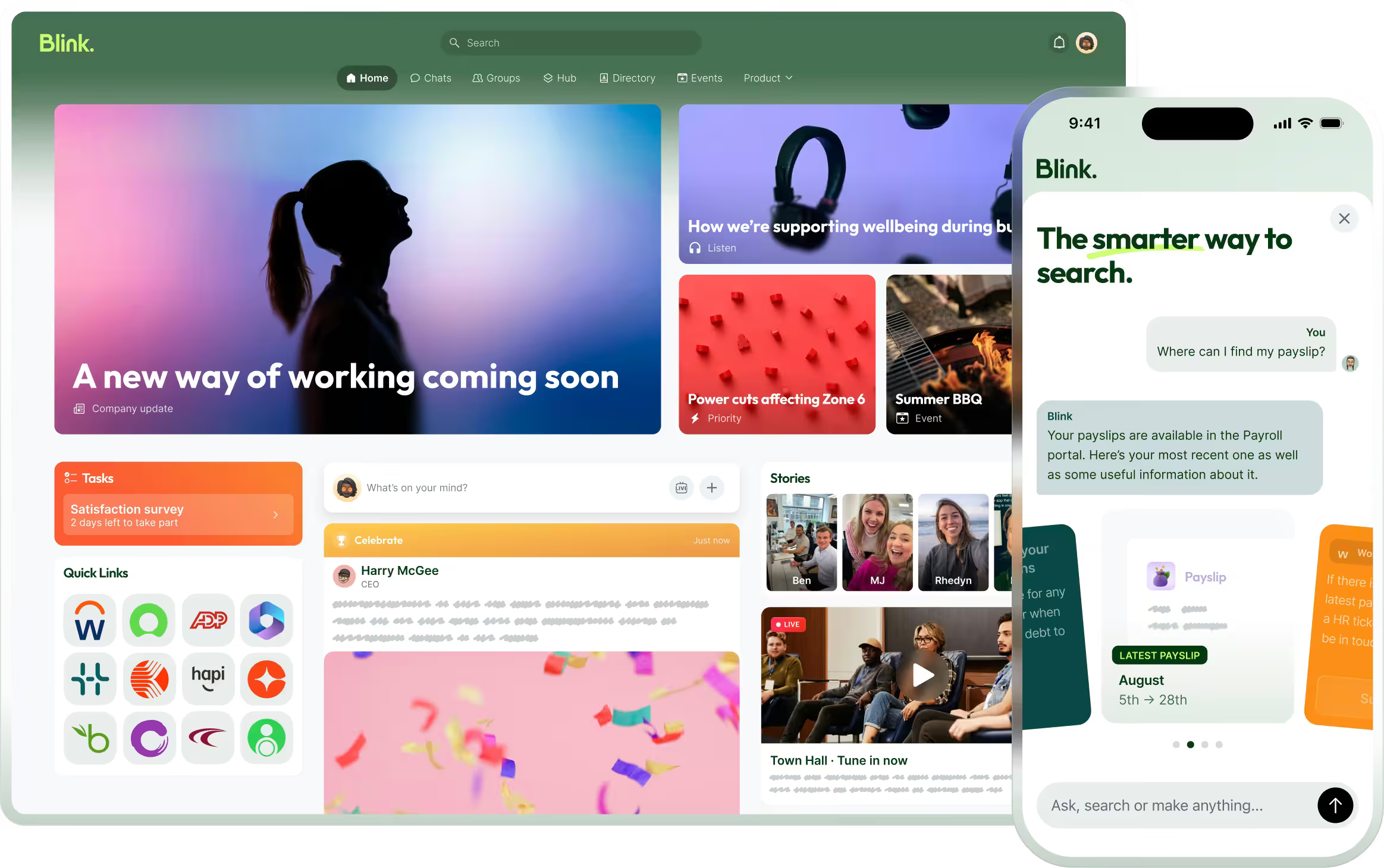
Facilitating two-way communication in your organization is easier than you think. For example, Blink is a corporate communication app that comes with a social-media-style news feed visible to all employees.
Anyone in the company can post an update, on which others can like and comment. This helps the most relevant stories rise to the top. Plus, the admins can choose to amplify selected updates even further.
5. Bring consistency in your communication
All your communication, whether written or verbal, and whether internal or external, should have the essence of your company’s brand and workplace culture.
Plus, it should have a unique, consistent voice that reduces any chance of ambiguity and unifies your workforce. Such a voice also helps you communicate in the right spirit, not to mention avoid conflicts and misunderstandings.
But the more people participate and contribute to your organization’s communication, especially from different locations and time zones, the harder it gets to keep the voice consistent.
So what you need is a set of shared guidelines, formats, and best practices that everyone can refer to when creating content. And you can prepare the same in the form of a communication style guide.
Once you’ve clearly laid out your communication guidelines, make sure to train your communication department, as well as other contributors, on how to put the instructions into practice for subsequent messages.
6. Make use of visual aids
Different people have different learning styles. Some are comfortable reading pages after pages of text, some want to listen on the go, while others need something to view, like a video.
Regardless, almost everyone gets enticed by imagery. Presentations and infographics help people wrap their heads around the given information. So using colorful posters, charts, and graphs to distill complicated ideas is one of the best ways to make your message clear and memorable.
There are many ways to use visual aids for workplace communication. For example, if you find yourself repeating certain messages to your staff, or answering the same questions again and again, you can save time and effort with a visual aid to share the corresponding content.
Is someone in your ear every 10 minutes with questions about holidays? Design a holiday calendar workers can check on their own. Bombarded with requests about printer passwords? Print them in large letters and stick them near the machine.
You don’t need to be a master designer to do this. Tools like Canva, Piktochart, and Venngage come with drag-and-drop functionality and hundreds of ready-made templates designed by professionals. So all you need to do is pick a template and replace its contents with yours.
7. Train your staff on effective communication
We have spent a good chunk of our lives communicating with others, but that doesn’t necessarily mean that we’re good at it.
For example, many employees have such a logical, fact-based communication style that they often forget to take others’ emotions into account. Others often get carried away by feelings and miss key details. And the gaps in communication lead to conflict, ambiguity, and workplace politics.
So in any organization, effective communication should be proactively taught and encouraged. And it should be a vital part of the training programs you have in place for workers.
Great communication training helps teach your employees how to keep their emotions in check and present their ideas clearly and comprehensively.
8. Conduct more open sessions
Meetings are seen as a dull affair, especially when just one or two people are doing most of the talking. You’ve probably sat through many where you were just expected to attend and listen.
But that doesn’t mean all meetings are bad. A meeting is just a tool. And like any other tool, you can handle it effectively or poorly.
So every once in a while, you should conduct an open session with all the workers in your company or in specific departments. This meeting will have a set agenda, and every employee will be encouraged to speak up and talk about their work, their experiences, and any concerns or suggestions.
Scheduling such open sessions regularly will not just improve communication, but also help you get a pulse of different teams and your overall culture.
9. Leverage the right tools and technology
Remote work, dispersed teams, smartphones, and other advancements are shaping the new reality of work. But in many organizations, the communication systems and processes haven’t caught up to this change.
The good news is modern technology and employee engagement tools have made it easier than ever to streamline internal communication and include every employee in the process, from hiring to global HR services.
Frontline workers, for example, have largely been excluded from communication channels available to desk-based employees, such as email and instant messaging. With the rise of smartphones and mobile apps though, it is now possible to make them a crucial part of your ongoing communication.
With Blink, for example, workers can easily share documents, engage in live chat with one another, and resolve problems fast.
So it’s time for you to see if the technology you have in place is really enough to get the job done. If not, invest in the right tools to take your communication to the next level.
10. Cultivate the habit of active listening
No doubt, writing and talking clearly are crucial for proper communication, but managers and other employees should also know how to listen.
Poor listening undermines communication and defeats the purpose of effective collaboration. Without the right listening skills, messages are more likely to be misunderstood.
Now, you may think you listen, but good listening is more than identifying others’ words. As Stephen Covey says, “Most of us listen with the intent to respond, not to understand.”
So, cultivate a habit of listening among yourself and your employees. Encourage everyone to practice active listening methods. And teach your staff to reflect, summarize, and ask clarifying questions when listening to a customer or coworker.
When employees and customers feel heard and understood, they’re more likely to keep working with you and have a positive image of your brand.
How can you improve organizational communication in the workplace?
Follow these tips to help achieve effective communication in the workplace:
Use the right tools. Having the right tools to communicate, that everyone can access, and use is vital. Review your tech stack and make improvements where needed.
Get feedback. Employee surveys can help shed light on your current communication methods and where you can make improvements.
Use different communication formats. Images, emails, videos, the list goes on. Use different formats for the different types of communications you need to deliver.
Distribute through the right channels. What's the best way to deliver the message? Email, instant message, intranet, app notifcation? Make sure you pick the right channel.
Focus on employee engagement strategies. An engaged workforce is open to communication and sharing their voice.
Measure the outcomes. Keep a close eye on your metrics. How many people are reading your emails and communications? Is it enough or do you need to improve?
Wrapping up: effective organizational communication strategies
As you can see, good communication doesn’t happen by accident. You need to make sure that your messages successfully reach the intended audience, are interpreted clearly, and are understood empathetically.
It takes effort from both you and your staff. So the more confidently you apply the organizational communication strategies we have outlined in this guide, the more your team would also integrate them into their actions. So take time to develop and execute these concepts diligently to build a collaborative and efficient workplace.
And remember, using a communication solution like Blink can reduce your communication effort while increasing the penetration of your messages, even with a largely remote or dispersed workforce. Book a free demo today.
Retention rate is a ratio of the total current employees and the employees at a previous point in time in the same positions at your company. You can calculate it annually or quarterly.
It provides a snapshot of how satisfied your employees are at your company.
A high retention rate indicates your employees enjoy the work they’re doing, fit in with your culture, and receive fair pay.
Conversely, a low retention rate means that one or more of those elements are less than ideal. Since retention rate is inversely related to employee turnover rate, low retention means high turnover.
Knowing your employee retention rate’s status, you can evaluate and adjust your employee retention strategies. When your employee retention rate improves, you know your retention efforts are paying off.
Measuring employee retention rate
To find your organization’s employee retention rate, you need data on the total number of employees with your organization at the beginning of a period and the number of employees who remain at the end. From there, you can quickly calculate your retention rate.
How to calculate employee retention rate
Find how many employees left your company in a period. Subtract that number from your total headcount at the start of the period. Divide the remaining number of employees by the initial headcount. The result should be a decimal. Multiply that number by 100 to find the retention rate in percentage.
Here’s what that looks like in the employee retention formula:
For example, let’s say you want to calculate your annual retention rate.
You started the year with 56 employees and ended with 50 employees. Here’s how you can find the retention rate:
56 - 6 = 50
50/56 = 0.8928
0.89 x 100 = 89
So in this scenario, the retention rate is 89%
Employee retention rate vs. employee turnover rate
Whenever we talk about staff retention rate, it’s also common to hear staff turnover rate. We use them interchangeably because they’re two sides of the same coin.
While retention rate measures how many people stayed, turnover is the measure of how many people left.
Similarly, you might be confused about attrition rate and employee churn rate. They are just other names for turnover rate.
How to calculate employee turnover rate
You can do so by:
Sum the total employees at the beginning and end of the time interval.
Divide by two to get the average number of employees.
Divide the total number of separations for a given time by the average number of employees.
For monthly turnover, you will work with this:
Suppose a company begins the month with 32 employees. Four employees leave, and six new employees join. So the company ends the month with 34 employees.
The average number of employees is:
(32+34)/2 = 33
Next, we find the turnover:
4/33 = 0.1212
Multiplying by 100, the turnover rate is 12%.
What is a good employee retention rate?
A good employee retention rate varies from industry to industry.
Retail and restaurants tend to have lower industry average retention rates than other sectors, while government and federal sectors have the highest retention rates.
The overall market and economy also affect your retention rate. During times of high uncertainty or in a strong talent market, retention may decrease for every industry. For example, turnover in 2020 was 57.3%, making it 20% higher than the previous year.
According to Built In, average retention rates range from 70-90%.
Following this logic, a good retention rate is somewhere above 75%. But for frontline organizations that deal with restaurant and retail, a retention rate above 50% is also decent.
Final thoughts: how to find your employee retention rate
Calculating your employee retention is an important metric while running your business. It can tell you a lot about how your employees feel at your company.
The same is true for turnover rate as that lets you know where the fault lies.
Use both metrics to get a complete picture of your business and employ retention strategies to keep your top talent around.
If you’re looking for a new way to keep your employees engaged, Blink is an all-in-one employee communications app that can help you stay connected to your employees and boost retention.
Engaged employees are more productive, more collaborative, and more likely to stay working for your company. And with 33% of hiring managers predicting that employee turnover will increase in 2024, there’s never been a better time to get the right employee engagement tech on your team.
Employee engagement apps are intuitive and easy to use. They enjoy high rates of adoption. And they offer a range of features that support employee engagement.
But which are the best of the many employee app options available? In this guide, we look at the seven best employee engagement apps for 2024 and explain a little more about why an app could benefit your business.
Best employee engagement apps for 2026
The best employee engagement solution varies depending on your industry, the functionality you need, and the engagement metrics you want to improve. Here are our top picks for this year.
Blink: best employee app for frontline workers
Workleap Officevibe: best employee app for EX data
Engagement Multiplier: best employee engagement app for small businesses
Bonusly: best employee app for rewards and recognition
WeThrive: best employee app for mental health support
Culture Amp: best app for performance management
Workvivo: best employee app for large, multi-lingual organizations
1. Blink — best employee engagement app for frontline workers
Blink is an employee engagement app built specifically for frontline workers. It brings employee engagement tools to every employee smartphone.
Frontline workers don’t need a desktop computer or even a company email address to access the Blink app. Instead, a simple sign-on process gives them access to an intuitive, user-friendly dashboard.
Here, they can view employee communications, respond to surveys, read policy documents, and use the newsfeed to take part in the company conversation.
They can also use the Blink Hub to access the other workplace tools you use. With a couple of clicks, they can view their current training module, their pay stub, or their upcoming shifts.
Managers get lots of useful engagement features too — like recognition and survey tools. They can also use Blink’s workforce analytics to measure engagement and make data-driven decisions.
All in all, the Blink employee app helps frontline teams to connect with each other and with leadership. It ensures they have access to the people, comms, and tools they need to do their jobs well.
2. Workleap Officevibe — best employee app for EX data
Performance management and recognition tools are part of the Workleap Officevibe employee app. But its most impressive features revolve around employee feedback. This app has a range of tools to help your HR team understand employee sentiment and make data-backed improvements.
Pulse surveys, onboarding surveys, eNPS scores — there are plenty of ways to find out what employees are thinking. You can also launch anonymous surveys so you know you’re getting honest, unfiltered feedback from employees.
Officevibe then helps you make sense of the feedback you’ve gathered. You can use reports to identify trending feedback topics. And use well-presented survey data to benchmark employee experience (EX) results and set targets.
Pricing
Workleap Officevibe has a free version with limited functionality. Prices for paid plans start at $3.50 USD per user per month.
Reviews
Capterra: 4.6/5
G2: 4.3/5
3. Engagement Multiplier — best employee engagement app for small businesses
Engagement Multiplier is a reasonably priced app aimed at small to medium-sized businesses. It’s not as in-depth as some of the other employee engagement software on this list. But it can be really useful for new companies and start-ups wanting to learn more about their engagement levels.
Features include benchmark assessments, anonymous data collection, recommended actions, and the ability to create custom employee engagement surveys.
Pricing
Prices start from $7.20 USD per user per month.
Reviews
Capterra: 4.8/5
G2: 4.3/5
4. Bonusly — best employee app for rewards and recognition
Bonusly is all about motivating your teams with employee recognition and rewards. The app lets you give each employee an allowance of points. They allocate these points to co-workers, appreciating them for their support, for doing a great job, or just for being an awesome work friend.
Recipients can then exchange their points for a variety of different rewards, choosing between big brand gift cards, company merchandise, and custom rewards chosen by your company. Employees can also convert their reward points into charitable donations.
Bonusly supports the kind of peer-to-peer recognition that engages employees. It also allows you to share recognition in a company-wide feed, so you improve motivation and amplify company culture to every member of every team.
Pricing
Bonusly offers new users a free trial. Paid plans start from $5 USD per user per month, plus the cost of employee rewards.
Reviews
Capterra: 4.8/5
G2: 4.8/5
5. WeThrive — best employee app for mental health support
WeThrive is an employee engagement platform focused on the mental health of your workers. It helps you create surveys to check on employee wellness and take action to safeguard it.
The app’s mental health and wellbeing survey helps you to identify the root causes of stress, burnout, and anxiety. An easy-to-use feedback dashboard segments results by team, location, department, tenure, and manager so it’s easy to see where improvements need to be made.
The app also uses feedback data to suggest wellbeing actions for your managers so it’s easy to decide the next steps.
Pricing
Pricing is available on request.
Reviews
Capterra: 4.7/5
G2: 4.6/5
6. Culture Amp — best employee engagement app for performance management
Culture Amp is an employee platform built around employee feedback and analytics. It also has some excellent performance management tools.
You can use 360-degree feedback to find out how employees are doing. You can use goal-setting functions to align employee work with company strategy. And you can use 1-on-1s to encourage meaningful communication between managers and employees.
With tools that support regular coaching and feedback, Culture Amp aims to provide organizations with everything they need to build a culture of continuous improvement and high employee engagement.
Pricing
Pricing is available upon request.
Reviews
Capterra: 4.7/5
G2: 4.5/5
7. Workvivo — best employee app for large, multi-lingual organizations
Workvivo is owned by Zoom. It’s a desktop intranet that comes with a user-friendly employee app.
There are lots of community and social features for employees to engage with. You have the option to live-stream company updates in real-time. And, with Spaces, users can create their own community groups
For large organizations with employees who speak a range of different languages, Workvivo has some particularly useful tools. The auto-translation feature allows you to easily translate posts into a user’s preferred language. There’s also the option to auto-translate video subtitles.
Pricing
Pricing is available upon request.
Reviews
Capterra: 4.7/5
G2: 4.8/5
What are the advantages of an employee engagement app?
The best employee engagement software meets employees where they are. These days, that tends to be on their smartphones. And that’s why employee mobile apps are an increasingly popular choice.
Apps are inherently engaging and very easy to use. In fact, 53% of frontline workers already use messaging apps like WhatsApp and Facebook Messenger for work-related conversations.
When you replace those apps with your own user-friendly employee app, you make communication more secure — and make it a key part of company culture, too.
1. An employee app reduces costs and improves profitability
Construction giant Caterpillar found increasing engagement helped save $8.8 million at one of its European factories in just one year. The company also improved customer ratings and increased profits by $2 million.
Gallup research shows that Caterpillar’s cost savings aren’t an anomaly. They looked at thousands of teams and found that highly engaged businesses experience:
A 43% decrease in employee turnover
A 10% improvement in customer satisfaction
An 18% uptick in sales
A 23% increase in profitability
Employee engagement has a big impact on a company’s bottom line. So an employee engagement app tends to have a high return on investment.
2. An employee app improves communication without adding to the noise
An employee app streamlines company communication by putting everything in one, searchable location.
A social-style news feed. Employee surveys. Messages from management. With an app, teams know exactly where to go to get the information they need.
Managers also get the tools they need to highlight critical messages and ensure employees read them.
3. You connect every member of your workforce — including those on the frontline
To make a success of employee engagement, you need to take every member of the workforce with you. That includes those hard-to-reach employees working on the frontline of your organization.
Deskless workers get the raw end of the deal in terms of engagement tech. Only 10% of frontline workers say they have high access to the tools, tech, and opportunities they need to connect and advance in their workplace.
But these workers are in greatest need of engagement intervention. Deskless employees are less trusting and engaged, and more likely to experience burnout than their desk-based peers.
An employee app ensures frontline workers aren’t excluded from company comms and culture. You take engagement beyond the office and a desktop computer and put it in the palm of every employee’s hand.
A good app is also easy and intuitive to use. It enjoys high rates of user adoption. So by using an employee app, you make engagement tech more accessible than ever to all employees.
4. You make work more engaging and efficient
The best employee engagement apps put the most effective engagement tools in one, single place. You give employees access to the things we know help to improve employee engagement:
Training and development
Recognition
Two-way communication and collaboration
Feedback opportunities
You also remove friction and frustration from the work day. Because employees can access all the comms, tools, and resources they need via your employee app, they become more efficient and productive.
Employees can get on with doing their jobs to the best of their ability. Managers save time thanks to improved communication channels and employee self-serve resources. That translates into increased levels of staff satisfaction.
5. Employee engagement apps support frontline safety
Employee engagement makes for better workplace safety and fewer workplace accidents. According to Gallup, companies with high engagement experience 64% fewer safety incidents than those with low levels of engagement.
An employee app supports frontline safety because workers have all policy documents and safety procedures at their fingertips. They also have a direct line to managers, so it’s quick and easy to report safety or maintenance concerns.
6. Managers get access to data and analytics
When employees engage with your organization via an employee app, managers get access to valuable user data and analytics.
They get insight into how people are using the app and how they’re engaging with company communications. They get to know what engagement looks like for different teams, locations, and managers. Use an app with great integrations and you get insight into how employees are using other workplace tools, too.
The best employee engagement apps present this data in a way that is easy to understand and act upon. So your teams have everything they need to make employee engagement improvements going forward.
Does your company need an employee engagement app? 3 key questions
Staff engagement apps aren’t the best fit for every company. You can figure out if your organization would benefit from this by answering the following questions.
Do we have a communication channel that reaches everyone?
Effective internal communication is the foundation of engagement. So you need a reliable communication channel for all employees, particularly when there’s a time-sensitive update to share.
Email may not be a viable internal communication strategy if some workers don’t have email addresses. Getting managers to make phone calls and send text messages takes up a lot of time. Paper notices up on a board are easy to miss.
If you have a patchwork of different communication channels, an employee mobile app is a great streamlining tool. It saves your comms team time — because they have fewer comms channels to maintain. And it makes communication more efficient, relevant, and reliable.
Are employees treated equally?
Fairness is really important for employee engagement. If an employee feels like someone else is getting preferential treatment, it’s unlikely they’ll bring their A-game. So when it comes to opportunities for engagement, it has to be a level playing field.
Use surveys to find out if frontline staff and office workers enjoy the same level of engagement and the same access to company comms, culture, and connection.
If some workers are feeling overlooked, an app can help you treat employees equally. Ditching a two-tier engagement strategy means everyone feels valued and like they belong.
Do we need to lighten the load for managers and HR teams?
When there isn’t an easy way to share company policies, resources, and comms, managers and HR teams often end up acting as gatekeepers. Employees have to ask for the information they need, which adds to the HR and management workload.
An employee app removes this bottleneck by allowing employees to access relevant information for themselves. They can view their schedule and vacation time. They can read the most recent safety policy and get details of the next company social event.
HR and management spend less time answering the same questions. And employees — with resources in the palm of their hands — feel more engaged with the organization.
Final thoughts: The best employee engagement apps
An employee engagement app can be a game-changer when it comes to your employee engagement strategy. Whether you’re a small office with a few dozen employees or a multinational corporation with hundreds of stores, the best employee engagement apps help your workers feel more connected.
At Blink, we’re passionate about helping companies connect with their frontline employees. And our frontline employee engagement solution will help your workforce thrive in 2026 and beyond.
Blink’s employee app offers the same great features across mobile and desktop. A company newsfeed, recognition, secure chat, surveys, analytics, and more. So your teams have everything they need to improve employee engagement — along with staff satisfaction, productivity, and retention.
Internal communication isn’t just about messages — it’s about impact
Too often, internal comms teams focus on sending the right messages through the right channels. But what if that’s not enough?
With workplace expectations evolving — especially among Gen Z and Millennial employees — internal communications leaders need to do more than inform. They need to engage. Influence. Inspire action.
That’s where the 3 C’s of internal communication come in: Curiosity, courage, and catalyst.
“We know that with younger generations, it’s so much more important for them to feel that they are a part of things. Old fogies like myself, you just get your head down, do the work, hope that you get a paycheck… It’s so different these days.”
This framework, developed by author and keynote speaker Shola Kaye, transforms internal comms teams from messengers into strategic influencers. In a recent podcast, the Blink team sat down with Shola to explore the 3 C’s — why they matter and how comms leaders can put them into action.
Let’s break it down.
Curiosity: Don’t make assumptions right off the bat
The first C you need in your internal communications toolkit is curiosity.
Curiosity prevents us from making assumptions, which get in the way of empathy. By being curious, we get to know and understand the people around us.
“If you want to engage people, you’ve got to really know who you’re speaking to. What is on their minds? Where are they coming from? Because otherwise, how will you know how to pitch your content?”
That means listening before you speak. And creating a company culture of psychological safety where employees feel confident that their thoughts and opinions will be taken on board.
Why it matters:
Too often, comms teams assume they know what employees want or need — but a strong company culture of employee engagement starts with listening.
It’s also worth remembering that internal comms trends and employee expectations are always evolving. What worked last year might not work today. So it pays to stay curious, listening to the voices of your target audience on a continuous basis.
How to apply it:
Use pulse surveys and real-time employee feedback loops. Uncover what’s resonating and implement two-way communication practices. Be sure to acknowledge and act upon employee input or employees will start to doubt the process.
Let employees shape your internal communication strategy. Ask them: What’s missing? What do they need? How do they like to receive company communications? You can then craft more effective and engaging messages.
Create conversational hooks. Ask informal questions. For example: What did you do on the weekend? What’s a great movie you watched recently? This creates conversational hooks, which lead to connection, trust, and collaboration within the workplace.
Go beyond small talk. Ask “big talk” questions. Instead of simply asking “How are you?” try asking, “How are you feeling about these changes?” These deeper-level questions encourage meaningful dialogue and bottom-up communication.
{{mobile-survey="/image"}}
Courage: Own your voice so people can’t help but listen
Internal communications teams are the unsung heroes of the workplace. It takes real courage to be the voice of a company — sharing tough news, listening to hard feedback, and taking bold risks to build a better employee experience.
“To be empathetic, you’ve got to open yourself up to what is going on for someone else. That can press buttons. It can be triggering. It can be exhausting. So it takes some courage to develop empathy and this level of communication in the workplace.”
Courage means having difficult conversations in the knowledge that you’ll come out the other side “stronger, better, more confident at communication.” It means taking your comms beyond the internal communication tools, styles, and channels you’ve used traditionally to deliver something more engaging and authentic.
Why it matters:
Internal comms teams often walk a tightrope between corporate messaging and employee advocacy.
But great communicators don’t just share what’s safe — they push for transparency, honesty, and authenticity. They speak in an open, human way that sets the tone for the whole organization.
How to apply it:
Advocate for direct, no-BS communication. Employees respect transparency over corporate jargon so don’t be afraid to speak honestly, as long as you approach tricky subjects with tact and sensitivity.
Take a stand on employee well-being and inclusion. Don’t sit on the fence. If it matters to your workforce, it should matter to senior management. Clearly communicate your business goals and what your company stands for.
Encourage business leaders to be real and visible. Align your internal communication plan to where senior leaders are on the “audacity scale.” For one C-suite member, that might mean recording a video message or running a listening tour, while the more gregarious may be happy to run a Q&A session with employees.
Be open to new channels and formats. For comms leaders, courage can mean experimenting with new internal communication channels and formats. Video updates. Mobile-first and social tools. Insta-grade storytelling. You don’t always know how these changes will go down with employees. But the reward may be worth the risk.
Catalyst: Make change happen
Being a catalyst for change is easier than you might think. Asking the right questions at the right time — and directing employees toward the collaboration tools and resources they need — can be all it takes.
However, to be an effective catalyst, inspiring others to do and be more, you need to put the other C’s — curiosity and courage — into action first.
“If we’re being empathetic and truly listening to others, we start to learn what they need to grow, to move forward… So then we can step into this role of catalyst to help facilitate that growth.”
Why it matters:
Internal comms isn’t just about informing employees. Done right, your internal communication strategy can inspire action. It can cultivate a motivated and engaged workforce. It can drive cultural change.
Effective communications help employees feel more connected and valued — and engaged in the company’s mission. And when employees understand how they contribute to organizational goals, they become more invested in their own growth and development, too.
{{mobile-main="/image"}}
How to apply it:
Turn communication into action. Don’t just inform. Invite employees to share ideas in town hall meetings or employee surveys. Provide clear steps and resources that make it easy for them to shape company culture.
Set an inspiring example. Leverage storytelling to highlight employee success stories, frontline employee contributions, and company impact. Show, don’t tell — using formats like short videos, photos, and quotes — how individuals are driving change.
Amplify unheard voices. Actively seek out perspectives from underrepresented teams, then amplify their contributions and elevate them as internal influencers so they reach a wider audience.
Champion new digital tools. Be the change you want to see. Advocate for technology that makes internal communication more accessible and inclusive. Think mobile-first apps, AI-powered chat tools, and one-stop digital hubs.
{{future-of-internal-comms-2025="/callouts"}}
Put the three C’s into action for next-level internal comms
Curiosity, courage, catalyst — three simple words that provide a blueprint for next-level internal communications. The 3 C’s can help you take your internal communications strategy from a function to a force for connection and change.
By staying curious, you uncover what truly matters to your workforce, across all generations. By leading with courage, you create space for honest, impactful conversations. And by stepping up as a catalyst, you empower employees to shape their futures — and that of the organization.
IM Flash Technologies, a semiconductor factory with a large frontline workforce, was struggling with its worst turnover in decades.
As a last resort, they turned to employee engagement surveys.
Senior leaders spent the next year collecting insights and making the changes their employees asked for.
By the next year, they'd reduced turnover by 50%.
Clear, actionable data is the key to making informed decisions about your workplace culture and internal communications: the good, the bad – and the ugly.
And what’s your best bet to get this data? Extract it straight from the source: your people.
Senior managers have been using the trusty annual employee engagement survey for the past 30+ to ask workers how they really feel.
And fair enough. When done right, an annual employee survey can get you some solid insights. But it’s not going to cut it in today’s world. At least not on its own.
In this post, we’ll walk you through the ins and outs of conducting an employee engagement survey, why it may or may not work for your company, and the employee survey alternatives you can start using right away.
What is an employee engagement survey?
An annual employee engagement survey is a set of questions shared with workers once a year. The answers help gauge employee sentiment, identify issues, and contribute to (possible) solutions.
mployee engagement is crucial for any organization’s growth. Teams with highly engaged members sell over 20% more than groups with low engagement, according to a PeopleMetrics study. Engaged workers have the potential to get your company more customers, while disengaged workers increase expenses and reduce profits.
So an annual employee engagement survey measures the extent to which workers feel valued at your organization.
With that in mind, here’s a rundown of how you’d typically go about conducting a yearly employee engagement survey in an organization.
How to run an employee engagement survey
Figure out your goal
Before creating and distributing a survey to your workers, you need a crystal clear idea of what you want to measure and why. This will help you generate the right questions and get data you can actually use.
For example, your purpose for conducting an annual employee engagement survey could be:
Help find ways to transform a toxic workplace culture
Identify how to increase employee engagement throughout the company
Come up with ways to improve employee retention
Develop two-way communication between managers and workers
Plan your survey questions
Asking great questions is the key to getting to the heart of workplace issues. The right questions will get better answers from workers. And the better responses you get, the easier for your company to identify areas of improvement.
Here are the best questions for an annual employee engagement survey. These are a baseline – but a solid one!
What is your favorite thing about working at our company?
What is your least favorite thing about working at our company?
What’s the most important thing we should do to make things better at our company?
Do you feel like a valued member of our company or just a number? Why?
What can we do to foster better internal communication at our company?
Do you get constructive feedback from your seniors on a regular basis?
Do you see your career growing in this company?
Is the number of tasks assigned to you reasonable?
Are you satisfied with our rewards and recognition policies?
Don’t overwhelm your readers
If you conduct an employee engagement survey only once a year, it’s tempting to combine multiple surveys or ask a wide range of questions.
Give in to this temptation, and you’ll likely end up with a survey that confuses workers and doesn’t generate actionable feedback.
That’s not what you want, right? So keep it simple. Only include the most important and specific topics to keep your survey from turning into an SAT exam. And make sure to use plain language that all the employees can easily understand.
Ideally, your survey should include around 30 questions. Go more than 40 and it’s overkill. 30-40 questions are just enough to cover all the key aspects as per your objective without putting too much burden on the workers.
Build and distribute your survey
The next step is execution. How will you create the survey and share it with the employees? The good news is there are many intuitive tools at your disposal. Take Blink for example.
Our employee experience platform helps you share anonymous polls and surveys with your employees. These surveys get high completion rates and honest feedback.
Now comes the fun part — getting workers to fill the survey. Just like charity begins at home, survey advocacy begins with senior management. Here are the key steps that will help maximize the reach of your annual employee engagement survey.
Get the senior leaders and managers to complete the survey first. This way, you can get feedback on the overall experience of filling the survey. So you can make any amends, if needed, before sharing the survey with the whole workforce.
Use an employee app to provide resources that may come in handy when a worker sits down to complete a survey.
Promote the survey at every opportunity. Boost participation by mentioning the survey in employee newsletters, posting flyers, announcing prizes, and reminding workers about the survey in meetings and conferences.
Are annual employee engagement surveys dead?
Now you know how to conduct surveys. But you should also know that an annual employee engagement survey has certain shortcomings.
An annual employee engagement survey can help gauge your work culture only to some extent. So when used on its own, it’s not the best way to learn more about your employees. Often, it may not reveal any solid insights into your organization’s core issues.
Before you decide on planning a survey, also consider the drawbacks below.
It’s impersonal
An annual employee engagement survey, by its nature, is a cold way to get feedback. When you send a set of questions once a year to be answered by your workers, the unspoken message they may hear is:
"We want your inputs, but only in a certain format and confined to the questions we have developed. We're not attempting to build or nurture a relationship or anything! Don’t think too much and just check a few boxes. No big deal!"
An annual employee engagement survey can make workers feel that their employer doesn’t take feedback seriously. So neither should they.
It doesn’t provide valuable data
An annual employee engagement survey doesn’t encourage honest feedback. Many of the workers may not trust the system. They might think that being too honest in an annual employee engagement survey - like slamming their manager - can get them in trouble.
It relies on fluffy metrics
HBR once reported in a case study that United Parcel Service faced a huge loss because its annual employee survey didn’t uncover problems associated with a surge in part-time jobs. So when workers went on strike, it cost the company hundreds of millions of dollars.
Most commonly-used questionnaires make use of “percent favourable” metrics. So the data you get consists of inflated scores and blind spots, giving you the illusion of high engagement when it’s the opposite in reality.
It’s not regular enough
For anything that matters, measuring your progress just once a year is not enough. Whether it’s your personal health, financial investments, or employee engagement, you’ll be wise to keep tabs regularly.
An annual employee engagement survey is a snapshot in time. And the feedback you get from employees in a singular moment can’t accurately reflect their feelings for the whole year.
Since organizations using annual surveys don’t get the data they need to act, they don’t. They finish conducting the survey like it was just a formality and move on, further tarnishing whatever trust workers had in the employer.
For these reasons, many HR leaders believe that annual employee engagement surveys are dead. While we won’t go as far, it’s evident that once-a-year surveys alone aren’t enough to get accurate and comprehensive insights, which brings us to the next part.
Employee engagement survey alternatives
Gone are the days when workers were happy just to have a job. And before you counter — Yes, even if it provides standard benefits like health insurance and retirement savings. The ingredients that make your employees engaged, satisfied, and happy are now more nuanced and sophisticated.
To find out how successful your recipe is, you need comprehensive techniques that can capture worker sentiment in a timely and relevant manner. Let’s see what those are.
1. Tracking company-wide metrics
The tools and technologies that you use for employee management and collaboration can give you a ton of real-time and continuous feedback from the workforce.
Most modern systems these days come with built-in analytics to drill down into worker behavior and identify areas of improvement. For example, you can view:
Performance appraisal and evaluation ratings
Number of discrimination complaints and legal claims
Number of workers on a leave of absence
Employees who have filed compensation claims
Number of workers who resigned in the last 12 months
Number of training hours workers attended voluntarily
Average employee commute time (the shorter, the better)
Number of workers on zero-hour contracts
By understanding such people trends, you can get an accurate sense of engagement across the organization. And you can do all this without directly involving your employees.
2. Pulse surveys
Research shows that 77% of employees want to provide feedback more than once per year. And that most employees prefer to provide feedback four times a year.
That’s where Pulse surveys come in. Pulse surveys get employee feedback using short, frequent check-ins that are not confined to specific content or topics. When you ask quick questions at short intervals, the feedback you get will be more authentic and practical.
3. Town-hall meetings
Townhalls are another viable alternative to annual surveys. If you manage a team that’s too large for a conference table, organize a Town Hall meeting to spark discussions and learn about team members’ concerns.
Don’t want to put yourself on the spot? Easy. Ask employees to submit questions in advance so you can be better prepared to answer them.
4. An open-door policy
Why wait for a formal process or tool to get feedback? You can create an environment in which spontaneous feedback is encouraged.
Make your employees feel safe and comfortable with two-way communication mechanisms. When they can talk openly about their concerns, you’ll always have a string of things you can improve in your repository. So you won’t have to go hunt for good ideas once every year.
Final thoughts
If you really want to have a lasting impact on your culture, you must consult your employees regularly and consider alternatives to a once-a-year survey. By pairing surveys with alternative ways to get employee feedback, you’ll be on your way to shaping a work environment where workers feel more productive and content.
Hi I am Fabien, I moved to London in 2012 from my home country France. I studied Business Management and prior to joining Blink in June 2021, I spent 8 years at Estée Lauder Companies as a Business Analyst.
In 2020, I took on a Software Engineering Bootcamp at General Assembly to start a new career as a Developer. 🚀
At Blink, I am a Full Stack Developer within the Solutions Engineering Team. Day to day, my job is to help our customers getting extra value out of Blink. ⭐️
Some of the projects I work on include building integrations with third party systems our customers use or creating digital forms within the app to replace existing paper processes our customers might have. ✅
I love working at Blink because we enable frontline workers from key sectors, such as healthcare or transport, to feel better connected to their organisation and we help them streamline some of the tasks they have to do on a day to day basis so they can focus on making the world a better a place.
If you want to make a difference, if you like to be challenged, if you are eager to learn and want to be part of an awesome team, Blink is the right place for you! 💙